Soy vs. Paraffin vs. Beeswax: Which Candle Wax Actually Matters for the Way You Burn
The $48 “Clean Burning” Soy Candle That Still Smokes
The label is beautiful. Hand-poured, all-natural, soy. Photographed like a cover story. Light it, sit back to feel virtuous, and within ten minutes there’s a small black halo creeping up the glass like a guilty conscience.
The thing is, the wax isn’t really the problem. The wick is wrong, the fragrance load is high, and it was burned too fast. But the story on the label is “soy = clean,” which is the candle internet’s favorite oversimplification and the reason so many people walk into a shop and pick by wax type alone.
So let’s untangle it. Soy, paraffin, and beeswax are the three waxes you’ll see on almost every label, and they really are different. But the differences only matter once you know what kind of burning you actually do. This is a guide to choosing the wax that fits your real life, not your fantasy of who you’d like to be on a Sunday evening.
Quick note before we light anything: every recommendation here is about scenting a room: the air, the corner you read in, the space your guests walk into. Not your skin. A candle is furniture for your nose, not perfume.
A Two-Minute Primer on the Three Waxes
Skim this if you already know it. Otherwise, this is the floor everything else stands on.
- Soy wax is made from soybean oil, a plant. It’s a relative newcomer (it showed up in the 1990s), and it became the poster child for “natural” candles. Vegan, biodegradable, lower soot than paraffin. It melts at a lower temperature, which means it burns slower but releases scent more gradually.
- Paraffin wax is a petroleum byproduct, refined from crude oil. It’s the OG candle wax: it’s what most of the candles you grew up with were made of, and it’s still what most big fragrance houses reach for. It holds a lot of fragrance oil and throws scent harder than any other wax in this guide.
- Beeswax is, exactly as advertised, made by bees. It’s the oldest candle material humans have used and the most expensive. It’s naturally a little golden in color and carries a faint honey scent of its own, even unscented. Burns longest, sheds the least soot, and is the friendliest option for sensitive noses.
That’s the three of them. Now let’s figure out which one is yours.
The Comparison Table You’ll Actually Use
Here’s the cheat sheet first. Each axis is rated ◎ great ・ ○ good ・ △ limited so you can scan it without reading every box.
| Soy | Paraffin | Beeswax | |
|---|---|---|---|
| Burn time (8 oz) | ◎ 40–50h | △ 25–35h | ◎ 50h+ |
| Scent throw (strength) | ○ steady, gradual | ◎ strong, fast | △ subtle, honey undertone |
| Soot / smoke | ○ low | △ noticeable | ◎ near-zero |
| Source | plant (soybean) | petroleum byproduct | bee-made |
| Price per oz | ○ mid | ◎ low | △ high |
| Sensitive noses / allergies | ○ generally gentle | △ heavy throw can overwhelm | ◎ hypoallergenic |
| Best for | long evening burns | filling a big room with scent | quiet, allergy-safe luxury |
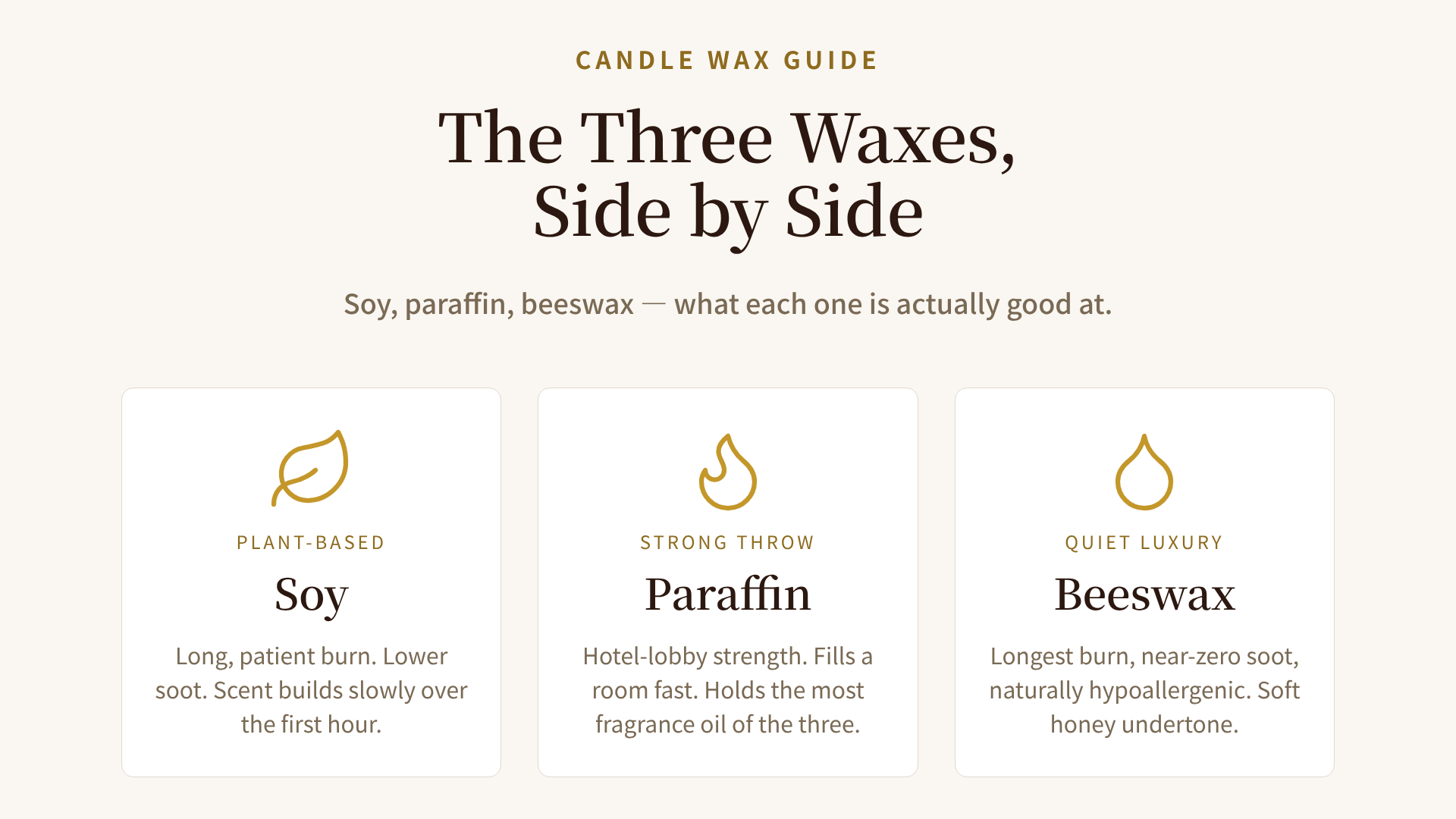
Two things to clock before we go deeper. First, paraffin wins on scent throw, by a lot. If you’ve ever stepped into a hotel lobby and instantly known what was burning, that was almost certainly a paraffin or paraffin-blend candle. Second, beeswax wins on burn time and soot, but pays for it with a softer throw and a higher price. Soy sits comfortably in the middle on most axes, which is part of why it’s the default for so many indie brands.
Now the parts the table can’t hold.
Soy: The Long, Quiet Evening Burn
Soy is the wax I keep on my coffee table for everyday use, and it earned that spot for a specific reason. It burns roughly 30 to 50 percent slower than paraffin. That means a 240g jar that would last you 25–35 hours in paraffin lasts 40–50 hours in soy. If you light a candle most evenings, that’s the difference between buying one a month and buying one every six weeks.
It’s also low-soot. Not zero (no candle is), but soy throws noticeably less black residue on the glass and on the walls than paraffin. For people who light candles regularly in the same spots (a reading nook, a bedside table), that compounds. Your walls thank you.
The honest tradeoff is scent throw onset. Soy needs a longer pool to reach full strength. You’ll get the bulk of the fragrance about 45 to 60 minutes into a burn, where paraffin would have already filled the room in 15 to 30. If you light a candle and then leave the room ten minutes later, soy will feel weak. If you light it and stay in for an hour, it’ll feel just right.
Pick soy if: You burn for long sessions in the same room, you want a candle that lasts, and you prefer scent that builds rather than announces itself. Soy is the introvert of the candle world. It rewards patience.
Paraffin: The Hotel-Lobby Scent Throw
If you have ever wanted to walk into your own house and feel the candle from the entryway, paraffin is what you want. Paraffin holds 10 to 12 percent fragrance oil, the highest of the three waxes, and it releases that fragrance fast and forcefully. This is the wax behind almost every “this candle is so strong” review online.
The reasons it’s loved by big fragrance houses are real: scent fidelity (complex top notes survive the burn better), a low melting point (so it pools fast), and price (it’s the cheapest of the three by a clear margin). NEST, Diptyque, and most of the candles people gift in glossy boxes are paraffin or paraffin-soy blends, not because those brands are cynical but because no other wax throws as well.
The downsides are equally real. Paraffin produces more soot than the other two, and the throw can be too much in small rooms. A paraffin candle that smells perfect in a living room will feel aggressive in a small bedroom at 11pm. There’s also the petroleum question, which is more about how you feel about it than measurable air-quality data at normal home use. The science on indoor paraffin emissions is genuinely contested; the marketing isn’t.
Pick paraffin if: You’re scenting a large open-plan space, you want a candle that hits within the first ten minutes, or you’re chasing a specific perfumer’s composition where fidelity matters more than burn time. Paraffin is the extrovert. It enters the room before you do.
Beeswax: The Quiet Luxury Pick
Beeswax is the one I quietly recommend to people who say “candles bother my sinuses.” It’s naturally hypoallergenic because it isn’t chemically processed, and it produces the least soot of any common candle wax. If you have asthma, allergies, or just a sensitive nose, beeswax is the gentlest landing.
It’s also the longest-burning. The same 100g of wax that lasts 15 hours in paraffin and 18 in soy will give you around 29 hours in beeswax. Per ounce, it’s the most expensive option. Per burn hour, it’s surprisingly competitive once you account for that.
The catch is scent throw. Beeswax doesn’t hold added fragrance as well as the other two; its high melt point and dense structure work against fragrance release. What you get instead is the wax’s own natural scent (a soft, sweet honey undertone) and a quieter version of whatever fragrance has been added. For many people who buy beeswax, that’s the entire point. It’s not trying to fill a room. It’s trying to fill a corner, quietly.
A small honest detail: that honey undertone can interact with added fragrances in ways that surprise you. Citrus over honey reads warm and candied. Rose over honey reads almost gourmand. Sandalwood over honey is so good it should be illegal. If you go beeswax, lean into pairings that play nicely with the wax itself, rather than fighting it.
Pick beeswax if: You or someone in your home is sensitive to scent or smoke, you love the idea of a “quiet luxury” candle that doesn’t announce itself, or you simply prefer natural materials and don’t mind paying for them.
The Variable That Matters More Than Wax
Here’s where I have to deflate the whole wax conversation a little. Wax alone doesn’t decide how a candle performs. Three things matter just as much, and pretending otherwise is how I ended up with a $48 sooty soy candle.
- Fragrance load. A weakly scented paraffin candle will out-throw a generously scented soy or under-throw it. Paraffin can hold 10–12% fragrance oil; soy taps out around 6–10% before the wax stops behaving. But the percentage the brand actually used is what matters, and most don’t publish it. A heavily scented soy can out-throw a half-hearted paraffin without breaking a sweat.
- Wick. Cotton, wood, and hemp wicks behave completely differently. Wood wicks crackle and burn cooler, which suits soy. Cotton wicks burn hotter and pair with denser waxes. A bad wick in a great wax gives you tunneling, smoke, and a sad candle. A great wick in mid-tier wax gives you the experience you actually wanted.
- First burn. No wax forgives a short first burn. If you light any candle for only 30 minutes the first time, the wax memorizes that pool size and tunnels forever after. (We have a whole first-burn ritual guide for this. It’ll save your next candle, regardless of wax.)
So when you read “soy is cleaner than paraffin,” take it with the same grain of salt as “olive oil is better than butter.” It depends what you’re cooking, how hot, and for how long. Wax is one variable. The wick, the load, and your habits do the rest.
Which Wax Matches the Way You Burn?
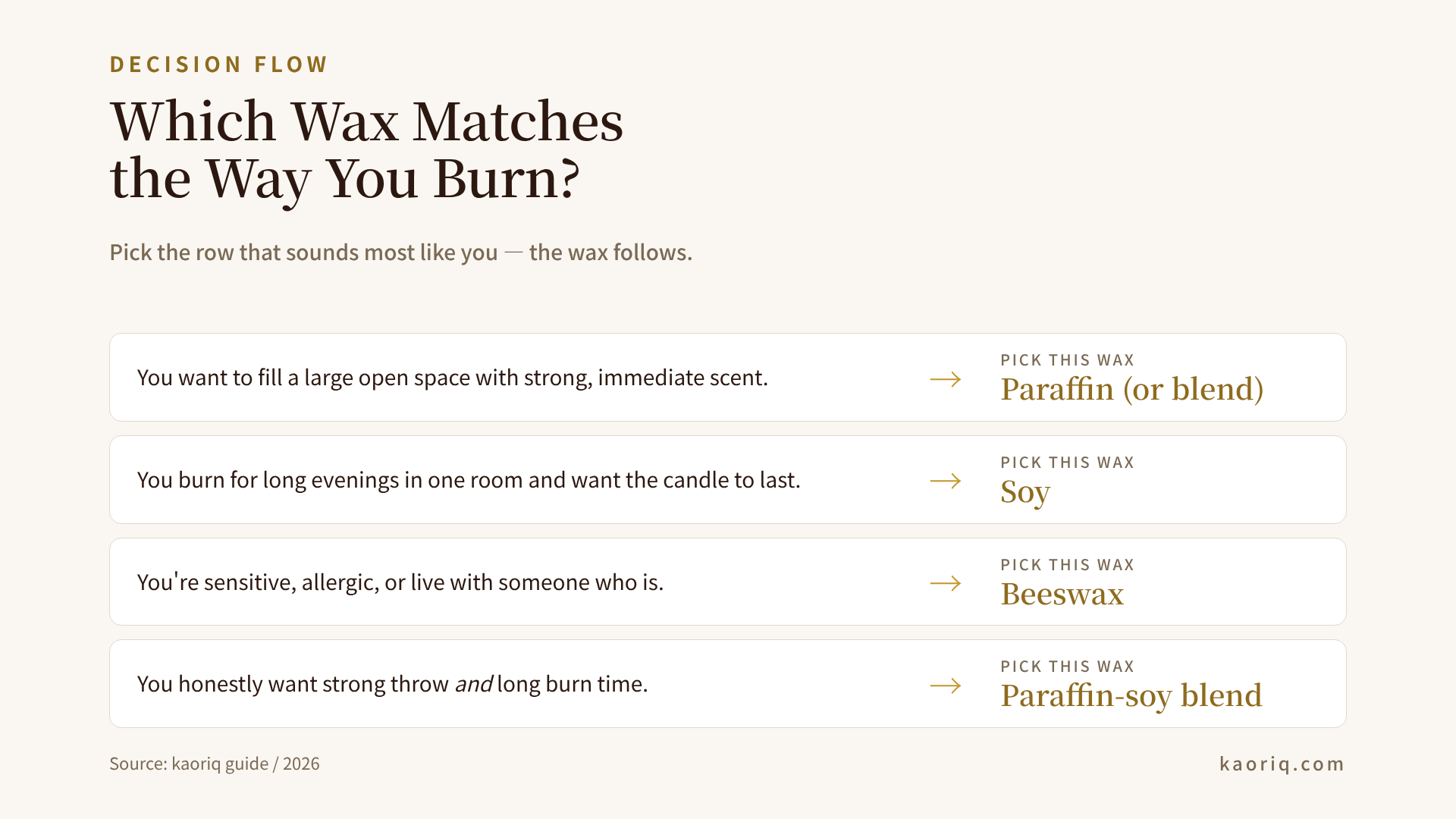
Here’s the shortcut. Pick the row that sounds most like you and the wax follows.
- You want to fill a large open space with strong, immediate scent → Paraffin (or a paraffin-soy blend). Living rooms, entryways, parties, anywhere fast throw matters more than burn time.
- You burn for long evenings in one room and want the candle to last → Soy. Reading nooks, home offices, slow evenings. Patient scent.
- You’re sensitive to scent, allergic, or you live with someone who is → Beeswax. Bedrooms, nurseries, homes with pets or asthma. (Pair this with our pet-friendly home fragrance guide before you commit.)
- You value natural materials and don’t mind paying for them → Beeswax. It’s the most expensive per ounce and the most defensible per principle.
- You honestly want both strong throw and long burns → Look for a paraffin-soy blend (sometimes called “coconut-soy” if there’s a third wax in the mix). These exist precisely because the wax wars are exhausting, and a good blend gets you 80% of paraffin’s throw with most of soy’s burn time.
A Quick Word on Sensitivity and Sustainability
Two questions I get a lot, answered briefly.
“Is paraffin actually unsafe?” The honest answer is: at normal home use, indoor air studies haven’t found paraffin candles to be meaningfully more harmful than other waxes, but they also haven’t given paraffin a clean bill of health. If you’re sensitive, asthmatic, or you simply prefer to err on the side of natural materials, soy or beeswax is the easier pick. If you burn occasionally and ventilate well, paraffin is probably fine. (Our highly sensitive person guide goes deeper on this for anyone whose nervous system votes loudly.)
“Which is most sustainable?” It depends on what you’re optimizing for. Soy is renewable but monoculture soy has its own footprint. Paraffin is a petroleum byproduct, which means it would otherwise be waste, but it’s still petroleum. Beeswax is the most natural but the most expensive and depends on healthy beekeeping. There isn’t a clean winner. There’s the wax you’ll burn happily and the wax you’ll feel guilty about. Pick the one whose tradeoff you can live with.
The Part Trends Don’t Cover
Every “best candles of 2026” list will tell you that warm vanilla and clean citrus-woody are still winning. Useful, but it skips the real question: a wax that soothes one person makes another restless. The format is the how; the scent that makes a room feel like yours is the who.
A person who recharges by going quiet (small bedside lamp, book, blanket) usually loves beeswax. A person who scents the room for guests, who wants the space to feel composed and announced, almost always loves paraffin. A person who lights one candle and works at the same desk for hours wants soy, even if they’ve never put it into words.
If you want a faster way to find the wax (and scent) that fits the way you actually live, our short personality-based fragrance test is built for exactly this. It takes a few minutes, and it skips the wax wars in favor of the question that actually matters: what does your nervous system want to come home to?
So, Which One Is You?
The shortest version of this whole guide:
- Strong, fast, room-filling scent → Paraffin (or a paraffin blend)
- Long, patient, low-soot evening burns → Soy
- Quiet, allergy-safe, naturally luxurious → Beeswax
- Best of both worlds → Paraffin-soy or coconut-soy blend
- Honestly want a rotation → Have all three. Beeswax for bedrooms, soy for reading evenings, paraffin for hosting. Each one earns its corner.
The wax matters. The wick matters. The fragrance load matters. But the thing that matters most is whether the candle, once lit, makes the room feel like a room you want to be in. Get that part right, and you’ll never argue about wax type again.
Related Reading
- Wax Melts vs. Candles: The Flameless Home Fragrance That Lasts Longer
- The Scents Everyone’s Burning in 2026
- Make a $40 Candle Last Like It’s $80 (the First-Burn Ritual)
- Natural, Non-Toxic Room Fragrance Without the Marketing Lies
- Highly Sensitive Person Home Fragrance Guide
- Pet-Friendly Home Fragrance for Cats and Dogs
- Heat-Proof Home Fragrance: A Summer Setup Guide
Was this article helpful?