The Highly Sensitive Person's Home Fragrance Guide: When 'Just a Little' Is Still Too Much
The Candle That Wasn’t Strong, Apparently
A friend handed me a candle last winter. “Try this. It’s barely scented, you’ll love it.”
Light it, walk into the next room, and within ninety seconds your nose registers the apartment as a library that somebody has built a small concert venue inside. Meanwhile the friend sitting two metres from the candle says it smells “kind of nice, actually.” Same room, same air, two completely different rooms.
This is the situation that the 20 to 30% of us who score high on the Highly Sensitive Person scale live in. Other people’s “barely” is our “too much.” Other people’s “subtle” is our “a lot going on, please everyone stop, including me.” The home fragrance industry is calibrated for the median nose, and the HSP nose is not the median nose.
What HSP Actually Is
The trait was named and measured by psychologist Elaine Aron in the late 1990s under the more technical label Sensory Processing Sensitivity (SPS). The shorthand is DOES:
- Depth of processing: your brain runs every input through more loops before letting go of it
- Overarousability: you hit nervous-system saturation earlier in the day than other people do
- Emotional reactivity and empathy: both the room’s mood and your own land harder
- Sensitivity to subtleties: you register information other people miss without noticing they’re missing it
A 2025 paper in Personality and Individual Differences linked higher SPS scores to reduced vagally-mediated heart rate variability, which is a fancy way of saying the parasympathetic system has less room to manoeuvre. This keeps pointing in the same direction every time it’s studied: a real, measurable physiological wiring, not a personality quirk you should grow out of.
About a third of HSPs are extroverts, which is the part most people get wrong. Introversion is about social energy. HSP is about sensory bandwidth. You can be both; you can be neither; and crucially, the fragrance choices that work for one don’t automatically work for the other.
For HSPs, fragrance is a calibration problem with a calibrated solution.
The Four Ways Home Fragrance Betrays HSPs
Before the picks, here is what is actually going wrong. Most fragrance products are designed to feel “present” on first sniff, which means they are tuned to push past the median nose. For HSPs, that same push lands as four separate small assaults.
- Too strong. Standard reed diffuser refills with eight reeds are calibrated for someone who walks past the room twice a day. We live in here.
- Too complex. A scent with twelve notes is fine if your brain is filtering nine of them out. The HSP brain filters fewer of them out, and now your living room smells like an argument.
- Too sudden. Bright top notes (citrus, mint, sharp green) spike the alertness system the moment a candle is lit. HSPs already have a hair-trigger alertness system. They do not need more.
- Too many at once. A laundry softener, a hand soap, and a kitchen candle in the same flat is a low-grade headache by 6 p.m.
The picks below assume you already know all of this. They are designed to be quiet, slow, transparent, and separated by enough time and space that no two of them are competing for your nose’s attention.
The Five Scenes
I sort home fragrance the way I sort everything: by the moment of the day, not the room. “Moment” here includes the nervous-system state you happen to be in when that moment arrives.
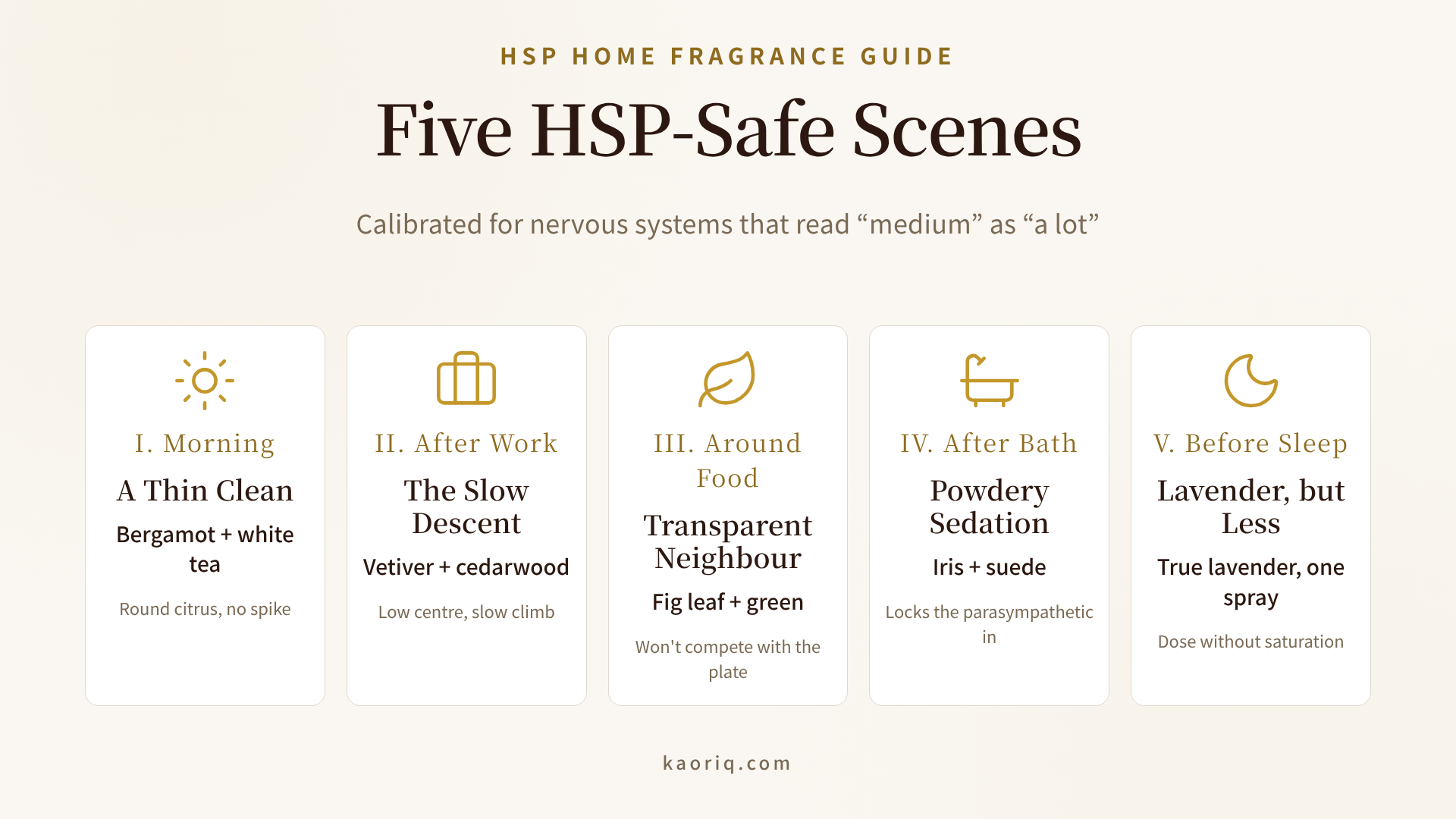
1. The Morning Preparation: A Thin Clean
Goal: signal to the body that the day is starting, without flooring the alertness system.
Most “energising” morning scents are tuned for non-HSPs who genuinely need a chemical alarm clock. We do not. We were already alert at 4:47 a.m. when the cat moved.
- Bergamot diluted with white tea, in a small reed diffuser with only two or three reeds (not the six or eight in the box). Bergamot’s citrus is more rounded than grapefruit or lemon: the bitter, almost tea-like end of citrus rather than the bright. White tea is a thin, near-watery clean note that gives the bergamot something to lean on without piling complexity on top.
What to avoid: anything called “energising,” “wake up,” or “uplifting.” Those are products for nervous systems that need waking. Yours does not.
2. After Work: The Slow Descent
Goal: drop the cortisol and lower the centre of gravity without anything sharp on top.
The forty minutes after you close your laptop are when an HSP either successfully resets for the evening or carries the day’s accumulated stimulation straight into dinner. The scent here should be heavy on the bottom, transparent on top, and slow to arrive.
- Vetiver + cedarwood, ideally in a single-wick candle with a small wax pool. Vetiver is rooty, slightly damp, almost smoky in a quiet way. Cedarwood is dry and patient. Together they sit low to the ground, and they take their time. A vetiver-cedarwood candle does not announce itself the moment it is lit. It earns its place over fifteen or twenty minutes, which is exactly the pace an HSP nervous system can tolerate.
What to avoid: pepper, ginger, anything described as “spicy.” Spice notes hit the trigeminal nerve as well as the olfactory bulb, and that is a second alertness channel you did not ask to open.
3. Around Food: A Transparent Neighbour
Goal: be present in the room without being a third person at the table.
For HSPs, eating with a strong room scent in the background is genuinely difficult. The food’s smell and the candle’s smell are both being processed at full depth, simultaneously, and one of them usually loses. You want a room scent here that is almost but not quite invisible.
- Fig leaf + green notes, as a low-throw room spray applied to a single soft furnishing thirty minutes before you sit down. Fig leaf (not fig fruit, which is sweet and dessert-coded) is a quiet leafy-green that suggests the outdoors without competing with what is on the plate. The green notes (galbanum or violet leaf) keep it from drifting toward sweetness.
What to avoid: vanilla, gourmand, anything explicitly labelled “kitchen.” Kitchen candles are designed to mask cooking smells. HSPs do not want anything masking anything. We want the room and the food to be on the same side.
4. After a Bath: Powdery Sedation
Goal: lock in the parasympathetic state the bath just produced, with a scent that does not ask anything of you.
A hot bath lowers your core temperature and cortisol in the hour afterwards. For HSPs, this is the most efficient regulation window of the entire day, and the scent in the room at this point is either reinforcing the calm or undoing it. The right move is what perfumers call a “powdery” scent: soft, slightly cold, slightly melancholy.
- Iris + suede, in a single-wick candle or a low-throw room spray used sparingly. Iris (orris root) takes years to age before it is even usable, and the resulting note is one of the gentlest in perfumery: soft, slightly chalky, very introspective. Suede adds a quiet warmth on top. Neither note is “doing” anything dramatic. That is the entire point.
What to avoid: anything called “uplifting,” “sparkling,” or “fresh.” You worked hard to get the cortisol down. Do not undo it before you have even put pyjamas on.
5. Before Sleep: Lavender, but Less
Goal: condition a sleep cue without the scent itself keeping you awake.
Lavender is the most-recommended sleep scent for good reasons (the linalool pathway has small but measurable sedative effects), and the most-misused sleep scent for one bad one: most lavender products are over-concentrated. For non-HSPs, that is mildly relaxing. For HSPs, an over-concentrated lavender is just another stimulus to process.
- True lavender (Lavandula angustifolia) pillow mist, applied as one spray on the pillow ten minutes before lying down. Then leave the room and come back. The single-spray rule sounds excessive until you have spent a night trying to fall asleep next to a pillow that smells like a Provençal gift shop.
What to avoid: lavender blends with bergamot, mint, or eucalyptus on top. Sleep is the chronic problem for many HSPs, and the longer bedroom fragrance sleep guide goes deeper if this is your hardest scene.
Quick Reference
| Scene | Lead notes | Format | Why it works for an HSP |
|---|---|---|---|
| Morning | Bergamot + white tea | Reed diffuser, 2–3 reeds | Round citrus, low complexity, no spike |
| After work | Vetiver + cedarwood | Single-wick candle | Slow climb, low centre of gravity |
| Around food | Fig leaf + green | Spritzed soft furnishing | Transparent, doesn’t compete with food |
| After bath | Iris + suede | Low-throw spray / candle | Soft, powdery, parasympathetic-safe |
| Sleep | True lavender | Single pillow spray | Linalool dose without over-saturation |
Seven Intensity Rules for the HSP Household
The right note is only half the work. The other half is how you use it. These rules are tedious. They also fix most HSP fragrance complaints I have ever heard.
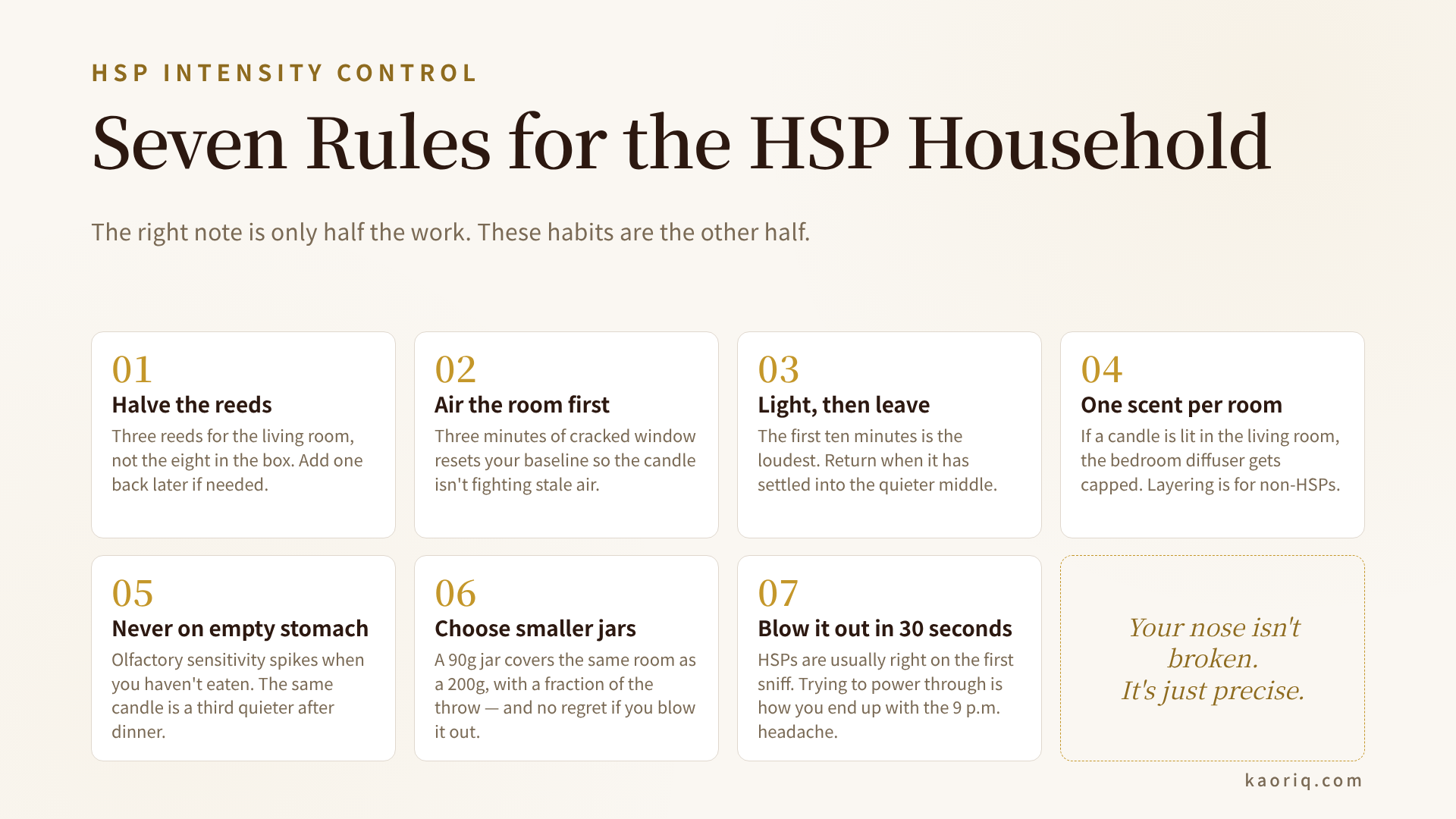
- Cut the number of reeds in your diffuser by half. Eight reeds is for a hotel lobby. Three reeds is for an HSP living room. You can always add one back.
- Air the room before you light anything. Three minutes of cracked window resets your nose’s baseline so the candle does not have to fight a stale room.
- Light it, then leave for five minutes. The first ten minutes of any candle is its loudest. By the time you return, the scent has settled into its quieter middle.
- Never burn two scents at the same time. If a candle is lit in the living room, the bedroom diffuser gets capped, the bathroom soap gets switched to unscented, and the kitchen stays neutral. One scent per habitable area. Layering is fun in theory and exhausting in practice. The longer home fragrance layering guide covers the cases where it works, but as a default HSP rule, do not.
- Do not light anything on an empty stomach. Olfactory sensitivity goes up sharply when you have not eaten. The same candle at 7 p.m. after dinner is a third quieter than it is at 11 a.m. on coffee alone.
- Choose smaller jars. A 200g candle in a small flat is too much candle. A 90g jar covers the same room with a fraction of the throw, and you can blow it out the moment it stops working for you without feeling like you wasted money.
- If a scent feels wrong in the first thirty seconds, blow it out. HSPs are usually right about scent on the first impression. Trying to power through is how you end up with a headache by 9 p.m. and a candle you resent for the rest of its life.
Your Nose Isn’t Broken
If you have spent years quietly suspecting that something about modern fragrance is calibrated for someone whose nervous system is not yours, you were right. Most of it is. The products on the shelf are tuned for the median, and the median is louder than you. That is not a defect in the HSP nose. That is a precision instrument being asked to read in a noisy room.
The fix is not unscented living, which leaves the most direct lever on the nervous system unused. The fix is carefully designed intensity: fewer notes, slower releases, smaller jars, single scents per room, and the discipline to blow it out when it is wrong.
If you do not know whether you are more “after work” or “after bath” on a given evening, you almost certainly already know. Pay attention to which scene you are already daydreaming about at 4 p.m. while everyone else in the meeting is still arguing about the Q3 number. The introvert home fragrance guide covers the same five-scene structure for the energy-budget variant of this problem, and the personality-fragrance overview is the science underneath both.
Your nose is not broken. It is just measuring something the rest of the room missed.
Was this article helpful?