Why Your Candles Melt and Your Diffusers Fade in Summer (And How to Build a Heat-Proof Setup)
The Day a Candle Becomes a Puddle With a Wick In It
Come home from a long July afternoon, open the door, and your favourite candle has quietly given up on being a candle. Slumped sideways in its jar, the surface gone glassy and wet, the wick listing like a tiny shipwreck. Nothing was lit. The room simply got hot enough to do the job on its own.
Across the apartment, the reed diffuser I’d refilled ten days earlier was already two-thirds empty. And the pretty room spray on the shelf had turned its bright lemon top note into something flat and slightly sour.
Nothing was broken. The summer just did what summer does to home fragrance, and I hadn’t planned for any of it.
So here’s the friend-to-friend version of what I wish someone had told me before the first heatwave: what actually goes wrong, which formats shrug it off, and where to put things so your home still smells like a home and not a warm gift shop.
The Three Things Summer Does to Your Fragrance
Before the buying advice, it helps to know your enemy. Heat attacks home fragrance in three separate ways, and most people only notice the dramatic one.
1. Wax softens and slumps. Every wax has a melting point, and a closed room in summer can climb past 30°C (86°F), well within sweating distance of that point. The candle doesn’t have to fully melt to lose. It just has to soften enough to lean, sweat, or develop that wet, oily sheen on top.
2. Scent evaporates too fast. Evaporation is temperature-driven, full stop. A reed diffuser in a 30°C room can burn through its oil at roughly double the rate it would at a cool 22°C. You’re not imagining it running out faster. It genuinely is. Your bottle that “lasts eight weeks” was tested in an air-conditioned lab, not your west-facing living room in August.
3. Quality quietly degrades. Direct sun and high heat break down delicate top notes first. That bright citrus or herbal opening flattens into something duller and occasionally a little rancid. And the practical safety note: candles left in hot, sunny spots are also a fire-and-mess risk nobody enjoys discovering.
The takeaway: summer doesn’t just make scent feel different (that’s a separate article). It physically attacks the product. So the fix is partly about what you buy and largely about where you put it.
Format Heat-Resistance, Ranked
Here’s the cheat sheet. Then the explanations.
| Format | Heat Resistance | Why |
|---|---|---|
| Reed diffuser | ★★★★ | No flame, no wax. Only downside: faster evaporation |
| Electric / ultrasonic diffuser | ★★★★★ | No flame, no wax, cool mist. Summer’s MVP |
| Nebulizing diffuser | ★★★★★ | No water, no heat, no wax. Unbothered |
| Gel / solid air freshener | ★★★ | Won’t slump like wax, but dries out faster |
| Candle | ★★ | The one thing summer can physically deform |
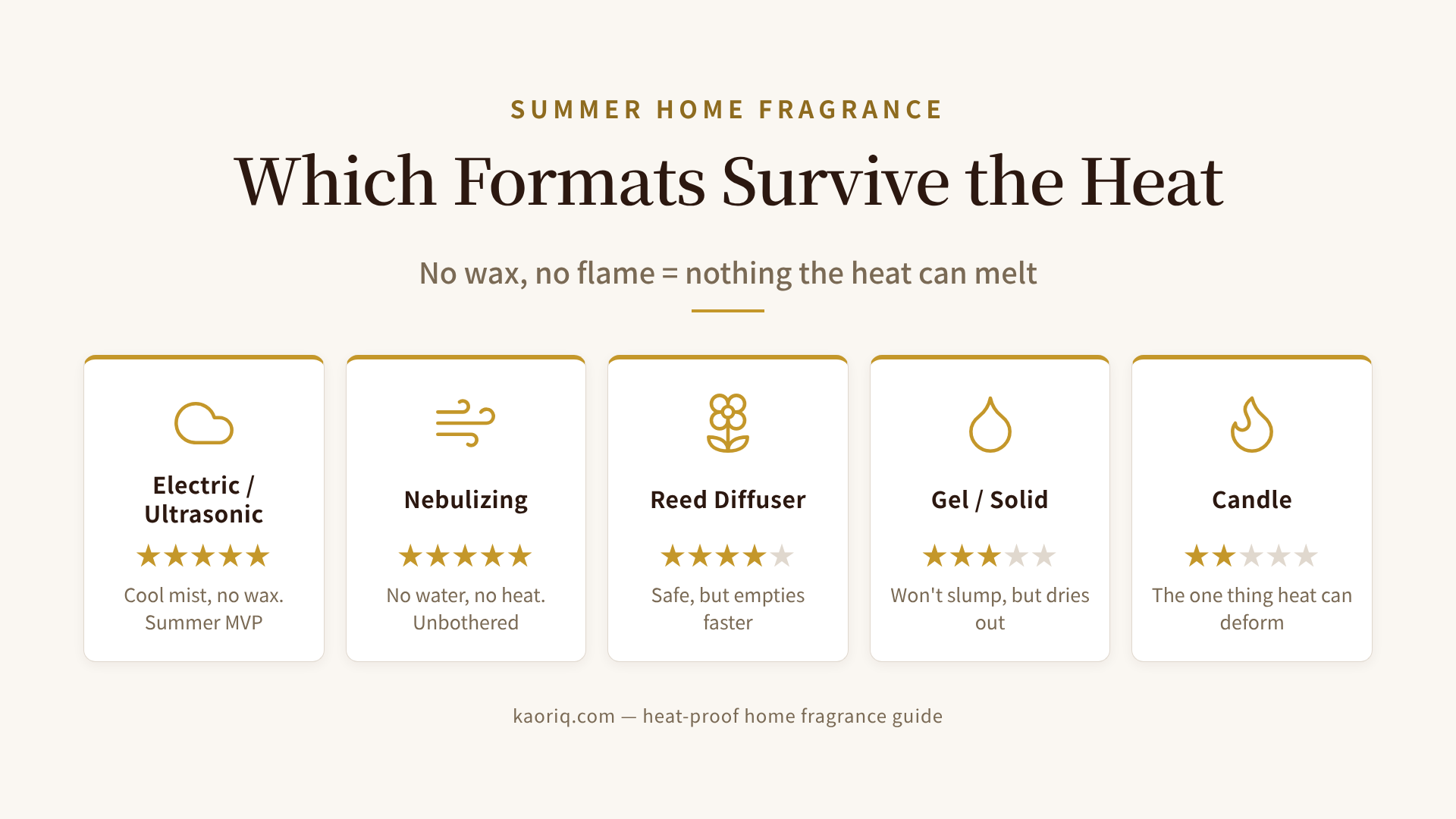
The headline: anything without wax and without a flame wins in summer. Electric, ultrasonic, and nebulizing diffusers don’t care how hot the room gets: there’s nothing to melt. Reed diffusers are nearly as safe; they just empty faster, which we can manage. Candles are the only format the heat can actually deform, and they’re also the one that turns a sunny windowsill into a hazard.
That doesn’t mean ban candles for the summer. It means handle them with a bit more respect, and lean on the others for everyday scenting.
If You’re Loyal to Candles: Mind the Wax
The wax type does not settle the question, and this page used to claim it did.
Corrected in August 2026. This section previously gave paraffin as ~46–68°C, soy as ~49–82°C and beeswax as ~62–65°C, with soy in the middle and beeswax on top. Those ranges came from secondary blogs and the soy upper bound could not be confirmed against any supplier spec. Here is what published specifications actually say.
| Wax | Melting point | Source |
|---|---|---|
| Paraffin | 48.9–71.0°C across nine JIS K 2235 grades (120P to 155P) | Nippon Seiro, petroleum wax standards |
| Beeswax | 62.8°C (bleached: 63.7°C) | Yamakei Sangyo, wax melting point table |
| Soy (domestic SG grade) | 46.5–48.5°C | Yamakei Sangyo, wax melting point table |
Read down the column. High-grade paraffin melts higher than beeswax, and soy sits below the lowest paraffin grade. The ranking the old table implied does not survive the numbers.
The name does not even fix a value within one wax. Monday Moon sells the same “Eco Soy Wax” at 45°C and 50°C.
What you can act on: most scented candles never print a melting point, so placement is the control you actually have. Wax choice is not the second line of defence. It is a line you usually cannot read.
Where You Put It Matters More Than What You Buy
This is the part that fixes 80% of summer fragrance problems for free.
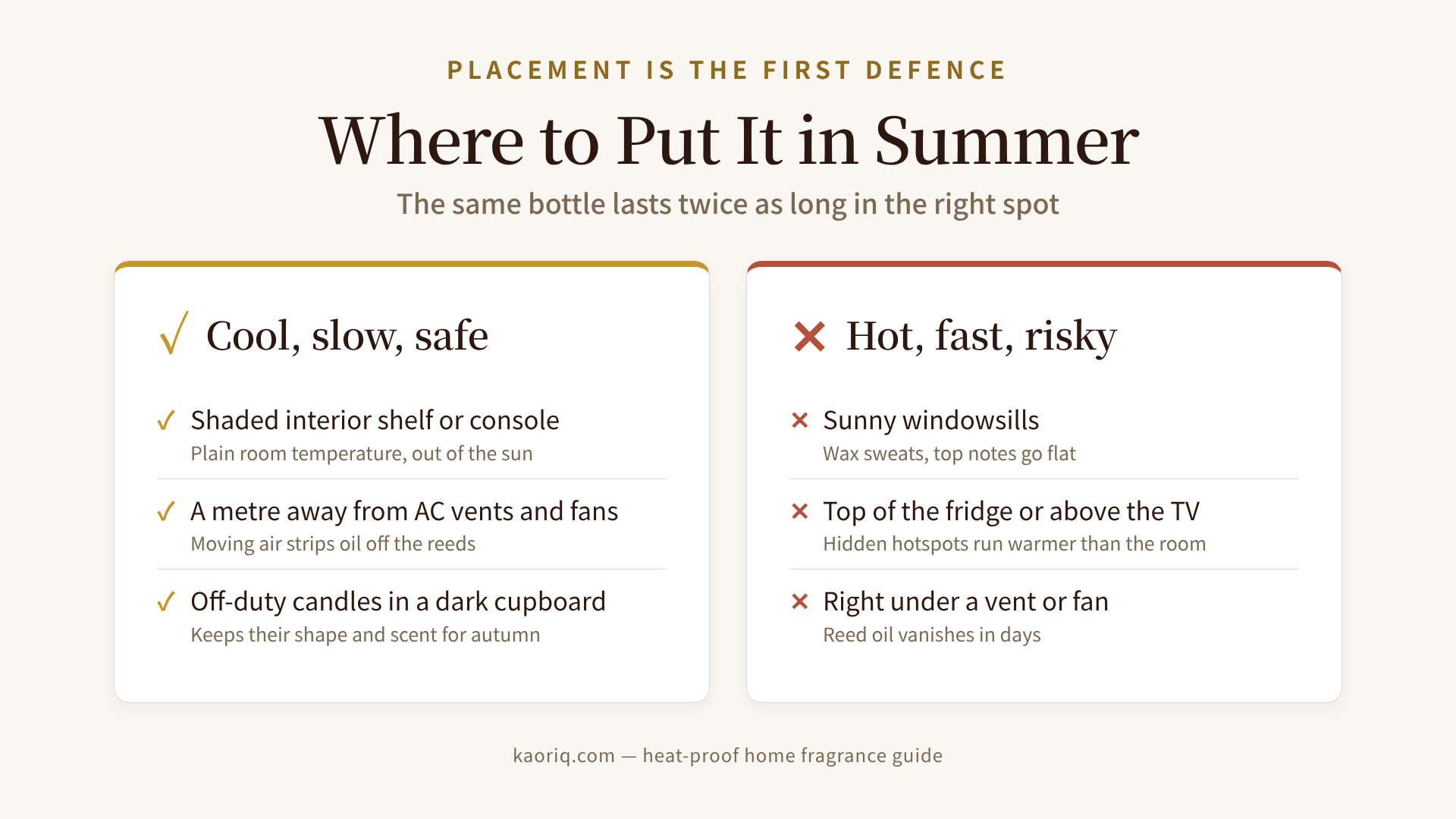
Keep everything out of direct sun. Sunny windowsills, the top of the fridge, shelves above the TV or router, anywhere near a radiator-turned-summer-hotspot: all of these run hotter than the rest of the room. A shaded interior shelf at plain room temperature is the slowest, safest spot for candles, reeds, and sprays alike.
For reed diffusers, fight the evaporation two ways:
- Use fewer reeds. Drop to 3–5 sticks instead of the full bunch. Fewer reeds means slower evaporation and a lighter, more appropriate summer scent. You wanted “subtle” in August anyway.
- Flip less often. Every flip refreshes the saturated surface and speeds things up. In summer, flip once a week or even once a fortnight, and only when you actually notice the scent fading.
Mind the airflow. A reed diffuser parked right under an AC vent or next to a fan empties shockingly fast: moving air strips the oil off the reeds. Keep passive formats at least a metre from vents and fans. (Room sprays, on the other hand, love that same airflow, so mist into the breeze and let it carry. Different tool, opposite rule.)
Store the off-duty candles cool. Your winter amber candle and any candles you’re not using right now belong in a cool, dark cupboard, not on display in the heat. They’ll keep their shape and their scent, and reward you in October.
Three Things Nobody Tells You
1. “It’s running out fast” usually means placement, not a bad product. Before you decide a diffuser is cheaply made, check whether it’s sitting in sun or airflow. Move it to a shaded interior shelf for a week and watch the difference. Most “this didn’t last” complaints are really location complaints.
2. Lighter scents are a summer feature, not a compromise. Heat amplifies everything, so the heavy winter blend that felt cosy in December now feels like it’s following you around the apartment. Fewer reeds, shorter candle burns, and naturally lighter formats all read as correct in summer, not weak. Your nose wants less right now.
3. Your nose stops noticing within twenty minutes anyway. Olfactory adaptation means constant scent goes invisible to you fast, so running a diffuser all day in the heat mostly just burns oil for an empty room. Run things in shorter bursts. You’ll smell it fresh every time you walk back in, and your bottle lasts twice as long.
Your Heat-Proof Summer Setup, in One Line Each
If you read nothing else, build it like this:
- Everyday scenting: an electric, ultrasonic, or reed diffuser with no flame and nothing to melt, set in a shaded spot.
- Reed diffusers: fewer reeds, flip less, keep a metre from vents and sun.
- Candles: save them for lit, supervised evenings; choose beeswax or beeswax-soy if your room runs hot; store the rest in a cool cupboard.
- Room sprays: keep them out of the sun, and mist into the airflow when you want a quick refresh.
Summer isn’t the enemy of a good-smelling home. It just rewards a slightly different plan than winter did. Move the candle off the windowsill, pull a couple of reeds out of the bottle, and let the heat do the one thing it’s good at: carrying a light, fresh scent further than it ever could in the cold.
For which scents actually hold up when the air gets heavy, our companion guide on five summer notes that stay fresh picks up exactly where this one leaves off.
Melting points: Nippon Seiro, petroleum wax standards (JIS K 2235) and Yamakei Sangyo’s wax and hydrogenated oil melting point table. Storage guidance: Kameyama Candle House Q&A, which states that candles kept in hot places or direct sunlight can deform and discolour.
Was this article helpful?