How to Choose a Home Fragrance That's Safe for Your Cat or Dog (Without Settling for Unscented)
One Candle, One Coughing Cat, and a Permanent Rule
Say it’s a eucalyptus-mint candle, which is usually the entire problem. Lit in the living room, ten minutes in, and the cat — who had been napping on the rug — gets up, stares at the candle, coughs twice in the way that cats cough when they have opinions, and walks into the bedroom. Cats cannot shut doors. The message lands anyway.
I felt terrible. I also felt confused, because the candle didn’t say anything on the label about cats. It said “100% natural essential oils” with the same energy a cereal box uses to say “wholesome.” I assumed natural meant safe. It does not. “Natural” includes hemlock, and hemlock is extremely natural.
That is where the real work starts: reading too many ingredient lists, ignoring half of what the internet says, and slowly settling on a baseline that lets a home actually smell like something while the cat keeps sleeping on the rug. Here’s the version worth having at the start.
One disclaimer before we start: this is general guidance based on widely available information from groups like the ASPCA, not veterinary advice. If your pet has a specific condition, or you’re seeing symptoms, talk to your vet, not a blog.
Why Pets React to Scent Differently Than We Do
Two pieces of biology do most of the work here.
Cats process scent compounds very differently than humans. Their livers lack a specific metabolic pathway — glucuronidation, if you want the technical term — that humans rely on to clear certain plant compounds. Phenols and some terpenes that we metabolize in hours can linger in a cat’s system for far longer. This is why essential oils that are mildly fragrant to us can be a real concentration problem in a small body that breaks them down slowly.
Dogs have roughly forty times more olfactory receptors than humans. They aren’t as metabolically vulnerable as cats, but a fragrance level you barely register can be overwhelming for them. “I can’t smell it” is not a useful proxy for “my dog can’t smell it.”
The combined practical takeaway: choose lower-concentration fragrances, prefer formats with continuous low output over high-intensity bursts, and keep the door open between scented and unscented rooms so the animal can self-select.
Ingredients to Skip
This list isn’t exhaustive, but it covers the recurring offenders. Worth scanning ingredient labels for these specifically.
Generally avoid around cats:
- Tea tree (melaleuca)
- High-concentration citrus oils (especially d-limonene heavy)
- Eucalyptus
- Peppermint
- Cinnamon
- Pine and pine-derived oils
- Ylang-ylang
- Wintergreen
Generally avoid around dogs:
- Wintergreen (methyl salicylate)
- Pennyroyal
- The above list, at high concentration
Worth being cautious with around either:
- Heavy paraffin candles in unventilated rooms (combustion particles)
- Very heavily fragranced “plug-in” products in small spaces
- Concentrated essential oil blends marketed for diffusers without a dilution guide
The phrase “essential oil” on its own tells you almost nothing. A 1% blend of lavender in a soy candle is a very different product than a 100% undiluted bottle of lavender oil running through a nebulizer. The format and the dose matter at least as much as the ingredient.
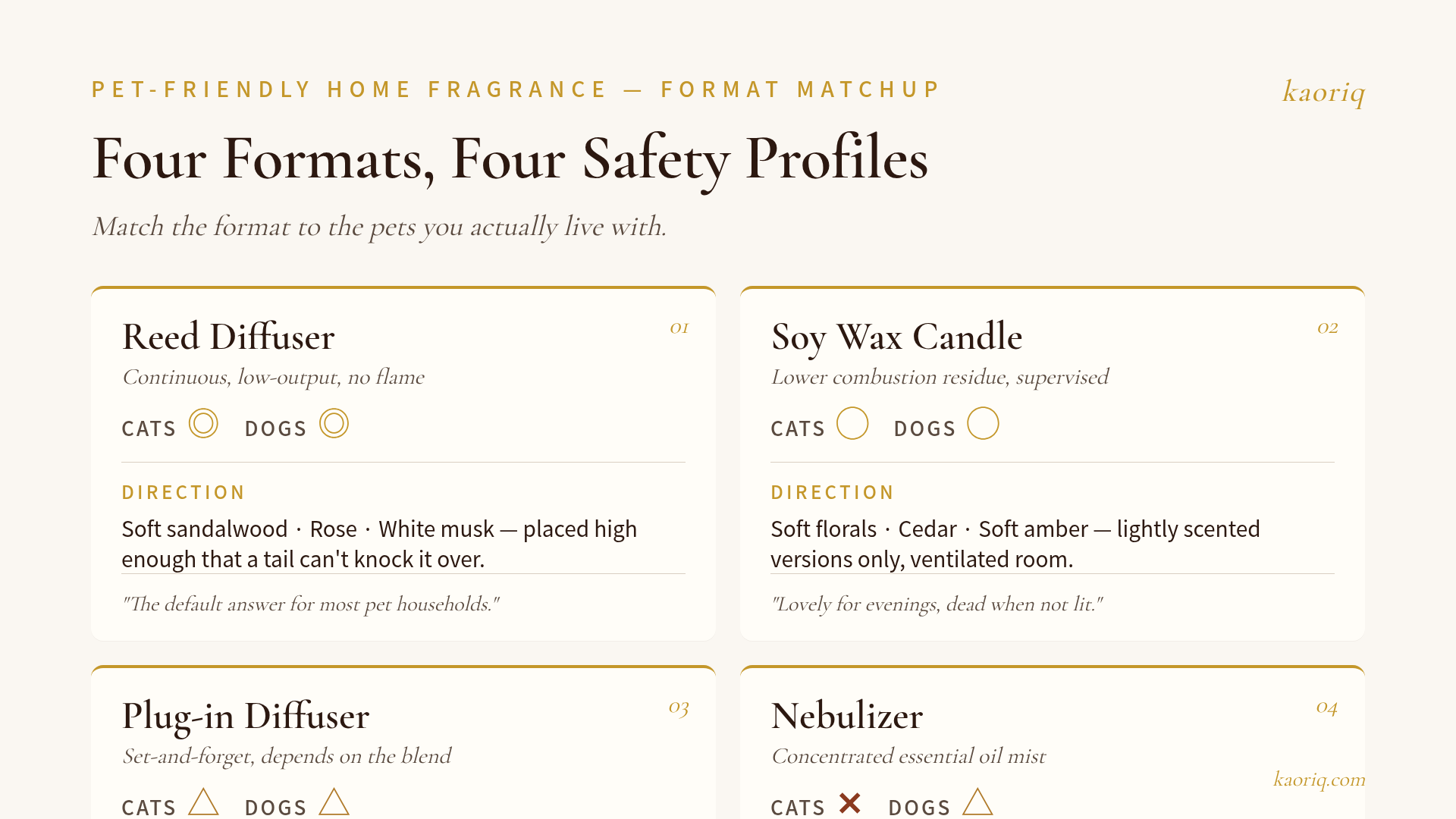
The Format Question: What Actually Works
| Format | Cats in the Home | Dogs in the Home | Notes |
|---|---|---|---|
| Soy or coconut wax candle | ◯ | ◯ | Lower combustion residue than paraffin. Choose lightly scented or fragrance-oil based. Always supervised. |
| Paraffin candle | △ | △ | Combustion particles are higher; ventilate the room. Avoid in small unventilated spaces. |
| Reed diffuser | ◯ | ◯ | Continuous, low output. Place high enough that a tail can’t knock it over. |
| Plug-in / electric diffuser (water-based) | △ | △ | Depends entirely on what you put in it. Tea tree, eucalyptus, and peppermint blends are the main concern. |
| Nebulizer (concentrated essential oil mist) | ✕ | △ | Designed for dispersion of undiluted oil. Concentration is too high for cats; use cautiously around dogs. |
| Incense | △ | △ | Combustion particles, plus some blends include ingredients pets shouldn’t inhale. Sandalwood and aloeswood incense in short sessions, with the windows cracked, is the gentler version. |
| Room spray | ◯ | ◯ | Best as spot use, in rooms the pet isn’t currently occupying. Lets the air clear before they re-enter. |
The honest baseline for most pet households is: a soy candle or reed diffuser in lightly fragranced versions, plus a room spray for moments you want a quick scent reset. Skip the nebulizers and the eucalyptus blends. You can have a beautifully scented home without either.
Scent Families That Tend to Work Well
Three directions that are usually well-tolerated, and that don’t make you feel like you’ve resigned yourself to “fresh linen” forever.
Soft Florals
Rose, neroli, magnolia, jasmine — in low to mid-concentration finished products. Light, expressive, and far enough from the typical irritant list that they’re a comfortable starting point. Avoid ylang-ylang heavy florals around cats specifically.
Soft Woods
Sandalwood, cedar, and hinoki at moderate concentration. These give a home a grounded, calming character without leaning on the conifer/eucalyptus end of the spectrum that causes the most issues. Sandalwood incense in short sessions is one of the more pet-friendly traditional formats.
Clean Cotton and Soft White Musks
The “fresh laundry” family, when chosen as a finished room fragrance product (not a DIY essential oil blend), is one of the more reliably pet-tolerated directions. The synthetic musks used in most modern commercial fragrance are designed for skin and air safety and don’t carry the metabolic concerns of concentrated plant oils.
Room-by-Room
The biggest mistake people make is treating “the home” as one fragrance space. Pets move; you can split it.
- Pet-frequented rooms (living room, hallway): lower-concentration reed diffuser or candle. Lighter scent families. Always leave a route to a less-scented room.
- Pet-restricted rooms (bedroom, office): if you keep your bedroom door closed and the cat isn’t in there, you have more room to play with bolder scents.
- Bathrooms and small rooms: keep concentration light here. Small volumes of air mean any scent stacks fast.
- Pet’s own space (bed, crate, food area): unscented. Always. The animal needs at least one scent-neutral area to retreat to.
A Starter Routine
If you’re rebuilding your fragrance setup with pets in mind, this is the slow approach that’s worked for me:
- Pick one room and one product. Living room reed diffuser is the easiest start.
- Run it for a week, with the bedroom door cracked. Watch the pet. Cats especially will tell you with their feet — they will literally relocate.
- Add a second format only after that week. A soy candle for evenings, maybe. One change at a time, so if there’s an issue you know which one.
- Keep one room unscented permanently. Their retreat space.
The Cheat Sheet
| Situation | Format | Direction |
|---|---|---|
| First-time pet household setup | Reed diffuser | Soft sandalwood or rose, low concentration |
| Multi-cat home | Reed diffuser + occasional room spray | Clean cotton or soft white musk |
| Single dog, mostly outdoors | Soy candle (supervised) + diffuser | Cedar, sandalwood, soft florals |
| Small apartment, one cat | Plug-in (mild) only | Light florals; skip nebulizers entirely |
| Senior pet or pet with health issues | Mostly unscented + occasional room spray | Talk to the vet first |
| The “guests are coming over” reset | Room spray, in unoccupied rooms | Whatever you have, used briefly |
What to Know Before the Eucalyptus Incident
Two things, looking back.
One: “unscented” is not the only honest answer for pet households. The choice isn’t between a reactive cat and a sterile-smelling apartment. The choice is between concentrated, irritant-heavy products and quieter, better-chosen ones. The latter category is bigger than most people realize, and quietly perfumed homes with happy animals in them are entirely possible.
Two: the label “pet-friendly” on a candle isn’t a regulated term. There’s no standard, no certification, no industry body checking. Your eyes on the ingredient list will outperform any front-label claim. It takes about thirty seconds and saves you the kind of evening a eucalyptus candle can produce in a cat’s house.
If you’re not sure which scent family suits both you and the home you share with your cat or dog, our personality-based scent quiz gives you a starting baseline you can then narrow down for pet-safe formats. For more on why personality is a useful filter at all, this piece goes deeper. And for matching format to room size once you know your direction, the room size guide and entryway guide cover the spatial half of the equation.
The right scent shouldn’t make your cat leave the room. The right scent shouldn’t make you leave it either. Mine is sandalwood and a little soft rose, the cat’s back on the rug, and the eucalyptus candle is in a drawer somewhere being a useful reminder.
Was this article helpful?