Natural, Non-Toxic Room Fragrance: How to Choose a Clean Scent for Every Room (2026 Guide)
The “Natural” Air Freshener That Is Mostly Petroleum
The bottle was the colour of oat milk. It said botanical. It said essential oils. It had a little drawing of a leaf. I felt very responsible buying it.
Then I read the back, where the ingredient list said, in full, “fragrance.” That’s it. One word doing a lot of hiding.
Here’s the thing nobody tells you when you go looking for a clean home scent: the word natural is barely regulated. A label can shout “natural” while the actual scent is 95% synthetic compounds derived from petroleum, held together with phthalates to make it last. The leaf drawing is doing more work than the formula.
So this is the guide I wish I’d had. Not a fear-mongering one. Just how to read a label, what the scary words actually mean, and which clean fragrance fits which room. No chemistry degree required.
What “Non-Toxic” Is Actually Trying to Avoid
You don’t need to memorise toxicology. You need to recognise three words and know why people skip them.
Phthalates. These are plasticisers used to make a scent linger longer. Diethyl phthalate (DEP) is the common one in fragrance. They’re the reason a cheap air freshener can perfume a room for weeks. The concern is that some are endocrine disruptors that can mimic hormones. Most clean brands now drop them entirely and use plant-based fixatives instead. Trade-off: a phthalate-free scent often fades faster. That’s not a defect. That’s the absence of the plasticiser doing its job.
VOCs (volatile organic compounds). These are what evaporate into the air to carry scent to your nose, so technically every fragrance has them, natural ones included. The issue is the heavy synthetic VOCs in some sprays and plug-ins that linger and irritate airways. “Low-VOC” on a label means the brand has tried to minimise the irritating ones. Worth more in a closed bedroom than a breezy entryway.
Synthetic fragrance (the word “fragrance” or “parfum” alone). Not inherently evil: plenty of safe synthetics exist, and “synthetic” doesn’t mean “bad.” But when the ingredient list says only “fragrance,” it’s a legal black box. Up to several hundred undisclosed chemicals can sit under that single word. Clean brands disclose what’s in the blend instead of hiding behind it.
That’s the whole vocabulary. Phthalates, VOCs, undisclosed “fragrance.” If a product is quiet about all three, that tells you something.
How to Read the Label (Without a Magnifying Glass)
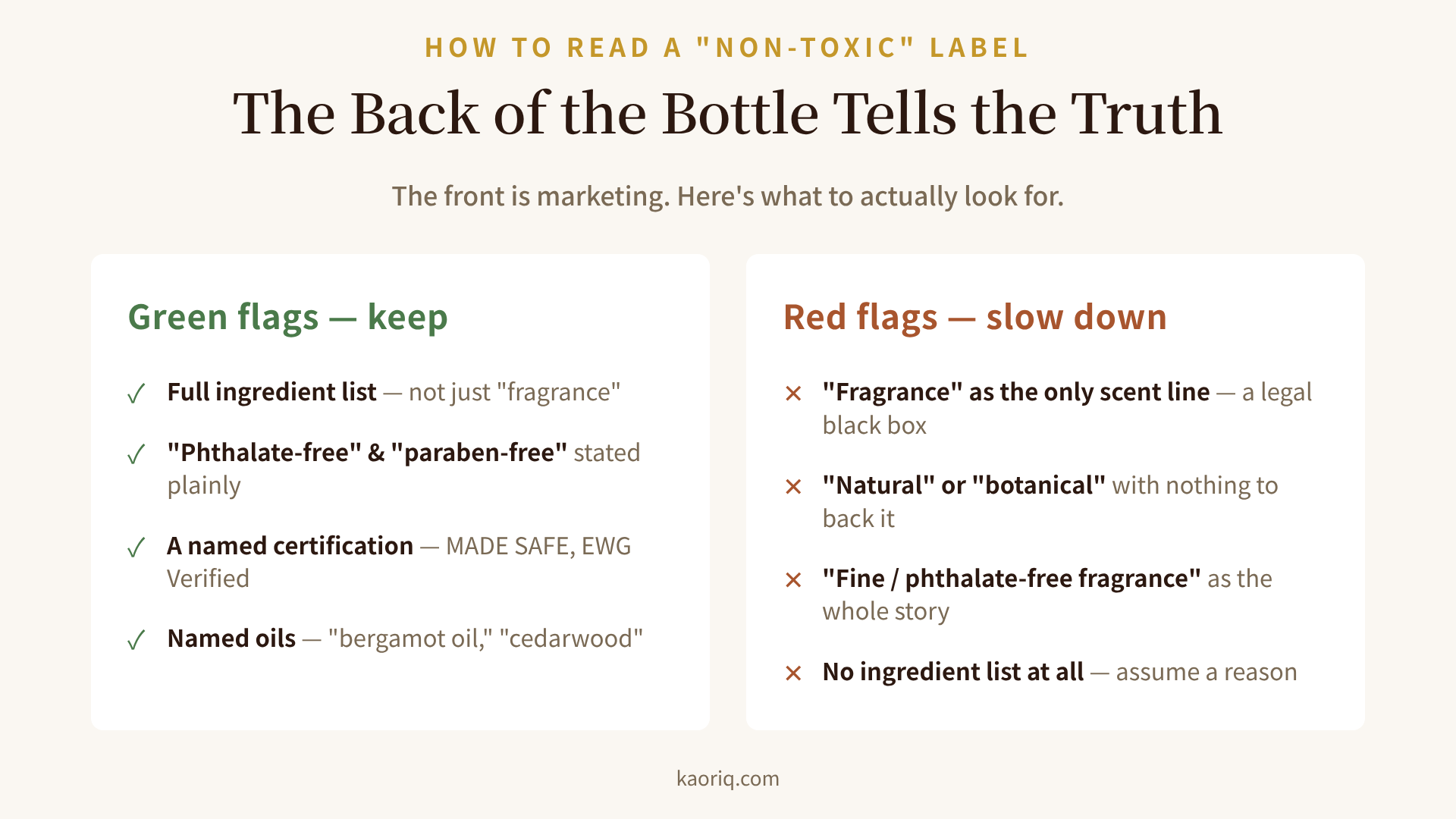
The front of the bottle is marketing. The back is the truth. Here’s how to tell a real clean formula from a leaf drawing.
Green flags, keep these:
- A full ingredient list, not just “fragrance.” Transparency is the single best signal.
- “Phthalate-free” and “paraben-free” stated plainly.
- A named certification. MADE SAFE, EWG Verified, or similar. These are third parties, not the brand grading its own homework.
- Named essential oils or specified scent compounds (“bergamot oil,” “cedarwood”) instead of a vague “natural fragrance blend.”
Red flags, slow down:
- “Fragrance” or “parfum” as the only scent ingredient. The black box.
- “Natural” or “botanical” with nothing to back it. Unregulated words. A leaf is not a certification.
- “Fine fragrance” or “phthalate-free fragrance” as the whole story. These are common greenwashing phrases that can still hide a mostly-synthetic blend.
- No ingredient list at all. If they won’t tell you, assume there’s a reason.
One honest caveat: even the cleanest essential oils contain natural allergens (limonene and linalool show up on EU labels for exactly this reason). “Natural” is not a synonym for “can’t irritate anyone.” If you or someone in the house is sensitive, patch the air, not your skin: run it briefly, leave the room, come back, and see how it reads.
Format Matters: Clean Doesn’t Mean One Shape
Once a formula is genuinely clean, the delivery decides how it behaves in your home. Here’s the honest scorecard.
| Format | Clean-formula availability | Throw | Air impact | Best for |
|---|---|---|---|---|
| Reed diffuser | ◎ easy to find clean | △ gentle | ◎ no combustion | Bedroom, bath, small rooms |
| Room spray | ◎ many plant-based | ◎ instant, ✗ no sustain | ○ brief | Entryway, quick refresh |
| Soy/coconut candle | ○ if wax + wick are clean | ○ medium | △ some soot | Living room, evenings |
| Essential-oil diffuser (water) | ◎ oils only, no carrier | ○ medium | ◎ just water + oil | Living room, kid/pet spaces |
| Plug-in warmer | △ often synthetic refills | ○ medium | △ check refill | Last resort, check label |
◎ great ・ ○ good ・ △ mediocre ・ ✗ none
A few things the table won’t say out loud:
- Reed diffusers are the easiest clean win. No flame, no electricity, and the carrier is usually a clean base oil. The catch is gentle throw: fine for a bedroom, underpowered for a big open-plan room.
- A candle is only as clean as its weakest part. A clean fragrance oil poured into paraffin wax with a metal-core wick isn’t clean. Look for soy or coconut wax and a cotton or wood wick.
- A water-based essential-oil diffuser is the simplest “I can see exactly what’s in this” option: you add water and a few drops of named oil. Nothing hidden, nothing burned.
Which Clean Scent for Which Room
The cleanest formula in the world still needs to suit the space. Here’s where I’d actually put each one.
The Bedroom: Lightest Touch, Lowest VOC
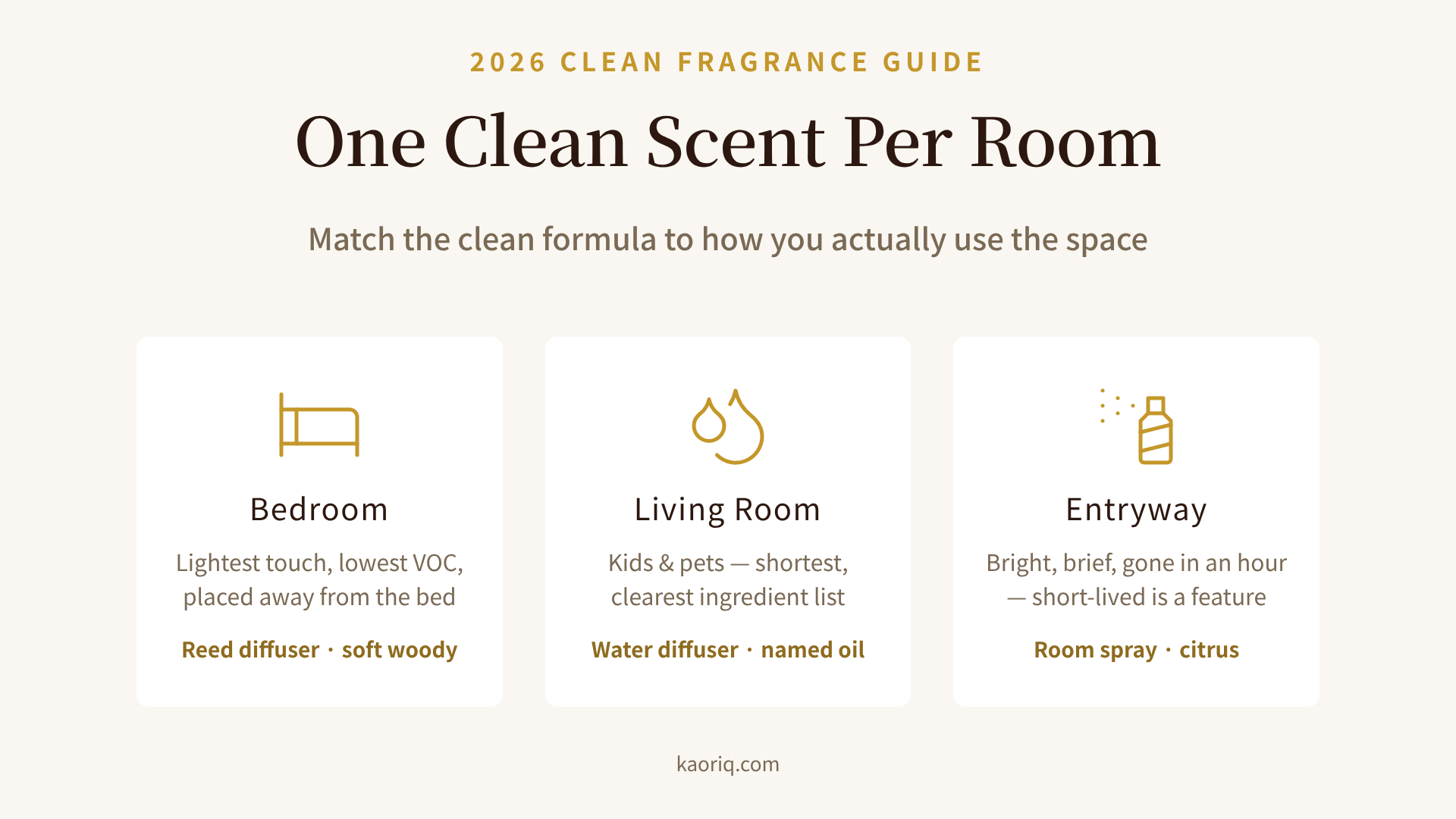
Bedrooms are small, often poorly ventilated, and you’re breathing the air for eight hours straight. This is the room to go quietest. A phthalate-free reed diffuser in a soft scent (lavender, sandalwood, white musk), placed across the room, not on the nightstand. Low-VOC matters more here than anywhere. You want a whisper you can sleep through, not a presence. (More on this in the bedroom sleep-fragrance guide.)
Clean pick: reed diffuser, soft woody or lavender, placed away from the bed.
The Living Room With Kids and Pets: Simple and Visible
This is the room where “I can read every ingredient” earns its keep. With small children and animals around, you want the shortest, clearest list possible: a water-based diffuser with a named essential oil, or a reed diffuser set out of reach. Skip the undisclosed “fragrance” entirely here. Note that some essential oils (tea tree, certain citrus, eucalyptus) don’t suit homes with cats and dogs, so this is a place to be specific rather than just “natural.” Our pet-friendly fragrance guide and baby- and toddler-safe guide go deeper than I can here.
Clean pick: water-based essential-oil diffuser, named oil, placed up high.
The Entryway: Clean First Impression, Briefly
The entry is the one room where short-lived is a feature. You walk through it; you don’t live in it. A plant-based room spray you mist before guests arrive does more here than a permanent diffuser: bright, gone in an hour, no lingering VOCs. Citrus and green notes shine. This is the cheapest clean win in the house. (See the entryway welcome-scent guide for the full version.)
Clean pick: plant-based room spray, citrus or green, one mist as guests arrive.
So Which Should You Actually Buy?
If you remember one sentence from all this: read the back of the bottle, and treat the word “natural” as a question, not an answer.
Then, the short path:
- Pick the room you most want to smell clean. Start with one, not the whole house.
- Match the format to it: reed diffuser for the bedroom, water diffuser for a kid-and-pet living room, a spray for the entry.
- Buy one with a full ingredient list and a real certification. If the label hides behind “fragrance,” put it back.
And if you want something more personal than “pick a clean scent from a list” (the family that actually suits you depends less on trend than on the kind of person you are), start with finding your fragrance family, then read why personality predicts scent preference better than any trend.
For now: read the back, skip the leaf drawing, and pick the one that tells you what’s actually inside. The honest bottle is almost always the better one. It just doesn’t shout about it.
Was this article helpful?