The Bergamot Story: How One Inedible Calabrian Citrus Became the Heart of European Perfumery
The Label Almost Everyone Misreads
It is easy to read “Bergamot” on the side of an Earl Grey tin and file it as a town in northern Italy: stone walls, hill terraces, a piazza with a fountain. The guess is half-right in the most embarrassing way possible. Bergamo is a town in northern Italy. Bergamot, the thing in the tea, has almost nothing to do with it.
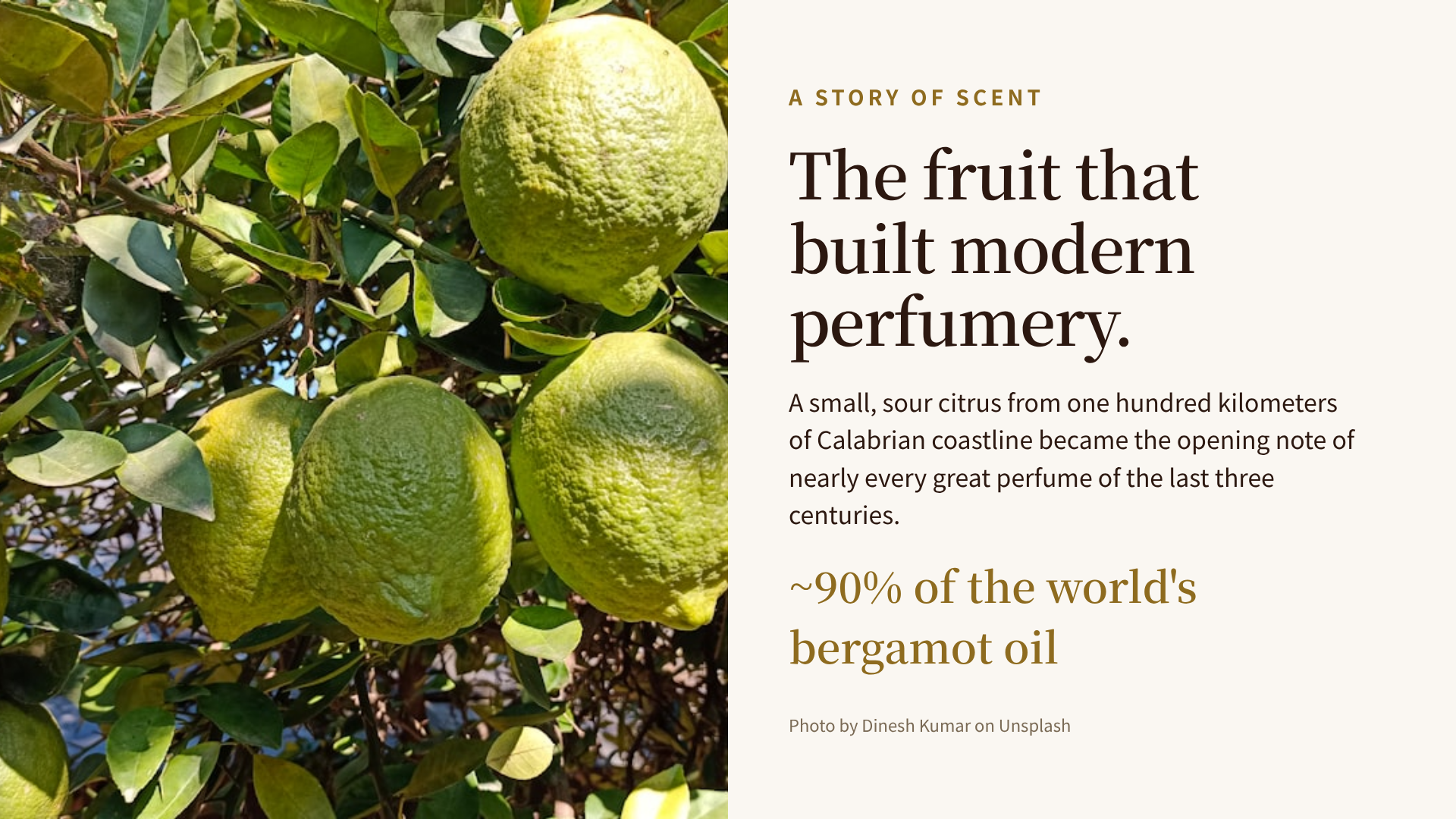
The fruit grows on the opposite end of the country. It is a citrus that is barely edible. Its juice is too sour to drink and too bitter to cook with. The flesh is essentially decorative. The only useful thing about it is its skin. And that skin, distilled into a pale-green oil, has been hiding inside more or less every great perfume of the last three centuries.
This is the story of bergamot. It is also the story of how a strip of coastline you have probably never visited became the opening line of European scent.
A Fruit That Refuses to Grow Anywhere Else
Bergamot (Citrus bergamia) is a small, yellow-green citrus, somewhere between an orange and a lemon and as deeply unloved at the dinner table as both of those are loved. It grows on a tree that looks unremarkable. The fruit ripens in winter, which is the first inconvenient thing about it, and the harvest happens by hand, in cold weather, by people standing on ladders.
What makes bergamot peculiar is not the tree. It is the geography.
Roughly ninety percent of the world’s bergamot essential oil comes from a single hundred-kilometer strip of coastline along the Ionian Sea, in the southern Italian region of Calabria. (Some sources put the figure even higher, near ninety-five percent.) The relevant area is essentially the toe of the Italian boot, around Reggio Calabria, where about fifteen hundred to two thousand hectares of bergamot groves produce around a hundred metric tons of essential oil per year.
You can plant bergamot trees elsewhere. People have tried. They grow. They flower. They fruit. But the oil that comes out of the rind smells, in the opinion of every perfumer with a functioning nose, wrong. Not unpleasant, exactly. Just thinner. Flatter. Without the cool, almost floral lift that defines the real thing.
The reason appears to be a stack of small, locally specific conditions that happen to align on that coastline: clay-and-volcanic soils, mild winters, sea winds, the precise rhythm of dry days and humid ones. Move the tree two hundred kilometers north, and one variable shifts, and the perfume disappears. Calabria is, by accident of climate, the only place in the world where this fruit has anything to say.
In 2001, the European Union finally formalized what perfumers had taken for granted for two centuries. Bergamotto di Reggio Calabria, Olio essenziale received a PDO (Protected Designation of Origin). The label is the EU equivalent of a passport. If you buy bergamot oil with that designation, you are buying something that legally cannot have come from anywhere else.
(I find this oddly reassuring. There are not many things in modern life where the law forces an object to have been a specific place. Champagne, of course. Parmesan. Bergamot is in that small club.)
The Citrus You Cannot Eat
Here is the part I find genuinely funny.
Bergamot is not really a fruit. It is a fruit-shaped object whose only purpose, after several centuries of human attention, is to be peeled and discarded.
The juice is sour and faintly bitter. The flesh has no culinary tradition to speak of. There is no bergamot marmalade industry, no bergamot juice section in the supermarket, no Italian grandmother who will sell you her secret bergamot dessert recipe. (Calabrians do make small amounts of bergamot jam and liqueur, and they will be furious with me for writing the previous sentence, but I stand by the general point.) For most of its history, the fruit’s flesh has been a byproduct.
The skin, on the other hand, is one of the most expensive raw materials in the perfume industry.
To make bergamot oil, the rinds are cold-pressed (not heated, not distilled, just squeezed) so that the volatile compounds in the peel are released in their original form. The result is a pale-green liquid that smells of clean citrus, a faint floral undertone, something almost herbal, and a coolness that is impossible to describe and impossible to mistake. Modern perfumery, almost unanimously, considers this the cleanest, brightest top-note material in existence.
You smell it every day and probably do not know.
Eau de Cologne, 1709
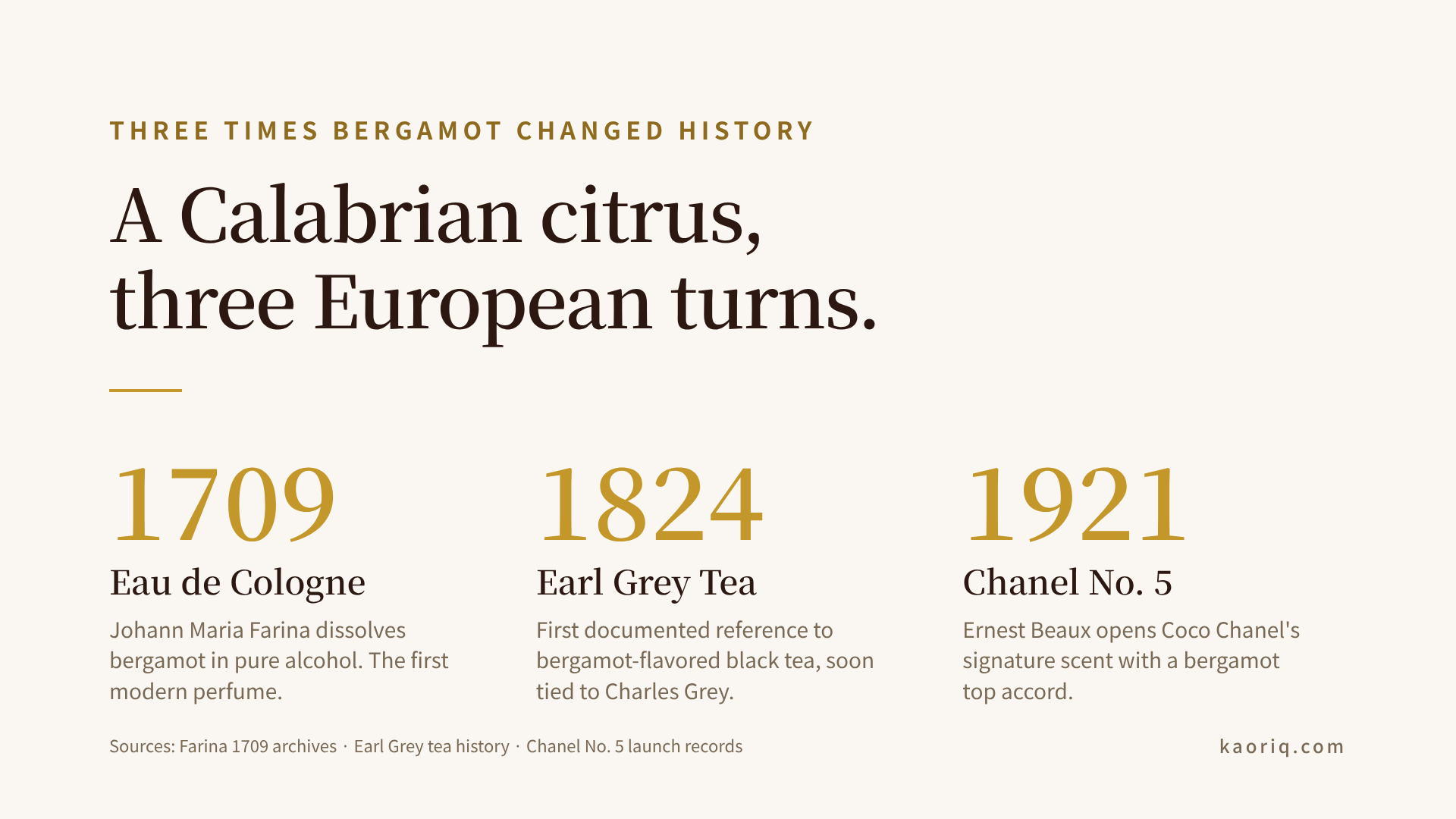
The moment bergamot enters the modern story is in Cologne, in 1709, when an Italian-born perfumer named Johann Maria Farina sat down and made something nobody had quite made before.
Farina had moved from northern Italy to Cologne, set up a perfume house, and become obsessed with the citrus oils of his home country. In a letter to his brother, he described what he was trying to capture: a fragrance that reminded him of “an Italian spring morning, of mountain narcissus, of orange blossoms just after the rain.” Whether he succeeded is impossible to verify across three centuries, but what he produced was structurally novel. He combined bergamot oil with neroli, lemon, and other citrus, dissolved them in a much higher grade of alcohol than was standard at the time, and named the result Eau de Cologne, the water of Cologne, after his adopted home.
It was the first modern perfume.
I do not use that phrase lightly. Almost every fragrance you have ever smelled, including the cheap drugstore body spray and the four-hundred-euro niche bottle, traces its structural logic back to what Farina did in that workshop. The “top notes / heart notes / base notes” idea, the use of alcohol as a carrier, the citrus-floral-woody triangle: these are, more or less, the Cologne template. And the engine of that template, the bright opening accord that announced the perfume the moment you uncorked it, was bergamot.
The European courts went, by all reasonable accounts, slightly insane for it. Emperor Charles VI bought it. The King of Prussia bought it. Napoleon, who took most of his fashion cues from his enemies, was reported to use approximately sixty bottles a month, dousing himself after bathing and pouring it over sugar cubes to eat. (I would like to remind you that this is a real historical figure, and that the sugar-cube thing is documented.) Farina 1709 still exists, in family hands, in the same building, still making the original formula. It is the oldest continuously operating perfume house in the world, and the entire enterprise was built on a single citrus from the wrong end of Italy.
The Tea That Stole the Spotlight
The second great story is in England, about a hundred and twenty years later.
Charles Grey, the second Earl Grey, was British Prime Minister in the early 1830s. (His political legacy is the Reform Act of 1832, which is to say he is the reason a certain number of British men, eventually, got the right to vote.) Somewhere along the way, his name became attached to a tea blend: black tea flavored with oil of bergamot.
The origin story is, charmingly, a disaster.
There are at least four competing legends. In one, a grateful Chinese mandarin sent the blend to Lord Grey after the Earl’s men rescued the mandarin’s son from drowning. That story falls apart on inspection, because Lord Grey never went to China, and bergamot tea was unknown there at the time. In another, the tea was specially blended for him by a Chinese mandarin to compensate for the heavy lime content in the water at Howick Hall, his family estate in Northumberland. In a third, Lady Grey served it as a political hostess in London, found it so popular that guests asked where to buy it, and licensed the recipe to Twinings.
The earliest documented reference to bergamot-flavored tea dates to 1824, six years before Lord Grey became Prime Minister. So at least one of the legends has the chronology wrong.
What is certain is that, by the late nineteenth century, the blend was sold worldwide under his name, and “Earl Grey” became the most identifiable bergamot product on earth. For a great many English-speaking people, the smell of bergamot is the smell of Earl Grey. They do not know it is a Calabrian fruit. They do not need to. They have been smelling Calabria, indirectly, with breakfast, for most of their lives.
(My personal favorite detail: bergamot tea is, by international convention, more closely associated with Britain than with Italy, which is roughly the equivalent of associating sushi with Norway. The flavor went on a journey.)
Chanel No. 5, May 5, 1921
The third great story is the one that codified bergamot’s role in modern perfumery for good.
In May 1921, in her boutique on the rue Cambon in Paris, Coco Chanel launched a perfume composed by a French-Russian chemist named Ernest Beaux. She had asked him for something specific and slightly impossible: a fragrance that smelled like a woman, not like a flower. The result was Chanel No. 5.
Beaux did several radical things in that bottle. He used aldehydes (synthetic organic compounds that had never been deployed at that intensity in commercial perfumery) to add a sparkling, almost soapy brightness at the top of the composition. He layered jasmine and rose absolutes in unprecedented concentrations. He let the base notes (sandalwood, vetiver, musk) run almost animalic underneath. The perfume was, by the standards of 1921, alarming.
But the first thing you smelled, before the aldehydes did their work and before the jasmine arrived, was a top accord built on bergamot, lemon, and neroli. The opening was Calabria. The reason it worked, the reason the whole towering, abstract composition above it did not feel hostile, was that the bergamot landed first: bright, cool, faintly floral, immediately familiar to the European nose because Eau de Cologne had been training it for two hundred years.
Beaux had grown up in Russia. He had spent the First World War as a lieutenant in the far north, in Arkhangelsk, where he later said the polar light and the smell of clean ice had inspired him. But the perfume he composed in Grasse, with Chanel watching, opened with a fruit from the warmest end of Italy. This is the strange geography of scent. The cold-air-of-the-north feeling of Chanel No. 5 starts, structurally, with a citrus that has never seen snow.
After 1921, the template was sealed. Open every perfume with bergamot. That is not literally true (modern perfumery is more varied than that), but as a default, as a safe choice, as the assumption a perfumer makes before deciding whether to do something different, the bergamot top has been the industry’s home key for a hundred years.
What You Smell, Once You Know
After learning all of this, I cannot smell Earl Grey the same way. I cannot smell my own desk candle the same way.
The bergamot in most homes is, almost certainly, not from a single hundred-kilometer strip of coastline. The bergamot in cheap candles is often partially synthetic, reconstructed from a handful of aroma-chemicals. But the idea of bergamot, the shape of the smell, the way it announces a fragrance as “clean and slightly bitter and faintly floral all at once,” is something the Calabrian growers gave to the world and that the world copied without quite understanding where it came from.
If you want to spend an evening with the real thing, look for an Italian-made room candle or diffuser that lists Bergamotto di Reggio Calabria explicitly. (PDO labels are common on bottle-grade oils but rarer on consumer fragranced products; when you see one, it usually means somebody paid real money for the raw material.) The character is subtle and worth paying attention to: cleaner than orange, less sour than lemon, with a faint coolness that you will not find anywhere else. It pairs naturally with quiet rooms in the morning, with the half-hour before a guest arrives, with summer evenings on a balcony when you want the air to feel awake.
(A confession: most of what I burn at home is not PDO-grade anything. Almost nobody’s is. The point is not to fetishize the label. The point is to know what you are reaching for when you reach for “citrus,” and to give the Calabrian coastline the small mental nod it deserves.)
A Hundred Kilometers of Coastline
I think about that strip of Ionian Sea sometimes. The orchards on the slopes. The growers picking by hand in January, before dawn, in cold weather, because the volatile compounds in the rind are most concentrated when the air is cool. The cold-presses crushing the rinds in the late morning. The pale-green oil drained into containers and shipped, in modest volumes, to Grasse and to Cologne and to factories everywhere else that pretend, every day, to bottle something from somewhere it is not.
A hundred kilometers of coast. Three hundred years of perfume. A fruit you cannot eat. A skin you cannot replace.
The next time you open a tin of Earl Grey, or uncork a bottle of cologne, or light a candle described as “citrus,” it is worth remembering: the brightness in the room came from a place. A real place. A specific, small, weather-particular place that the rest of the world has been quietly copying for centuries.
It turns out the label was right. Bergamot is a town, in the sense that any flavor with a strong enough origin eventually becomes one.
(If you want the science of why citrus oils have such a measurable effect on the nervous system, the actual neuroscience of what bergamot is doing inside your head when you smell it, I wrote about that recently in a piece on citrus and the brain, in Japanese. The story side, you have just read.)
Was this article helpful?