Powdery Home Fragrance Guide 2026: Orris, Violet, and Heliotrope for a Soft-Focus Room
The Candle That Makes a Bedroom Feel Like a Photograph
Powdery works best in the room that has never quite settled on a personality — small, over-lit, always slightly cold. Put a mid-tier violet candle on the dresser, wait twenty minutes, and walk back in.
The room had softened. Not warmed, exactly. It felt like a filter had been dropped over the corners, the way a portrait photographer bumps the fill light two stops and everything harsh in the frame dissolves. I sat down on the edge of the bed and thought, oh, this is what “powdery” means.
If you’ve read about powdery fragrance and gotten either “vintage grandmother” or “expensive iris” as your only landmarks, this guide is for you. Powdery is a small, quiet family with three main players, each behaving differently in a room. The trick is knowing which one flatters your space, and which ones will flatten it.
For the six-year-cellar backstory of why one of these notes costs more than gold, I wrote a longer piece here: The Iris Root That Hides in Every Luxury Fragrance. This guide is the practical follow-up: what to actually buy for your home.
Meet the Three Powdery Notes
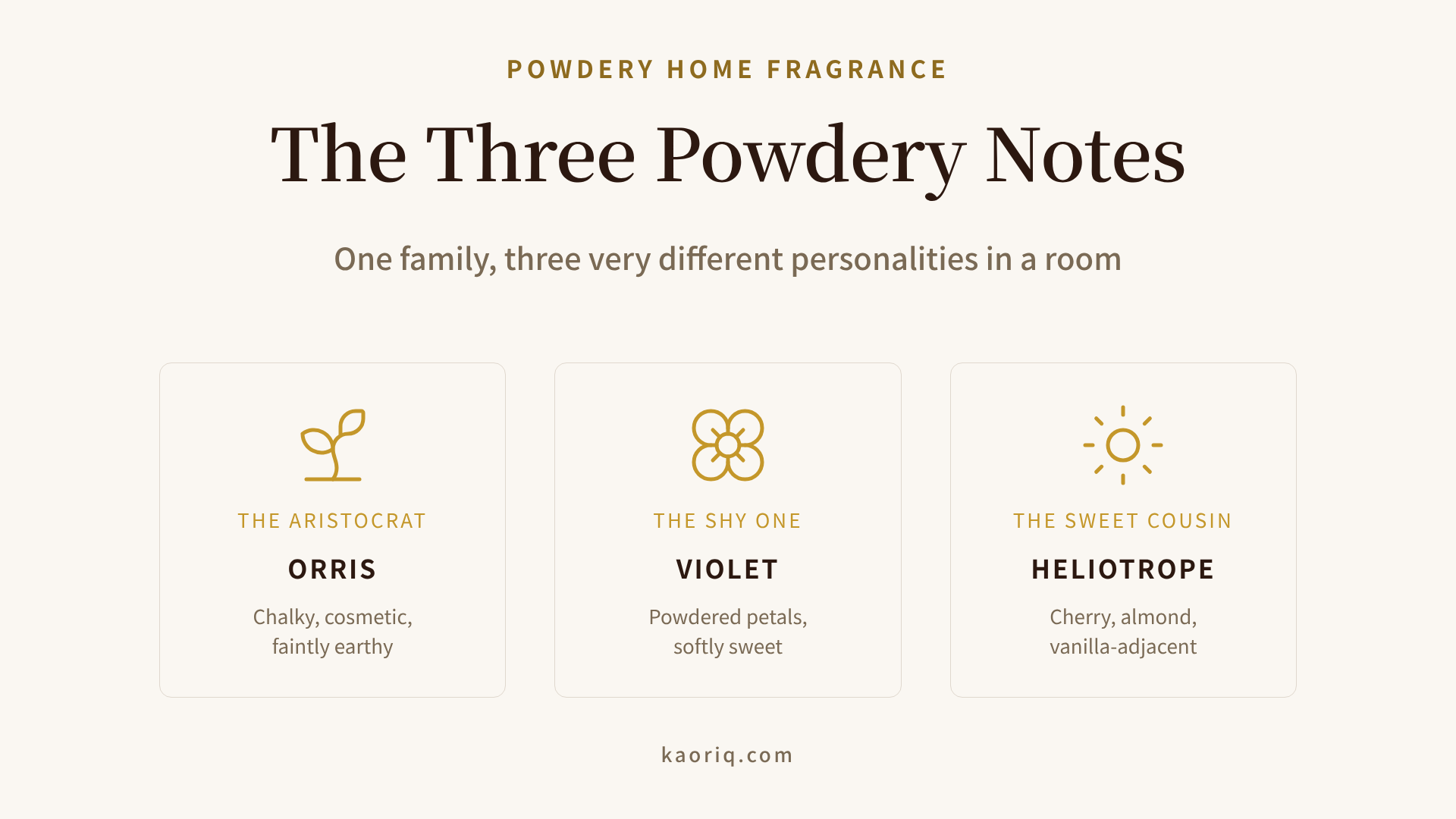
Powdery home fragrance almost always reduces to three ingredients, sometimes solo, more often blended. Each has a different character and a different price ceiling.
| Note | Smells Like | Cost Tier | Best Room |
|---|---|---|---|
| Orris (Iris root) | Chalky, cosmetic, faintly carrot, expensive suede | High to very high | Bedroom, dressing area, reading nook |
| Violet (Ionones) | Sweet-shy, powdered petals, faint blackberry leaf | Low to mid | Bedroom, guest room, small library |
| Heliotrope (Piperonal) | Cherry, almond, vanilla-adjacent, pillowy | Low | Nursery-adjacent rooms, guest bath, cozy corners |
If you’re only going to remember one thing about the group: orris is the aristocrat, violet is the shy one, heliotrope is the sweet one. Most rooms want exactly one of them at a time. Two together works occasionally; three together turns into a bath-shop candle and the room stops feeling composed.
Orris (Iris Root) — The Grown-Up Center
Orris is the dried, aged rhizome of Iris pallida, mostly grown in Tuscany, and it takes six years of underground and cellar time before it has a scent at all. That’s why it’s priced like a small emergency. In home fragrance it shows up as candles and reeds where iris is paired with sandalwood, violet, or amber. Powdery orris smells like the inside of a well-kept vintage handbag. It’s the note you can’t quite name in an expensive hotel lobby.
There are three separate faces of iris in home fragrance (powdery, rooty, and modern-bright). If you want to go deeper, the iris and orris home fragrance guide breaks all three down and matches them to personalities. For this guide, we’re staying in the powdery lane.
Violet (Ionones) — The Friendly Entry Point
The violet you smell in a candle is almost never actual violet flower absolute, because that material is priced somewhere between orris and platinum. It’s ionones, a family of aroma molecules that also occur naturally in violet flowers and iris root, produced synthetically at a fraction of the cost. They give you the powdery-sweet-slightly-berry character of a violet petal without the extraction bill.
In a room, violet reads younger and softer than orris. It’s the powdery note for people who find orris intimidating or too expensive to keep restocking. A violet-forward candle in a bedroom or a small library is one of the easiest ways to test whether powdery is your family without a $60 to $200 commitment.
Heliotrope (Piperonal) — The Sweet Cousin
Heliotrope in perfumery is a note built around piperonal, which smells like a cherry, an almond, and a vanilla wafer decided to share a body. It’s the powdery note closest to a gourmand, but with the powder still winning. In home fragrance it appears in candles and mists labeled things like “sugared violet,” “almond blossom,” or “meringue,” and it pairs well with vanilla, tonka, and iris.
Heliotrope is the powdery note that non-powdery people accidentally like. If you’ve ever loved a candle that seemed to smell like macarons in a drawer, that was probably heliotrope doing quiet work under the label. It’s the sweetest of the three, which makes it the riskiest in rooms that already have any sweetness (kitchens, dining rooms). Keep it to soft rooms.
Format Matrix: Candle, Reed, or Spray?
Each of the three notes behaves differently in each of the three formats. Choose by how the room actually gets used, not by which format looks best on a shelf.
| Format | Orris | Violet | Heliotrope |
|---|---|---|---|
| Candle | Excellent, needs slow burn | Good, warms up fast | Good, can turn cloying if left too long |
| Reed Diffuser | Excellent for continuous quiet | Good, one of the cheapest reed families to keep restocked | Fine, tends to fade faster |
| Room / Linen Spray | Weak (orris wants time to develop) | Excellent for a fast top-up | Excellent, especially on bedding |
A few practical rules that fall out of this:
- Bedrooms: violet reed or orris candle. Never both.
- Dressing areas / walk-in closets: violet spray on the shelves, not a candle (fire risk in a small space with fabric).
- Guest rooms: heliotrope candle or violet reed, whichever is easier to swap between guests.
- Home offices: orris reed if you want the “quiet luxury” register. Skip violet here, it can read juvenile in a work setting.
- Reading nooks: any of the three, matched to the mood of what you read there.
If you want the broader “candle vs reed vs spray vs plugin” breakdown before you commit, see Home Fragrance Formats Compared.
When Not to Use Powdery
Powdery notes fail in specific, predictable rooms. It’s worth knowing them before you buy.
- Kitchens. Powdery gets buried under cooking smells within a single meal. Use citrus or herbal notes here instead.
- Bathrooms with poor ventilation. Powdery in humid, still air turns claustrophobic. Reeds fare better than candles, but neither shines.
- Anywhere you use synthetic “linen” plug-ins. They cancel powdery out and you’ll blame the powdery.
- Kids’ bedrooms. Powdery reads as adult, in the same register as a wool coat or a leather bag. Save it for rooms adults sit still in.
There’s also a season problem worth flagging. Powdery notes fade in high humidity because the soft molecules that carry the scent get suppressed by heavy water vapor. In muggy July or a rainy September, a powdery reed diffuser can seem to have stopped working. It hasn’t. The air just isn’t letting it through. Switch to a spray during those weeks, or move the diffuser to a room with air conditioning, and the note comes back.
Pairing Rules That Work
Powdery notes are supporting actors. They lift what’s next to them and rarely lead alone. The pairings that consistently work in home format:
- Orris + Sandalwood. The safest, warmest combination. Creamy under, chalky over. Great in candles.
- Violet + Cassis or Blackcurrant. Slightly fruity, still soft. Works in guest rooms.
- Heliotrope + Vanilla + Tonka. Cozy, autumn-leaning, but read the room before deploying (too much and it’s a bakery).
- Orris + Rose. Vintage-hotel powder-room, in the best way.
- Violet + Iris (both). Doubles down on powder. Beautiful in a bedroom. Overwhelming in a kitchen.
Avoid: powdery + heavy amber (drowns the powder), powdery + aggressive citrus (contradicts it), powdery + gourmand caramel (turns into a candle-shop clearance bin). Powdery needs quiet neighbors.
Bottom Line
Buy a small violet candle first, in a bedroom or a guest room, and see whether powdery is a family you want to keep in the house. If yes, graduate to an orris reed diffuser in a room you sit still in (reading nook, home office, dressing area). Save heliotrope for the third slot when you want something soft and slightly sweet, like a cozy corner of the living room in winter.
Skip powdery entirely in kitchens, humid bathrooms, and kids’ rooms. Rotate to something juicier in high summer if the note seems to have vanished; it’ll come back in the fall.
If you enjoyed this and want the origin story of the most expensive note in the group, that’s here. For the full map of iris in perfumery (the iconic fragrances, the three forms of the raw material), see the pillar guide: Every Orris in Perfumery. And if you’ve bounced off florals before but suspect powdery might be your way in, start with Iris Fragrance for People Who Don’t Like Florals.
For the home. Not for the skin.
Frequently asked questions
- What does 'powdery' actually smell like in a home fragrance?
- Powdery describes a soft, chalky, faintly cosmetic smell that reads like an old dressing table rather than a bouquet. Think loose face powder, warm suede gloves, and violet petals sitting close together in a drawer. It's the opposite of sharp or juicy. In home fragrance, powdery notes make a room feel hushed and slightly older, in the good sense of a well-kept apartment.
- Powdery vs floral, what's the actual difference?
- Floral fragrances present the whole flower, petals and pollen and green stems, and they usually feel wet or living. Powdery fragrances present the *dry* side of a flower, the pressed petal in a book rather than the fresh cut stem. Orris and violet are both flowers, but in home fragrance form they read powdery because the extraction methods strip out the fresh notes and leave the soft ones behind.
- Which powdery note should I start with at home?
- Start with violet. It's the cheapest of the three (heliotrope is close behind), the most beginner-friendly, and it plays well in bedrooms and dressing areas without needing a $200 candle to prove itself. If you love violet after a month, you're ready to graduate to orris. Save heliotrope for when you want a slightly sweeter, cherry-almond version of the same soft-focus feeling.
Was this article helpful?