Wax Melts vs. Candles: The Flameless Home Fragrance That Lasts Longer (and Costs Less to Run)
The $40 Candle Nobody Is Brave Enough to Actually Burn
You know the one. The heavy glass jar, the scent that smells like a more organized version of your life, the price tag justified by calling it “self-care.” It gets home and then… rationed. Lit for ten guilty minutes on special occasions, blown out the second the doorbell rings, the wax barely moving for six months. That isn’t using a candle. That’s guarding it.
If you’ve ever treated a candle like a small, flammable family heirloom, this one’s for you. Because there’s a whole other way to fill a room with scent, no flame, no guilt, and often less money: wax melts. The question everyone actually types into a search bar is, “Are wax melts better than candles?” The honest answer is the most annoying one: it depends on how you live. So let’s figure out which is your one.
First, What Even Is a Wax Melt?
Quick definition, because the word trips people up. A wax melt is a small, wickless cube (or shaped piece) of scented wax. You don’t light it. You drop it into a warmer, a little dish that heats the wax from below, and as the wax melts it releases the fragrance into the air. When the scent fades, you swap in a fresh cube and pop out the old one.
There are two kinds of warmer, and the difference matters:
- Electric warmer: a heating element gently melts the wax. No flame at all. The flameless choice for homes with pets, kids, or a strict lease.
- Tealight warmer: a small tea light candle underneath does the heating. Prettier glow, but it does involve a tiny open flame, so it’s not truly flameless.
For this guide, when I say “wax melts beat candles on safety,” I mean the electric warmer version. That’s the real no-flame option.
The Six Things That Actually Decide It
Forget which one photographs better on a shelf. When you’re choosing, only six things matter.
1. Scent throw: how strongly it fills the room
Here’s the plot twist that surprises people: wax melts can throw scent harder than candles. Because the warmer melts a wider pool of wax without burning anything off, you often get a stronger, faster hit of fragrance, and you can use more than one cube at once if you want to crank it up.
But the real secret isn’t the format at all. It’s fragrance load, the percentage of actual scent oil in the wax. Paraffin holds roughly 10–12% fragrance oil; soy tends to hold 6–10% before it stops performing well. So a generously scented melt can out-throw a weakly scented candle and vice versa. The takeaway: don’t assume “candle = stronger.” Read the product label, because the format alone won’t tell you.
2. Safety: flame, soot, pets, kids
This is where electric wax melts pull clearly ahead. No flame means no fire risk, the single biggest reason people switch. There’s also no soot or smoke, since nothing is combusting, which makes for cleaner air and cleaner walls. For curious toddlers, tail-knocking cats, and landlords with a “no open flame” clause, a flameless warmer is just the lower-stress choice.
A candle, by contrast, sells you the open flame as a feature, the flicker, the ritual, and for many people that’s worth the supervision. It’s perfectly safe with a bit of attention. It just asks you to actually be in the room.
3. Cost over time
This is the quiet win for melts. A single cube typically gives 6 to 12 hours of scent (premium ones stretch toward 20), and a multi-cube pack can run for weeks. Compared to a candle in the same price bracket, which might give you a few dozen hours total before the jar’s done, melts usually come out cheaper per hour of scent. Think in cost-per-month, not cost-per-purchase, and the wickless cubes tend to win.
4. Maintenance: how much it asks of you
Candles are needier than they look: trim the wick, watch for tunneling, supervise the burn, never leave it unattended. (We wrote a whole first-burn ritual guide precisely because candles punish neglect.) Wax melts are refreshingly low-effort: no wick to trim, nothing to babysit. When the scent fades you scoop out the cooled wax and drop in a new cube. That’s the entire chore.
5. Atmosphere: the part melts can’t fake
Let’s be fair to candles, because here they win outright. You cannot melt a mood. The flicker of a real flame, the soft pool of light, the small ceremony of striking a match on a Friday night, no electric warmer reproduces that. If the ritual is the point, if you want ambiance layered over scent, a candle is doing a job a melt simply can’t.
6. Renters, pets, and small kids
If your situation includes any of “I rent,” “I have animals,” or “there’s a toddler,” flameless wins by default. An electric warmer placed up high, out of paw and hand reach, gives you scent without the fire-code anxiety. (More on the no-flame life in our renter’s guide to flameless scent.)
The Cheat Sheet
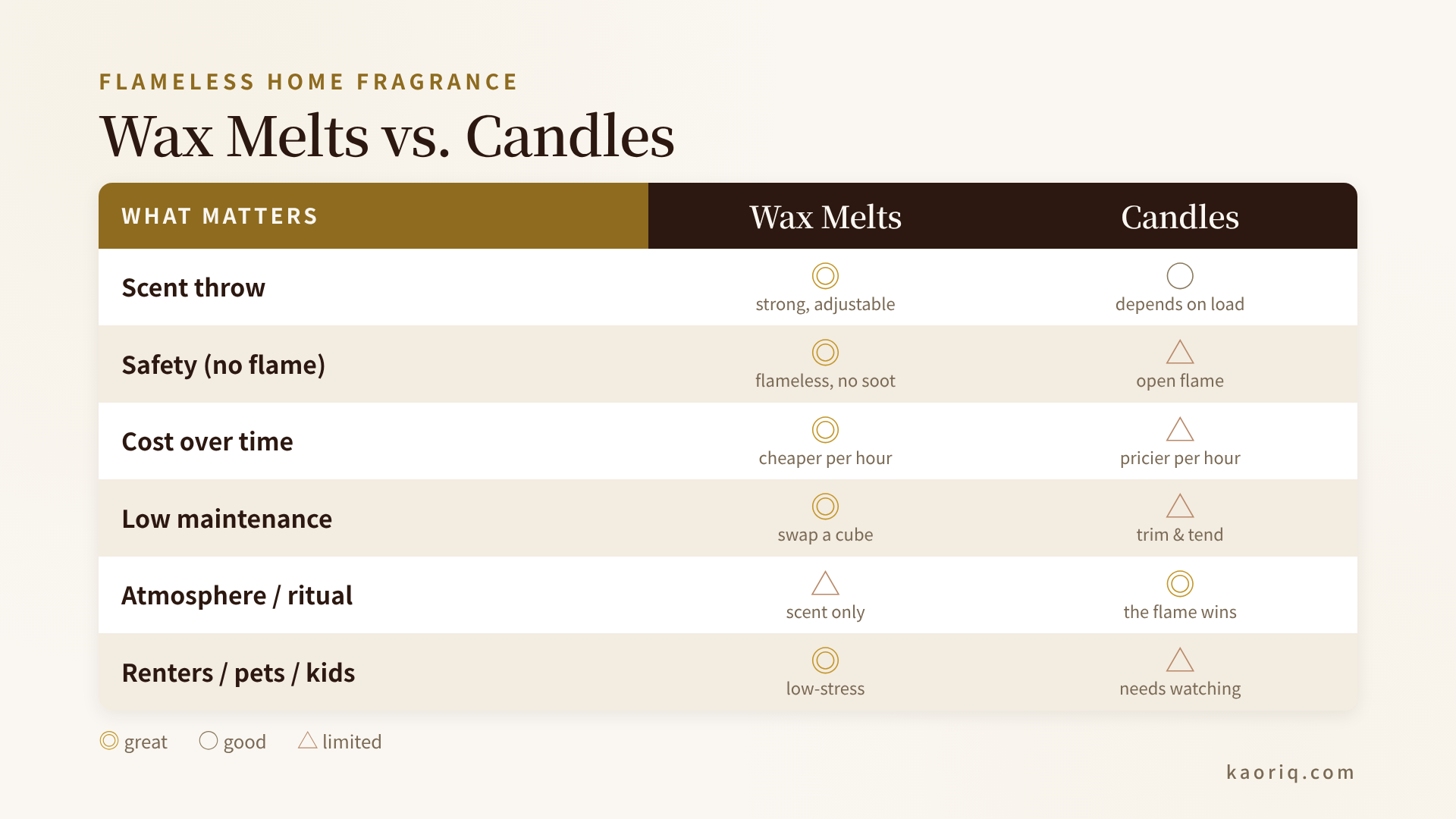
Screenshot this and send it to the friend who’s overthinking it in the home-goods aisle:
| Wax Melts (electric warmer) | Candles | |
|---|---|---|
| Scent throw | ◎ strong, fast, adjustable | ○ good, depends on load |
| Safety (flame) | ◎ flameless, no soot | △ open flame |
| Cost over time | ◎ cheaper per hour | △ pricier per hour |
| Low maintenance | ◎ swap a cube | △ trim, watch, tend |
| Atmosphere / ritual | △ scent only | ◎ the flame wins |
| Renters / pets / kids | ◎ low-stress | △ needs supervision |
◎ great ・ ○ good ・ △ limited
A Word on Pets (Read This Before You Buy Anything)
Flameless is safer, but “flameless” isn’t the same as “anything goes.” Cats in particular are sensitive: they lack a liver enzyme that helps process certain compounds, so some essential oils (tea tree, eucalyptus, citrus, pine, cinnamon, and others) can be a problem in a home with animals. Fragrance oils are generally gentler, but the smart habits are the same either way: keep the warmer up high and out of reach, give the room good ventilation, and if anyone in the house has fur, read our pet-friendly home fragrance guide before you commit. As with everything here, these are scents for your space, the air and the room, never for your skin.
So, Which One Is You?
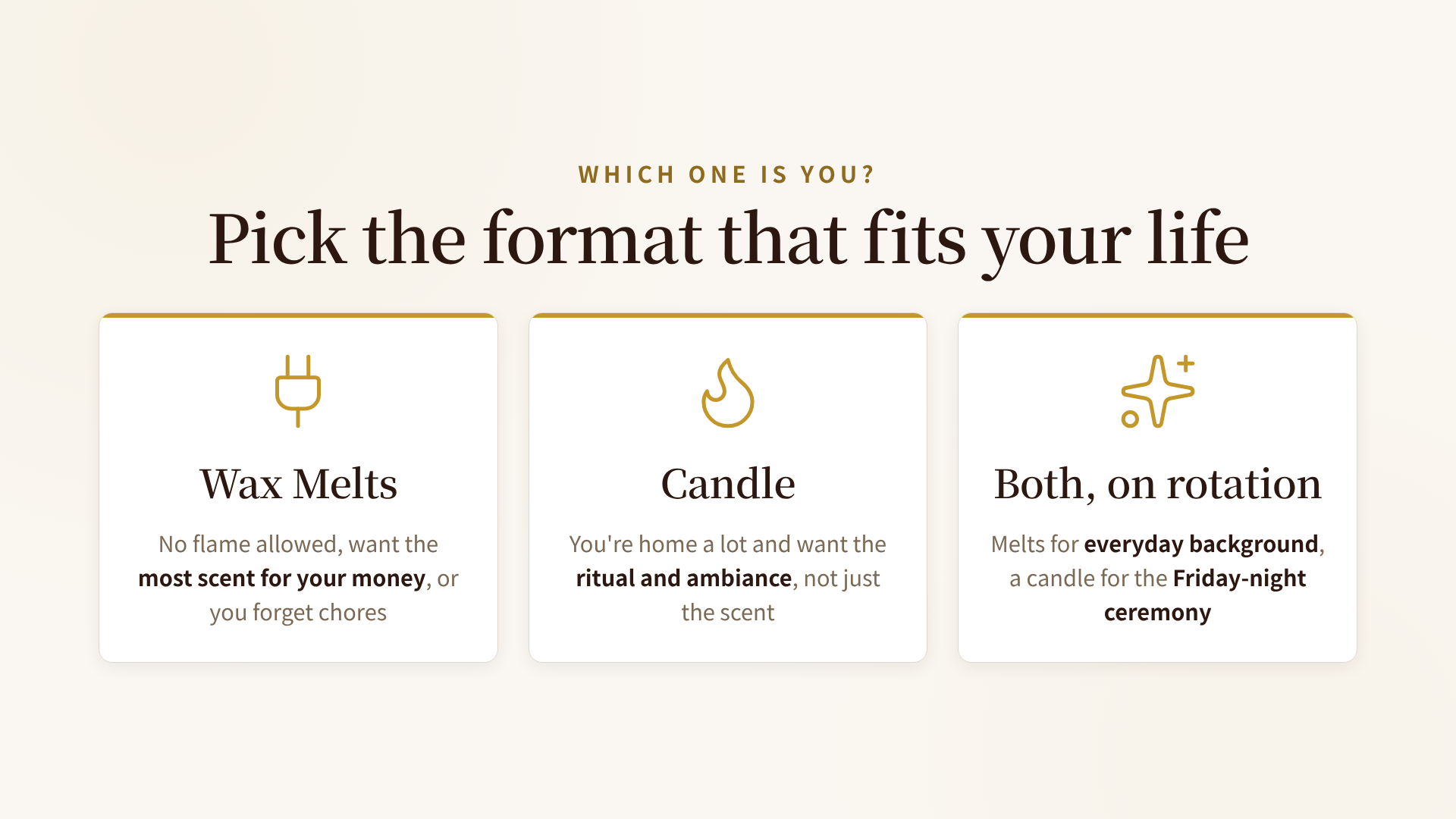
Here’s the shortcut. Match the format to your actual life, not your fantasy of who you’d like to be:
- You can’t use a flame (lease, dorm, pets, kids) → Wax melts, electric warmer. Full scent, zero fire.
- You want the most scent for your money → Wax melts. Cheaper per hour, easy to swap.
- You forget things and hate chores → Wax melts. Nothing to trim or supervise.
- You’re home a lot and love the ritual → Candle. You’ll be there to enjoy the flame, and the flame is half the point.
- You want ambiance on top of scent → Candle. A warmer can’t flicker.
- You honestly want both → Have both. Melts for everyday background scent, a candle for the Friday-night ceremony. Treat them as a rotation, and each one does what it’s best at.
The Part Trends Don’t Cover
Every “best of 2026” list will tell you warm vanilla is still winning and fresh citrus is the safe gift. Useful, but it skips the real question: a scent that soothes one person makes another restless. The format is the how; the scent that makes a room feel like yours is the who. A homebody who recharges in quiet wants something different on the warmer than a host who scents the room for guests.
That’s the part we actually care about here. If you’re not sure where to start, find your fragrance family first, then read why personality predicts fragrance preference better than trends. Pick the format that survives your real schedule, then pick the scent that fits the person living there.
The resolution, usually, is an electric warmer, the $40 candle retired to permanent display, and a home that smells lovely on a random Tuesday for the first time in its life. Turns out the secret to enjoying a beautiful scent was, simply, being allowed to use it.
Sources: CandleScience wax guide, Blended Waxes on scent throw, ScentSationals on wax melt longevity, Seventh Avenue Apothecary on pet safety.
Was this article helpful?