How to Choose a Welcome Fragrance for Your Entryway: The First Scent Anyone Knows About Your Home
When the First Thing Your Apartment Says to a Guest Is “Garlic”
Say you cooked the night before. Pasta with way too much garlic, the kind of dinner you only make alone because you don’t want to talk to anyone for twelve hours afterward. You ventilated. You took out the trash. You lit a candle in the living room.
What you have not done is scent the entryway.
Your guest walks in, pauses, does the polite thing of pretending not to notice — and you spend the rest of the evening hyper-aware that the first sentence your home ever spoke to them was Italian leftovers, two days old.
This is the part nobody warns you about with home fragrance: the room you spend the least time in is the one everyone else experiences first. The entryway is the only space in your house that’s actively working when you’re not home, holding the lingering smell of last night’s dinner, your shoes, your coat, the building’s hallway. And the moment a guest crosses your threshold, that smell is the headline.
So here’s a guide to writing a better headline.
Why Entryways Need Their Own Fragrance Logic
Your living room scent has a hard job: be pleasant for hours while you sit in it. Your entryway scent has a different job: make a first impression in about four seconds, then disappear before anyone notices the disappearance.
Three things flip the rules.
1. People only stand there briefly. Guests pass through in seconds. You walk in after work and keep moving. Nobody adapts to the smell, which means top notes, usually the first to fade, are the most important part. In a living room, top notes are the show; in an entryway, they are the fragrance.
2. The space cycles air constantly. Doors open. Hallway air pours in. Outside air follows. The fragrance has to keep arriving in small, continuous doses. That favours formats with continuous, low-volume output over big “moments.”
3. It has to overpower competing inputs. Shoes. Coats from the rain. The faint chemistry of whatever your building does to its hallways. Your entryway scent is in a constant competition, and the assumption that “subtle” is always classier breaks down fast.
This gets learned slowly, and expensively. Below is the version worth having before the garlic night.
The Format Question: What Actually Works at the Door
Before scent, format. The wrong format in an entryway is just expensive air.
| Format | Entryway Suitability | Why |
|---|---|---|
| Reed diffuser | ◎ | Continuous low-output. No flame. Survives the door opening. The default answer. |
| Plug-in diffuser | ◎ | Set-and-forget. Works in rentals where candles are forbidden. Good for guests. |
| Incense (short stick) | ○ | Strong opening impression, but only when you light it. Best for “guest is arriving in 20 minutes” mode. |
| Single-wick candle | △ | Lovely when lit, dead when not. Most of the time you’re at work, so most of the time it’s nothing. |
| Room spray | △ | Great for emergencies (the garlic moment). Useless as a baseline. |
| Nebulizer diffuser | ✕ | Designed for big rooms. Will overpower anyone within three feet of your door. |
The honest answer for most people is: a reed diffuser as your baseline, plus a room spray for the moments you need to reset things in a hurry. Everything else is a bonus.
Four Scenarios, Four Welcome Scents
This is where most generic advice falls apart, because “the right scent for your entryway” depends entirely on what your entryway is for. Here’s how I’d split it.
1. The “Guests Are Coming” Entryway
You want polish without performance. The scent should read as “this person has their life together” without screaming any single note.
Try: Soft white florals (jasmine, neroli, magnolia) blended with a touch of clean musk. Or a warm, low-key amber with a hint of citrus on top.
Avoid: Heavy ouds, smoky incenses, anything that says “I have opinions about scent.” Save those for the living room, where guests have already committed to being there.
2. The “I Just Want to Come Home” Entryway
This one is for you alone. The scent has to do emotional work: signal that you’ve crossed from the outside world into your own.
Try: Cedarwood, sandalwood, or fig: the warm, slightly resinous notes that feel like exhaling. A soft tea note (think bergamot + black tea) works for early evening.
Avoid: Anything bright and energising. You don’t want to walk in at 8 PM and feel like it’s 8 AM.
3. The “Family Lives Here” Entryway
Pets, kids, varying sensitivities, and people who track in actual mud. You need something that reads as clean and reassuring without being either floral-perfumey or clinical.
Try: Mandarin and basil. Linen-and-cotton accords. Soft lavender (the herbaceous kind that actually smells like the plant, the one that doesn’t make you think of bathroom cleaner). Mid-strength only. A high-throw fragrance plus a four-year-old plus a wet labrador equals headache.
Avoid: Strong essential oil blends with eucalyptus or tea tree if pets, especially cats, frequent the entryway. Some of these are not pet-safe in concentrated form. When in doubt, choose a finished room fragrance product (a candle or reed diffuser designed for indoor use) over a DIY essential oil setup.
4. The “Tiny Apartment, No Window” Entryway
You don’t really have an entryway. You have a pinch point between the door and the rest of the room. Whatever you scent here will dominate everything within three meters.
Try: Light teas, soft greens (mint, fig leaf), or a mild green floral. Volume turned all the way down: fewer reeds in your diffuser, lighter concentration in your spray.
Avoid: Anything heady or sweet. Vanillas and gourmand notes pile up in small spaces and turn from “warm welcome” into “candy shop in a hot car.”
The Personality Layer
Here’s where it gets interesting, and where kaoriq’s whole “scent matches who you are” thing earns its keep.
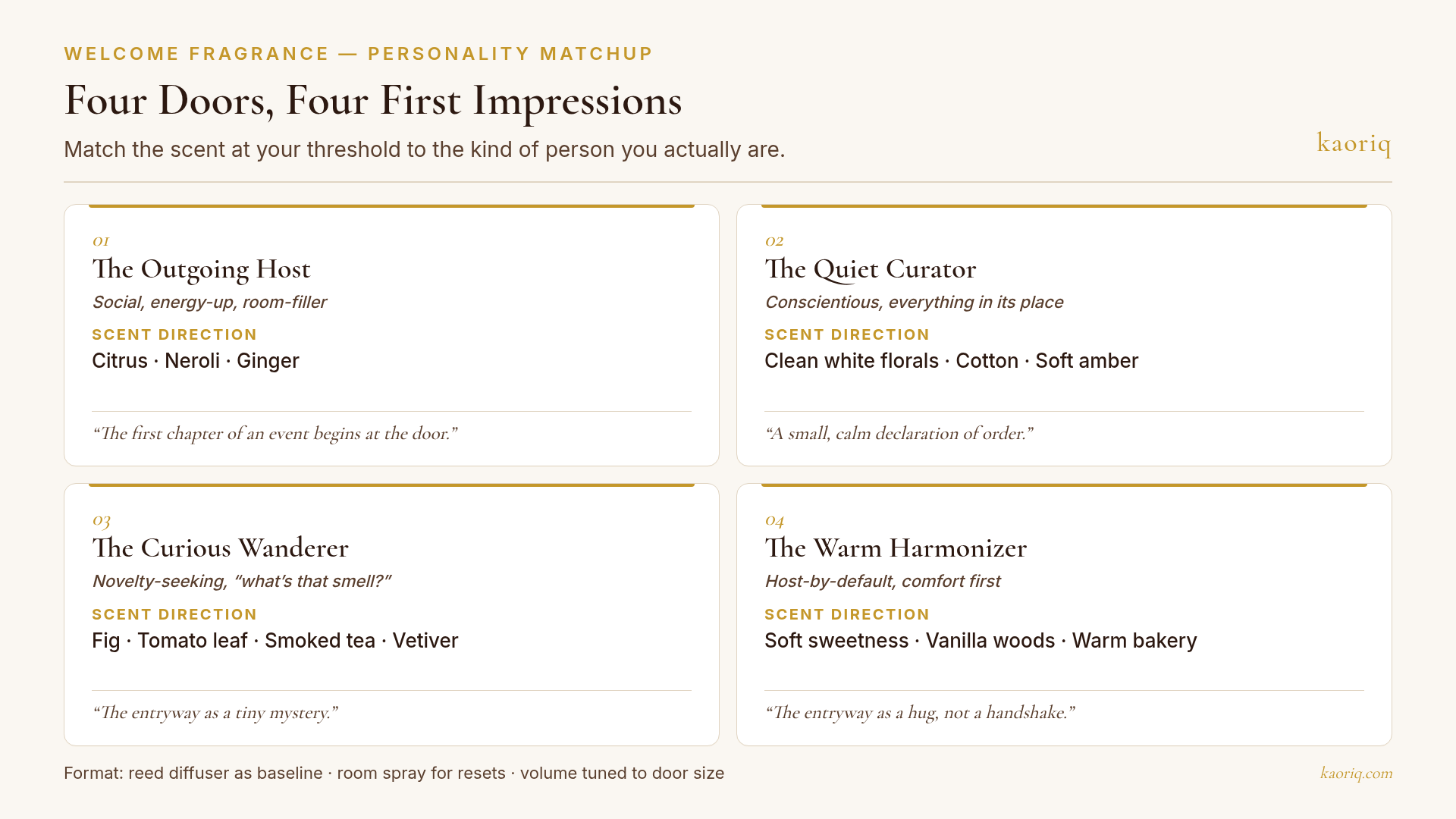
The four scenarios above tell you what the room needs. Personality tells you which version of that you’ll actually love. Roughly:
- Outgoing, social, energy-up types: Bright top notes that announce themselves. Citrus, neroli, ginger. The entryway becomes the first chapter of an event.
- Quietly conscientious, “everything in its place” types: Clean white florals, cotton, soft amber. The entryway as a small, calm declaration of order.
- Curious, novelty-seeking, “what’s that smell?” types: Unusual notes like fig, tomato leaf, smoked tea, vetiver. The entryway as a tiny mystery.
- Warm, harmony-seeking, host-by-default types: Soft sweetness, vanilla-adjacent woods, baked-bread-but-not-literally accords. The entryway as a hug.
If you’ve taken any version of a Big Five or similar personality test, you can probably spot yourself here in seconds. If you haven’t, our why personality predicts fragrance preferences piece is the deeper version of this argument.
The Cheat Sheet
Screenshot this part if nothing else:
| Situation | Format | Scent Direction |
|---|---|---|
| Default baseline | Reed diffuser | Soft amber + citrus, or cedar + tea |
| Hosting tonight | Above + room spray 20 min before | White florals or warm amber |
| Coming home tired | Reed diffuser only | Cedar, fig, sandalwood |
| Kids and pets | Plug-in or finished candle | Linen, soft lavender, mandarin |
| Tiny shared apartment | 3-4 reeds (not 8) | Green tea, mint-green floral |
| The garlic emergency | Room spray | Whatever you have, opened immediately |
What I Wish I’d Known Before the First Date
Two things, for the record.
One: an entryway scent doesn’t have to be expensive to be correct. A $30 reed diffuser placed well will do more than a $90 candle that’s only lit on weekends. The discipline is matching the format to a space that runs on its own.
Two: the smell your home greets people with says more about how you live than the art on your walls. It’s the only sensory choice that works while you’re at the office, asleep, or just out picking up groceries. Treating it as decoration, something you set up once and let do its quiet job, is a more flattering frame than treating it as a performance.
If you’re not sure which direction matches you, take our personality-based scent quiz and let the matching do the work. And if you’re between the “guests are coming” and “I just want to come home” entryways: pick the second one. Your friends will forgive a slightly underdressed door. You won’t forgive the door that greets you with anything other than relief.
Mine, for what it’s worth, is now cedar and bergamot. The garlic is long gone, and the apartment introduces itself politely. Most evenings, that’s all I’m asking of it.
Was this article helpful?