Why Bedrooms Need a Different Kind of Fragrance: A Practical Guide to Sleep-Friendly Scents
The “Sleep Candle” That Makes You Want to Re-Alphabetise a Bookshelf
It was lavender, of course. It’s always lavender. The packaging promised “deep restorative rest” in a font that probably costs $400 a year. Light it half an hour before bed and you expect to drift off into a documentary about a Swedish forest.
What actually happens: you lie awake for an hour, hyper-aware of the candle smell, then get up to re-organise a bookshelf because the lavender is, somehow, making you feel productive. The candle isn’t broken. You aren’t broken. The match between the scent and the job is wrong.
This is the part nobody warns you about with bedroom fragrance: a room scent that smells lovely in a shop, or in someone else’s living room, can turn into a tiny background irritation when your goal is “stop thinking and fall asleep.” The bedroom is the one room in your house with a function, and most fragrance advice forgets that.
So here’s a guide written from the function side first, smell second.
What Makes a Bedroom Scent “Sleep-Friendly”
Three things separate a sleep-friendly room scent from a generic nice-smelling one.
1. It’s quiet, not loud. A bedroom scent has to compete with you trying to switch off, and it loses if it’s too assertive. The best sleep-friendly scents have what perfumers call low sillage: they sit close, they don’t announce themselves. A candle or diffuser that fills your living room is often too much for the same square footage in a bedroom, because you’re not moving around to dilute the experience.
2. It survives olfactory adaptation. Your brain stops registering most steady smells after about 15-20 minutes. That’s actually a feature in a bedroom: you don’t want to be aware of the scent at hour two. But it means the impressive top notes you smelled at the store are mostly irrelevant. What matters is the base note, the part that lingers and quietly does its job while your conscious nose has clocked out.
3. It calms more than it stimulates. Some lovely fragrances are subtly energising: bright citrus tops, peppermint, eucalyptus, certain green florals. Wonderful in a bathroom at 7 AM. A nightmare on your nightstand at 11 PM. A bedroom scent should slow your physiology, not nudge it the other way.
You’ll notice none of this is about how the scent smells in the abstract. It’s about what it does in a room where you’re trying to stop thinking.
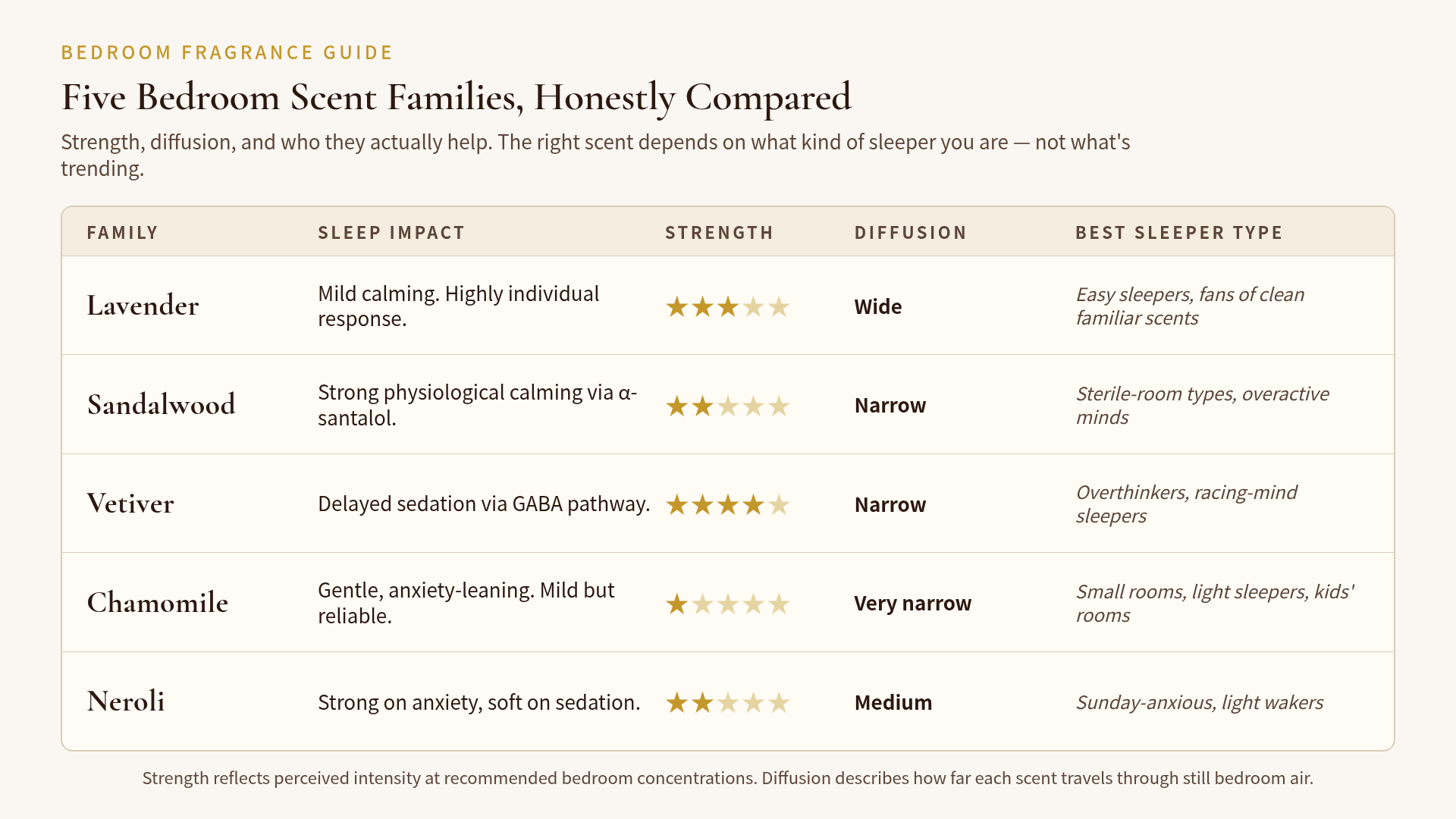
The Five Bedroom Fragrance Families
These are the scent families that actually earn their place on a nightstand. I’ve ranked them not by popularity but by how forgiving they are of common mistakes.
Lavender: The Default That Doesn’t Work for Everyone
Lavender is the most-recommended sleep scent in the Western world, and the science behind it is real but smaller than the marketing suggests. Studies have shown reduced heart rate and increased slow-wave sleep with lavender exposure, particularly with linalool, one of its main aroma compounds. But (and this is the bit nobody tells you) the response is highly individual. About one in four people find lavender mildly stimulating, not calming, especially if they associate the smell with cleaning products or a relative they didn’t get on with. Lavender also adapts fast: your nose tunes it out within twenty minutes, sometimes less.
Best for: People who already enjoy the smell and don’t have strong negative associations. A safe starter scent.
Watch out for: Cheap synthetic lavender oils. They tend to lean sharp and “laundry-bright” rather than the soft, herbaceous version that actually helps you wind down. If lavender smells like a public restroom to you, you’ve been buying the wrong one.
Sandalwood: The Quiet One That Actually Sedates
Sandalwood is where the research gets genuinely interesting. The active compound is α-santalol (alpha-santalol), and rat studies on sleep-disturbed animals showed it significantly decreased total waking time and increased non-REM sleep when inhaled. The mechanism is unusual: santalol may travel via the bloodstream rather than the olfactory nerve, which means the calming effect doesn’t depend on you consciously enjoying the scent. That’s rare.
In practice, sandalwood is a soft, creamy, slightly sweet wood. It has almost no top notes: it just sits there, gently. It survives olfactory adaptation better than lavender because the experience isn’t supposed to be loud in the first place.
Best for: People whose bedrooms feel sterile or “empty,” or whose sleep problem is “my mind won’t shut up.” Pairs naturally with low light and warm fabrics.
Watch out for: True East Indian sandalwood is endangered and expensive. Many products labelled “sandalwood” use Australian sandalwood or synthetic santalol, which are perfectly fine but smell different (drier, less creamy). Read the ingredients.
Vetiver: The Paradoxical Calmer
Vetiver does something strange. EEG studies in humans show it briefly increases alertness in the first few minutes, then shifts toward sedation, with measurable improvements in sleep quality and fewer night wakings after about four weeks of nightly use before bed. There’s also evidence it raises GABA levels in the brain, the same neurotransmitter system targeted by anti-anxiety medication.
That short alertness window is why vetiver is good for what I call the “racing mind” sleeper. It doesn’t try to bypass your overthinking; it gives your brain something rich and earthy to land on, then pulls you down once you’ve stopped resisting.
Best for: Overthinkers, people who lie awake replaying conversations, anyone who finds floral or sweet scents annoying at bedtime.
Watch out for: Vetiver is intense. It’s a deep, smoky, root-like scent that some people experience as “wet basement.” Sniff it before committing to a bedside diffuser bottle.
Chamomile: The Gentle Specialist
Roman chamomile (different from the chamomile in your tea, which is German) has a soft, slightly fruity, hay-like profile. It’s mild (almost too mild for a 20 m² bedroom), but in a small room, or used as a pillow mist, it works exactly the way the marketing promises. Studies on chamomile have generally focused on the tea, but inhalation studies show modest reductions in self-reported anxiety and improved sleep onset.
Best for: Small bedrooms (under 12 m²). Children’s rooms (with a parent’s supervision and very low concentration). People who want “barely there.”
Watch out for: People with daisy-family allergies, since chamomile can trigger them. And don’t expect chamomile to perform in a large airy room; it’ll just disappear.
Neroli: The Anxiety Specialist
Neroli is the oil distilled from bitter orange blossom. It’s the only citrus-adjacent scent that genuinely belongs in a bedroom, because the floral side dominates and the citrus side is so soft it doesn’t lean energising. Studies in pre-surgical patients have shown reduced anxiety scores after neroli inhalation, and it’s commonly used in clinical anxiety reduction protocols.
If your sleep problem is really an anxiety problem dressed up as a sleep problem, neroli is the one to try. It’s bright enough to lift the suffocating heaviness some people feel at night, but soft enough that it doesn’t keep you awake.
Best for: Anxious sleepers, people whose insomnia is worse on Sunday nights, anyone who finds heavy woods oppressive.
Watch out for: Cost. Real neroli is one of the most expensive natural materials in perfumery. A lot of “neroli” pillow mists are mostly synthetic petitgrain (a cheaper relative), which smells similar but greener and less complex.
The Cheat Sheet
For when you don’t want to read all of that twice:
| Family | Sleep Impact | Strength | Diffusion | Best Sleeper Type |
|---|---|---|---|---|
| Lavender | Mild calming (high individual variation) | ★★★ | Wide | Easy sleepers, fans of clean scents |
| Sandalwood | Strong, physiological calming | ★★ | Narrow | Sterile-room types, overactive minds |
| Vetiver | Delayed sedation via GABA | ★★★★ | Narrow | Overthinkers, racing-mind sleepers |
| Chamomile | Gentle, anxiety-leaning | ★ | Very narrow | Small rooms, light sleepers |
| Neroli | Strong on anxiety, soft on sedation | ★★ | Medium | Sunday-night-anxious, light wakers |
The single biggest mistake is reaching for lavender first because it’s familiar. If lavender hasn’t worked for you in three or four serious tries, it probably never will. Move on.
Format: This Is Where People Mess Up
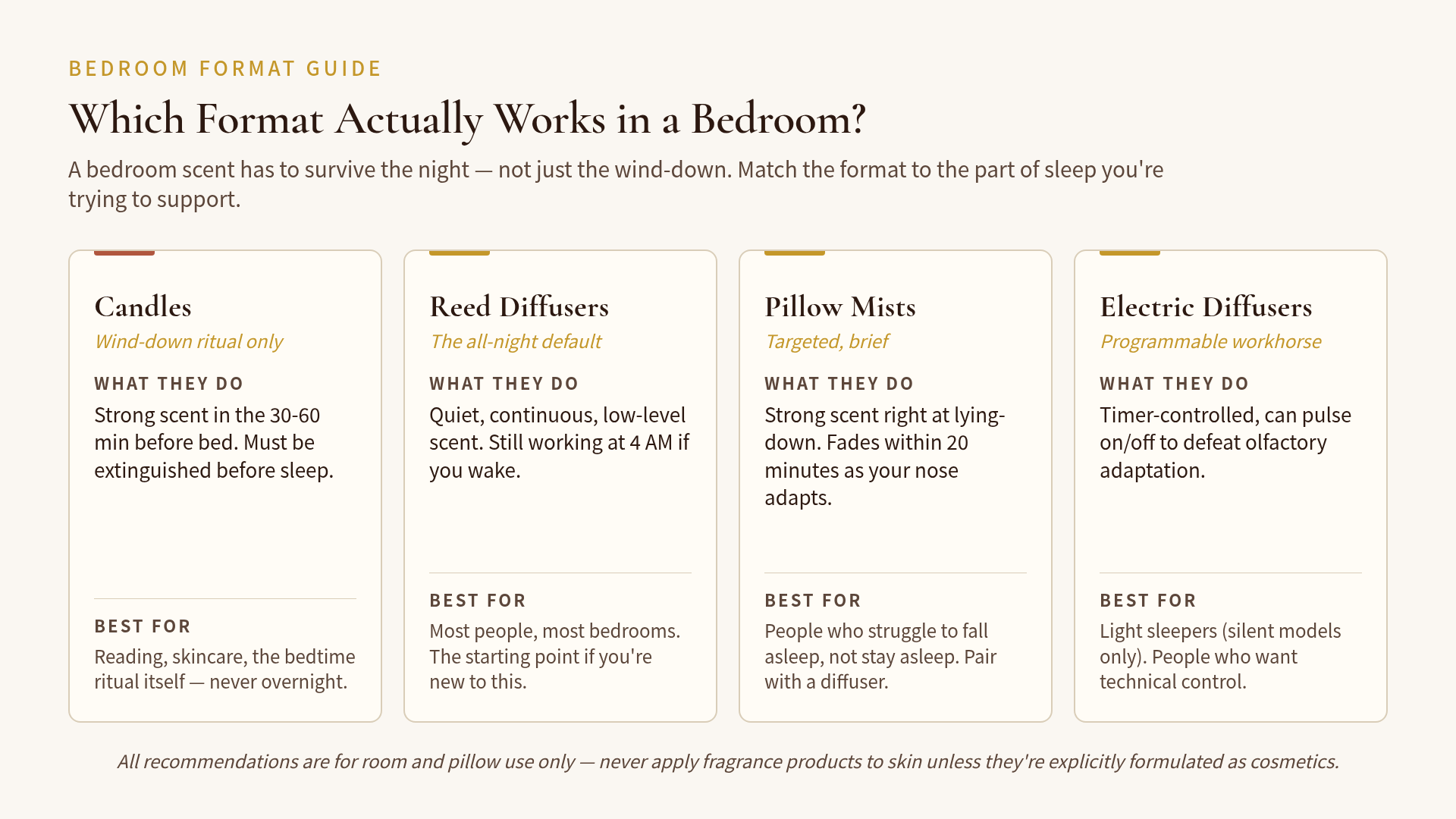
The right scent in the wrong format is, somehow, worse than the wrong scent in any format. Here’s the honest comparison.
Candles: The One You Probably Shouldn’t Use in a Bedroom
I love candles. I have a candle problem. And I’m telling you: candles are the worst format for a bedroom, for two reasons.
First, the obvious one: fire. You shouldn’t burn a candle while you sleep, full stop. So the candle has to do its job in the 30-60 minute window before bed, and then you blow it out, and then the scent fades fast. You’re paying premium prices for a brief experience.
Second, candles encourage you to “front-load” the scent. You light it, the room fills, you go to bed, your nose has already adapted, the candle is out, and by 1 AM there’s nothing left to support a 3 AM wake-up. The scent isn’t there when you actually need it.
Use candles in the bedroom only as a wind-down ritual: lit while you read or do skincare, then blown out before you get into bed. Don’t expect them to support sleep through the night.
Reed Diffusers: The Solid All-Nighter
Reed diffusers are passive: no flame, no electricity, no buttons. They release scent slowly and consistently for weeks. For a bedroom, that’s exactly what you want: a quiet, continuous low-level scent that’s still working at 4 AM if you wake up.
The catch is they’re gentle, so the room size matters. A standard 100ml diffuser with 5-7 reeds works well in a bedroom up to 15 m². In a larger space, double up rather than upsizing: two small diffusers placed apart cover the room better than one big one in a corner.
Best for: Most people. Most bedrooms. The default I’d recommend if you’re starting fresh.
Pillow Mists: The Targeted Tool
A pillow mist is a fragrance spray made specifically for your pillowcase and bed linen, not your skin. (This matters legally: pillow mists are room sprays, not body products, even though they end up close to your face.) The advantage is the scent is right there, so even a small amount delivers a strong, intimate experience.
The disadvantage is olfactory adaptation. You’ll smell it strongly when you first lie down, then your nose tunes it out within twenty minutes, and it’ll be gone by morning. This is fine if your problem is falling asleep, useless if your problem is staying asleep.
Best for: People who specifically struggle with the moment of getting into bed. Pair with a reed diffuser for through-the-night support.
Bedside Electric Diffusers: The Programmable Workhorse
An ultrasonic or nebulizer diffuser with a timer is the most flexible bedroom format. You set it to run for 30-60 minutes after you go to bed, then auto-off. The scent supports the falling-asleep window, then stops, so you’re not over-saturating the room or wasting oil all night.
Some sleep-focused models have a “pulse” mode that runs in 5-minute bursts every 30 minutes, a clever workaround for olfactory adaptation, since each pulse refreshes your awareness.
Best for: People who want technical control. Light sleepers who get woken by sustained noise (look for models below 30 dB).
Watch out for: Ultrasonic models in already-humid bedrooms (mold risk). And the blue/green LED indicators on many cheap diffusers. Buy one with a “dark mode” or you’ll be sleeping next to a tiny disco.
Three Sleeper Types, Three Recipes
This is the part where the format and the family come together. Use these as rough starting points and tweak them.
Type 1: The Anxious Overthinker
You don’t have a sleep problem so much as a not switching off problem. Your body is tired; your brain isn’t. You lie in the dark composing emails to people you don’t even particularly like.
What you want: Something deep, earthy, and a little weird. Interesting enough to give your mind something to land on, but heavy enough to pull you down.
Recipe: Vetiver-and-sandalwood reed diffuser at the foot of the bed, plus a neroli pillow mist for the moment of lying down. Skip lavender. It’s too clean for what you’re dealing with.
Type 2: The Light Sleeper
You fall asleep fine, but the slightest thing wakes you, and once you’re awake you’re awake for an hour. Your sleep is fragile rather than absent.
What you want: Through-the-night support that doesn’t drop off. Something soft enough not to startle you when you half-wake.
Recipe: Sandalwood electric diffuser on a 4-hour pulse program, with Roman chamomile as a secondary note. Avoid pillow mists: they’re too localised and fade by 3 AM.
Type 3: The Want-A-Cosy-Room Sleeper
You sleep fine. You just want your bedroom to feel a certain way: like a place that takes care of you. The scent is more about the ritual and the atmosphere than fixing a problem.
What you want: Something familiar, a little nostalgic, easy to like. The function here is mood — pharmacology can sit this one out.
Recipe: Lavender candle for the wind-down hour, blown out before bed, with a soft chamomile-and-amber reed diffuser for steady background. This is the only category where I’d recommend lavender first.
What to Skip Entirely
A short list of bedroom scents that get recommended too often and disappoint:
- Eucalyptus. Energising. Belongs in a bathroom or a spa. Not a bedroom.
- Peppermint. Same. Active and minty does not equal restful.
- Heavy gourmands (vanilla cake, caramel, chocolate). Pleasant for ten minutes, cloying for the next eight hours, and oddly stimulating because your brain reads them as “food.”
- Strong oud. Beautiful, intense, completely wrong as a sleep companion. The complexity demands attention; you need less attention at bedtime.
- Anything labelled “energising,” “uplifting,” or “fresh.” These are marketing words for “actively the wrong thing for sleep.”
The One-Line Version
Pick a base note (sandalwood, vetiver, chamomile, or neroli; lavender if you genuinely like it), put it in a format that runs while you actually sleep (reed diffuser or programmable electric diffuser), and ignore anything described as fresh or uplifting. That’s 90% of bedroom fragrance, sorted.
Where This Goes Next
The right scent for your bedroom is closely tied to who you are: whether you’re an overthinker, a light sleeper, or just someone who wants the room to feel cared-for. That overlap between personality and scent isn’t accidental. If you missed our piece on why personality predicts fragrance preferences better than trends, it’s the deeper version of the three sleeper types above.
For now: figure out which type you are, pick one family from the cheat sheet, and start with a reed diffuser before you commit to anything fancier. The bedside disco diffuser can wait until you’ve earned it.
Sleep well. And please, if the lavender candle isn’t working after the third try, it’s not you.
Was this article helpful?