How to Choose a Home Fragrance for a Home With Babies and Toddlers (Without Going Fragrance-Free)
Packing Away Every Scented Thing, and Then Missing Your Home
Bring a baby home and a lot of first-time parents do the same thing: treat the apartment like a clean room at a chip factory. The reed diffuser goes in a cupboard. The candles go in a box. The room spray gets exiled to the back of the bathroom shelf, next to the expired sunscreen. For a couple of months the home smells of precisely nothing, and that reads as the responsible choice.
Then one evening you walk in from outside, and the place smells like… a place. Not your place. Just neutral rooms with a faint base note of diaper bin. The swing went from “I want my home to smell nice” all the way to “my home should smell like an absence,” with no stops in between.
Here’s the part the panic-Googling skips: the choice isn’t between a scented home and a safe one. It’s between concentrated, stimulating products and quiet, well-placed ones. The second category is much bigger than it looks at 2am. This guide is the version worth having at month one.
One disclaimer before we start: this is general, room-fragrance guidance based on widely available pediatric and aromatherapy sources — it is not medical advice, and none of it is about putting anything on your child. We’re talking strictly about scenting the air in a room. If your child has asthma, allergies, or any respiratory condition, or you see any reaction, your pediatrician outranks any blog, including this one.
Why Little Ones Need a Gentler Setting
Two simple facts do most of the work here.
Babies breathe faster and lower than you do. An infant takes far more breaths per minute than an adult, and a crawling toddler lives in the bottom two feet of the room — exactly where heavier scent molecules settle. So the air they actually move through their lungs is both more frequent and, often, more concentrated than the air at your nose height. “I can barely smell it from the sofa” is not a useful measure of what’s happening at floor level.
Their systems are still under construction. Very young children process certain aromatic plant compounds slowly, and a few — the cooling, camphor-ish ones especially — are genuinely too stimulating for them. The practical translation isn’t “fragrance is dangerous.” It’s “go lower, go softer, and ventilate.” Think of it as the difference between a whisper and a megaphone. You can still say the thing. Just whisper it.
The One Chart to Screenshot: Gentle vs. Stimulating
If you read nothing else, read this. These are scent directions, judged on whether they tend to read as soft and rounded or sharp and stimulating in a shared room. (Note: I’m describing the character of the scent, not making any health claim about a specific oil.)
| Direction | Around babies & toddlers | Why |
|---|---|---|
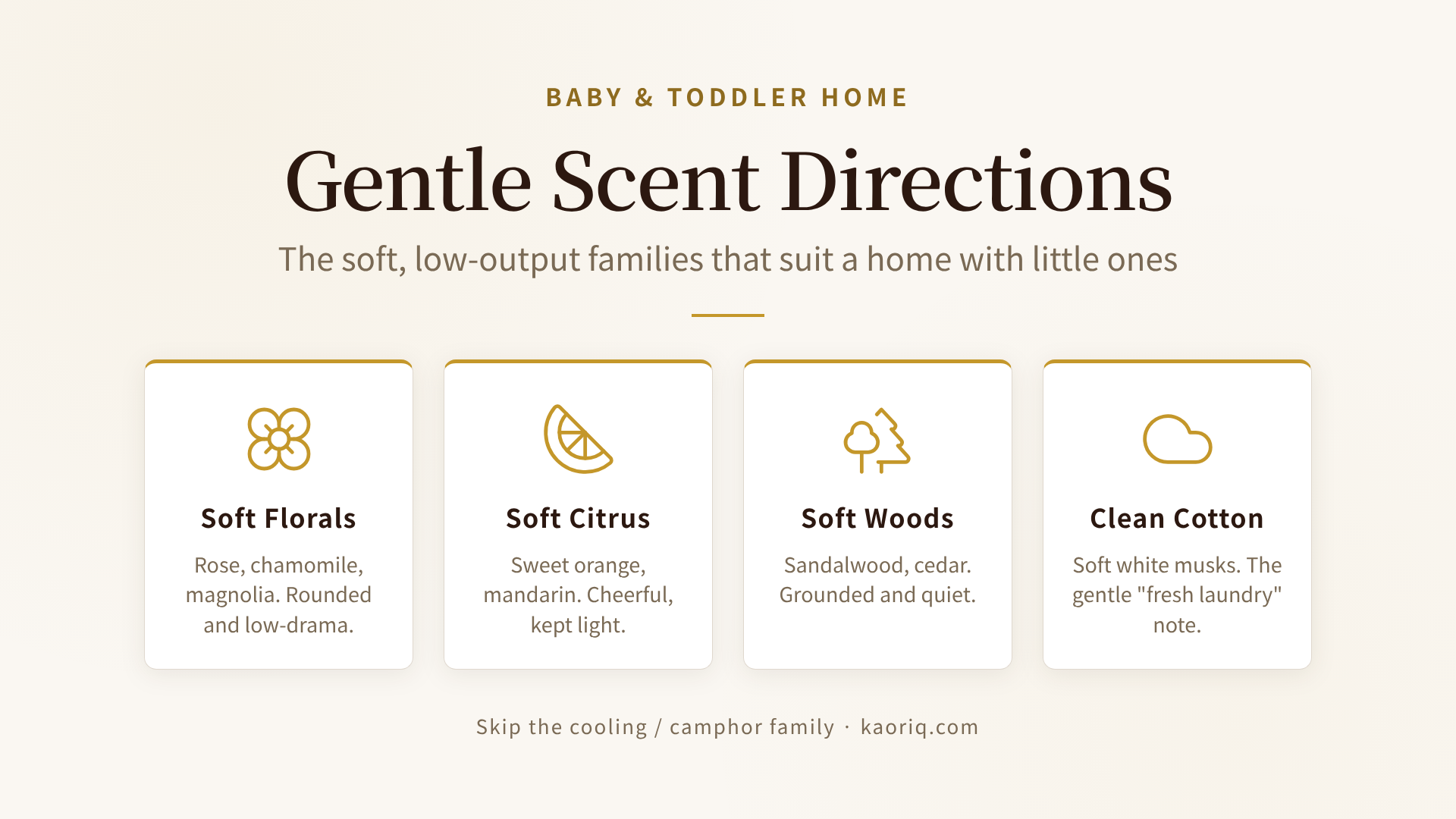
| Soft florals (rose, chamomile, magnolia) | ◎ | Rounded, low-drama, easy on a shared room. The classic “nursery-adjacent” comfort zone. |
| Soft citrus (sweet orange, mandarin) | ◎ | Cheerful and light when kept gentle. Skip the sharp lemon/grapefruit peel end. |
| Soft woods & soft musks (sandalwood, cedar, clean cotton) | ◯ | Grounded and quiet. Finished room-fragrance versions, not undiluted oils. |
| Vanilla / soft gourmand | ◯ | Warm and comforting; just keep it light so it doesn’t turn cloying. |
| Sharp citrus & “fresh” herbals | △ | Can read as harsh up close. Fine in low doses in a ventilated, non-sleep room. |
| Cooling / camphor types (eucalyptus, peppermint, menthol, rosemary, camphor) | ✕ | Too stimulating for very young children. The recurring “skip it” group. |
| Heavy musk, patchouli, smoky incense | ✕ | Dense and lingering — too much presence for a small body in a small space. |
The takeaway in one line: lean soft-floral, soft-citrus, and soft-wood; skip the cooling/camphor family and the heavy, smoky end entirely.
The Format Question: What Actually Belongs in the Room
A toddler changes the format math completely. The bottle stops being only a scent decision and becomes a can-they-reach-it decision. Here’s the honest rundown.
| Format | With babies & toddlers | Notes |
|---|---|---|
| Reed diffuser | ◎ | No flame, no power, no noise, continuous low output. The default for most family homes. The only catch: the oil. Place it well out of reach — a knocked-over bottle is the real hazard, not the scent. |
| Passive scent (sachet, scented stone, cotton) | ◎ | The gentlest of all. Tiny output, nothing to spill, nothing to switch off. Lovely in drawers and closets. |
| Room spray | ◯ | Excellent as spot use, in a room nobody’s in yet — spray, let it settle, then bring everyone in. Not a fog-the-nursery tool. |
| Electric / water diffuser | △ | Depends entirely on what you put in it and how long you run it. Short cycles, gentle oils, high-traffic rooms only — never a closed nursery on a timer. |
| Plug-in | △ | Convenient, but it runs constantly and sits at outlet height — low, and grabbable. If you use one, choose the mildest setting and a high outlet. |
| Candle | △ | The scent can be fine; the open flame and hot wax are the problem with a curious toddler in the room. Supervised, out of reach, never near nap time. |
| Incense | ✕ | Open flame plus a steady stream of smoke in a shared space. This is the one I’d simply skip for now. |
The baseline that holds up: a reed diffuser up high in the living room, a sachet or two in the closets, and a room spray for the quick “someone’s coming over” reset — used in an empty room, never as a mist over the play mat.
Where You Put It Matters as Much as What It Is
This is the part that gets underestimated. The same gentle diffuser is a good idea on a high shelf and a bad idea on the coffee table. A few rules that have held up:
- Up high, always. Out of reach of hands, tails, and toppling. The number one real-world incident isn’t the scent — it’s the spill. Gravity plus a toddler is undefeated.
- High-traffic rooms, not sleep zones. The living room and hallway, where air moves, beats a closed nursery where scent just pools. Keep the room the baby actually sleeps in essentially neutral.
- Ventilate. A cracked window does more for “is this too much?” than any label claim. If you can smell it strongly when you walk in, it’s a notch too high — dial it down.
- One change at a time. Introduce a single new scent, give it a few days, and watch. If anyone seems bothered, you know exactly which thing to pull.
- Keep a neutral room. Just like the nursery, leave at least one space scent-free. Everyone, small or large, deserves a reset zone.
A Slow Starter Routine
If you’re rebuilding your setup with a little one in mind, here’s the unhurried version that worked for me.
- Start with one reed diffuser, up high, in the living room. Soft rose, sandalwood, or a gentle sweet-orange. Low and quiet.
- Live with it for a week. Window cracked. Watch everyone. This is the whole test.
- Add a sachet or two in the closets once you’re happy. Passive, spill-proof, easy.
- Keep a room spray for resets — guests, cooking smells, the diaper bin having a moment — used in an empty room, briefly.
- Leave the nursery and one other room neutral. Non-negotiable.
The Cheat Sheet
| Situation | Format | Direction |
|---|---|---|
| Newborn at home, first setup | Reed diffuser, up high, living room only | Very light soft floral or soft wood |
| Crawling baby (everything is at floor level) | Reed diffuser high up + closet sachets | Soft rose, sandalwood, clean cotton |
| Busy toddler (everything is a toy) | Sachets + spot room spray | Gentle, in unoccupied rooms |
| The “guests in 20 minutes” reset | Room spray, empty room | Whatever’s gentle, used briefly |
| Nursery / sleep room | Neutral | Nothing. Let it be the calm, blank space. |
| Anyone with asthma or allergies | Mostly neutral + occasional gentle spot use | Ask the pediatrician first |
What’s Worth Knowing at Month One
Two things, looking back.
One: “fragrance-free” was never the only safe answer. Two months of believing the only responsible home is an odorless one ends the same way for most people: the responsible home is just a gently scented one — soft directions, low output, smart placement. The bottle on a high shelf doing quiet work is a completely different object than the same bottle blasting a closed nursery. Format and placement carry most of the safety; the scent itself, kept gentle, is the easy part.
Two: “natural” on a label tells you almost nothing, and “baby-safe” isn’t a regulated term — there’s no standard quietly vouching for it. The cooling, camphor-type oils are natural too, and they’re exactly the ones to skip for now. Thirty seconds reading what’s actually in the bottle, plus putting it somewhere small hands can’t reach, beats any soothing front-label promise.
If you’re not sure which gentle direction suits both you and your home right now, our personality-based scent quiz gives you a starting point you can then narrow to the soft, low-output end. For why personality is a useful filter at all, this piece goes deeper. If a no-flame household is your constraint, the renter’s flameless guide covers every format without a match, and if there’s a cat or dog in the mix too, the pet-safe guide overlaps almost completely with this one.
The home can smell like something again: a little soft rose in the living room, a sandalwood sachet in the hall closet, the nursery kept blank and calm. The baby sleeps. You walk in and it smells like you. That was always available. It just had to be whispered.
Was this article helpful?