Find Your Fragrance Family: A Beginner's Guide to Fresh, Floral, Woody, and Amber Home Scents
Eleven Candles Later, It Turns Out You Like Two Things
For most people, the candle-buying strategy is “the label sounds nice.” This is how you end up with a drawer of half-burned jars that have nothing in common except that, individually, in a shop, on a good day, they sounded nice.
Line them up and the obvious shows itself: the three that actually get re-lit are all woody. The eight gathering dust are floral, gourmand, and one aggressively “fresh linen” thing that smells like a hotel that doesn’t like anyone. That is shopping one product at a time, when the job is shopping for a family.
That’s the whole trick to choosing home fragrance without wasting money. You don’t need to memorise 200 notes. You need to know which of four families your nose belongs to. Everything else is detail.
The Four Families (and Why “Oriental” Quietly Became “Amber”)
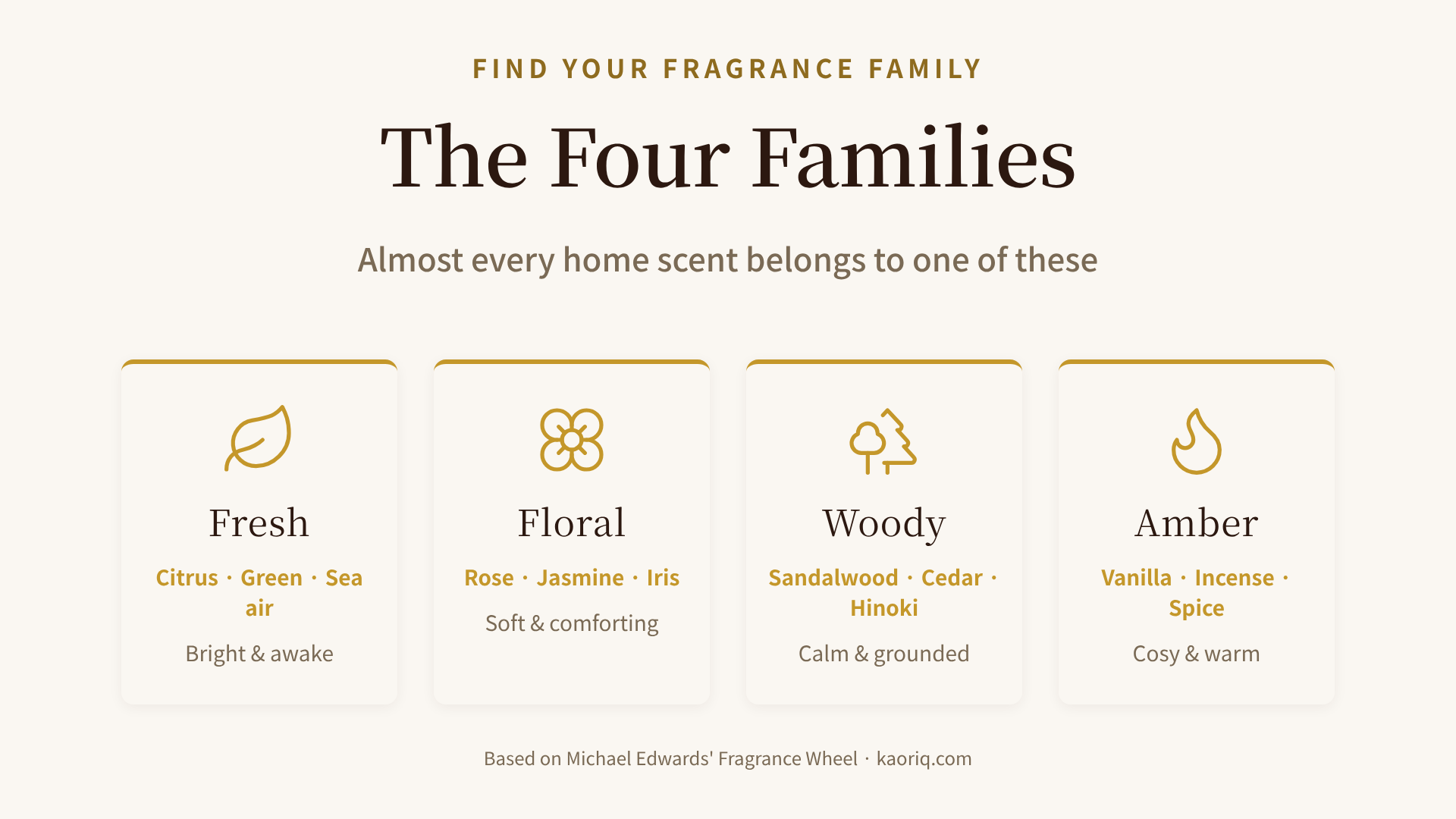
Back in 1983, a fragrance expert named Michael Edwards drew a wheel that sorted every scent into four big families: Fresh, Floral, Woody, and Amber. Perfumers and shop staff have used it ever since, because it works. Scents next to each other on the wheel get along; scents across from each other create contrast.
One footnote, because it comes up: until 2021 the fourth family was called “Oriental.” Edwards renamed it “Amber”: same warm, spicy, resinous scents, less baggage. So if you see an old guide calling it Oriental and a new one calling it Amber, they mean the same thing. The candle did not change. The label grew up.
Here’s the cheat sheet. Find the row that makes you nod.
| Family | Smells Like | Mood | Best For This Person / Room |
|---|---|---|---|
| Fresh | Citrus, green leaves, sea air, cut herbs | Awake, clean, bright | Mornings, kitchens, anyone who throws the windows open first thing |
| Floral | Rose, jasmine, orange blossom, iris | Soft, romantic, comforting | Bedrooms, dressing areas, people who like a room to feel tended |
| Woody | Sandalwood, cedar, hinoki, vetiver | Grounded, calm, quietly expensive | Living rooms, studies, anyone who wants warmth without sweetness |
| Amber | Vanilla, incense, spice, resins | Cosy, sensual, enveloping | Winter evenings, snug corners, people who run cold and love a blanket |
A note before we go further: everything below is about scenting a room: candles, diffusers, incense. Not your skin. Home fragrance lives in the air, not on you, and the families behave a little differently when they’re filling a space instead of warming on a wrist.
Fresh: The “Open a Window” Family
Citrus, green notes, herbs, and that cool “just rained” aquatic register. Fresh scents are made of small, fast molecules that lift a room and then politely leave. They read as clean and energetic, which is exactly why they’re the safest first purchase: almost nobody actively dislikes a bright citrus.
At home, Fresh shines in the morning and in spaces you want to feel alive rather than cosy: kitchens, entryways, a home office at 9am. The catch is that it fades fast, so reed diffusers and electric diffusers serve it better than a long candle burn. If you want to understand why bergamot in particular anchors so many fresh blends, the story of Calabrian bergamot is a good rabbit hole.
Pick this if: you like rooms to feel uncluttered and slightly cold-water-on-the-face. You find sweet scents heavy by mid-morning. Your ideal Sunday involves an open window.
Floral: The Most Popular One, and the Most Misunderstood
Floral is the biggest family by a mile, and it ranges from a single shy bloom to a full bouquet. The mistake beginners make is assuming “floral” means “old-fashioned” or “powdery.” Some are. But the modern end (neroli, orange blossom, a clean jasmine, the cool elegance of iris) feels less like your grandmother’s powder room and more like fresh laundry that went to finishing school.
In a home, floral wants soft delivery: a candle in a bedroom, a reed diffuser on a dresser. It’s the family that makes a room feel cared for. The deep, expensive version of floral is iris, which is one of the strangest, most patient ingredients in all of fragrance, and worth reading about if you’ve ever wondered why “iris” costs what it costs.
Pick this if: you want a room to feel gentle and human. You’re drawn to “comforting” over “energising.” You like the idea of a space that hugs you a little.
Woody: The One That Reads as “Adult” Without Trying
Sandalwood, cedar, hinoki, vetiver. Dry, warm, grounding, faintly expensive. Woody is the foundation under a huge share of fragrances, which is why it so often turns out to be the family people keep. It’s the one people keep buying, three jars deep, without realising there’s a pattern.
Woody is the great all-rounder for living spaces. It fills a room without shouting, never reads as sweet, and matches almost any interior. Hinoki (Japanese cypress) in particular has a cool, clean, almost watery edge that makes it the rare wood that works year-round. Woody is happy in nearly any format, which makes it the most forgiving family to commit to.
Pick this if: you want warmth without sugar. You like a space to feel calm and considered. You’ve ever described something as “smells like a nice hotel lobby” approvingly.
Amber: The Blanket-Fort Family
Vanilla, resins, incense, warm spice. Amber (the family formerly known as Oriental) is enveloping and a little sensual: the scent equivalent of a heavy curtain and low light. It’s the boldest of the four, which means it’s the easiest to overdo and the most rewarding to get right.
Amber belongs to evenings, winter, and small snug rooms. In big bright spaces it can feel like too much; in a reading nook in January it feels like the only correct choice. If your version of amber leans toward incense and smoke rather than vanilla and spice, the Japanese tradition of kōdō, “listening” to incense, is a whole quiet world worth visiting.
Pick this if: you run cold and love a blanket. You think most scents are too timid. Your happy place is dim, warm, and slightly dramatic.
How to Actually Use This
Once you know your family, the wheel does the rest of the work for you.
| Your Move | What It Does |
|---|---|
| Stay in your family | Safest. A woody person buying another woody candle will almost never regret it. |
| Step to the neighbour | Fresh ↔ Floral and Woody ↔ Amber sit next to each other and share notes. Low-risk way to add variety. |
| Jump across | Fresh ↔ Amber, Floral ↔ Woody. High contrast, more interesting, occasionally a mistake. Try before you commit. |
The honest truth is that most people belong firmly to one or two families and dabble in a third. You do not need all four. I own zero amber candles and feel no poorer for it.
And here’s the one rule that survives everything else: test before you buy the big version. A family is a starting point, not a guarantee. Within “woody” there’s a galaxy of difference between a milky sandalwood and a smoky vetiver. The cheapest way to find your exact spot is to sample first and scale up later, rather than discovering at full price that you bought the wrong wood.
So, Which One Are You?
If you read the table at the top and one row made you nod harder than the others: that’s your family. Start there. Buy one good thing in it. Stop buying labels that “sound nice.”
If you couldn’t pick (if every row sounded a bit like you), that’s not indecision; it’s information. Which family you’re drawn to tends to track who you are more than what’s trendy this season, and that’s a more reliable compass than any wheel. I dug into why your personality predicts your fragrance better than the season does, and turned it into a practical map from your traits to the candle you’ll actually re-light.
The usual ending: the hotel-linen candle goes out, the three woody ones keep going. It was never a candle problem. It was a filing problem.
Sources: Fragrance wheel — Wikipedia, The Fragrance Wheel: A Guide to Identifying Scents — Air Aroma, Explore Michael Edwards’ Fragrance Wheel — Fragrances of the World
Was this article helpful?