Candle vs. Reed Diffuser vs. Room Spray vs. Plug-In: How to Choose the Right Type of Home Fragrance
An Hour of Smelling Scents, and Still the Wrong Purchase
Here’s a common first attempt. You stand in a shop for an hour sniffing testers, fall in love with a fig-and-cedar scent, buy it as a candle… and then realise you’re the kind of person who leaves the house at 8am and forgets candles exist. The scent was perfect. The format was wrong for the life.
That’s the mistake almost everyone makes. We obsess over the smell and ignore the delivery system. But a great scent in the wrong format is just money you set on fire, sometimes literally.
So here’s the rule I wish someone had told me: decide the type before you decide the scent. Figure out whether you want a candle, a reed diffuser, a room spray, or a plug-in first, based on how you live. Then go fall in love with a fragrance that fits.
This guide is the “decide the type” part.
The Four Formats, Honestly
Every home fragrance you’ll find falls into one of four families. They’re not better or worse than each other. They’re just good at different things.
Candles scent the air through a heated wax pool, and they sell atmosphere as much as scent. The flame, the flicker, the ritual of lighting one. They’re the emotional favorite for a reason.
Reed diffusers are the set-and-forget option: rattan sticks soak up fragrance oil and let it evaporate off the tips. No flame, no electricity, no buttons. Just a quiet background note that works while you live your life.
Room sprays are the instant fix. One spritz, immediate scent, gone in an hour or two. They don’t fill a room continuously. They punctuate it.
Plug-ins turn an outlet into a constant scent source. Set it and the room stays scented for weeks, no thought required, as long as there’s a socket where you want the smell.
The Five Axes That Actually Decide It
Forget the marketing photos. When you’re choosing a format, only five things matter.
1. Longevity: how long one purchase lasts
This is where the four formats split most dramatically:
- Reed diffusers win on endurance: a typical bottle runs one to three months, and larger ones can stretch toward a year.
- Candles last as long as they’re lit, usually a few dozen hours of burn time total, spread across however many evenings you light them.
- Plug-ins run continuously and swap out oil vials every few weeks.
- Room sprays are the sprinters: one to two hours per spritz, then you reapply.
If you want “scent something and forget it,” reeds and plug-ins lead. If you want “scent on demand,” sprays are built for exactly that.
2. Scent throw: how far it travels
“Throw” is how far the smell carries from its source. The consensus among perfumers is consistent: candles generally throw stronger than reeds, especially as room size grows, because heat actively pushes fragrance into the air. Reed diffusers are gentle by design and fade in large or drafty spaces. Room sprays hit hardest and fastest, then drop off a cliff. Plug-ins sit in the middle: steady, moderate, very local to the outlet.
If your space is big or open-plan, this axis matters more than any other. (We go deep on matching format to square footage in our room-size fragrance guide, worth a read if your living room flows into your kitchen.)
3. Safety: fire, kids, pets
This is the axis people skip until it bites them.
Candles involve an open flame. That’s an immediate non-starter if you have curious toddlers, pets that knock things off shelves, or a landlord with opinions. Reed diffusers, sprays, and plug-ins are all flame-free, which is why they dominate in rental apartments and homes with little ones.
But flame-free isn’t the same as worry-free. Diffuser oil can be harmful if a pet drinks it, and some essential oils don’t agree with cats and dogs at all. If you share your home with animals, read our pet-safe home fragrance guide before you buy anything. And if you rent and can’t risk flame or wax stains, our flameless renter’s guide covers the safe options in detail.
4. Cost: upfront vs. over time
Cheap upfront doesn’t mean cheap long-term. A $10 room spray feels economical until you’re buying one a month. A $40 reed diffuser feels expensive until you realize it quietly works for three. Candles sit in between, with premium ones costing the most per hour of scent. Plug-ins are cheap to start but the refill vials add up over a year. Think in cost-per-month, not cost-per-purchase.
5. Maintenance: how much it asks of you
Some formats are needy. Candles want trimmed wicks and supervised burns. Sprays want you to remember to spray. Reeds want an occasional stick-flip and nothing else. Plug-ins want a socket and a vial swap. Be honest about how much attention you’ll actually give it. The most beautiful candle is useless if you never light it.
The Cheat Sheet
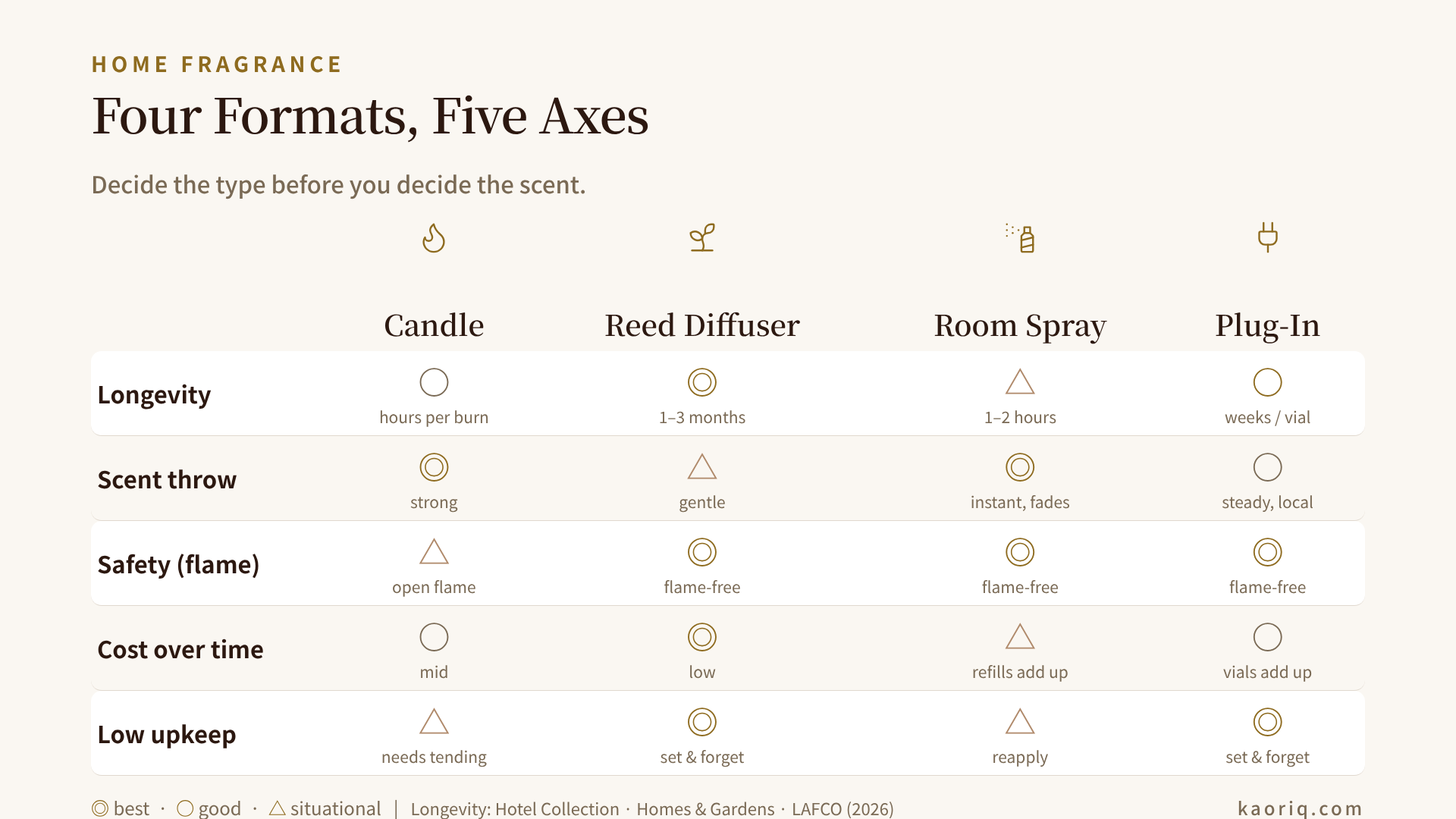
Here’s the part you can screenshot and send to a friend who’s standing in a shop, paralyzed:
| Candle | Reed Diffuser | Room Spray | Plug-In | |
|---|---|---|---|---|
| Longevity | ◎ per session, △ overall | ◎ (1–3 months) | △ (1–2 hrs) | ○ (weeks per vial) |
| Scent throw | ◎ strong | △ gentle | ◎ instant, fades fast | ○ steady, local |
| Safety | △ open flame | ◎ flame-free | ◎ flame-free | ◎ flame-free |
| Cost over time | △ | ◎ | △ | ○ |
| Low maintenance | △ needs tending | ◎ set & forget | △ reapply often | ◎ set & forget |
| Atmosphere / mood | ◎ the flame wins | ○ | △ | △ |
Now Match It to How You Actually Live
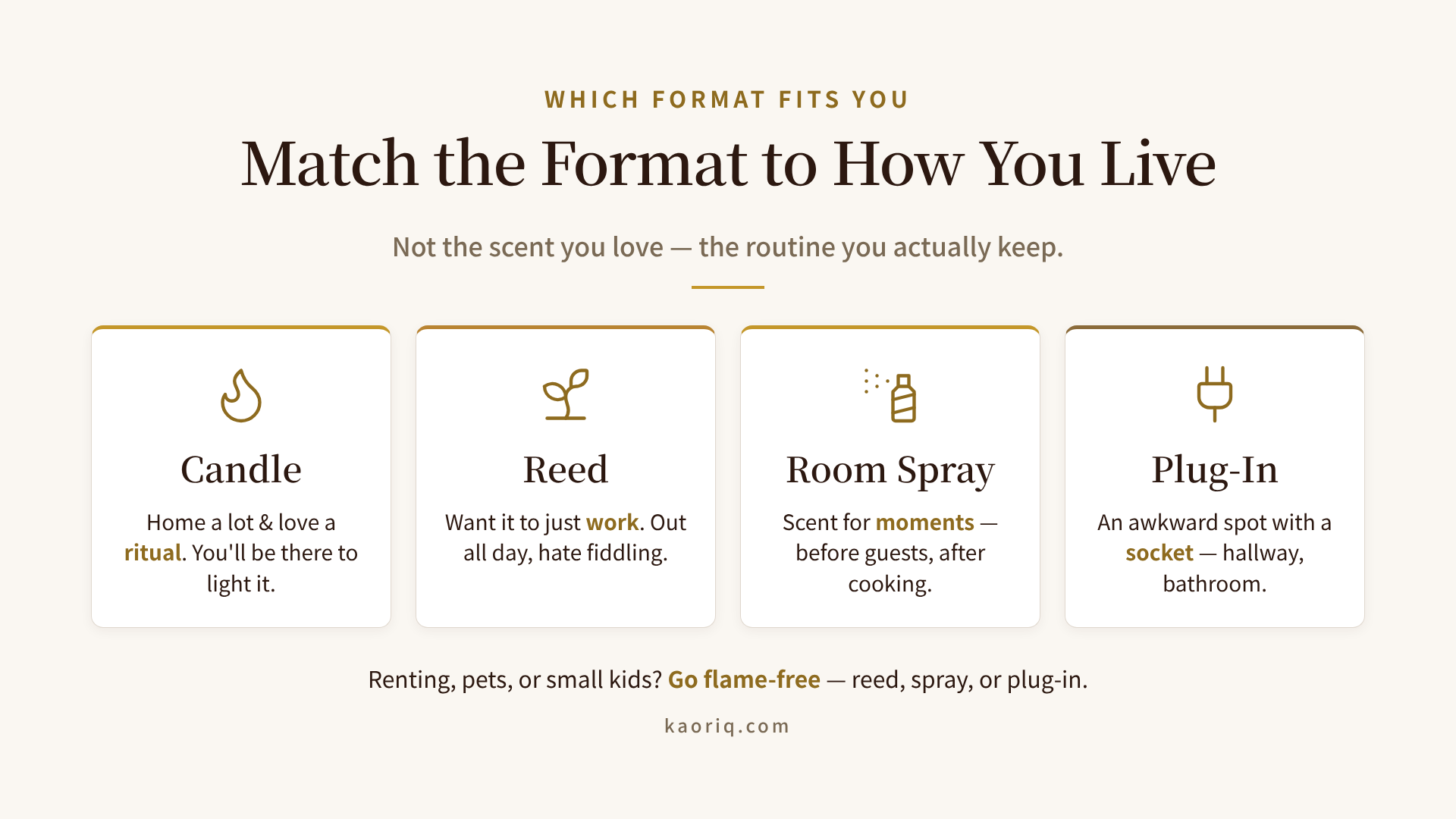
The table tells you what each format is. Your life tells you which one fits. Here’s the shortcut:
- You’re home a lot and love a ritual → Candle. You’ll be there to light it, enjoy it, and blow it out. The flame is half the point.
- You want it to just… work, without thinking → Reed diffuser. Out all day? Hate fiddling? This is the quiet workhorse that scents while you’re not even there.
- You only want scent at specific moments (before guests arrive, after cooking) → Room spray. Fast, targeted, no commitment.
- You have an awkward spot with a socket (hallway, bathroom, entryway) → Plug-in. Constant coverage where a candle would be unsafe and a reed would be too faint.
- You rent, have pets, or have small kids → Anything flame-free. Reed, spray, or plug-in. Skip the candle until life calms down.
One nuance worth a line: if you want your home to smell expensive rather than loud, a gentle reed or a low-output plug-in is often the smarter pick. The 2026 mood has tilted toward “quiet fragrance,” present but never shouting, and the softer formats do that naturally. We unpacked that whole aesthetic in our quiet luxury home fragrance guide.
Two Things People Get Wrong
Mixing up “diffuser” types. “Diffuser” is doing a lot of work as a word. A reed diffuser is passive and gentle; an electric or ultrasonic diffuser is a different machine with very different throw and upkeep. If you’re leaning electric, our diffuser types comparison sorts out which is which before you spend.
Blaming the scent when the format failed. If your reed diffuser “stopped working” after two weeks, the oil probably didn’t quit. Your nose adapted, or it was in a drafty spot. That’s a format-and-placement problem, not a bad bottle. We wrote a whole troubleshooting piece on why reed diffusers seem to die early and how to choose one that lasts.
Where This Goes Next
Pick the format that survives contact with your actual schedule, not your fantasy of who you’d like to be. (I am not, it turns out, a candle person. I am a reed-diffuser-and-forget-it person. The fig-and-cedar candle is now a very fancy paperweight.)
Once the format’s settled, the fun part begins: choosing the scent, and that’s where who you are starts to matter more than what’s trending. If you want to choose by personality instead of by guesswork, start with why personality predicts fragrance preference better than trends.
Format first. Scent second. Your future self, and your paperweight collection, will thank you.
Sources on format longevity: Hotel Collection, Homes & Gardens, LAFCO.
Was this article helpful?