The Quiet Luxury Home Fragrance Guide: How to Choose Subtle Scents That Reward Proximity (2026's Biggest Trend)
The Candle That Can Be Smelled From the Street
Picture a “luxury” candle. Big black jar, gold lid, a name that sounds like a law firm. Light it for one dinner party and a guest asks, with genuine concern, whether something in the kitchen is on fire. The candle is not subtle. The candle is a smoke alarm with ambitions.
That is the difference between expensive and loud. They are not the same thing, and in 2026 the fragrance world has largely come around to it.
If you’ve been seeing the phrase quiet luxury attached to everything from cashmere to home scent, you’re not imagining a trend. According to multiple fragrance forecasts this year, the most sophisticated choice is no longer the scent that fills a room before you do. It’s the one a guest only notices when they lean in. So the question becomes: how do you choose a home fragrance that whispers instead of shouts, without ending up with something so faint you wonder why you spent the money? Let’s sort it out.
What “Quiet Luxury” Actually Means in a Scent
First, the most important misunderstanding to clear up: quiet does not mean weak.
A weak scent is one that’s badly made: thin, synthetic, gone in an hour. A quiet scent is one that’s deliberately composed to sit close. The industry phrase this year is “rewards proximity.” It’s a fragrance you have to come toward, not one that comes at you.
Three ideas are driving the 2026 version of this:
- Skin scents at home. The same “your space, but better” softness people love in personal fragrance has moved into candles and diffusers: clean musks, pale woods, no drama.
- Scentscaping. Instead of one dominant candle, you layer a couple of low-key scents to build an atmosphere, the way you’d layer lighting. Quiet pieces layer beautifully; loud ones just fight.
- Mood over impressiveness. People now choose home scent by how they want a room to feel, not by how much it announces that a scented thing has been purchased.
In other words: the goal shifted from “smells like money” to “smells like a calm, well-kept life.” Which, for the record, is a much harder thing to fake.
The Four Quiet Scent Families
Most quiet-luxury home scents live in one of four families. None of them shout. But they whisper very different things, and that’s where your personality comes in.
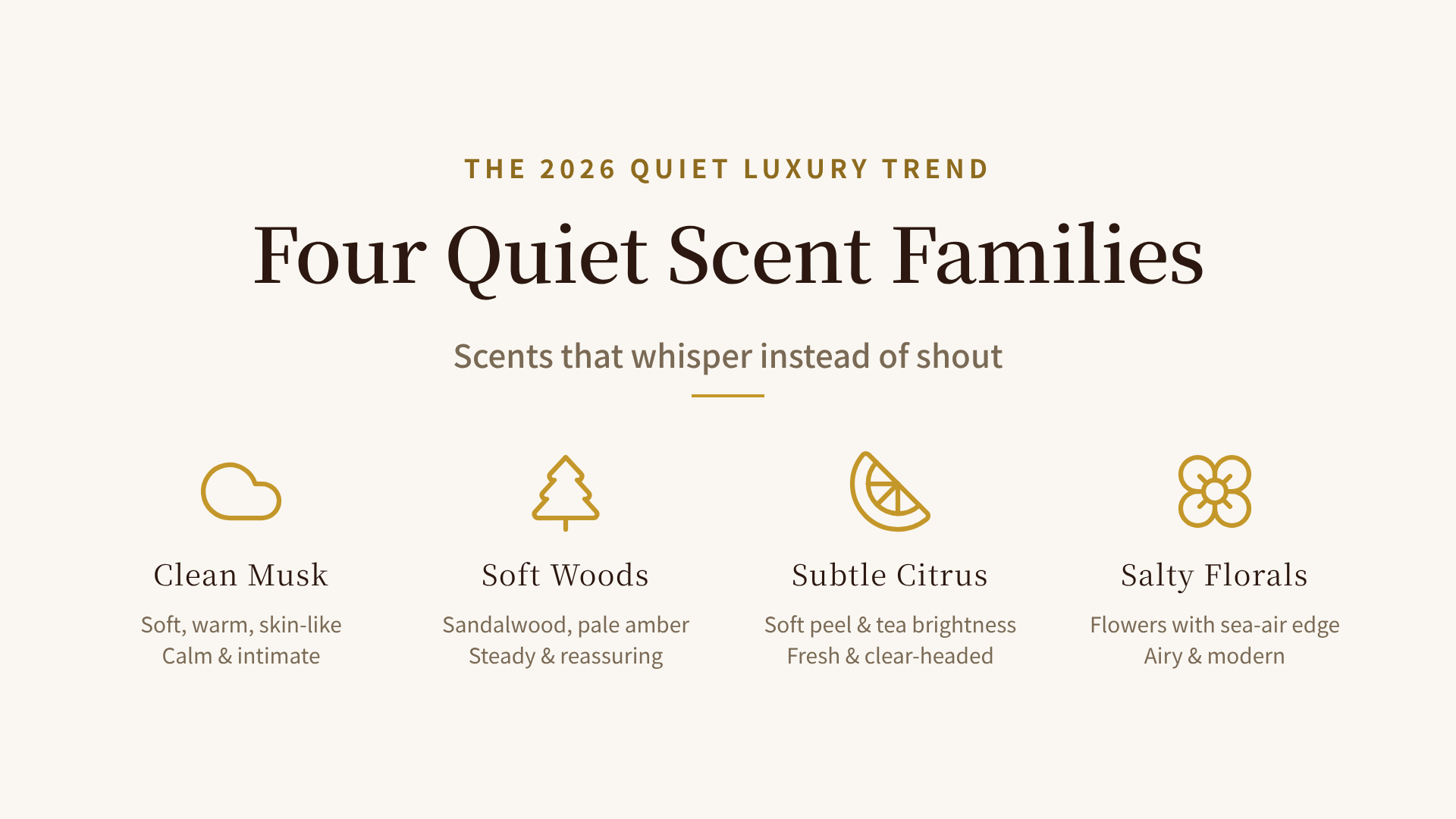
- Clean musk — soft, warm, skin-like, faintly powdery. The “freshly folded laundry but make it expensive” family. Reads as calm and intimate.
- Soft woods — sandalwood, cedar, pale amber. Grounded and quietly confident, the radiant-wood look that’s replacing heavy oud this year. Reads as steady and reassuring.
- Subtle citrus — not a cleaning-spray lemon, but a soft peel-and-tea brightness. A lift without a shout. Reads as fresh, clear-headed, undemanding.
- Salty florals — the newcomer of 2026: delicate flowers with a cool, mineral, sea-air edge. Reads as airy, modern, a little wistful.
Match the Family to Your Personality
Here’s the part the big fragrance magazines skip. They’ll tell you what’s trending; they won’t tell you which quiet scent is right for you. At kaoriq we sort that by personality. And for quiet luxury, two of the Big Five traits do most of the work.
Extraversion governs how much sensory input feels good versus draining. Openness governs whether you want the familiar and cozy, or the unusual and intriguing. Map those two and the family chooses itself.
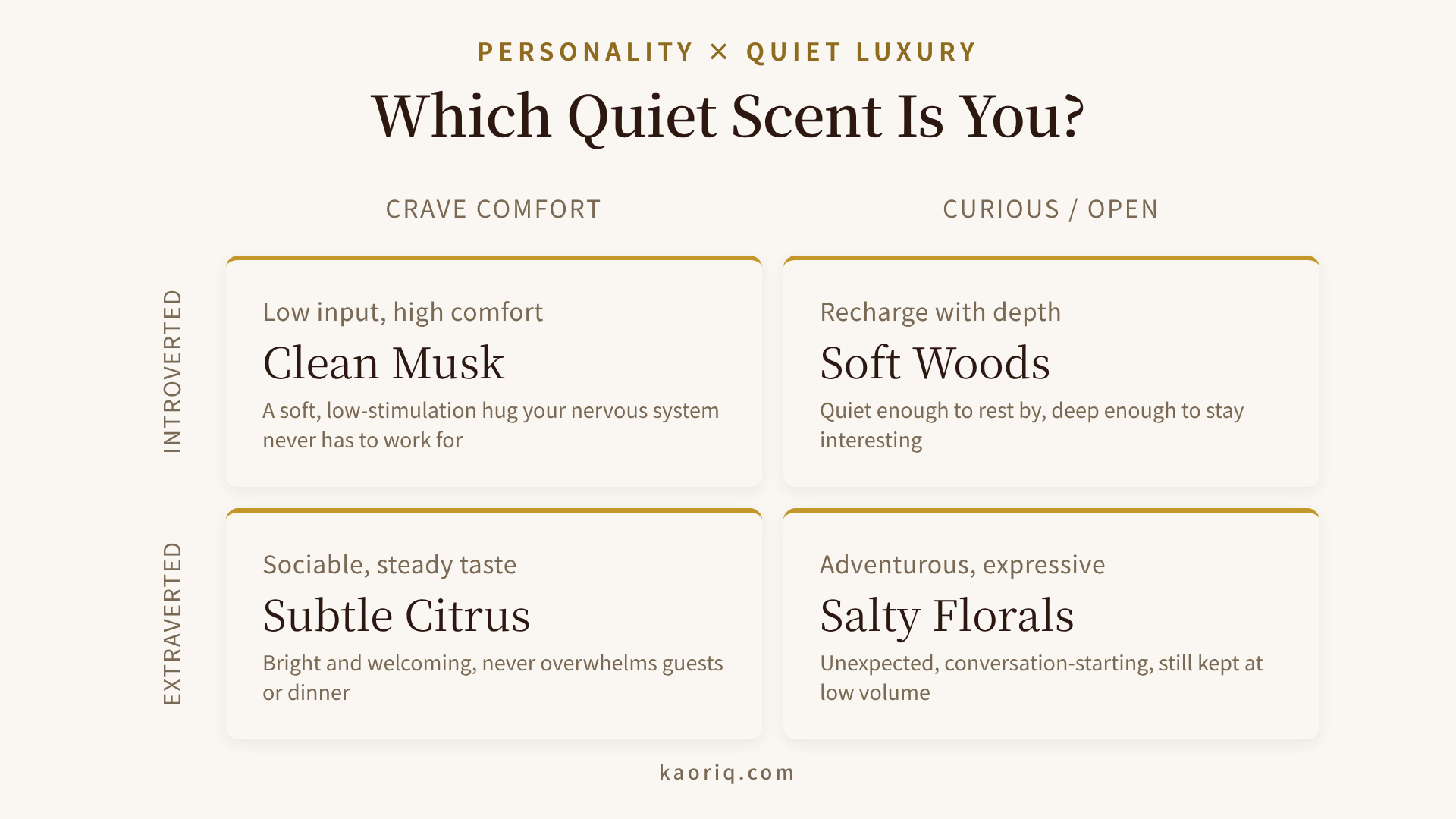
| If you’re… | You probably want… | Why it fits |
|---|---|---|
| Introverted + crave comfort | Clean musk | A soft, low-stimulation hug that never asks anything of your nervous system |
| Introverted + curious | Soft woods | Quiet enough to recharge by, with enough depth to stay interesting |
| Extraverted + steady taste | Subtle citrus | Bright and sociable, but it won’t overwhelm guests or compete with dinner |
| Extraverted + adventurous | Salty florals | Unexpected and conversation-starting, while still keeping the volume low |
If you read that and immediately knew which row was you, good — that instinct is exactly what the personality-and-fragrance overview is built on. And if you’re somewhere in between two rows, you’re allowed to own two scents. That’s just scentscaping with extra steps.
Where Quiet Scents Earn Their Keep
A subtle scent in the wrong room is a wasted scent. Quiet luxury shines specifically in the spaces where you slow down and get close to things.
The bedroom. This is the home stadium of quiet scent. You’re near the pillow, the lamp is low, nothing is competing. Clean musk or soft woods here read as genuinely luxurious because there’s nothing to drown them out. (If sleep is the real goal, our bedroom fragrance sleep guide goes deeper.)
The study or home office. A subtle citrus or soft wood sits at the edge of your attention: present enough to make the desk feel cared-for, faint enough that it never co-authors your emails.
The reading corner / wind-down spot. Anywhere you physically settle in. Quiet scents reward proximity, and these are the rooms where you actually get proximate.
Where quiet scents don’t earn their keep: large open-plan spaces, kitchens mid-cook, anywhere with a fan running. Volume gets eaten by air. In those rooms, a whisper just becomes silence. And silence is free, so don’t pay candle prices for it.
If You’re Genuinely Scent-Sensitive
One more group this trend was practically designed for: people who find most home fragrance too much. If a single candle gives you a headache by hour two, quiet luxury is not a compromise for you — it’s the main event. Low-throw, skin-close, close-sitting scents are the entire point. Our highly-sensitive-person home fragrance guide and the introvert’s recharge guide both lean heavily on exactly these families.
So, Which One Do I Choose?
If you want the one-line version: pick the family that matches how you want a room to feel, not how impressive you want it to seem. Comfort-seeker, go clean musk. Curious homebody, soft woods. Sociable and steady, subtle citrus. Adventurous, salty florals.
And if you still can’t decide, here’s the quiet-luxury cheat code: buy the smallest size of two contenders, put one in the bedroom and one at your desk, and pay attention to which room you start lingering in. Your nose will pick before your brain does. It usually does.
Quiet luxury isn’t about owning the most expensive candle on the shelf. It’s about owning the one that, two weeks later, you don’t even consciously notice anymore, because it has quietly become the smell of being home. If you want to go one level deeper on the families themselves, the fragrance family beginner’s guide maps the whole field. No smoke alarms required.
Was this article helpful?