How Room Size Changes Which Fragrance Format Actually Works
The $65 Candle That Can’t Scent a Bathroom
Take a single-wick soy candle — gorgeous vessel, beautiful cold throw in the store. Bring it home, light it in a 35 m² living room, and get… nothing. Not faint. Not subtle. Nothing. The flame burns bravely for four hours while the room smells exactly like it did before: coffee and mild regret.
The candle wasn’t bad. It was wrong for the space.
This is the mistake most people make when buying room fragrance for the first time. We pick based on scent, not format. We sniff a reed diffuser at a friend’s cozy bathroom and assume it’ll fill our open-plan kitchen the same way. It won’t.
So here’s the part nobody tells you at the store: how much air you’re trying to scent matters more than what you’re scenting it with.
What “Throw” Actually Means
In the fragrance world, “throw” describes how far a scent travels from its source. There are two kinds:
Cold throw is what you smell when the product isn’t active — an unlit candle sitting on a shelf, for instance. It gives you a preview of the fragrance but tells you almost nothing about performance.
Hot throw is what matters. It’s the scent radius when the product is doing its job: a candle burning, a diffuser running, incense smoldering. Hot throw depends on three things: the concentration of fragrance oil, the delivery mechanism, and — here’s the part people forget — the volume of air in your room.
A candle with excellent hot throw in a 10 m² bedroom might disappear entirely in a 40 m² living room. Not because it’s weak, but because the math doesn’t work.
The Four Formats, Honestly
Candles: The Emotional Favorite
Candles have an unfair advantage: fire is hypnotic. The flickering light, the ritual of striking a match, the way wax pools around a flame. People don’t just buy candles for scent — they buy them for theater.
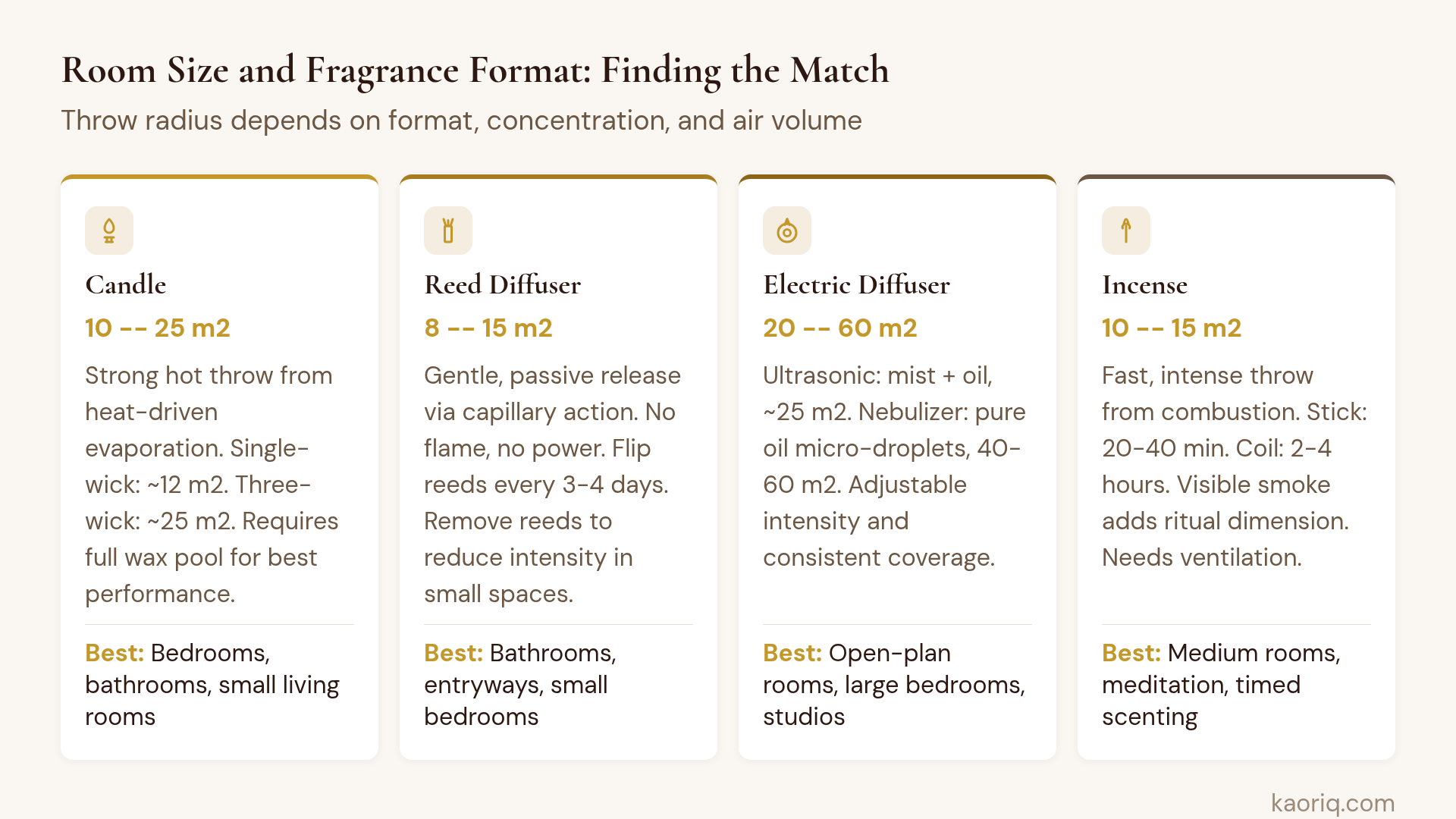
That said, candles are the most room-size-sensitive format. A small single-wick candle (150-200g) throws well in rooms up to about 12 m² (130 sq ft). A large three-wick candle (400g+) can handle 20-25 m² (215-270 sq ft) if you let the wax pool fully across the surface before blowing it out.
Best for: Bedrooms, small living rooms, home offices, bathrooms. Anywhere you want scent and atmosphere during a specific window of time.
Watch out for: Open-plan spaces. If your kitchen flows into your living room, a single candle won’t cut it unless you place it in the smaller “zone” you actually occupy.
Reed Diffusers: The Quiet Workhorse
Reed diffusers are deceptively simple: wooden or rattan sticks sit in fragrance oil. Capillary action pulls oil up the reeds. The oil evaporates off the tips. That’s it. No flame, no electricity, no buttons.
The catch is they’re gentle. A standard 100ml reed diffuser with 6-8 sticks works in rooms up to about 15 m² (160 sq ft). In a larger space, you’ll stop noticing the scent within a week as your nose adapts to the lower concentration.
Here’s a trick that extends their range: flip the reeds every 3-4 days. Fresh oil on the tips gives a burst of throw. In a smaller room, you can even remove 2-3 reeds to prevent the scent from becoming overpowering — particularly useful in a bathroom where the door stays closed.
Best for: Bathrooms (8-12 m²), entryways, small bedrooms. Spaces where you want a consistent background note without managing anything.
Watch out for: Drafty areas. Airflow speeds up evaporation without improving throw. Your oil runs out faster, but the scent doesn’t travel farther. A reed diffuser near an open window is a waste of money.
Electric Diffusers: The Space Conquerors
Electric diffusers come in two main types, and the difference matters.
Ultrasonic diffusers use vibrating water to create a fine mist that carries essential oils into the air. They’re quiet, affordable, and handle rooms up to about 20-25 m² (215-270 sq ft). The mist adds humidity, which can be a bonus in dry climates and a problem in damp ones. They require diluted oil and water refills.
Nebulizer diffusers are the heavy hitters. They use pressurized air to shatter pure essential oil into micro-droplets — no water, no heat. The scent is more concentrated and can fill spaces of 40-60 m² (430-650 sq ft) or more. They’re also louder, use more oil, and cost roughly 3-4x what an ultrasonic model does.
Best for: Open-plan living areas, large bedrooms, studios. Anywhere you need consistent coverage across a lot of air without babysitting the product.
Watch out for: Ultrasonic models in humid climates (mold risk near the unit). Nebulizers in small rooms (the concentration can become headache-inducing within minutes).
Incense: The Ancient Wildcard
Incense is the oldest room fragrance format still in active use, and it has properties none of the others share: visible smoke, a distinctive “burned” base note, and an almost ritualistic pace. Good incense from Japan or India bears zero resemblance to the cheap sticks that made your college dorm smell like a head shop.
A single incense stick fills 10-15 m² (108-160 sq ft) within minutes. The throw is fast and strong compared to its size, but the scent fades quickly after the stick finishes — usually 20-40 minutes. Coil incense (the spiral kind) burns for 2-4 hours and maintains a gentler, longer throw.
Best for: Medium rooms where you want intense but temporary scenting. Meditation spaces. Moments, not backgrounds.
Watch out for: Ventilation. Incense produces particulate matter. In a room smaller than 8 m², or one with no airflow, the smoke accumulates faster than it dissipates. If you’re burning incense daily in a small space, crack a window.
The Cheat Sheet
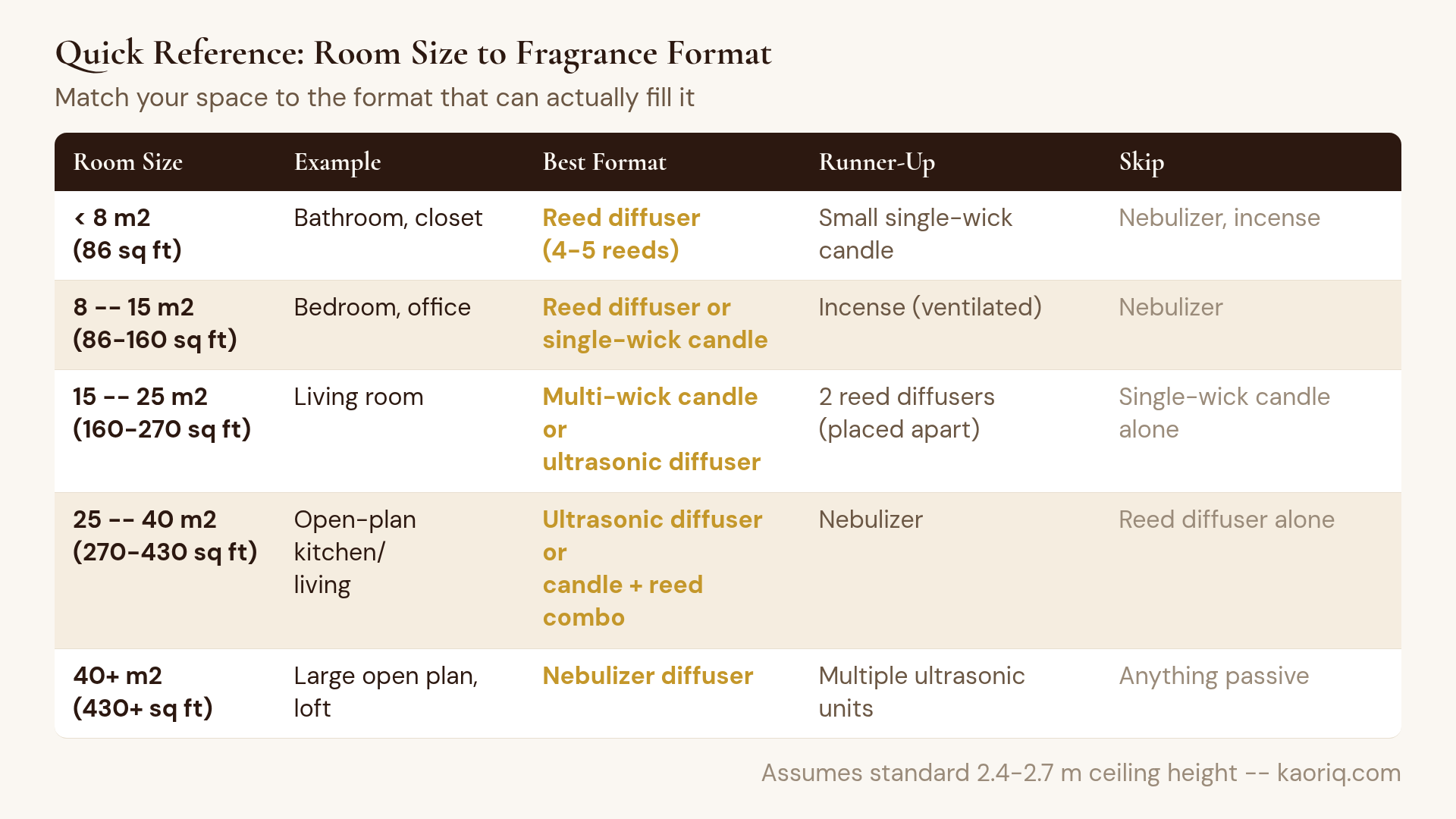
Here’s the part you can screenshot and send to a friend:
| Room Size | Best Format | Runner-Up | Avoid |
|---|---|---|---|
| Under 8 m² (86 sq ft) — bathroom, closet | Reed diffuser (4-5 reeds) | Small candle (single wick) | Nebulizer, incense |
| 8-15 m² (86-160 sq ft) — bedroom, office | Reed diffuser or single-wick candle | Incense (with ventilation) | Nebulizer |
| 15-25 m² (160-270 sq ft) — living room | Multi-wick candle or ultrasonic diffuser | 2 reed diffusers, placed apart | Single-wick candle alone |
| 25-40 m² (270-430 sq ft) — open plan | Ultrasonic diffuser or multi-wick candle + reed combo | Nebulizer | Reed diffuser alone |
| 40+ m² (430+ sq ft) — large open plan | Nebulizer diffuser | Multiple ultrasonic units | Anything passive |
Three Things Nobody Mentions
1. Ceiling height changes everything. All the numbers above assume standard 2.4-2.7m (8-9 ft) ceilings. If you live in a loft with 4m ceilings, you’re scenting a much larger volume of air than the floor area suggests. Add one format tier up.
2. Soft furnishings absorb scent. A room full of curtains, rugs, and upholstered furniture will feel less scented than a minimalist room with hard floors and bare walls, even at the same square footage. Textiles grab fragrance molecules and hold them, which means the scent doesn’t float freely in the air. On the bright side, those textiles release the scent slowly after you stop the source — a kind of natural sustain effect.
3. Your nose lies to you. Olfactory adaptation — the process by which your brain tunes out a constant smell — kicks in after about 15-20 minutes of continuous exposure. You’ll think the scent has faded, but a visitor walking in will smell it immediately. Before adding a second product or turning up your diffuser, step outside for five minutes and come back. You might find the room is already perfectly scented.
Where This Goes
The format question is just the first filter. Once you’ve matched your space to the right delivery mechanism, the actual scent you choose becomes the interesting part — and that’s where personality starts to matter. If you missed our piece on why personality predicts fragrance preferences better than trends, that’s where we go deeper.
For now: measure your room. Pick the right format. Then worry about whether you’re a sandalwood person or a bergamot one.
Your nose will thank you. And so will that $65 candle, if you finally put it in the right room.
Was this article helpful?