Reed vs Ultrasonic vs Electric vs Nebulizing: Which Diffuser Is Actually Right for Your Space
Standing in the Diffuser Aisle and Quietly Giving Up
Forty minutes in a homewares store trying to choose a diffuser is a normal amount of time. There’s a $22 reed bottle, a $48 ultrasonic, a $35 plug-in warmer, and a $240 nebulizing tower in a slim ceramic body that looks like it costs more than the coffee maker at home. The labels say useful things like “calming” and “modern” and “for your wellness journey.”
What none of them said was the only thing worth knowing: which one of these will fill an apartment with scent without sounding like a fish tank, costing a hundred dollars a month in oil, or putting out so much mist that the houseplants think it’s the rainy season.
So I left empty-handed and went home to research it. This article is what I wish the labels had said.
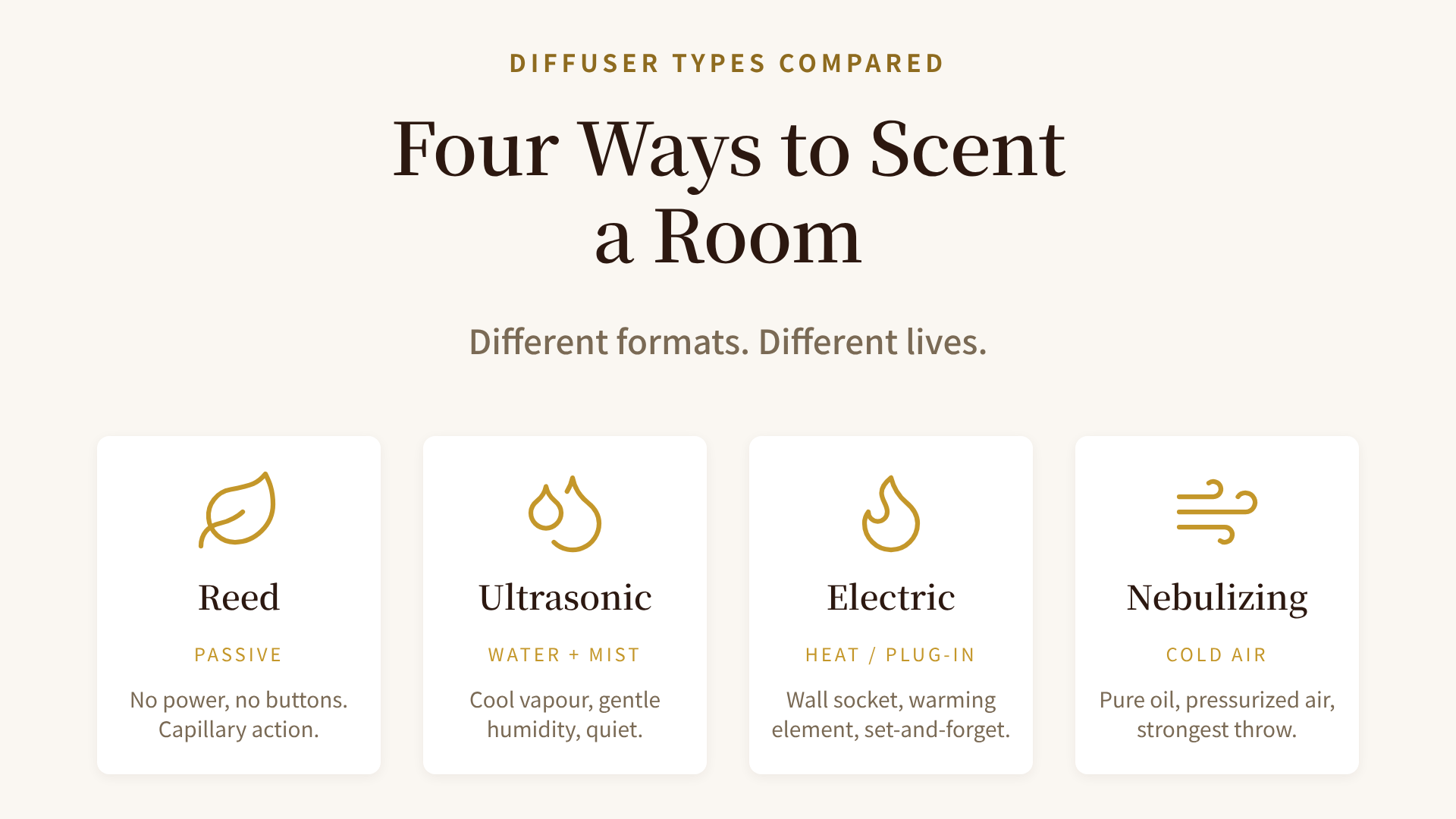
The Four Types, in Plain English
Reed Diffusers: The Silent, Passive Type
A bottle of fragrance oil with rattan or fibre sticks poking out of the top. Capillary action draws the oil up the sticks. It evaporates off the tips. No electricity, no buttons, no maintenance beyond flipping the sticks every few days. The cheapest entry point and the most foolproof to use.
Ultrasonic Diffusers: Water + Vibration
A small reservoir of water with a few drops of essential oil. A ceramic disc at the bottom vibrates at ultrasonic frequencies, breaking the water into a fine cool mist that carries the scent into the room. The unit is also, technically, a humidifier. This is the most popular type sold on Amazon, the one with the soft glow and the slow-rolling cloud of steam.
Electric (Plug-in / Heat) Diffusers: The Wall-Socket Workhorse
The simplest version is a plug-in unit you stick into a wall outlet, where a small heating element gently warms a bottle of fragrance oil or wax. There’s also a fan-driven variant that pushes air across a saturated pad. Cheap, set-and-forget, and the format you probably grew up with even if you didn’t know its name.
Nebulizing Diffusers: Pressurized Air, No Water
The premium option. A small pump forces pressurized air through a tube of pure, undiluted essential oil, shattering it into ultra-fine droplets. No water, no heat. The scent throw is noticeably stronger than anything else in this list, comparable to walking into a hotel lobby that has clearly spent money on its scenting system. Because it has.
The Honest Comparison Table
Here’s the chart I wish I’d had in the homewares store. The ratings (◎ excellent / ○ good / △ workable / × avoid) reflect typical mid-range models, not the absolute top of each category.
| Reed | Ultrasonic | Electric (Heat) | Nebulizing | |
|---|---|---|---|---|
| Scent strength | △ | ○ | ○ | ◎ |
| Coverage | 10-15 m² | 20-25 m² | 10-20 m² | 40-60 m²+ |
| Upfront cost | $15-120 | $25-140 | $20-60 | $150-300+ |
| Oil consumption / month | 100 ml / 6-8 weeks | 10-20 ml | varies (refill cartridges) | 30-50 ml |
| Maintenance | flip reeds | refill water, clean weekly | replace cartridge | minimal |
| Noise | ◎ silent | ○ near-silent (faint hum) | ◎ silent | △ audible pump |
| Bedroom-friendly | ◎ | ◎ | ○ | △ |
| Fire / burn risk | ◎ none | ◎ none | ○ warm to touch | ◎ none |
| Humidity added | none | adds mist | none | none |
| Set-and-forget | ◎ | △ refill needed | ◎ | ◎ |
A few of these deserve unpacking before you make any decisions.
What the Table Hides
Ultrasonics in a humid climate are a quiet trap
The “doubles as a humidifier” line is sold as a feature. In a dry winter apartment, it genuinely is. In a humid summer or a small bathroom that already collects steam, you are now actively contributing to your future mould problem. If you live somewhere with sticky summers, this is the single biggest reason to look at a non-water format.
Nebulizers are louder than the marketing photos suggest
Almost every nebulizer review describes them as “quiet” and shows a serene bedside table. The pump is real, and it’s somewhere between a fridge hum and a faint air-mattress inflator. In a bedroom, at 3am, that pump is suddenly the loudest object in the apartment. Most decent models include an intermittent cycle (2 minutes on, 8 minutes off) that helps, but if you are a light sleeper, audition before you buy.
”Electric” doesn’t mean one thing
The strongest critique of plug-in heat diffusers is that the warming element degrades delicate top notes, so you lose the bright, fresh character of a citrus or herb scent within minutes. For warm woody or amber scents, it barely matters. For anything bright, you’ll be smelling a flatter, duller version of what the bottle promised. Fan-based electrics avoid this, but throw less far.
Reed diffusers have a hidden expiration
The bottle says “lasts 8 weeks.” What it doesn’t say is that the scent lasts 8 weeks, but your nose stops registering it after about 10 days due to olfactory adaptation. The trick that fixes this for almost no money: pull the reeds out completely for 24 hours every couple of weeks. When you re-insert them, the room smells brand new. Free trick, no upgrade required.
Pick by Lifestyle, Not by Marketing
This is the section I would have written across the homewares store on a sign.
”I want to set it once and forget about it” → Reed or Plug-in
If the appeal of a diffuser is that it disappears into the background of your life, a reed diffuser in a small room or a plug-in in a hallway is your honest answer. No water, no buttons, no maintenance schedule.
”I want a calm bedroom and I’m a light sleeper” → Ultrasonic on intermittent mode, or a reed
Ultrasonics on a 30-minutes-on / 30-off cycle give you scent and gentle humidity without running all night. The faint white-noise hum some people actively like; others find it intolerable. If you fall in the second camp, reed wins. Silence is its superpower.
”My apartment is open-plan and the candle isn’t cutting it” → Nebulizer
This is where the price difference earns itself back. Anything passive (reed) or water-based (ultrasonic) will lose to the air volume of a 40+ m² space. A cold-air nebulizer with a quality oil cartridge fills it without breaking a sweat. The Vitruvi Air and similar 2024-2026 generation waterless models cover up to 1500 sq ft on a single cartridge for around 30 days. The format finally got the design language to match the price.
”I work from home and want low-key scent at my desk” → Small ultrasonic or compact nebulizer
A desk is a small volume of air with a person sitting still in it. You don’t need range; you need a gentle, consistent presence. A 100-150 ml ultrasonic on the intermittent setting is the budget pick. A USB-powered mini nebulizer (this category is genuinely good now) is the upgrade.
”I love essential oils and want the full aromatherapy experience” → Nebulizer
This is the only category that diffuses pure, undiluted essential oil with no water and no heat in the path. Whatever the oil maker put in the bottle is what reaches your nose. For anyone serious about the actual chemistry of the oils, nothing else competes.
”I just want the room to smell nice when guests arrive” → Reed in the entryway
This is the most underrated answer. You don’t need coverage, sustain, or control. You need a five-second impression at the door. A reed diffuser on the entryway console handles this for $30 and zero ongoing thought. Save the budget for somewhere else.
Three Things Nobody at the Store Will Mention
1. The oil itself matters more than the device. A $300 nebulizer running synthetic-fragrance oil will smell worse than a $30 reed diffuser running quality botanical oil. The hardware is the delivery system; the oil is the actual product. Set your budget accordingly: if money is tight, spend it on the bottle, not the box.
2. “Coverage in square feet” assumes a sealed room. Every coverage figure on every product page assumes you have closed doors and average ceilings. If your space is open-plan, has high ceilings, or is well-ventilated, mentally cut the number by 30-40%. The air you’re scenting includes the air you don’t think about.
3. Stop running it all day. This is the unglamorous truth. Olfactory adaptation means that within fifteen to twenty minutes of constant exposure, you have stopped smelling it. The diffuser is now scenting the room for no one, while burning through your oil. Run on intermittent cycles, or simply turn it off after an hour. You’ll smell it again the moment you return.
The Decision Shortcut
If you read nothing else:
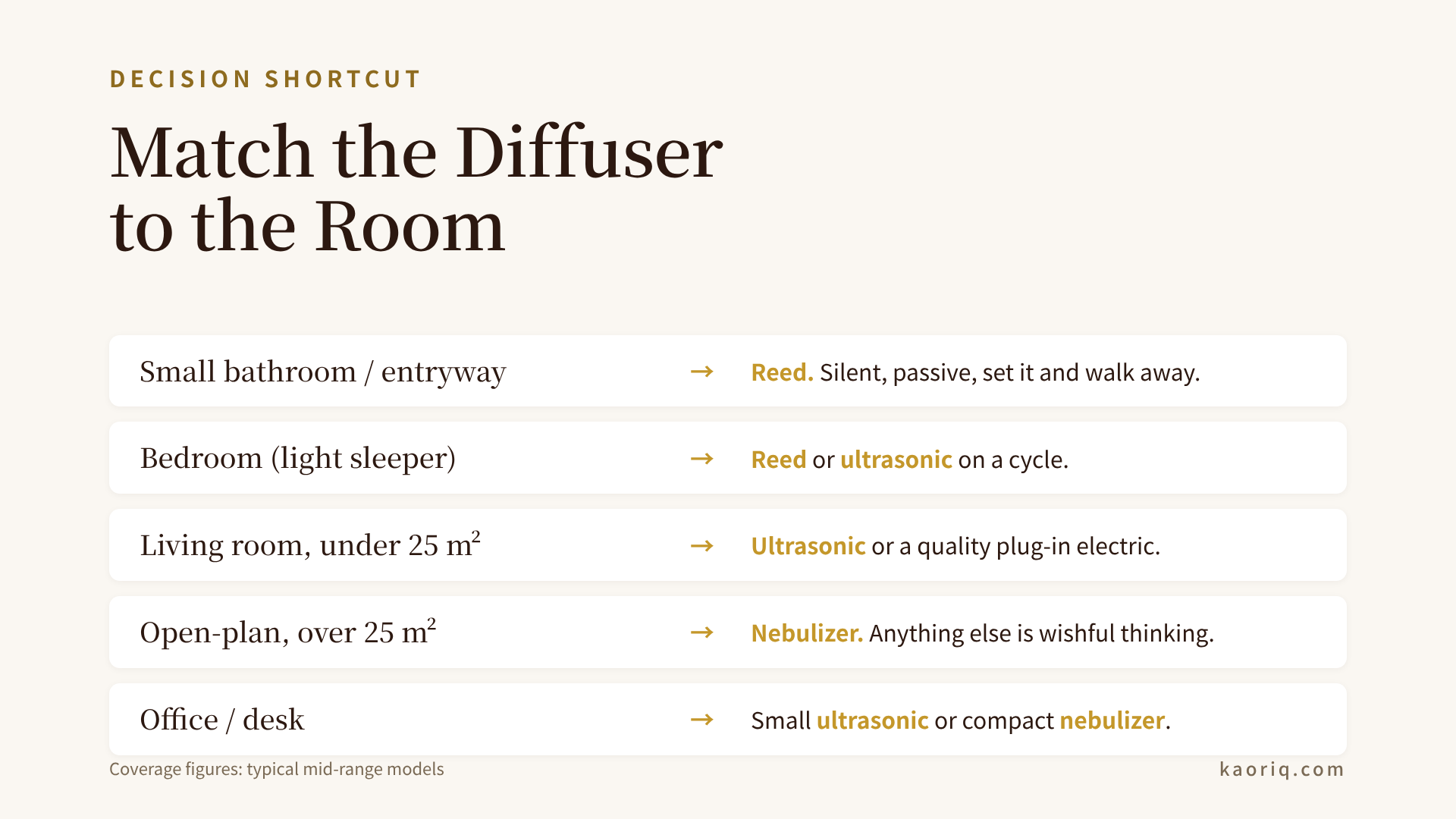
- Small bathroom / entryway: reed.
- Bedroom, light sleeper: reed or ultrasonic on a cycle.
- Living room under 25 m²: ultrasonic or a quality plug-in.
- Open-plan over 25 m²: nebulizer. Anything else is wishful thinking.
- Office / desk: small ultrasonic or compact nebulizer.
There is no single right diffuser. There is the right diffuser for the room you actually live in. Once you’ve chosen the format, the next question is which scent belongs in that room, and that’s where the air gets really personal.
If you’re not sure where to start with that part, our upcoming fragrance personality quiz will help you find which scent family fits your temperament. The hardware is half the answer. The other half is whether the room you walk into smells like you.
Was this article helpful?