Why Your Reed Diffuser Dies in Two Weeks: How to Choose One That Actually Lasts (and Fills the Room)
When a Reed Diffuser Quits in 11 Days
Here’s the usual arc. A lovely little 100ml bottle, all eight reeds jammed in like a triumphant bouquet, and for about a week and a half the hallway smells like a fancy hotel. Then nothing. Not faded. Not subtle. The reeds are still standing there, still wet, still doing absolutely nothing the nose can detect.
I assumed I’d been sold a dud. I hadn’t. I’d just made three of the most common reed diffuser mistakes in a single confident gesture.
If your reed diffuser keeps “dying” early, or never seems to reach past the table it’s sitting on, you’re not unlucky and you didn’t buy a bad one (probably). You bought the wrong one for your room, set it up to burn out fast, or picked a scent that was never going to last. All three are fixable. Let’s go.
Why Reeds Stop Smelling: the Honest Version
A reed diffuser is gloriously low-tech: rattan sticks sit in fragrance oil, capillary action wicks the oil up, and it evaporates off the tips into the air. No flame, no electricity, no app. That simplicity is exactly why it’s the most renter-friendly, no-fuss format there is. It’s also why a few small things quietly sabotage it.
Here are the real culprits behind the early death:
- You used all the reeds at once. More reeds means more evaporation surface, which means a stronger scent and a much shorter lifespan. Eight reeds in a small room is a sprint, not a marathon.
- Cheap oil with alcohol or solvent. Budget oils often cut the fragrance with alcohol to boost the initial throw. It smells great on day one and evaporates off by week two. An alcohol-free, slow-evaporating base diffuses gently for far longer.
- You parked it in the wrong spot. Heat and airflow speed up evaporation without improving how far the scent travels. A diffuser on a sunny windowsill or above a radiator is just expensive air, evaporating faster than your nose benefits.
- Your nose adapted. This is the sneaky one. After 15-20 minutes near a constant scent, your brain tunes it out. The diffuser may be working fine (a visitor would smell it instantly), but you can’t anymore.
So before you blame the bottle: a good-quality reed diffuser should run 90 days to 3-6 months. If yours died in two weeks, one of the four things above is the reason.
Which Scent Families Actually Last
Here’s the part the store never mentions: the fragrance family decides longevity before you’ve even chosen a brand. It comes down to molecular weight. Light, fresh molecules evaporate fast and travel quickly, so they’re bright but short-lived. Heavier molecules evaporate slowly, last for months, and have a stronger “throw” (how far the scent carries).
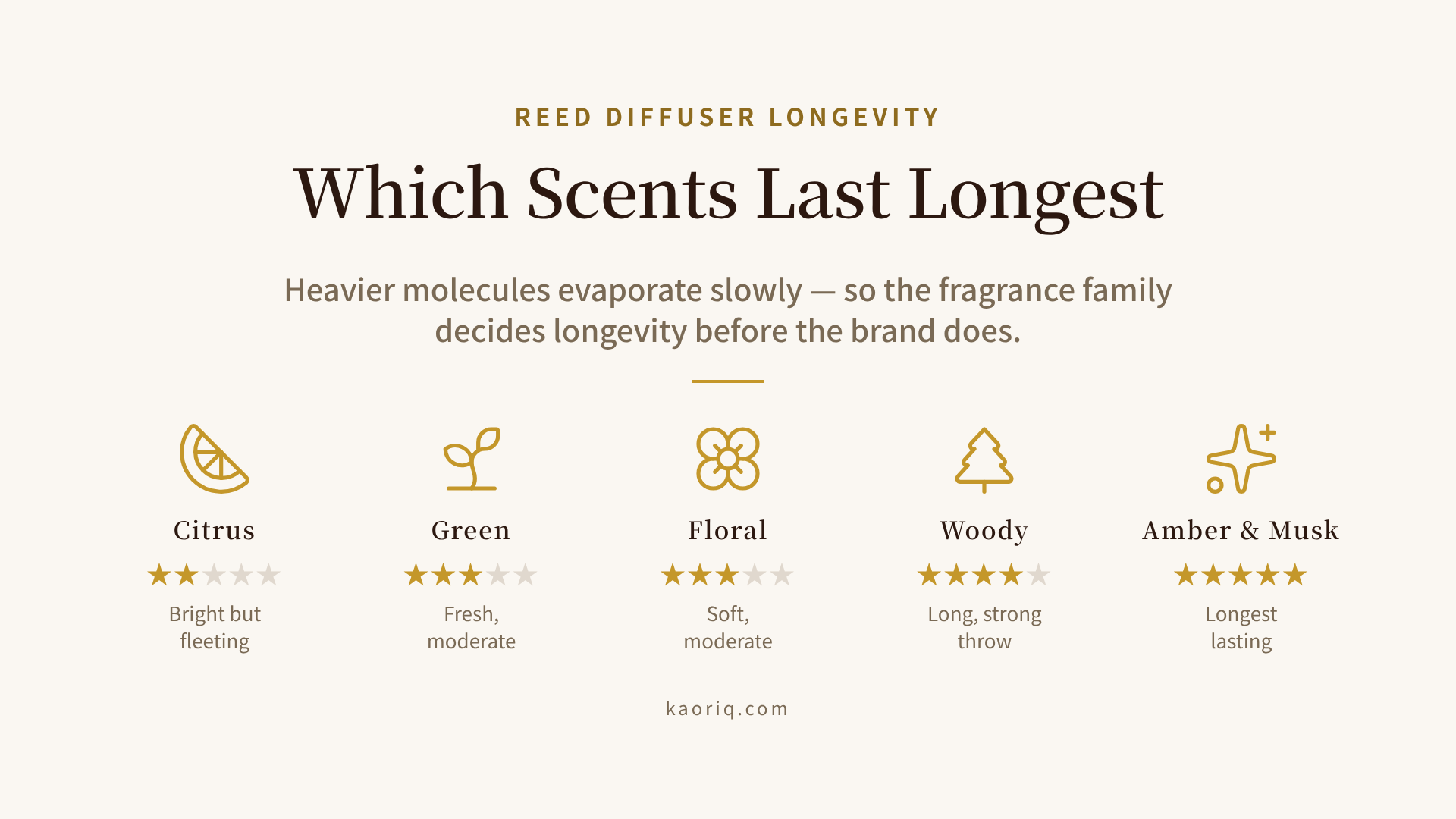
| Fragrance Family | Longevity | Scent Throw | Best For |
|---|---|---|---|
| Citrus / Fresh (bergamot, lemon, grapefruit) | ★★☆☆☆ Short | Fast but fleeting | Kitchens, bathrooms, bursts of brightness |
| Green / Herbal (basil, mint, fig leaf) | ★★★☆☆ Medium | Moderate | Entryways, studies, “clean” rooms |
| Floral (rose, jasmine, peony) | ★★★☆☆ Medium | Moderate | Bedrooms, living rooms |
| Woody (sandalwood, cedar, vetiver) | ★★★★☆ Long | Strong | Living rooms, large open spaces |
| Amber / Musk (amber, patchouli, white musk) | ★★★★★ Longest | Strongest | Big rooms, hallways, “I want it to last” |
If you adore citrus but want it to last, you’re fighting chemistry, and chemistry wins. The workaround is to choose a citrus blended over a woody or musky base, so the bright top notes sit on a heavier foundation that keeps releasing after the citrus has flashed off. A pure lemon reed diffuser in a big room is the home-fragrance equivalent of lighting a match in a wind tunnel.
How Many Reeds for Your Room
This is where most of us overcommit on day one. The fix is to treat reeds like a dial, not a switch.
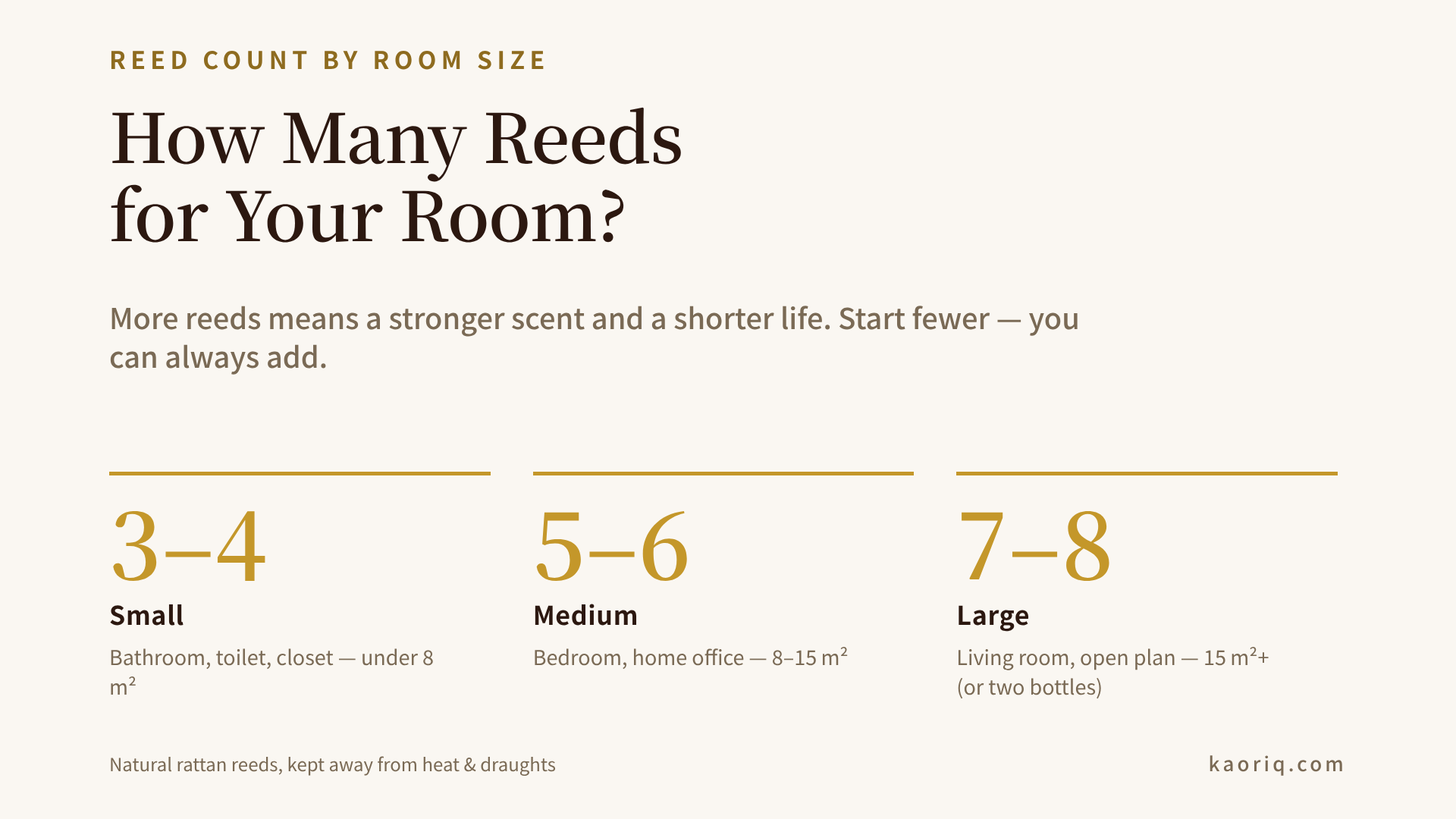
| Room | Reeds to Start | Notes |
|---|---|---|
| Small: bathroom, closet, toilet (under 8 m²) | 3-4 reeds | Add more only if you genuinely can’t smell it after a few days |
| Medium: bedroom, office (8-15 m²) | 5-6 reeds | The comfortable default for most homes |
| Large: living room, open plan (15 m²+) | 7-8 reeds, or two bottles placed apart | One bottle rarely fills a big open space alone |
Two upgrades that genuinely move the needle: natural rattan reeds wick better than synthetic fibre ones because they’re more porous, and thicker reeds (around 4-5mm) carry more oil for a stronger throw in big rooms. If your set came with thin synthetic sticks, swapping them is the cheapest performance boost available.
And the famous trick of flipping the reeds works, but use it sparingly. Inverting the sticks puts the saturated ends in the air and gives a real burst of scent. It also spikes evaporation each time, so flip once a week to revive a fading diffuser, not every day as a routine. Daily flipping is just speed-running to the bottom of the bottle.
Where to Put It
Placement is the free upgrade nobody uses:
- Avoid heat and direct sun. No radiators, no sunny sills, not on top of the TV. Heat burns through oil fast.
- Avoid strong airflow. Directly under an AC vent or beside an open window, the oil evaporates faster without travelling farther. You lose oil, not gain reach.
- Choose gentle, moving air. A hallway, a spot near a doorway, somewhere people pass through. Slow air circulation carries the scent through the home; a dead-still corner traps it.
- Lift it up. Around chest height or a little above diffuses better than floor level, because warm air rises and carries the molecules with it.
The “Which One Am I?” Bit
Here’s where it gets personal, and where I’ll stop pretending there’s one right answer. The best reed diffuser depends less on reviews and more on what you actually want from a room:
- You want it loud and long. You like walking in and knowing the room is scented. Go amber, musk, or woody, 7-8 thick rattan reeds, and lean into the strongest throw. The 2026 trend toward quiet, barely-there “clean” scents is lovely, but it is simply not for you, and that’s allowed.
- You want it soft but constant. You’d rather have a faint, always-on background than a statement. Pick a woody or soft floral, use fewer reeds (4-5) in a medium base, and let it hum quietly for months. This is the sweet spot for the “quiet fragrance” mood without it vanishing entirely.
- You want it fresh and you’ll top it up. You love citrus and green notes and you accept they fade faster. Buy smaller bottles, refresh more often, and treat scent like cut flowers: gorgeous precisely because it’s not permanent.
There’s no wrong pick here, only a wrong match. The same diffuser that delights one person reads as “overpowering” or “I can’t smell anything” to another. That’s the whole reason we think scent should start with you, not with a bestseller list. If you want to go deeper on that, here’s why your personality predicts fragrance preference better than any trend, and a plain-English tour of the fragrance families themselves.
If You Only Remember One Thing
Buy quality oil, start with fewer reeds than feel right, pick a heavier scent family if you want it to last, and keep it out of heat and draughts. Do that and a reed diffuser will quietly outlast almost any other no-flame format. That’s exactly why it’s my first recommendation for renters who can’t burn a candle.
Still deciding whether a reed diffuser is even the right tool for your space? That’s a fair question, and it depends on how big the room is and how a reed compares to ultrasonic, electric, and nebulizing diffusers, or on how room size changes which format actually works.
The setup that lasts: four reeds, a soft woody-amber, kept away from the window. Seventy days is achievable. The diffuser was never the problem.
Was this article helpful?