Room Spray vs. Air Freshener vs. Linen Spray: Which Spray Actually Solves Your Smell Problem (and Won't Stain Your Pillowcase)
Spraying What Looks Like a Room Spray on a Pillow
Spoiler: it’s a kitchen deodorizer. The kind designed to neutralize fish-curry energy at twenty paces. You go to bed smelling like a lightly fragranced freeway, and someone asks, very politely, whether you could “open a window for some reason.”
That’s the truth nobody puts on the label: the bottle marked “spray” on the shelf is actually three completely different products in matching outfits. Room spray, air freshener, linen spray. They look identical. They are not.
If you have ever stood in the aisle holding two near-identical bottles thinking surely these are the same thing, this guide is for you. Below is what each spray is actually for, when to reach for which, and the single decision rule that means you’ll never spritz a kitchen deodorizer on your pillowcase again.
The Three Sprays, Honestly
Here’s the simplest framing that finally made it click for me.
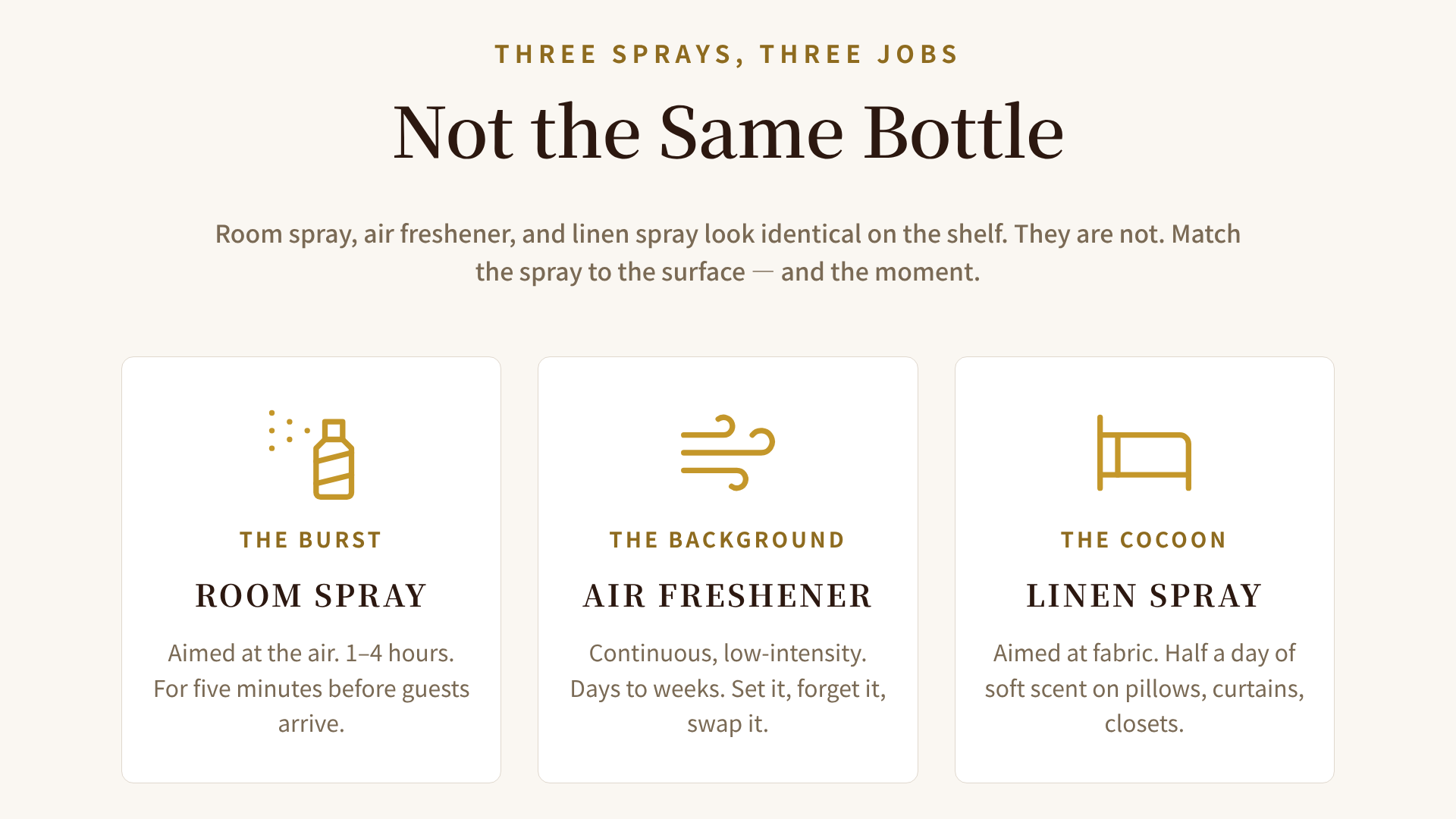
Room spray is a burst. You spritz it, the room smells nice for an hour or two, and then it’s gone. It’s the one you reach for five minutes before guests arrive, or after the dog has done something unspeakable on the rug. Concentrated fragrance, alcohol or solvent base, designed to disperse fast and fade gracefully.
Air freshener is a background. Plug-ins, gels, aerosols that drip-feed fragrance into the air for days or weeks. Lower intensity, longer runway, less ritual. The product you forget about for a month and then suddenly remember when it runs out and the bathroom starts misbehaving.
Linen spray is a transfer. You spritz it onto fabric (pillowcases, curtains, the inside of a coat), and the scent lives in the fibres, releasing gently every time you move. Softer formula, often water-based, specifically engineered not to stain. It is not a more polite room spray. It is its own thing.
If you remember nothing else from this article, remember the targets: room spray = air. Air freshener = air, but slowly. Linen spray = fabric. Get that right and you’re already ahead of most people.
The Six-Axis Comparison
The aisle gives you marketing copy. Here’s the honest version.
| Room Spray | Air Freshener | Linen Spray | |
|---|---|---|---|
| Duration per use | 1–4 hours | days to weeks | half a day on fabric |
| What it targets | the air, instantly | the air, continuously | textiles |
| Typical base | alcohol + concentrated oil | propellant + synthetic fragrance | water-based + light fragrance |
| Scent intensity | ◎ strong burst | ○ steady, moderate | △ deliberately soft |
| Safe on bedding / pets | × not on fabric | △ ventilate, keep low | ◎ designed for it |
| Best scene | guests in 5 min | bathroom, hallway, all day | pillow, curtains, closet |
A few of these deserve unpacking before they start making real decisions for you.
Duration: how long the smell actually lasts
This is the axis where the three sprays split most cleanly. Room sprays last one to four hours per application and are explicitly not built to linger. That’s a feature, not a bug. Air fresheners deliver continuous odor control throughout the day, which is exactly the trade-off: less intense, but you don’t have to think about it. Linen sprays sit in between, but on a different surface. The fragrance is held in the fabric, so it releases each time you fluff the pillow or push the curtain. You get roughly half a day of soft scent without ever spraying the air.
Target: air vs. fabric is not a small detail
This is the rule most people break. Room sprays contain enough alcohol and concentrated oil to leave rings on silk, marks on light cotton, and a sticky residue on synthetics. Linen sprays are specifically formulated to evaporate cleanly off fibres, which is the entire reason they exist as a separate product. If you’re going to spritz the pillow, use the bottle that was designed for the pillow. Your laundry will thank you.
Ingredients: not all “spray” is built the same
Room sprays are typically alcohol-forward: fast evaporation, strong throw, gone in an hour. Air fresheners often include a propellant or a slow-release wick, which is what enables the background-noise effect but also what some people object to indoors. Linen sprays lean water-based and lower-concentration, which is why they smell softer at the bottle but feel right on bedding. None of these is a moral category. They’re just engineered for different jobs.
Safety: pets, bedding, and the pillow rule
A note worth taking seriously: if you live with cats, some essential oils don’t agree with them at all, and that’s true across all three spray types. The safest move is to ventilate after any aerosol use, keep heavy-fragrance plug-ins out of small enclosed rooms, and check ingredient lists before you spray anything near a bed shared with an animal. I won’t pretend a blog can replace a vet. If you have a particularly sensitive pet, ask one. Our pet-friendly home fragrance guide goes deeper.
If you’re sensitive to synthetic fragrance yourself, the highly sensitive person’s guide covers which formats tend to be gentler.
The “Which One Do I Buy?” Decision Flow
Forget the marketing photos and the scene-setting product names. Ask yourself one question.
1. What’s the timing?
- Guests in five minutes, room currently smells like dinner. → Room spray. Two spritzes by the entryway, one in the bathroom. Done. (For the full pre-guest sequence, see our 90-minute hosting guide.)
- It’s Tuesday and I want the bathroom to smell consistently okay all month. → Air freshener. Plug-in or gel, set it, forget it, swap the cartridge when it stops working.
- I want my bedroom to feel like a soft hug at 11pm. → Linen spray. Two pumps on the pillow before you make the bed in the morning, and the scent will be there waiting when you climb in.
2. What surface are you aiming at?
If your answer involves the word fabric at any point (pillow, curtain, sofa, scarf, inside-of-a-coat), the answer is linen spray. Not “a softer room spray.” Not “I’ll just stand farther back.” Linen spray. The product engineers literally made it for this reason.
3. How much do you want to think about it?
Room sprays demand presence: you have to remember to spritz. Air fresheners are background plumbing; you only think about them when they fail. Linen sprays are a small ritual: a couple of pumps in the morning, payoff at night. Pick the one that matches the kind of attention you’ll actually give.
The kaoriq Take: Match the Spray to Your Energy
Here’s where I think most spray guides stop too early. Choosing between three bottles isn’t only about the bottles. It’s about how you want your home to feel and how you tend to live in it.
If you’re an extrovert who hosts a lot, a great room spray is your secret weapon: the five-second ritual that resets the apartment before people arrive. (We unpack this in the extrovert home fragrance guide.)
If you’re more introverted and your home is a recharge station, linen spray probably matters more than either of the others. It builds a soft, personal cocoon you live inside, not a stage you perform on. The introvert recharge guide is the companion read.
If you’re particularly sensitive to fragrance (the kind of person who gets a headache in a department store), start with a water-based linen spray on bedding only, skip the plug-in entirely, and use room spray sparingly and well-ventilated.
The bottle is the easy part. The harder, more interesting question is which of those three flavours of fragrance (the burst, the background, the cocoon) actually fits the way you live. That’s not a question you can answer in an aisle. But it is the question worth asking before you buy anything.
If You Take One Thing
Don’t buy a “spray.” Buy the right one of three sprays.
- Room spray for the burst before guests, or after the kitchen got dramatic.
- Air freshener for the rooms that just need to behave themselves all day.
- Linen spray for everywhere fabric touches skin: pillows, curtains, the closet.
And if you’re curious which of the three best fits your personality and home rhythm, that’s the rabbit hole our personality-based fragrance guide was built for. Five minutes, a clearer answer than another hour in the aisle.
Just, please, don’t spray the kitchen deodorizer on your pillow. Learn from my mistakes.
Was this article helpful?