The 90-Minute Hosting Scent Plan: A Three-Phase Guide to Fragrance Before Guests Arrive
The Candle Lit Six Minutes Before Guests Arrive
I have a confession that I think most hosts share, even if no one will admit it.
For a lot of people, the entire “preparing my home for guests” scent strategy is lighting a candle approximately six minutes before the doorbell. Sometimes four. Occasionally while walking to the door.
The candle doesn’t have time to do anything. It just sits there, gently emitting hot wax fumes, while the apartment continues to smell exactly like the chicken that was roasting twenty minutes earlier. Guests walk in, sniff politely, and everybody pretends the room smells the way it was supposed to.
It does not. It smelled like chicken. With notes of late-lit candle.
If you host even occasionally, you’ve probably done some version of this. The good news is that scenting your home for guests is not really about finding one perfect candle. It’s about a sequence: what you do at ninety minutes out, what you do at thirty minutes out, and what you do while everyone is in the room. Below is the version I wish someone had handed me before the chicken incident.
Why Hosting Needs Its Own Scent Logic
Your everyday home scent has an easy job: please one or two people who are mostly nose-blind to it anyway. Your hosting scent has a harder one.
Three things change the moment guests walk in.
1. The room fills with new noses. Yours are adapted. Theirs aren’t. The candle you can barely smell anymore is, to them, the headline scent of the evening.
2. Cooking smells take over. Roasted things, fried things, garlic, fish: all of it builds for an hour before anyone arrives. By the time your guests cross the threshold, the kitchen has been broadcasting at full volume into the rest of the house.
3. Bodies arrive. Six people in a small living room raise the temperature, the humidity, and the load on your fragrance. A diffuser that read as “perfect” when the room was empty starts to feel either thin (drowned out) or suddenly intense (warmed up).
Most “dinner party scent” advice ignores all three. It tells you to light a nice candle and trust the universe. The universe, in my experience, smells like chicken.
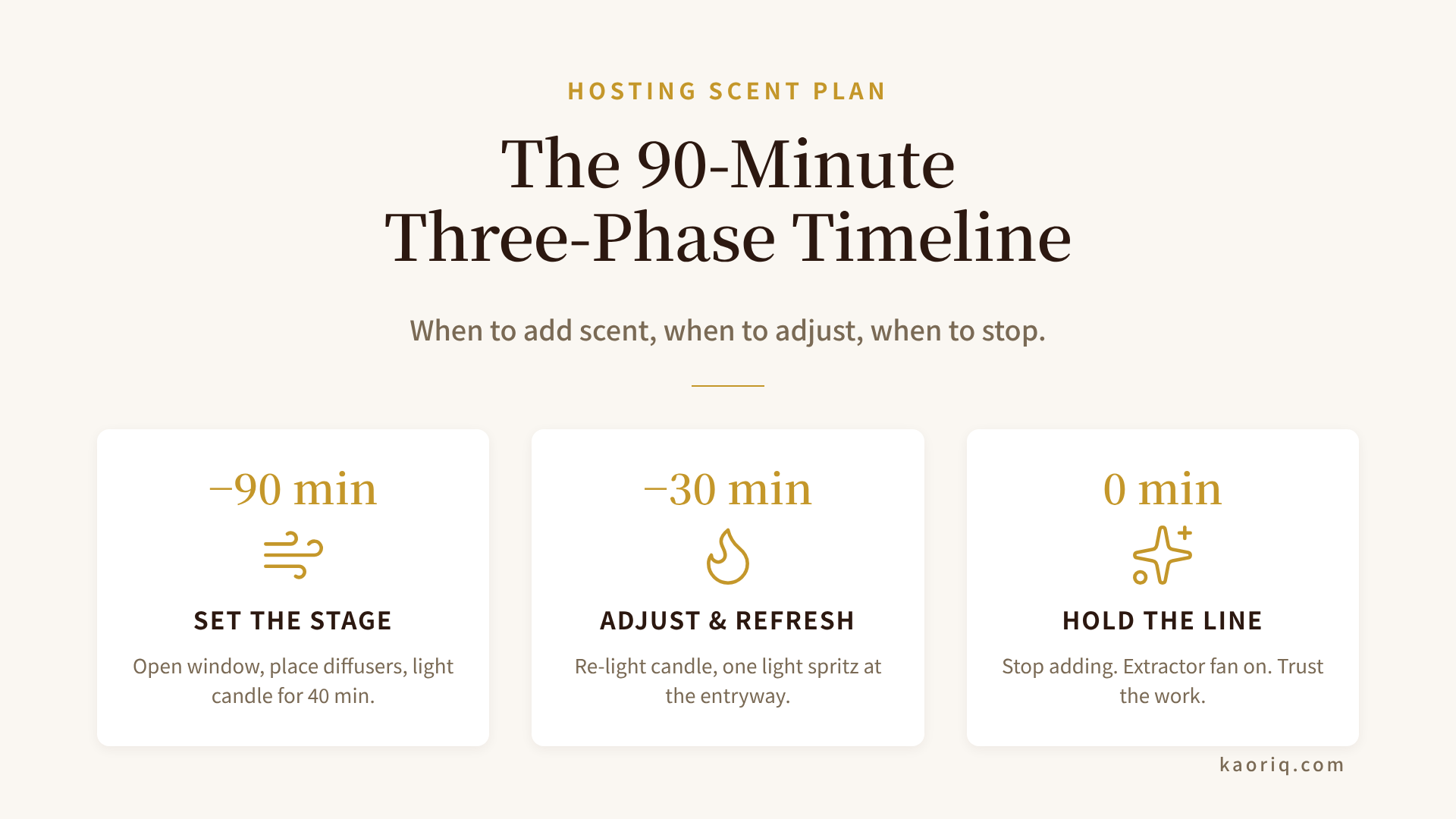
Phase 1, Ninety Minutes Out: Set the Stage
This is the phase almost everyone skips, and it’s the one that decides the whole evening.
Ninety minutes is enough time for a low-output diffuser, a brief candle burn, or an open window to do real work. It’s also enough time for your nose to fully adapt, which means whatever you set up now will register strongly to guests and barely at all to you. That’s exactly what you want. You don’t need to smell it. They do.
What to do:
- Open a window for ten minutes. This is the single highest-impact move you’ll make all evening. Cooking smells dilute, the kitchen resets, and the room can take on a new scent rather than layering one on top of another.
- Place reed diffusers or plug-ins in the rooms guests will use. Living room, entryway, bathroom. Not the kitchen, and not the dining table.
- Light a candle now if you’re going to use one. Burn it for thirty to forty minutes, then blow it out. The candle’s “first impression” comes from the warm wax pool, not the flame at the moment guests arrive.
The goal of Phase 1 is to lay down a quiet base scent that the room has time to accept as its own. By the time you move to Phase 2, the scent should already feel ambient, not perfumed.
Phase 2, Thirty Minutes Out: Adjust and Refresh
Now you check your work. Close the windows. Walk back into the apartment from the hallway, the way a guest will. Then decide what to do.
What to do:
- Re-light the candle (if you blew it out earlier) in the room where guests will linger most. Living room or entryway. Not the dining room. Not within three feet of the food.
- One light spritz of a room spray in the entryway. Just one. Spray it toward the ceiling, not at the door. This is the “first impression” sentence.
- Skip the bathroom for now. Phase 3 has a specific bathroom move, and pre-scenting it tends to overdo things.
If you’re tempted to add a second candle in another room, please don’t. The combined output of two candles in adjacent rooms is the single most common way well-meaning hosts produce that hotel lobby smell. Pleasant in concept, headache in practice.
Phase 3, Guests Are Here: Hold the Line
This is the trickiest phase, and the one most people overcomplicate.
Once guests arrive, your job is no longer to add scent. It’s to keep the existing scent stable while the conditions in your home shift around it. Bodies, conversation, kitchen activity: everything is now competing.
What to do:
- Leave the candle alone. Don’t move it, don’t light a second one, don’t switch scents mid-evening. Your guests have already calibrated their noses to what’s there.
- Take the kitchen seriously. Strong cooking smells will roll out during plating and serving. The fix is mechanical, not aromatic: extractor fan on, kitchen door (if you have one) closed, separate hand soap in a non-competing scent.
- The bathroom move: Before guests arrive, place a single small reed diffuser or a hand soap with a clear, simple scent (lemon, neroli, soft eucalyptus) in the bathroom. Nothing else. Bathrooms are the one room every guest visits alone and notices acutely.
If something goes wrong mid-evening (fish too aggressive, dog smell, an accidental kitchen catastrophe), the rescue tool is a room spray in the entryway only, after the offending source is dealt with. Not before. Spraying perfume on top of fish smell does not fix the fish. It just produces fish in a bouquet.
Room Roles at a Glance
The biggest mistake hosts make is treating the whole apartment as one scent canvas. It isn’t. Different rooms have different jobs.
| Room | What it should do | Intensity |
|---|---|---|
| Entryway | Make the first four seconds count | Medium-high (the only room you can be slightly bold in) |
| Living room | Comfort, conversation, “this person has good taste” | Medium, warm, low-key |
| Dining area | Stay out of the food’s way entirely | None. Unscented, or extremely faint |
| Bathroom | Clean and simple, not floral-perfumey | Low, single-note |
| Kitchen | Whatever the food is doing, plus a clean hand soap | None added |
If you remember nothing else: scent the entryway, restrain the living room, leave the dining table alone. That’s eighty percent of the work.
Common Failures (All of Them Extremely Easy to Commit)
For the record, in case you’re tempted:
- Lighting the candle six minutes before guests arrive. Already covered. Useless. Set a phone reminder for ninety minutes out instead.
- Layering three different fragrances “to make it richer.” What this actually makes is a headache. One scent direction per evening, please.
- Scenting the dining table. Even subtle table-side candles compete with the food, especially with anything floral or sweet. Use unscented candles for dining.
- A new fragrance you’ve never tried before. Hosting night is not the night. Your nose hasn’t calibrated to it, so you can’t tell if you’ve overdone the spray. Use something familiar.
- Strong incense before guests with allergies or asthma. Cedar and frankincense smell beautiful and will absolutely close some people’s throats. When in doubt, default to lighter formats.
The Personality Layer
Once the mechanics are in place, the direction of the scent is where personality starts to matter, and where most hosts choose badly by copying someone else’s playbook.
Roughly:
- Outgoing, “the apartment is a stage” hosts: Go a step bolder than your everyday scent. Bright top notes (citrus, neroli, ginger) in the entryway, warm amber or sandalwood in the living room. Guests should feel the room has opinions.
- Quietly conscientious, “everything in its place” hosts: Soft florals (jasmine, magnolia) and clean woods. The scent reads as care, not performance. Stop one shade lighter than you think you should.
- Curious, novelty-seeking hosts: Unusual notes (fig, smoked tea, vetiver, iris) for guests who already know your taste. Save these for people who’ll appreciate the choice. With first-time guests, default to the conscientious version instead.
- Warm, harmony-seeking hosts: Soft sweetness, vanilla-adjacent woods, baked-bread accords. The home as a hug. The risk here is going too sweet. Keep the entryway slightly drier than the living room to give the nose somewhere to land.
If you don’t yet know which of these you are, our why personality predicts fragrance preferences piece is the longer version of the argument. And for the entryway specifically, the entryway welcome scent guide drills further into format and notes.
The Cheat Sheet
Screenshot this if nothing else:
| Time | Action | Where |
|---|---|---|
| −90 min | Open window 10 min, place diffusers, light candle | Living, entryway, bathroom |
| −30 min | Re-light candle, one light spritz at the ceiling | Entryway only |
| −15 min | Extractor fan on, kitchen door closed if possible | Kitchen |
| 0 min | Stop adding. Trust the work. | Everywhere |
| Mid-evening rescue | Room spray after dealing with the source smell | Entryway only |
What to Know Before the Chicken
Two things.
One: the goal is never for guests to notice the scent. It’s for them to step inside, feel the room is well-cared-for, and forget about it forty seconds later. If anyone says “wow, what’s that smell?” you’ve slightly overdone it. The next time, dial it back a notch.
Two: hosting fragrance is more about timing than products. A modest reed diffuser placed ninety minutes early will outperform a stunning candle lit at the doorbell. The discipline is in the schedule, not the shopping.
A setup that holds up: a soft cedar-and-bergamot diffuser in the entryway, started thirty minutes before guests; an amber candle in the living room, burned for forty minutes and then snuffed; a small neroli reed in the bathroom; absolutely nothing on the dining table; and an extractor fan treated with the reverence usually reserved for expensive perfume.
The chicken, for the record, is allowed to smell like chicken. It’s the dinner. The fragrance just has to make space for it.
Was this article helpful?