The Introvert's Home Fragrance Guide: 5 Scents That Turn Your Apartment Into a Recharge Station
A Saturday Brunch Will End Me By 2 P.M.
Picture a Saturday brunch. Eleven people, three hours, one round of small talk about someone’s startup pivot that you nod through while internally calculating the earliest socially acceptable exit. You get home at 2:30, take your shoes off in the hallway, and then stand there for a full minute trying to remember what to do with your own apartment.
The lights are too bright. The dishwasher is humming in a way you have never noticed before. You need something. Not silence, exactly — more like a kind of olfactory shoulder squeeze that says you’re home, you don’t owe anyone a sentence for the next six hours.
The candle most people reach for at that moment is, frankly, the wrong one — something bright and fruity that makes the room louder. Which points at something useful: for introverts, home fragrance is infrastructure. It is the thing that quietly does the work of putting your nervous system back together when you walk through the door.
What “Sensory Load” Actually Is
Susan Cain’s Quiet re-introduced introversion as a real, biological wiring difference rather than a personality flaw or a phase you’d grow out of with enough networking events. Elaine Aron’s research on the highly sensitive person overlapped: somewhere between 30% and 50% of introverts process sensory information more deeply, which means more noticing, more thinking, and more depletion per hour of input.
In plain English: an introvert’s nervous system has a smaller daily budget for stimulation. By 6 p.m. on a meeting-heavy day, the budget is gone. Home becomes a place to balance the books before tomorrow.
Room scent is doing a small but real job here. Olfactory input bypasses most of the brain’s filtering and lands directly in the limbic system, the part that decides whether the body is on or off duty. The right scent flips the switch faster than tea, faster than a hot shower, sometimes faster than silence itself.
So the question stops being “what scent do I find pretty” and becomes “what scent tells my nervous system it’s allowed to stand down.”
The Five Scenes
I sort home fragrance by moments through the day, with the rooms playing a supporting role. What matters more is the job your body is asking that moment to do.
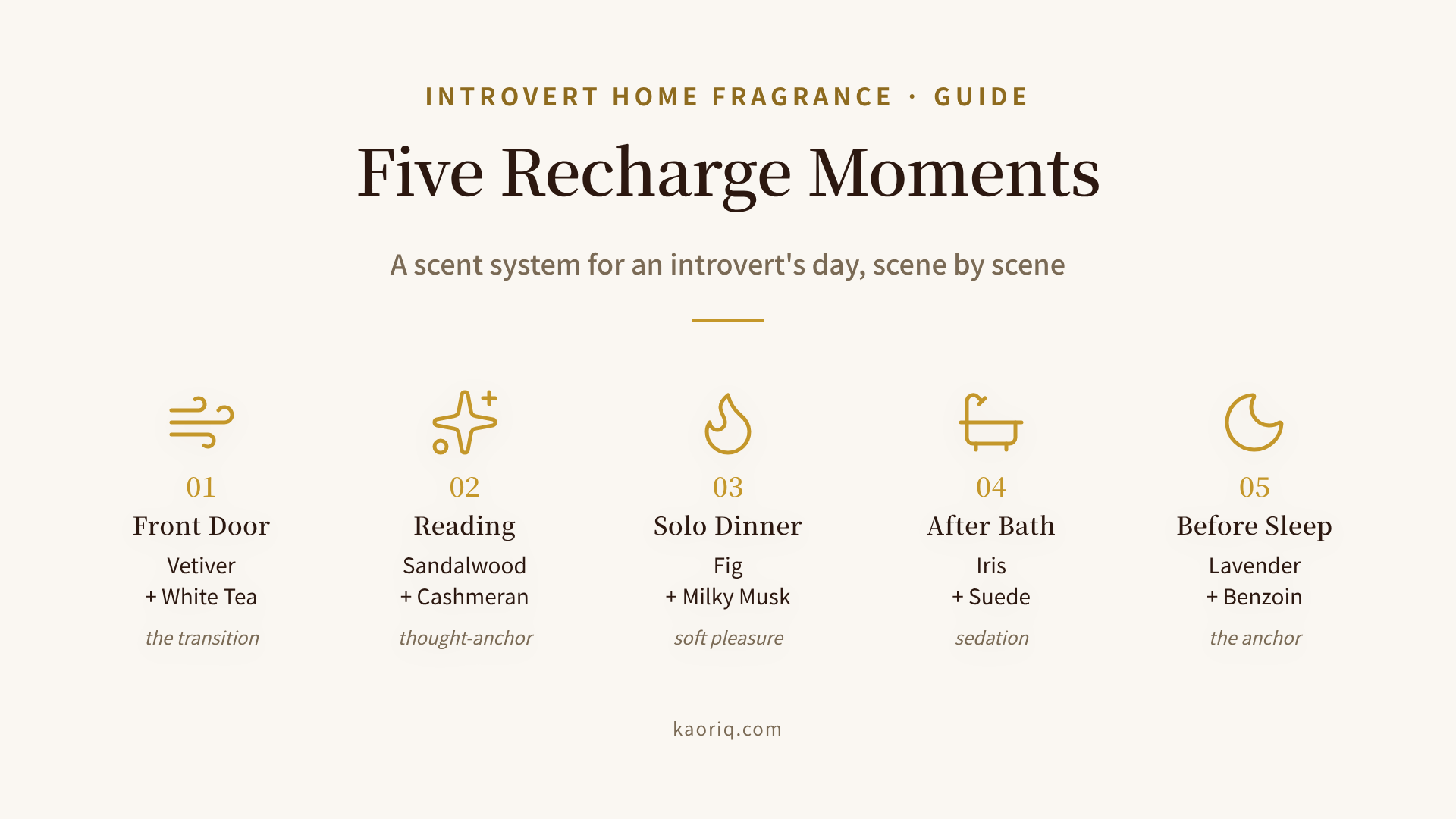
1. The Front Door: The Transition Scent
Goal: close the loop between Out There and In Here.
The most important scent in your apartment is the one that hits you within three seconds of walking in. This is your transition cue, your nervous system’s “the show is over” signal.
- Vetiver + white tea in a reed diffuser, low refill volume. Vetiver is grounded and slightly damp, the smell of wet earth after rain. White tea adds a thin clean note on top, like a window cracked open. Together they say the noise stops here without being precious about it.
What to avoid at the entryway: anything sharp or peppery. Those notes re-trigger the alertness you spent the whole day burning off.
2. Reading: The “My Thoughts Are Mine Again” Scent
Goal: a scent that doesn’t compete for the foreground of your attention.
For introverts, reading is how the inner monologue gets the floor back after a day of being interrupted. The fragrance has to be present enough to anchor the body in the chair, but quiet enough that it isn’t co-authoring your thoughts.
- Sandalwood + cashmeran, a single-wick candle, ideally a small jar that won’t perfume the whole flat. Sandalwood is the elder statesman of contemplation scents. There are reasons it has lived in temples for two thousand years. Cashmeran (a synthetic musk that smells like warm wool) gives it a softer, more contemporary edge.
What to avoid: anything fruity. Fruit notes pull the brain toward consumption. You want it pulled toward stillness.
3. The Solo Dinner: The Soft Pleasure Scent
Goal: make a Tuesday night feel like an occasion you chose.
Eating alone is, for many introverts, secretly one of the best parts of the week. The lighting is whatever you want. There’s no conversation tax. The risk is that without any effort it tilts toward “sad desk dinner,” even when you’re nowhere near the desk.
- Fig + a milky white musk in a small diffuser by the dining area, or a pillow mist gently spritzed across the chairs ten minutes before you sit down. Fig has a complicated leafy-sweet quality that smells expensive without smelling like dessert. The milk note softens it into something that feels like company.
What to avoid: vanilla-heavy gourmands. They tip the room into “bakery” and you will want more food than you actually need.
4. After a Bath: The Sedation Scent
Goal: help the body stay in the parasympathetic gear it just found.
A long hot bath drops your cortisol and your core temperature in the hour afterward. The window between drying off and falling asleep is the most efficient regulation window of the entire day. The scent here matters more than most people realise.
- Iris + suede as a low-throw room spray, or a single ceramic burner with a calibrated essential oil blend. Iris (orris root) has a powdery, slightly cold, almost melancholy quality that perfumers call “introspective.” Suede adds a softness like a second towel. The combination pumps you down, gently, the way a heavy book on your chest does.
What to avoid: anything described as “uplifting” or “energising.” You worked hard to get the cortisol down. Don’t undo it before you’ve even put pyjamas on.
5. Before Sleep: The Anchor Scent
Goal: a scent your body learns to associate with falling asleep, full stop.
This is the only scent in the rotation that should be a little boring. The whole point is conditioning: night after night, the smell precedes sleep, and eventually it triggers sleep on its own. Complexity here works against you.
- True lavender + benzoin, as a single-note pillow mist or a small bedside candle (extinguished before you doze off — bedside candles and duvets are a known combination). Lavandula angustifolia, not the cheap synthetic stuff, has small but reliable sedative effects through the linalool pathway. Benzoin adds a faint sweetness that smooths the slightly medicinal edge.
What to avoid: blends with bergamot or citrus on top. Bright top notes wake the nose back up just when you wanted it to clock out. If sleep is the chronic problem, the longer bedroom fragrance sleep guide has more on this.
A Quick Comparison
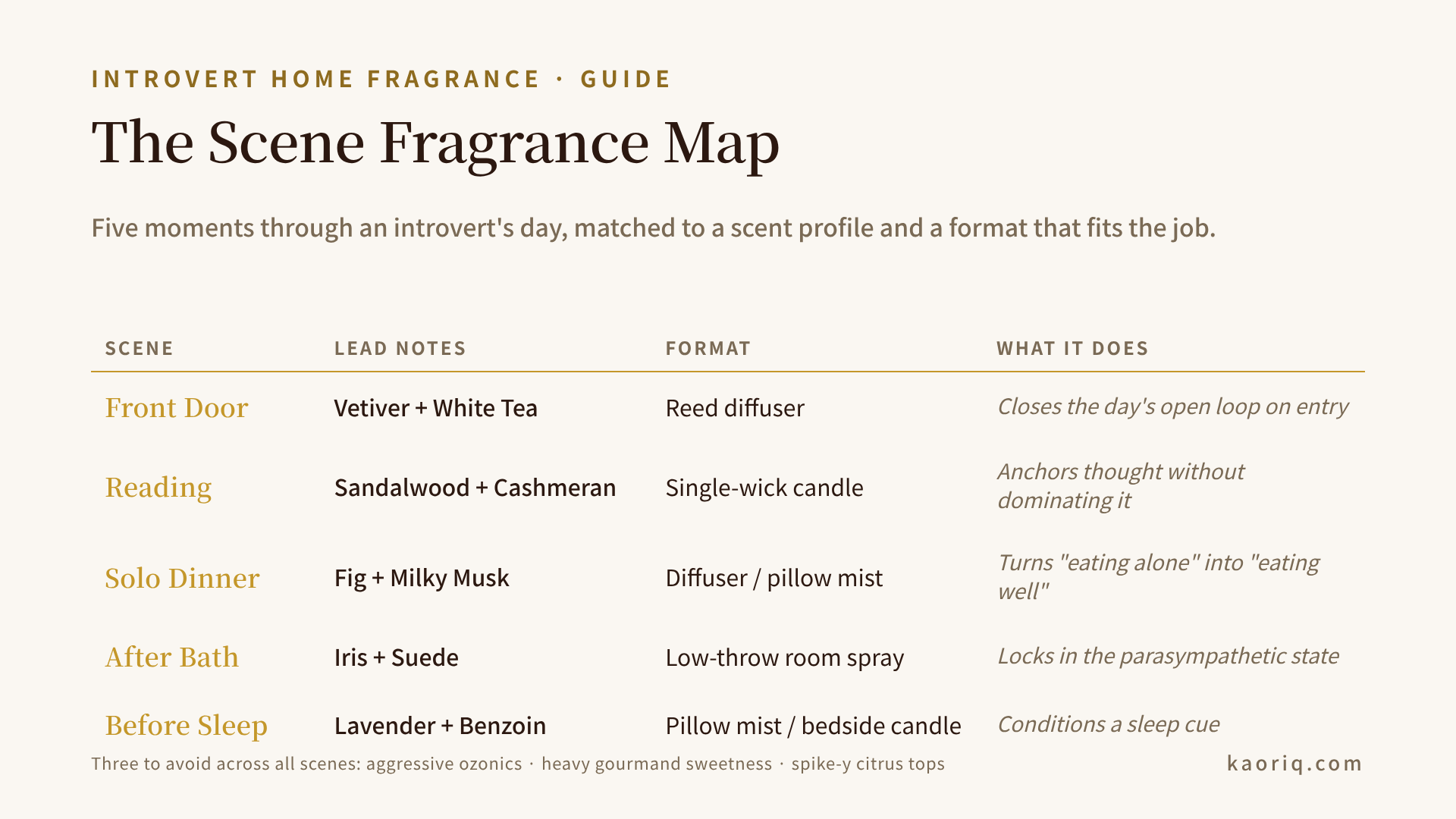
| Scene | Lead notes | Format | What it does for an introvert |
|---|---|---|---|
| Front door | Vetiver + white tea | Reed diffuser | Closes the day’s open loop on entry |
| Reading | Sandalwood + cashmeran | Single-wick candle | Anchors thought without dominating it |
| Solo dinner | Fig + milky musk | Diffuser / pillow mist | Turns “eating alone” into “eating well” |
| After bath | Iris + suede | Low-throw room spray | Locks in the parasympathetic state |
| Before sleep | Lavender + benzoin | Pillow mist / bedside candle | Conditions a sleep cue |
Three Things to Avoid Across All Five Scenes
If you’re an introvert designing a fragrance system for your home, three categories will sabotage you no matter where you put them.
- Aggressive ozonics. “Clean,” “fresh laundry,” “sea breeze.” These smell like an open-plan office. Your nervous system will read them as “still at work.”
- Heavy gourmand sweetness. Cake batter, marshmallow, salted caramel candles. Cute on a shelf, but they raise dopamine and pull you toward consumption when you needed regulation.
- Spike-y citrus tops on evening fragrances. A grapefruit candle at 7 a.m. is a gift. The same candle at 10 p.m. is an enemy. Citrus tops re-stimulate the alertness system you just spent the day fighting.
Home Is the Recharge Station
If you’re an introvert, and especially if you’re somewhere on the highly-sensitive end of the spectrum, your home is doing more emotional work for you than most people’s homes do for them. It is, quite literally, where your nervous system gets to renegotiate the next day’s contract.
Scent is one of the cheapest, most direct levers you have on that negotiation. It’s faster than dimmer switches, quieter than music, easier than rearranging furniture.
The right introvert home fragrance system doesn’t smell like a brand. It smells like the room you finally get to be in.
If you don’t know which scenes are loudest in your week, the personality-fragrance overview lays out the science underneath. And if you’re not sure whether you’re more “front door” or “before sleep” person, you almost certainly already know. Pay attention to which moment of the day you were daydreaming about while everyone else at brunch was still ordering coffee.
Was this article helpful?