Best Iris & Orris Home Fragrance 2026: Powdery, Rooty, and Modern-Bright Candles and Diffusers (by Personality)
The $200 Iris Candle That Smells Like Carrots
Light a genuinely iris-heavy candle for the first time and the reaction is usually some version of “I think there’s something wrong with this one, it smells like a vegetable.” There isn’t. Iris in perfumery is not the flower. It’s the root. Earthy, chalky, faintly carrot-adjacent. That’s the material working exactly as intended.
If you’ve bought a candle described as “iris” or “orris” and thought either “this smells like nothing” or “this smells like the ground,” you are not broken and the candle probably isn’t broken either. Iris is one of the most misunderstood ingredients in home fragrance, and it splits into three very different personalities depending on how it’s used. This guide is the map that saves you $200 confirming that carrots exist.
If you want the long, slow story of why orris behaves this way (three years underground, three years in a Tuscan cellar, more expensive than gold by weight), I wrote it here: The Iris Root That Hides in Every Luxury Fragrance. This guide is the practical follow-up: what to buy for your home, and which iris flatters which room and which person.
The Three Iris Families for Your Home
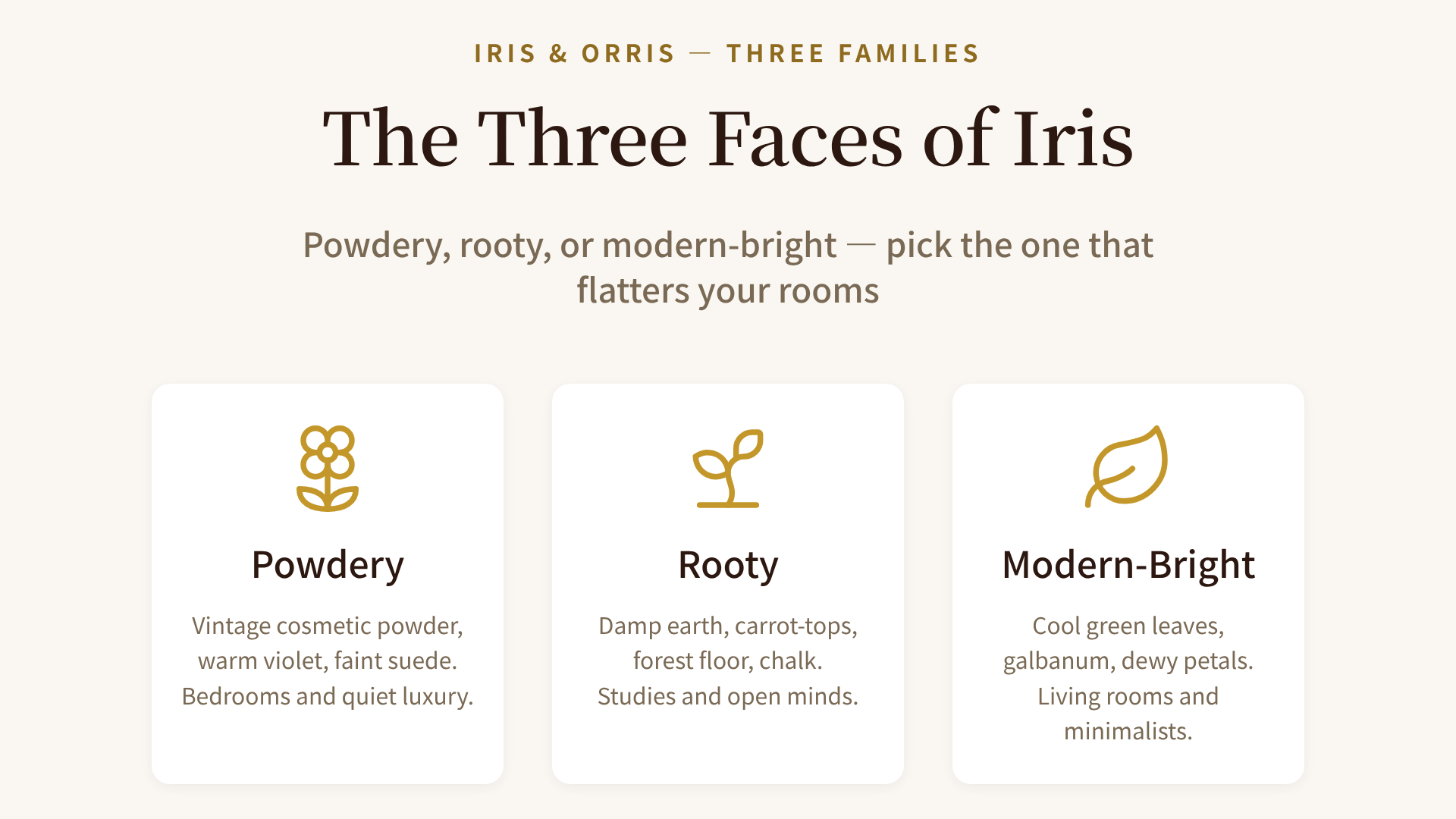
Iris in home fragrance almost always falls into one of three camps. The candle label rarely says which, so learning to smell the difference is what turns “expensive candle roulette” into confident buying.
| Family | Smells Like | Rooms It Flatters | Personality Match |
|---|---|---|---|
| Powdery Orris | Cosmetic powder, warm violet, faint suede | Bedroom, dressing area, reading nook | Quiet-luxury seeker, HSP, introverts |
| Rooty Orris | Damp earth, carrot-tops, forest floor, chalk | Study, entryway, library, small den | Openness-high, comfortable with strange |
| Modern-Bright / Green Iris | Cool green leaves, galbanum, dewy petals | Living room, home office, wide hallways | Conscientiousness-high, minimalist |
If you’re only going to remember one thing: powdery is the friendly one, rooty is the challenging one, green is the clean one. Most beginners fall in love with powdery first and either graduate to rooty or stay happily powdery forever. Both are fine outcomes.
Powdery Orris — The Vintage Luxury Side
This is the iris that hides inside expensive perfumes and that costs $200 as a candle. Frédéric Malle’s Iris Poudre is the reference: aldehydic, cashmere-sweater, unmistakably grown-up. In the home, powdery orris shows up in candles built on iris + violet + suede or iris + sandalwood + amber. It should feel like a well-kept vintage handbag: soft, closed, faintly cosmetic. Never sharp.
Rooty Orris — The Raw-Material Side
Christian Louboutin’s Fétiche L’Iris is only two notes: orris and patchouli. That’s the rooty family in a bottle. In the home, rooty orris often comes as an unblended fragrance oil for cold-air diffusers (Aroma360’s Iris scent, or DIY blends with orris absolute) or in niche candles that lean into carrot-and-chalk rather than powder-and-violet. It rewards patience. The first ten minutes can smell odd; the next three hours smell like a hushed cathedral.
Modern-Bright / Green Iris — The Clean Side
Chanel N°19 is the historical reference: iris with galbanum and violet leaf, cool and aristocratic. In home fragrance, this family shows up in candles and reeds where iris is paired with vetiver, moss, or green tea. It’s the iris for people who bounce off “powdery” as a compliment. It reads as composed, not soft.
Format Guide: Candles, Reeds, or Ultrasonic?
Iris behaves differently in each format. Choose by how you actually use the room, not by which format is trendiest.
Candles
Iris candles reward slow, honest burns. The powdery family melts into a mid-note nicely after 20 minutes; if you snuff the wick at 5 minutes you’ll miss the whole point. Try 1502 Candle Co. Iris & Santal Apothecary Jar: cardamom and melon open, then powdery orris and violet settle into santal and amber. It’s a forgiving introduction to the family. For a smaller commitment, the same brand’s travel tin candle or fragrance mist give you the profile at lower risk.
If you’re new to iris and worried about spending, a small candle (under 4 oz) in the powdery family is the cheapest way to find out whether iris is your thing without committing to a $200 jar.
Reed Diffusers
Reeds are where iris earns its keep for continuous, low-effort home fragrance. The 1502 Iris & Santal Reed Diffuser No. 2 runs 4 ounces across eight rattan reeds for five-plus months, a long, quiet, ambient tour through cardamom, orris, violet, santal, and amber. Place it somewhere the air moves (a hallway that catches a door swing works better than a still corner), and let it do its thing.
Rule of thumb: for orris, one reed diffuser per 200-square-foot room is enough. Two is a mistake, because iris has volume you don’t realise until you double it.
Ultrasonic Diffuser + Essential Oil Blends
Pure orris absolute is priced like a small emergency, so most home ultrasonic blends use iris accord (a synthetic-natural blend) rather than the real material. That’s fine; it lets you experiment. A gentle starter blend: 3 drops iris accord, 2 drops sandalwood, 1 drop violet leaf. Run it in short bursts (30 minutes on, an hour off), because orris fatigues the nose fast and rewards restraint.
Waterless cold-air diffusers like Aroma360’s Iris system are the luxury tier of this format. Coverage runs from 600 to 6,000+ square feet, and the fragrance holds character better than through steam. Worth it if you want signature-scent coverage across an open-plan space.
Match Iris to Your Personality
If you already know your Big Five (or have taken a fragrance-personality quiz), the iris family that flatters you is usually predictable. If you haven’t, here’s why personality actually matters for fragrance and how to find yours.
- Highly Sensitive Person (HSP) / low-stimulation seekers: Powdery vintage orris. Small candle, dim room, one wick. See the fuller playbook in our HSP home fragrance guide.
- Conscientiousness-high / minimalists: Modern-bright green iris. Reed diffuser, single location, no rotation. Iris + vetiver works especially well.
- Openness-high / novelty-seekers: Rooty orris. Unblended, weird, and it will start conversations. See openness and fragrance novelty if this is you.
- Introverts / quiet-luxury seekers: Orris + sandalwood combos in reed form. Pairs well with the quiet luxury home fragrance approach.
- Extraversion-high / signature-scent people: Skip pure iris in home format — it’s too quiet for a signature. Use it as a base under a louder floral (see below), or reach for Diptyque/Jo Malone/NEST luxury brands by personality.
Unsure which family fits your rooms overall? Start upstream with Find Your Fragrance Family: A Beginner’s Guide. Orris tucks into both the Floral and Amber families depending on how it’s paired.
Pairing Rules That Actually Work
Iris is a supporting actor’s actor. It rarely leads a scent; it lifts whatever it’s next to. A few rules that stop you buying orris that fights with your other room fragrance:
- Orris + Sandalwood — creamy, forgiving, the safest pairing. The 1502 line proves this at the reed and candle level.
- Orris + Rose — vintage-perfume in the best way. Feels like a hotel powder room from 1965.
- Orris + Violet — doubles down on powdery. Beautiful in a bedroom, cloying in a kitchen.
- Orris + Cedar — sharpens iris toward the modern-bright end. Good for offices.
- Orris + Vanilla — softens iris into gourmand territory. Cozy, autumn-leaning.
Avoid orris + heavy amber, orris + sweet gourmand, or orris + fresh citrus. Iris gets buried under warmth, drowned in sugar, or contradicted by sharpness. It needs quiet neighbours.
Where NOT to Use Iris in Your Home
- Kitchens. Cooking smells win against orris every time. Save iris for rooms that only smell of themselves.
- Small bathrooms with poor ventilation. Powdery orris turns claustrophobic in tight, humid air.
- Kids’ bedrooms. Iris reads as adult — nothing wrong with that, just wrong audience.
- Anywhere you also plug in a synthetic “linen” plug-in. They’ll cancel each other out and you’ll blame the iris.
Iris is a room-mood ingredient. Use it in rooms you sit still in.
Bottom Line
Buy powdery orris first, in a small candle or a mid-sized reed diffuser, and put it somewhere you actually spend quiet time. If you love it, graduate to a signature-scent format across a bigger room. If you love it and it feels too polite, try a rooty orris (Louboutin, Aroma360, or a DIY orris + patchouli blend) and see whether the strange side is your side. Either way, iris is one of the few home ingredients that gets more interesting the longer you live with it. That’s what six years in a cellar is buying you.
If you liked this and want the origin story of why iris is priced like gold, that’s here. Keep for the home. Not for the skin.
For the full map of orris in perfumery — the iconic fragrances, the three forms, the six-year timeline in one place — see the pillar guide: Every Orris in Perfumery: A Reader’s Guide to Iris, Orris Root, and the Iconic Fragrances That Use Them (2026).
Frequently asked questions
- What does orris actually smell like at home?
- It reads differently depending on the family. Powdery orris smells like cosmetic-powder from a grandmother's dresser and warm violet petals. Rooty orris smells earthy and slightly carrot-like, closer to damp forest floor than to a flower. Modern-bright orris smells cool and green, like iris leaves after rain. All three share a quiet, chalky character that other flowers don't have.
- Powdery vs rooty iris — how do I pick one?
- Powdery iris suits soft rooms — bedrooms, dressing areas, reading corners — and personalities who want quiet luxury without volume. Rooty iris suits studies, entryways, and personalities open to something strange and grounded. If you're unsure, start with a powdery orris candle in the bedroom; it's the more forgiving side of the family.
- What's the best iris candle for beginners?
- A candle where iris is paired with sandalwood, like the 1502 Candle Co. Iris & Santal Apothecary Jar, is the friendliest first step. The santal underneath softens the chalky-cool edge of orris and gives the scent a warm base to lean on, so beginners rarely find it too strange or too shy.
Was this article helpful?