Orris Butter, Concrete, Absolute: Three Iris Forms Explained
Two Bottles, One Root, and a Confusing Checkout Page
Try to buy orris to blend at home and you give up in the middle of the checkout page. One supplier sells “orris butter, 15% irones.” Another sells “orris concrete, 8% irones.” A third sells “orris absolute” at a price that would cover a plane ticket. The tab gets closed, to be figured out later — which is what everyone says when the correct number of parenthetical clarifications is more than two.
Later turned out to be years. The reason it took me so long is that nobody explains this in one place. The perfume blogs stay poetic, the raw-material suppliers assume you already know, and the Reddit threads argue in circles. So this is the guide I wish had existed: what butter, concrete, and absolute actually are, why the same substance sometimes has two names, and how to spot each of them in a finished perfume.
If you want the slow story of how orris gets made (three years underground, three years in a Tuscan cellar, more expensive than gold by weight), I already wrote it: The Iris Root That Hides in Every Luxury Fragrance. This piece is the technical follow-up. Less poetry, more spec sheet.
The Three Names You’ll See on a Perfumer’s Bench
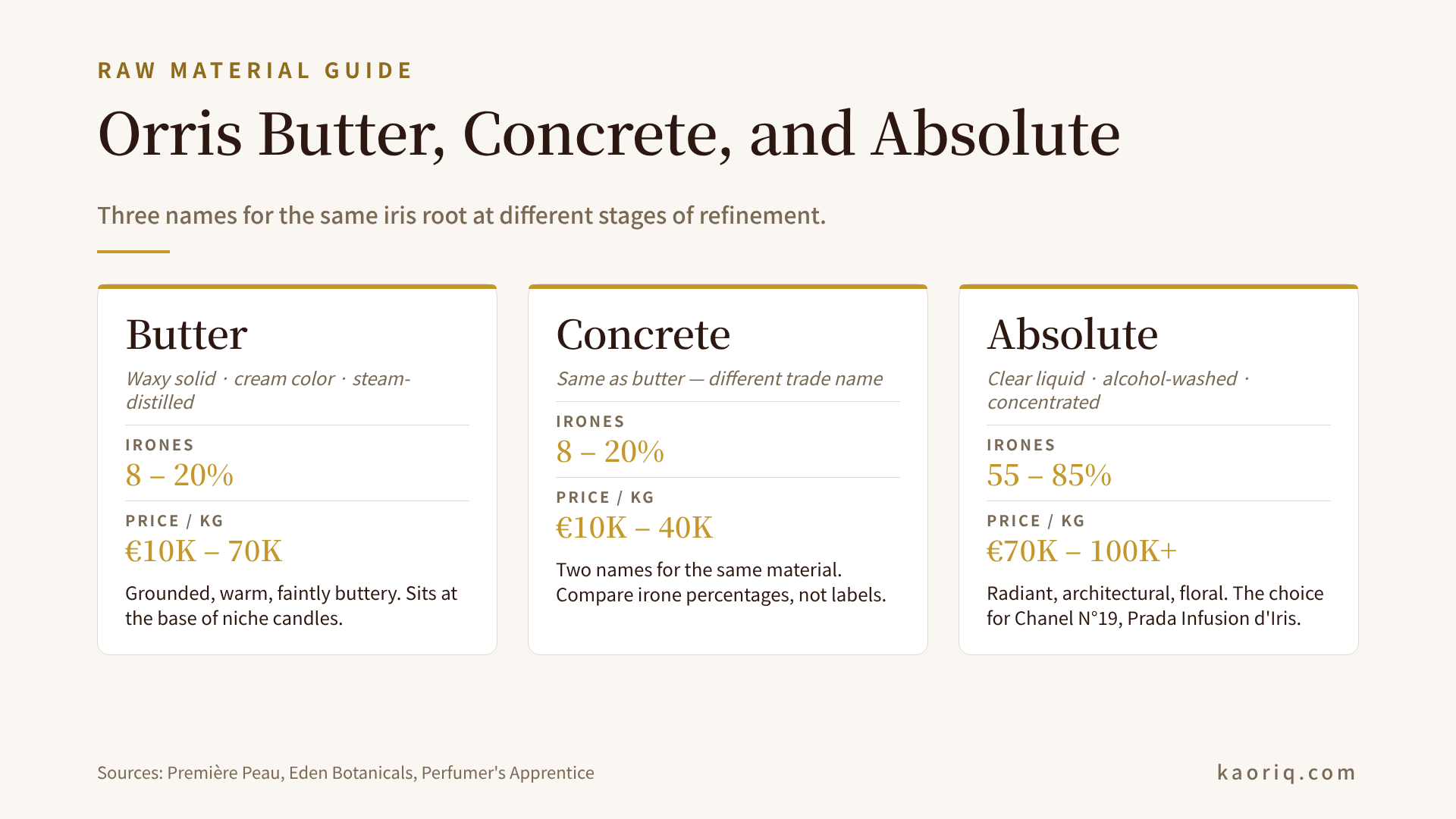
Here is the shortest possible version, in one table:
| Form | Physical State | Irones % | Price/kg | How It’s Made |
|---|---|---|---|---|
| Butter | Waxy solid | 8–20% | €10,000–70,000 | Steam-distilled from aged rhizomes |
| Concrete | Waxy solid | 8–20% | €10,000–40,000 | Same as butter (mostly the same thing) |
| Absolute | Clear liquid | 55–85% | €70,000–100,000+ | Butter, alcohol-washed to strip fatty acids |
If you take one thing away from this article: butter and concrete are usually the same material under different trade names, and absolute is the concentrated version of both. Everything below is elaboration.
Orris Butter — Steam-Distilled, Waxy, Cream-Colored
Butter is the first stop after the rhizome finishes its six-year wait. Aged Iris pallida roots are ground and steam-distilled, and what condenses out is a pale-yellow to cream-colored solid that melts around 40–46°C. In a warm room it looks like slightly gone-off shea butter. In a cool room it holds a clean fingerprint.
The reason it’s solid at room temperature is chemistry, not artisanship. Roughly 60–85% of the mass is myristic acid, a saturated fatty acid that has no smell of its own and just sits there being waxy. The remaining 8–20% is the good part: a family of molecules called irones, which are what your nose reads as “iris.” Commercial grades are usually labelled by irone percentage: an 8% butter is entry-level, 15% is standard for niche perfumery, 20%+ is high-end.
Yield is brutal. Roughly 500 kg of dried, aged rhizome yield 1 kg of butter, which is why the base price starts around €10,000/kg even before you get to the fancy grades.
Orris Concrete — The Trade Name That Confuses Everyone
This is where the terminology gets stuck. Every glossary defines “concrete” differently from “butter,” but every actual raw-material supplier sells them as if they’re interchangeable, and mostly they are.
The technical origin of the distinction: in general perfumery, “concrete” is a solvent-extracted waxy solid (jasmine concrete, rose concrete), while “butter” is a steam-distilled waxy solid. But orris is the one flower that breaks this rule, because orris “butter” is actually distilled, not extracted with hydrocarbon solvents like jasmine or rose concrete would be. So orris “concrete” is used interchangeably with “butter” for the distilled, waxy product.
Some houses do reserve “concrete” for the lower-irone material (8–10%) and “butter” for the higher-irone material (15–20%), but there’s no industry-wide standard. The safest rule when reading a supplier catalog: compare irone percentages, not names. A 15% “concrete” and a 15% “butter” from two different suppliers will smell like near-siblings, whatever the label claims.
This is the part nobody tells you before that first checkout page.
Orris Absolute — Alcohol-Washed, Radiant, Priced Like an Emergency
Absolute is what happens when you take butter and wash it with ethanol. The alcohol dissolves the irones and leaves the fatty acids behind as a discarded wax cake. What remains, after the alcohol evaporates, is a clear or pale-yellow liquid that is essentially pure iris signal.
Irone content jumps from 8–20% (butter) to 55–85% (absolute). Yield drops by roughly the same ratio, which is why the price rockets from €10,000–40,000/kg to €70,000–100,000+/kg. If butter is cream, absolute is the milk fat you spun out of it. Smaller, denser, more expensive per gram.
The character shift is real. Butter has weight and warmth, a comfort-food quality, like sandalwood butter or beeswax. Absolute is lighter, more architectural, more overtly floral. Perfumers describe butter as “grounded” and absolute as “radiant.” Both are true. The difference is whether you want the material to sit at the base of a composition (butter) or float up into the heart (absolute).
What Each Form Actually Smells Like
If you sniff all three side by side, the differences arrive in this order:
- Butter (or concrete): violet at first, then a warm powdery note like old-fashioned face cream, then a faint damp-cellar earthiness underneath. The fatty acids add a soft, almost buttery persistence — like the smell has a body, not just a shape.
- Absolute: a much more vertical smell. Violet lifts off the strip immediately, then a bright, almost rooty-green edge, then a long dry-down of chalky floral warmth. Less body, more radiance. If butter is a wool sweater, absolute is a silk scarf.
- Iris accord (synthetic-heavy): the smell of the idea of iris. Usually loud on the powdery-violet note, thin on the earthy underpinning, and gone in an hour. Fine for mass-market use, but you can hear the pixels if you know what to listen for.
The trap for beginners is that iris accord shows up in most “iris” candles under $50, so a lot of people’s first impression of iris is actually their first impression of a synthetic shortcut. If your only reference for iris is a $30 candle from a mall brand, you have not yet met iris. You have met its stunt double.
How to Find Each Form at Home
You won’t often see “orris butter” or “orris absolute” written on a consumer label. But you can spot them by what they enable.
Absolute-heavy luxury perfumes. Chanel N°19 (galbanum + orris, cool and aristocratic), Prada Infusion d’Iris (transparent modern orris on neroli and cedar), Dior Homme (orris + cocoa + leather), and Frédéric Malle Iris Poudre (aldehyde-lifted powdery orris) all lean on the absolute. If a perfume reads as clean iris that lifts rather than iris that sits, absolute is doing the work.
Butter-heavy niche perfumes and candles. Christian Louboutin Fétiche L’Iris (only two notes: orris and patchouli), Serge Lutens Iris Silver Mist, and most niche iris-forward candles use butter or concrete because the waxy myristic acid gives the scent a slow, low-lying presence that a candle’s melt pool needs. If a candle reads as earthy iris that broods, butter is doing the work.
Iris accord in mass-market home fragrance. Most mainstream candles, reed diffusers, and room sprays priced under $50 that mention “iris” or “orris” are using an iris accord. This is not a scandal. The accord costs 1–2% of the real material and lets iris exist at accessible price points. Just know that the loud powdery note is doing more of the work than any real orris would.
If you want to explore actual orris at home without spending on a $200 candle, the compromise is to buy a small vial of orris butter, 15% irones from Eden Botanicals or Perfumer’s Apprentice and smell it on a strip. It is the cheapest way to calibrate your nose to what the real thing actually does, and it will probably re-tune how you read every iris candle you buy afterwards.
The Short Version, One More Time
Butter and concrete are the same waxy, steam-distilled material at 8–20% irones. Absolute is the alcohol-washed, concentrated version at 55–85% irones, priced accordingly. Luxury perfumes lean on absolute; niche candles lean on butter; mass-market “iris” products lean on synthetic accords. Once you know which form is doing the work in a bottle, “iris” stops being one confusing note and starts being three distinct experiences.
Which is exactly what I would have wanted someone to tell me the afternoon I closed that checkout tab.
Ready to bring iris into your home? Start with the three iris families guide to figure out which face of orris flatters your rooms: powdery, rooty, or modern-bright.
For the full map of orris in perfumery — the iconic fragrances, the three forms, the six-year timeline in one place — see the pillar guide: Every Orris in Perfumery: A Reader’s Guide to Iris, Orris Root, and the Iconic Fragrances That Use Them (2026).
Frequently asked questions
- Is orris concrete the same as orris butter?
- In most catalogs, yes — they're two trade names for the same steam-distilled, waxy material. Some suppliers reserve 'butter' for higher-irone grades (15–20%) and 'concrete' for the raw 8–10% stock, but this is not standardized. If you see 'orris concrete 15% irones' and 'orris butter 15% irones' side by side, you're looking at the same thing under two names.
- Why is orris absolute so expensive?
- Two reasons stack. First, the root has to be aged three to five years in a cellar before it develops any real irone content, so every gram of finished material starts with six-plus years of patience. Second, making absolute means alcohol-washing the butter to strip out the fatty acids and concentrate the irones from around 15% up to 55–85%. You lose roughly 80% of the mass in that step. Add both together and you're pricing time plus reduction, which is how you get to €70,000–100,000 per kilogram.
- Which form do most luxury perfumes use?
- Almost always the absolute. Chanel N°19, Prada Infusion d'Iris, Dior Homme, Frédéric Malle Iris Poudre — the classic iris-forward luxury perfumes use orris absolute because the alcohol wash removes the myristic acid that would otherwise dull the top notes. Butter and concrete are used more often in candles, room fragrance, and niche perfumery where the waxy softness is a feature rather than a problem.
- Can I buy orris at home?
- You can buy orris butter from suppliers like Eden Botanicals or Perfumer's Apprentice at 8–15% irone grades. Absolute is harder to find retail and often sold only to trade. What you'll actually encounter in home fragrance is 'iris accord' — a synthetic or natural-synthetic blend priced at $500–2,000/kg that mimics the smell of the real material at roughly one percent of the cost. That's how mass-market candles labelled 'iris' can exist without any real orris in them.
Was this article helpful?