Every Orris in Perfumery: A Reader's Guide to Iris, Orris Root, and the Iconic Fragrances That Use Them (2026)
Try Explaining Orris to Someone
Try explaining orris to someone. You say “iris root.” They ask whether people put actual roots in perfume. You say yes. They ask why the flower isn’t good enough. You say it doesn’t really smell. And they look at you the way you look at someone who has just told you their favorite band is a spreadsheet.
That’s the trouble with orris. It has three names, five stages of production, six years of waiting time, and a starring role in about half the perfumes on a well-stocked shelf. Almost no one, including the people wearing it, can tell you what it is. I could not, for years. I’d been sold an “iris candle” for $200 and I still couldn’t have picked orris out of a lineup.
This piece is the map I wish someone had drawn me. It pulls together three years of me writing about the same root from different angles, and points you to the deeper piece for whichever part catches. If you only read one thing about iris in perfumery, this is the one to read first.
Iris, Orris, and the Five Stages of Confusion
Let’s start with the vocabulary problem, because most of the confusion is linguistic before it’s chemical.
- Iris — the flower, or the whole plant. In casual conversation, “iris” is what people say. In a perfume note pyramid, “iris” is what marketers write, because “orris” sounds like a mistake.
- Orris — the plant’s dried, aged rhizome, the fat lump of stem that lives underground. This is the part perfumery actually uses. Fresh, it smells of almost nothing; aged, it smells like the most expensive whisper in your bottle.
- Iris pallida — the Latin species name of the pale-blue Tuscan iris, grown mostly around Florence, that gives the finest orris.
- Iris germanica — a hardier, cheaper species grown mostly in Morocco and China. Used for lower grades of orris.
- Iridals — the odorless precursor molecules inside a fresh rhizome. They have to break down before anything smells like iris.
- Irones — the family of molecules irridals eventually become, three to five years later. Irones are what your nose reads as iris.
The short version: iris is the flower, orris is the aged root, and irones are the molecules the root makes if you wait long enough. Everything else in this article is elaboration.
(Chanel N°19 gets called “flower-forward” constantly. It is, in fact, root-forward.)
The Three Raw Forms Every Perfumer Starts With
Once the rhizome finishes its six-year wait (three years in the soil, three years in a Tuscan cellar), it enters the raw-material trade in one of three forms. Each form is a different stage of refinement, and each ends up in a different kind of finished product.
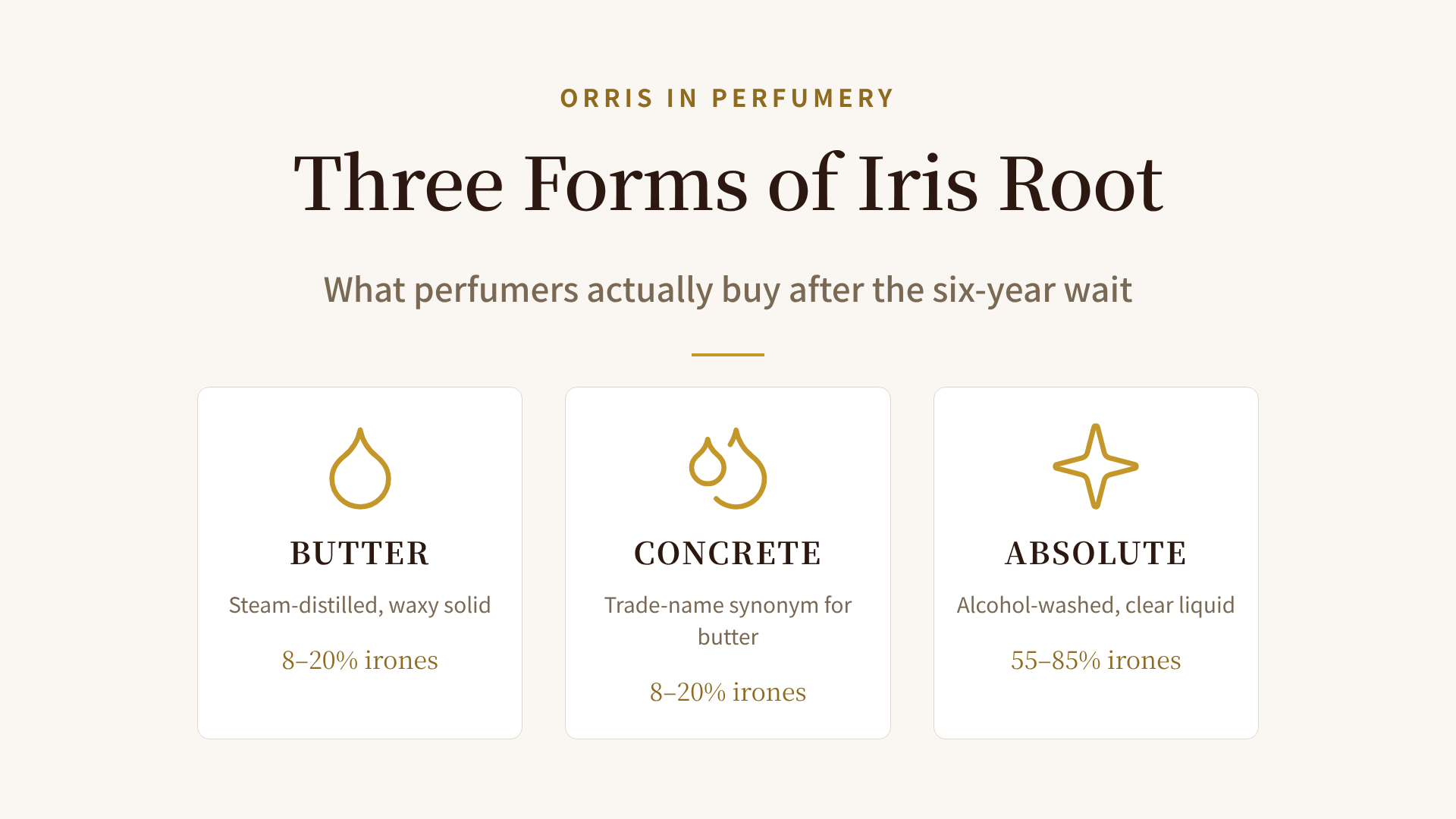
| Form | What It Is | Irone % | Where You’ll Find It |
|---|---|---|---|
| Orris butter | Steam-distilled, waxy, cream-colored solid | 8–20% | Niche candles, room fragrance, base of some perfumes |
| Orris concrete | Mostly a trade-name synonym for butter | 8–20% | Same as butter |
| Orris absolute | Alcohol-washed butter, clear liquid | 55–85% | Almost all famous iris perfumes |
Butter is where the six-year story ends and the perfumer’s story starts. Absolute is what most iconic perfumes actually contain. The alcohol wash strips out the waxy fatty acids and leaves a smaller, brighter, more radiant liquid, priced somewhere between “an emergency” and “a small car.”
For the full technical breakdown of what each form actually smells like and why butter costs a fifth of what absolute costs, that’s the piece dedicated to it: Orris Butter, Concrete, Absolute: Three Iris Forms Explained. This section is the summary; that one is the spec sheet.
The Three Scent Families You’ll Actually Smell
Once orris is in a finished product (a candle, a diffuser, a perfume), it almost always presents in one of three characters. Learning to hear the difference is what turns “expensive iris roulette” into confident buying.
- Powdery orris. Cosmetic-powder from a vintage vanity, warm violet petals, faint suede. The friendly face of iris, and the one most people fall in love with first. Frédéric Malle Iris Poudre and Hermès Hiris are the reference points.
- Rooty orris. Damp earth, forest floor, a faint carrot-tops undertone. The strange, grounded side. Serge Lutens Iris Silver Mist and Xerjoff Irisss live here.
- Modern-bright / green iris. Cool green leaves, galbanum, dewy petals. The clean, architectural profile. Chanel N°19 and Prada Infusion d’Iris built entire compositions on this side.
If you’re only going to remember one thing: powdery is the friendly one, rooty is the challenging one, green is the clean one. For the full three-families guide at home, which family flatters which room, which personality tends to prefer which, and specific candles and diffusers in each, I wrote that here: Best Iris & Orris Home Fragrance 2026: Powdery, Rooty, and Modern-Bright.
The Iconic Fragrances That Made Orris Famous
Now the fun part. Orris shows up in a lot of perfumes, but a handful of them defined how the world hears iris. Here are the eight I would put on a mixtape. Think of it as a listening list rather than a shopping list. Hearing them on a paper strip, on a friend, or in a passing elevator is the fastest way to educate your nose.
Chanel N°19 (1970)
The green-iris archetype. Henri Robert built N°19 on galbanum and orris the way a modernist architect builds a house on steel and glass: everything else is transparent around the frame. It reads as cool, intelligent, and slightly intimidating in a way that feels intentional. If someone has ever described a fragrance as “the cologne of a woman who runs a museum,” they were probably describing N°19. It is the fragrance that taught a generation of noses to hear iris as sharp and green rather than sweet and powdery.
Prada Infusion d’Iris (2007)
Daniela Andrier’s Infusion d’Iris arrived thirty-seven years after N°19 and re-tuned iris for a quieter room. It uses orris absolute over neroli and cedar, and it wears like a linen shirt in July. Where N°19 is aristocratic, Infusion is domestic in the good sense. It fits into normal life, into an office, into a small apartment. It also happens to be the fragrance that put “iris” into thousands of shopping bags at Sephora, which is its own kind of achievement.
Frédéric Malle Iris Poudre (2000)
Pierre Bourdon’s Iris Poudre is what powdery iris looks like when someone pushes it to its logical limit. Aldehydes lift the top; sandalwood carries the base; orris fills the whole middle with something like cashmere. It’s the perfume most often described as “the smell of quiet luxury,” and it earned the description before quiet luxury was a trend. If you want to know what powdery orris can be, Iris Poudre is where you go.
Serge Lutens Iris Silver Mist (1994)
Maurice Roucel took the opposite path with Iris Silver Mist. Where Iris Poudre is warm and enveloping, Silver Mist is cold and rooty and unsettling in a way that some wearers find beautiful and others find alarming. This is orris at its most carrot-and-cellar. It smells like a mineral basement in a house that has been closed for the winter. It is the fragrance most likely to teach you that iris is a root, because it refuses to let you forget.
Hermès Hiris (1999)
Olivia Giacobetti’s Hiris is the soft-powdery counter-argument. Almost transparent, faintly cosmetic, unmistakably iris. Hermès discontinued it, then reissued it under the Hermessence line, which tells you how much its devotees mourned it. If Iris Silver Mist scares you and Iris Poudre feels heavy, Hiris is the version of iris that sits somewhere between a face-powder compact and a very good linen. It is the softest way into orris.
Xerjoff Irisss (2007)
Xerjoff Irisss is what happens when a niche house decides to make an unapologetic rooty iris and add three s’s to the name. Earthy, mineral, faintly sweet in the way freshly-turned soil is sweet. It’s a compelling introduction to the rooty family for people who found Silver Mist too austere.
Dior Homme (2005 original formulation)
François Demachy’s Dior Homme was, until recently, the perfume that persuaded an entire generation of men that they wanted to wear iris. Orris + cocoa + lavender + leather, over a soft base. That combination made powdery iris feel modern, wearable, masculine (or genderless, depending on your reading). The 2020 reformulation pivoted away from the iris-forward original, which is why “Dior Homme Original” now trades at a small premium among iris devotees.
Penhaligon’s Iris Prima (2013)
Alberto Morillas built Iris Prima as a tribute to the English National Ballet. Orris on beeswax, leather, and sandalwood, meant to evoke rosin, chalk, and the faint sweat of a dance studio. It is one of the few iris perfumes that unironically earns its narrative concept. If you want a fragrance that reads as elegant plus a little used, Iris Prima is the one.
A note for home-fragrance readers. This section talks about the finished perfumes because they’re the fastest way to hear what orris sounds like. But kaoriq is a home-fragrance site: I’m not suggesting any of the above as a wear-on-skin recommendation, only as a way to educate your nose. Once you know what iris sounds like, the home-fragrance versions (candles, diffusers, sprays) become much easier to shop for.
Why Orris Takes Three Years to Make and Costs More Than Gold
The economic story of orris is the same story as the sensory one, just told in euros.
A ton of dried, aged Iris pallida rhizome yields about two kilograms of orris butter. That is a 0.2 percent yield. A standard 15-percent-irone butter sells for around €12,000 per kilogram. A high-grade absolute at 80-percent irones can exceed €100,000 per kilogram. Per gram, orris absolute costs more than gold.
The reason is that you cannot accelerate it. You cannot brute-force the chemistry. The plant needs three years in the soil to form a rhizome large enough to harvest. The rhizome needs three to five years in a cellar for iridals to break down into irones. Every step of that timeline belongs to the plant, to the room, to the humidity and the mice and the family that has been turning the shelves since Napoleon. You buy patience, and you buy it at market rate.
For the long, slow version of that story (the Florentine hills, the eight-year timeline from planting to perfume, the reason iris shows up on the seal of the city of Florence), that’s here: The Iris Root That Hides in Every Luxury Fragrance: A Story of Patience.
How to Smell Orris at Home Without a $300 Perfume
You don’t need a $300 bottle of Iris Poudre to meet orris. In descending order of cost, here’s what actually works.
- A small vial of orris butter. Under $50 from Eden Botanicals or Perfumer’s Apprentice, at 15-percent irones. Smell it on a paper strip. This is orris uncostumed, and it will re-tune how you hear every iris candle you buy afterwards.
- A powdery-orris candle. Look for iris paired with sandalwood, violet, or amber. This is the friendliest first candle format: soft, closed, unmistakably iris. Under $80 gets you a real one.
- A rooty-orris diffuser. For readers who want the strange side. Cold-air diffusers with unblended orris fragrance oil, or niche candles built on orris + patchouli, deliver the carrot-and-cellar face of iris that Silver Mist made famous.
- A green-iris room spray. Orris + galbanum + a citrus lift, in a light spray, works well in living rooms and home offices. This is the N°19 face translated for the home.
The full guide, covering which family suits which room, which personality tends to prefer which, and specific candles and diffusers, is here: Best Iris & Orris Home Fragrance 2026.
The Short Version, for the Friend Who Asked
Back to the question at the top: do people really put roots in perfume.
Yes. The most patient root anyone puts in anything, in fact. It has to grow for three years. Then it has to sit in the dark for another three, doing nothing visible while its own chemistry slowly rearranges itself into a smell. Then a perfumer takes two kilograms out of every ton and turns it into either a waxy butter for candles or a clear liquid for perfumes. Then someone (maybe you, maybe me, maybe a French woman at a museum in 1985) smells the finished thing and calls it “elegant” without knowing that “elegant” here means “eight years of a small farm outside Florence.”
Once you know that, iris stops being a flower on a candle label and starts being a whole quiet economy of patience, buried under a hillside, waiting.
Which is, honestly, my favorite thing to know about anything I own.
This is the pillar guide to orris on kaoriq. If you want to go deeper on any single face of the root:
- The forms and prices: Orris Butter, Concrete, Absolute: Three Iris Forms Explained
- The families at home: Best Iris & Orris Home Fragrance 2026
- The origin story: The Iris Root That Hides in Every Luxury Fragrance
Frequently asked questions
- What is orris, exactly?
- Orris is the dried and aged rhizome (underground stem) of the pale-blue iris, mostly Iris pallida from Tuscany. Freshly harvested, the root smells of almost nothing. After three to five years of cellar aging, chemical precursors inside the rhizome break down into a family of molecules called irones, which are what your nose reads as 'iris.' Orris is the name perfumers use for that aged, aromatic root.
- Are iris and orris the same thing?
- They come from the same plant, but they refer to different parts and different stages. 'Iris' usually means the flower (or, casually, the whole plant). 'Orris' is the technical name for the rhizome after it has been dried and aged for years and can be distilled or extracted. In perfumery, when a note says 'iris,' it almost always means orris; the flower itself has too little scent to matter.
- Why is orris so expensive?
- Two costs stack. First, the root has to sit in a cellar for three to five years before its irone content develops, and the plant itself needs three years in the soil before that. Second, yield is brutal: a ton of dried rhizome produces only about two kilograms of orris butter, and refining that to orris absolute loses another 80 percent of the mass. The finished absolute costs €70,000 to over €100,000 per kilogram. Per gram, that's more than gold.
- Which iconic perfumes feature orris?
- The classic list includes Chanel N°19 (green iris and galbanum, 1970), Prada Infusion d'Iris (transparent modern iris, 2007), Frédéric Malle Iris Poudre (powdery iris pushed to its limit, 2000), Serge Lutens Iris Silver Mist (cold rooty iris, 1994), Hermès Hiris (soft powdery iris, 1999), Xerjoff Irisss (earthy carrot-forward iris), Dior Homme (iris and cocoa, 2005), and Penhaligon's Iris Prima (dance-inspired iris, 2013). Each uses a different face of the root.
- How can I smell orris at home without buying a $300 perfume?
- The cheapest route is a small vial of orris butter at 15 percent irones from a supplier like Eden Botanicals; under $50 gets you enough to calibrate your nose. The next step up is a niche iris candle: powdery-family candles (iris paired with sandalwood or violet) are the friendliest starting point at home. Both are covered in the home fragrance guide linked below.
Was this article helpful?