Iris Fragrance for People Who Don't Like Florals: A 2026 Beginner's Guide to Powdery, Rooty, and Non-Floral Options
The Perfume Everyone Keeps Recommending, That You Keep Avoiding
If you dislike floral perfumes, sooner or later someone will tell you to try iris.
You will probably ignore them. Reasonably. You have your reasons. Rose has turned into shampoo on your skin more than once. A car full of jasmine gave you a headache last summer, and tuberose once felt like it was applying for a job you never offered. So when a stranger at a counter says “you should try iris, it’s beautiful,” your instinct is to nod politely and walk toward the wood section.
Here is the thing nobody explains at the counter: iris in perfumery is not a flower.
It is a root. A dried, aged, cellared root that smells like almost nothing when you dig it up and takes three to five years of patience before it becomes usable. What you meet in a bottle labelled “iris” is the material called orris, and it belongs to the same corner of the scent world as suede, damp earth, and cosmetic powder. If woods, leather, or clean minerality already work for you, orris sits much closer to home than you might expect.
This guide is the map for people who read “iris perfume” and mentally translate it to “another floral I won’t like.” Your suspicion is fair. It’s just pointed at the wrong shelf.
Iris Is a Root, Not a Flower
Let’s get the botany out of the way in one paragraph.
The iris flower produces very little scent. Perfumers do not use it. What they use is the rhizome, the underground stem, mostly from Iris pallida grown in Tuscany. Freshly harvested, the rhizome smells of dirt. After three years drying in a cellar, molecules called irones develop inside it and give the root its unmistakable powdery, suede, and faintly carroty character. That aged root is orris. If your bottle says “iris,” it almost certainly means orris.
So when someone recommends iris, they are recommending a root note that sits closer to vetiver and sandalwood than to rose or jasmine. The full slow story of why this material costs more than gold by weight lives here: The Iris Root That Hides in Every Luxury Fragrance. For today, the useful takeaway is simpler. Iris reads as powder, quiet earth, and cool chalk.
What Non-Floral People Actually Get When They Try Iris
Here is what iris smells like in the wild, translated for a nose that resists petals.
| If You Like… | Iris Feels Like… |
|---|---|
| Vetiver, cedar, sandalwood | A softer, chalkier cousin. Less smoky, more powdery. |
| Suede and leather | A refined version. Same quiet luxury, minus the animal. |
| Clean laundry musks | The grown-up upgrade. Less bright, more textural. |
| Damp forest floor, mushroom, moss | The refined mineral relative. Cool, chalky, root-y. |
| Nothing at all (“I don’t wear perfume”) | The one that tends to convert people. Reads as skin. |
If you dislike florals because they feel sweet, heady, or performative, orris does none of those things. It stays close to the skin, reads as texture instead of bouquet, and rarely announces itself in a room. This is why fashion magazines and fragrance blogs quietly keep pushing it at people who have sworn off flowers. It is the loophole.
The Three Iris Faces (Pick the One Furthest From “Flower”)
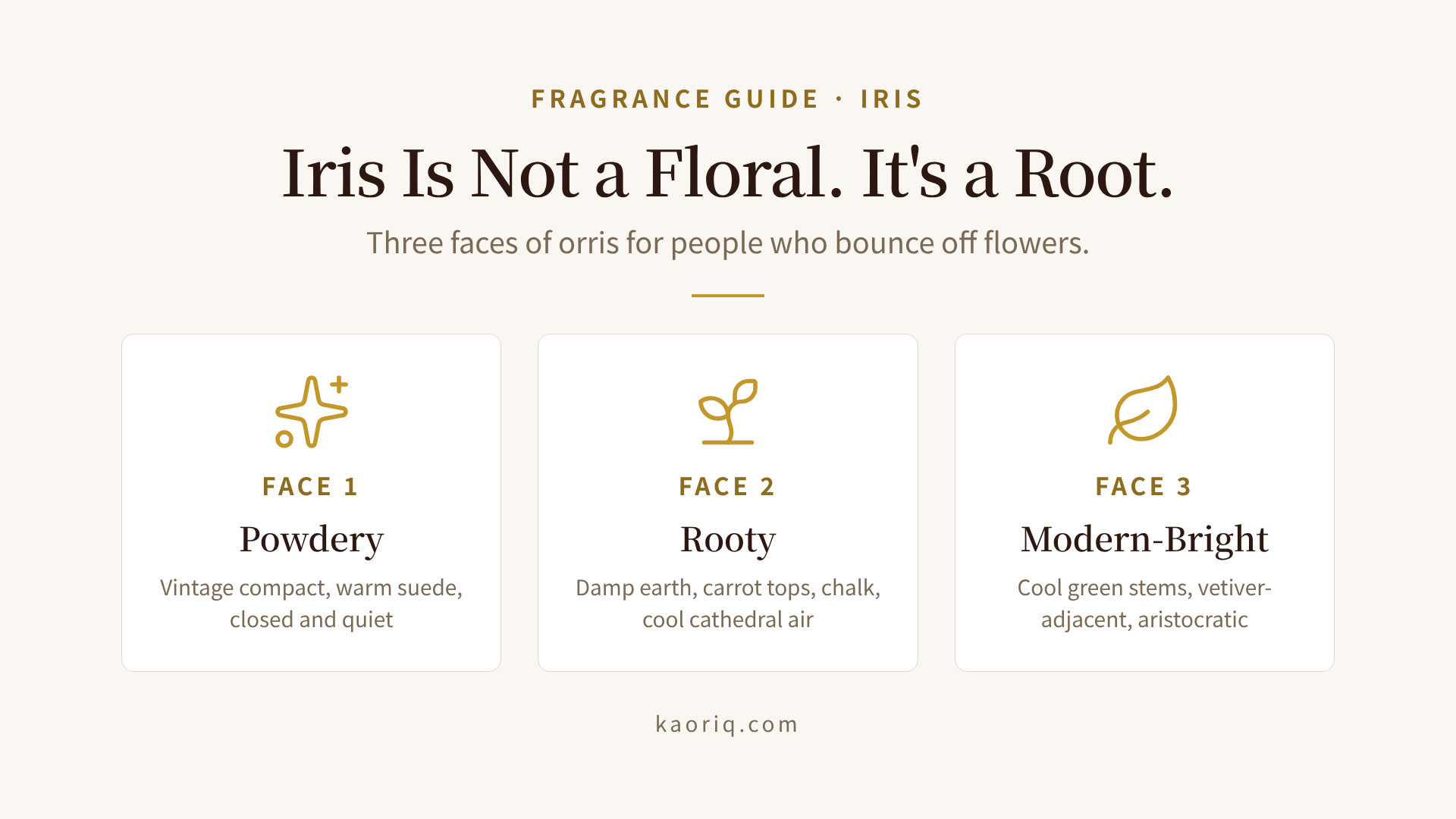
Iris appears in perfumery as one of three broad personalities. If florals are a hard no for you, two of these three are your friends.
Face 1: Powdery Orris (Vintage-Luxury Soft)
This is iris paired with violet, suede, or amber. It smells like a well-kept vintage handbag, faintly cosmetic, closed and quiet. Frédéric Malle Iris Poudre is the extreme example. In a home, powdery orris candles and reeds settle into bedrooms and reading corners. For flower-averse people, this face is the borderline one: some read it as “the good kind of powdery,” others as “still slightly makeup-y.” Try it, but not first.
Face 2: Rooty Orris (Earthy, Chalky, Cold)
This is the face flower-averse people usually fall for hardest. Rooty orris smells like damp soil and carrot tops, with the chalky hush of a November cathedral. Serge Lutens Iris Silver Mist is the reference. Christian Louboutin Fétiche L’Iris pairs it only with patchouli. If you like vetiver, oud, or mushroom-forward niche perfume, this is home ground. Start here.
Face 3: Modern-Bright Green Iris (Composed and Clean)
Iris with galbanum, vetiver, or violet leaf. The mood is cool and green in an aristocratic way. Chanel N°19 is the historical reference; Prada Infusion d’Iris is the modern minimalist. This face reads as composed rather than soft. If you dislike florals because they feel too soft, this is the iris that won’t make that mistake.
The three-forms-of-iris breakdown (butter, concrete, absolute) that produces these faces lives in Orris Butter, Concrete, Absolute: Three Iris Forms Explained if you want the raw-material angle.
Which Iris for Which Kind of Flower-Averse
Not everyone dislikes florals for the same reason. Match your objection to the right face.
| Your Reason for Disliking Florals | Best Iris Face | Try First |
|---|---|---|
| Too sweet, headachey | Rooty (Face 2) | Serge Lutens Iris Silver Mist, or an orris + patchouli candle |
| Too feminine, too “obvious” | Modern-bright (Face 3) | Prada Infusion d’Iris, Dior Homme |
| Too loud in a room | Rooty (Face 2) | Rooty candles at bedroom scale, one wick, low burn |
| Too soft, forgettable | Modern-bright (Face 3) | Chanel N°19 spritzed on paper first, not skin |
| I just don’t wear perfume | Powdery (Face 1), small dose | 1502 Iris & Santal small candle in a bedroom |
If you cannot decide, the safest first purchase for a flower-averse buyer is a small orris and sandalwood candle. Sandalwood underneath softens the chalk edge and gives orris a warm bed to lean on. The exhaustive list of iconic iris perfumes and which face each belongs to sits in Every Orris in Perfumery: Iconic Fragrances.
Format Guide: How to Meet Iris Without Committing
Iris rewards low-risk experimentation. A few honest routes in:
- Small candle (under 4 oz) in the powdery or modern-bright family. Cheapest way to find out whether the material suits your nose. Burn honestly for at least twenty minutes; iris does not show up in five.
- Reed diffuser for continuous, low-effort exposure. One reed diffuser per 200 square feet is plenty. Two is a mistake, because iris has volume you don’t feel until you double it.
- Spritz on paper, not skin for perfumes. Orris smells different against paper than it does against your body chemistry, and paper gives you the raw material before it warms up.
- Sample vials for the expensive stuff. Iris Poudre, Iris Silver Mist, Dior Homme all come as decants online for under a coffee’s cost. Buy three, live with each for a weekend.
If home fragrance is where you want to start rather than personal perfume, the fuller by-personality playbook for iris at home lives in Best Iris & Orris Home Fragrance 2026.
If You Remember Only One Thing
Iris in perfumery is a root. It smells like powder, chalk, damp earth, or cool green stems depending on the version. None of those match the sweet petal-driven notes flower-averse people reject. If someone at a counter says “try iris,” they are probably right; they just picked the wrong word to describe it.
Try rooty orris first if you dislike florals for being loud or feminine. Try modern-bright iris if you dislike florals for being sweet or soft. Skip powdery orris until later, or take it at low dose in a small bedroom candle. And when you find the one that works, you’ll understand why the fashion magazines keep quietly telling people like you the same secret.
Not sure which fragrance family you belong to at all? Start upstream with Find Your Fragrance Family: A Beginner’s Guide. Orris tucks into more corners of that map than any other single ingredient, which is exactly why it keeps finding people who thought they had already made up their minds.
Frequently asked questions
- Is iris perfume actually floral?
- Technically no. What perfumers call 'iris' is almost always orris, the dried and aged rhizome (root) of the iris plant. It smells powdery, chalky, faintly earthy, and cool. The iris flower itself has very little scent, so the material in your bottle is a root note, not a petal note. If you dislike sweet or heady florals like rose, jasmine, or tuberose, orris behaves very differently from all three.
- What does iris smell like if it isn't floral?
- Depending on how it's used, orris reads as one of three things: cosmetic-powder soft (like a vintage compact), damp earth and carrot-tops (like a forest floor after rain), or cool green stems (like iris leaves after rain). None of these are the sweet, indolic, petal-heavy smell most flower-averse people bounce off. The dominant sensation is powder, suede, and quiet coolness.
- Which iris perfume is best for someone who hates florals?
- Start with Prada Infusion d'Iris (transparent and clean, almost airy) or Dior Homme (iris paired with cocoa and leather, structurally masculine). Both use iris as a texture rather than a bouquet, so neither reads as 'a flower.' If you want something cheaper to test the water, a small iris and sandalwood candle is a lower-risk way to check whether the material suits you at all.
- Why is iris the go-to note for people who don't like florals?
- Because it delivers the elegance and softness people expect from perfumery without the sweet, petal-driven core that flower-averse noses reject. Fashion magazines like Marie Claire and WhoWhatWear now recommend iris specifically for non-floral wearers for this reason: it feels grown-up and quiet-luxury while sitting closer to woods and suede than to bouquets, and rarely comes across as feminine the way rose or jasmine can.
Was this article helpful?