Essential Oil Diffuser Blend Recipes for 2026: 5 Drop-by-Drop Recipes Matched to How You Actually Live
Standing Over a Diffuser With Eight Bottles Open
Spread eight small essential oil bottles across the kitchen counter, open every cap, and stand there re-sniffing them like you’re tuning a radio. Lavender. Peppermint. Bergamot. Sweet orange. Rosemary. Cedarwood. Eucalyptus. Ylang ylang. Bought one at a time over eighteen months, following whichever “top 10 essential oils” list was in front of you that week.
Two of them get used. The rest sit there because nobody knows what to combine, and every “diffuser blend” article on the internet gives the same generic list: 3 drops lavender, 2 drops cedarwood, congratulations, sleep well. Great — but why that combination for you, versus a roommate who is a morning person and has never met a floral they liked?
This article is what I wish someone had handed me that night. Five blends that actually work, with drop counts, a note on why each combination hangs together, and — because “one recipe fits all” is a lie — a note on which kind of person tends to love it most.
First, the Three Rules That Make Any Blend Work
Before the recipes, a very short primer. Skip this if you already know it.
Rule 1: Every blend is built on three layers. Top notes (citrus, mint) hit first and disappear fastest. Middle notes (florals, herbs) carry the heart of the blend for the middle stretch. Base notes (woods, resins) show up late and linger. A blend without a base evaporates in twenty minutes. A blend with only base notes smells muddy. You want at least one from each layer.
Rule 2: Fewer oils, better blends. Three to five oils is the sweet spot. Six or more and the individual character of each one gets lost in a beige middle-ground blur. When in doubt, remove one.
Rule 3: Drop counts, not “just wing it.” Every recipe below is calibrated for a small-to-medium ultrasonic diffuser (100-150 ml reservoir, ~20 m² room). If your diffuser is bigger, scale up proportionally. If it’s a plug-in cartridge unit, ignore this article — those aren’t blendable.
What “Personality Match” Actually Means Here
Every blend below has a personality tag. That doesn’t mean only that type will like it — it means the sensory profile tends to land best with that trait, based on how different personalities process scent input. If you don’t know your fragrance personality yet, why personality matters for fragrance is the short version. If you already know you run introverted or extraverted, high-neuroticism or high-openness, pick accordingly.
If you’re unsure, just start with the Summer Cool-Down blend. It’s the safest crowd-pleaser on the list, and it’s what most of you actually need in July.
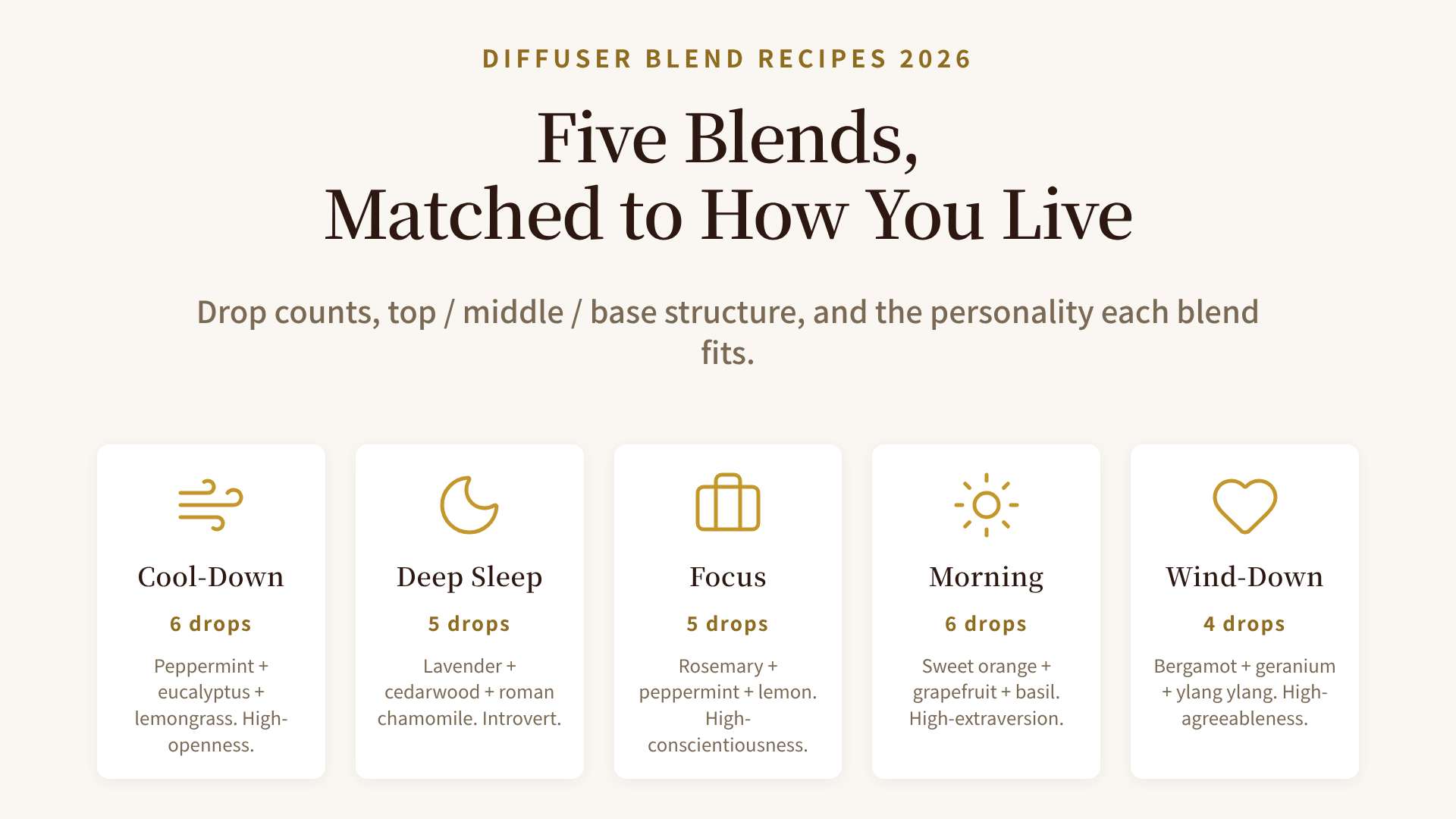
The Five Blends
1. Summer Cool-Down — for the day the AC gives up
Best for: High-Openness personalities and anyone whose apartment hits 28°C by 2pm.
Peppermint     1 drop  (top)
Eucalyptus     2 drops (top)
Lemongrass     2 drops (middle)
Cedarwood      1 drop  (base)
Why it works: Peppermint contains menthol, which triggers the same cold-sensing receptors in your nose and airways that actual cold does — the room isn’t cooler, but your body reads it as cooler. Eucalyptus reinforces the effect and adds a clean, open quality. Lemongrass keeps it from tipping into “menthol lozenge” territory. Cedarwood gives it something to stand on so it doesn’t evaporate in fifteen minutes.
Why the personality fit: High-openness people tend to gravitate toward unusual, aromatic-camphorous scents that most people find “medicinal.” If you love this blend, that’s your tell.
Swap-in if you don’t have peppermint: spearmint (2 drops instead of 1). Softer, sweeter, still cooling.
2. Deep Sleep — for the light sleeper who overthinks at midnight
Best for: Introverts, high-neuroticism, anyone whose brain won’t turn off.
Lavender           2 drops (middle)
Cedarwood          2 drops (base)
Roman chamomile    1 drop  (middle)
Why it works: This is the least surprising blend on the list, and I include it because the classics are classic for a reason. Lavender’s linalool has genuine sedative effects that show up in sleep studies. Cedarwood adds a grounding quality that keeps lavender from feeling floral-perfume-y (which some people find stimulating, not calming — yes, really). Roman chamomile is the finisher — one drop, no more, or it turns into a tea shop.
Why the personality fit: Introverts and high-neuroticism types tend to have more sensitive sensory processing, meaning strong scents can feel intrusive rather than relaxing. This blend is deliberately quiet. Run it for 30 minutes before bed, then turn it off. You should be able to almost-not-smell it. That’s the point.
Swap-in if lavender doesn’t work for you: frankincense (2 drops instead of lavender). More resinous, less floral, same calming effect on the nervous system.
3. Focus / WFH — for the 2pm slump
Best for: High-conscientiousness personalities. Also anyone with a deadline and a coffee tolerance that’s stopped working.
Rosemary       2 drops (middle)
Peppermint     1 drop  (top)
Lemon          2 drops (top)
Why the personality fit: High-conscientiousness types like scents that feel purposeful — they want the diffuser to be a tool, not a mood. This blend smells like a well-run home office. Sharp enough to actually shift you into work mode; not so sharp that you can’t take a phone call.
Why it works: Rosemary has been studied for memory and alertness effects that hold up better than most aromatherapy claims. Peppermint keeps the head clear. Lemon prevents the whole thing from smelling like an herbal supplement. Run this for 40 minutes at the start of a work block, then off. If it’s still going when the block ends, you’ll stop noticing it anyway.
Swap-in if you don’t have rosemary: basil (2 drops). Similar herbal-cool profile, slightly softer.
4. Morning Wake-Up — for the person who hates mornings
Best for: High-extraversion personalities, and the extravert who’s currently trapped inside an introvert’s mornings.
Sweet orange     3 drops (top)
Grapefruit       2 drops (top)
Basil            1 drop  (middle)
Why the personality fit: Extraverts respond well to bright, high-key scents that add energy to a room. This blend is unashamed about that. It’s cheerful in a way that will annoy anyone in your household who is still asleep, so run it in the kitchen while they’re still under the covers.
Why it works: Sweet orange and grapefruit together are more than the sum of their parts — the grapefruit adds a slight bitter edge that keeps the sweet orange from feeling like cheap candy. Basil is the surprise ingredient. One drop, tucked underneath, gives the blend a savory-green anchor that makes it read as sophisticated rather than juice-box.
Swap-in if grapefruit is too sharp for you: mandarin (2 drops). Sweeter, softer, still bright.
5. Wind-Down / Family Time — for the shared living room at 8pm
Best for: High-agreeableness personalities. Also households where the four people in the room have four different scent preferences and you need something nobody will object to.
Bergamot        2 drops (top)
Geranium        1 drop  (middle)
Ylang ylang     1 drop  (middle)
Why the personality fit: High-agreeableness types care about the shared experience of a scent — will everyone in the room like it? This blend is engineered to be pleasant to almost everybody without being boring. Bergamot has a broad appeal (it’s the tea note in Earl Grey), geranium adds a soft floral middle without going full “grandmother’s guest bathroom,” and ylang ylang gives it a warmth that reads as welcoming rather than romantic.
Why it works: This is the blend I use when I’m having friends over. It’s the “olive oil and garlic” of diffuser blends — almost impossible to mess up, almost universally liked, and the base for a hundred variations.
Swap-in if you don’t have ylang ylang: sandalwood (1 drop). Drier, woodier, still warming.
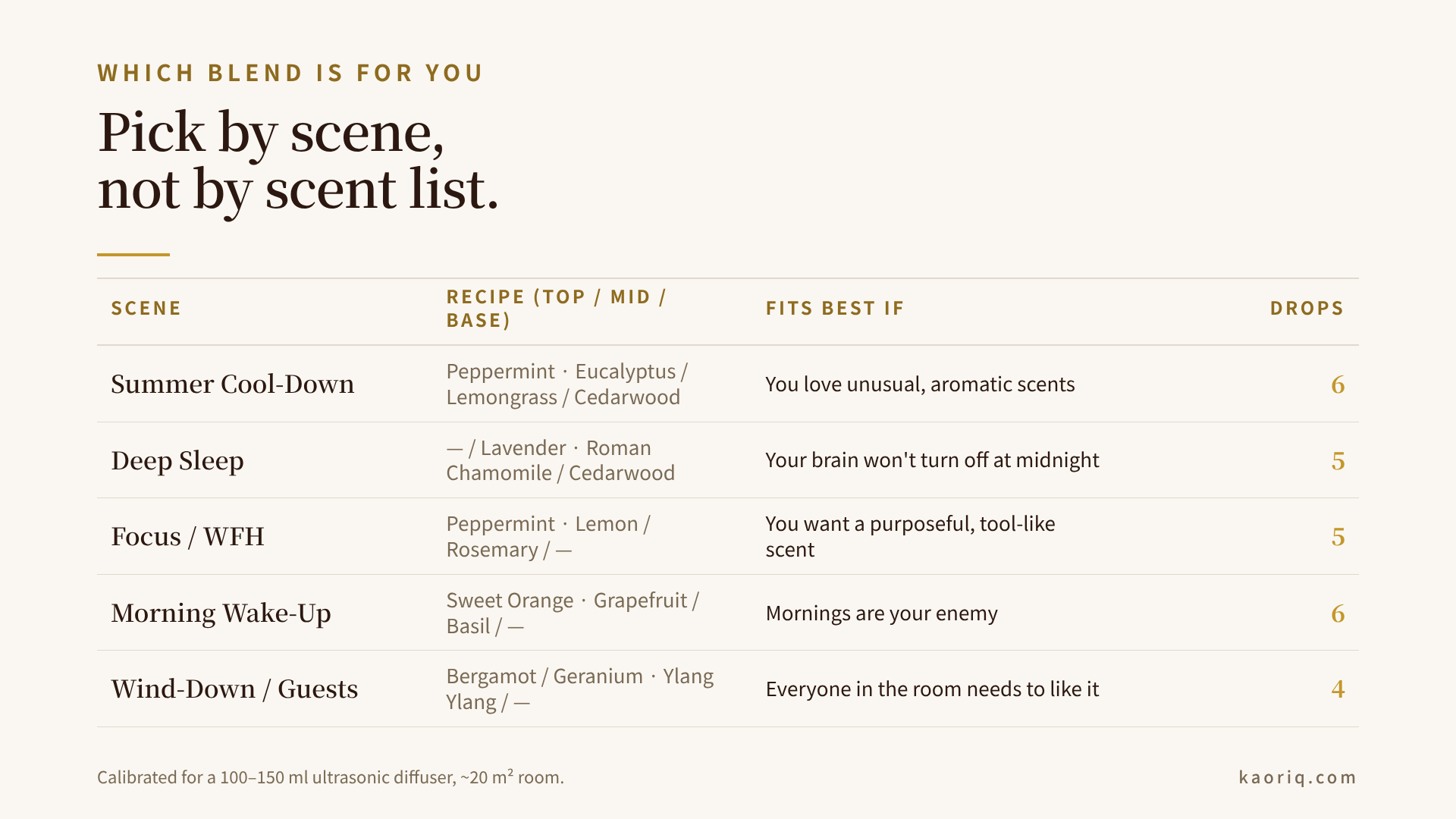
The Compatibility Cheat Sheet
The reason those five blends work is that certain oil families combine reliably. Once you internalize this, you can improvise. Here’s the shortest version I can write:
| Family combo | Result | Example |
|---|---|---|
| Citrus + Herbal | Bright, energizing, safe bet | lemon + rosemary |
| Citrus + Woody | Fresh but grounded | bergamot + cedarwood |
| Floral + Woody | Warm, softly romantic | lavender + sandalwood |
| Floral + Citrus | Cheerful, feminine-coded | geranium + orange |
| Herbal + Minty | Cooling, focus-oriented | basil + peppermint |
| Minty + Woody | Clean, spa-like | eucalyptus + cedarwood |
| Resin + Citrus | Meditative, “cathedral morning” | frankincense + bergamot |
Two families I would generally not combine without a reason:
- Two florals together (e.g. rose + jasmine) — competes for the middle-note space, gets muddy fast
- Mint + resin (e.g. peppermint + frankincense) — the mint makes the resin smell dusty rather than sacred
Rules are made to be broken; break them on purpose.
The Safety Notes Nobody Wants to Read
Read them anyway. These are the ones that matter.
Pets, especially cats. Cats process essential oils very differently from humans and can’t metabolize certain compounds. Tea tree and eucalyptus are the two biggest concerns. If you have a cat, skip the Summer Cool-Down blend entirely, or run it only in a room the cat can’t enter with the door closed. Dogs tolerate more but still shouldn’t be in a small sealed room with a running diffuser for hours. The full breakdown is in the pet-friendly home fragrance guide.
Kids and pregnancy. Peppermint, rosemary, and eucalyptus at high concentrations are not appropriate for infants under 6 months or during the first trimester. Halve the drop count, run for shorter cycles, or skip until later.
Run time. 30-45 minutes on, then off. Not because the oils are dangerous, but because your nose stops registering them after that and you’re wasting oil into a room nobody is smelling. Olfactory adaptation is real; running your diffuser for four hours doesn’t give you four hours of scent, it gives you fifteen minutes of scent and then three hours forty-five of paying for nothing.
Diffuser choice matters. Everything above assumes an ultrasonic or nebulizing diffuser. Reed diffusers can’t run blends this way — you’d be committing 100 ml of oil to a recipe you might not like. If you’re not sure which type you have or need, the diffuser types comparison walks through it.
The Decision Shortcut
If you read nothing else:
- You’re in July and it’s hot: Summer Cool-Down.
- You can’t sleep: Deep Sleep, 30 minutes before bed, off at lights-out.
- You’re working from home and struggling: Focus / WFH, 40-minute cycle at the start of a work block.
- You hate mornings: Morning Wake-Up in the kitchen, not the bedroom.
- You have people over: Wind-Down / Family Time.
Buy the eight oils that recur across those blends first — lavender, cedarwood, peppermint, eucalyptus, bergamot, sweet orange, rosemary, lemon — and you can make all five of these plus dozens more. That’s the actual starter kit nobody sells you.
The rest is trial and error, which is the fun part. Uncap two bottles at once, hold them a few centimetres apart, and take one slow inhale over both. If it makes you close your eyes, that’s a blend. If it makes you flinch, that’s a lesson. Neither one costs anything.
If you’d rather skip the trial and error, our upcoming personality quiz will match you to a scent family before you buy your first bottle. Blending gets a lot easier when you already know which family your nose belongs to.
Was this article helpful?