Your Home Gym Deserves Its Own Scent: How to Fragrance a Workout Space That Survives Sweat (and Actually Gets You Moving)
The Home Gym as a Museum of Old Sweat
A lot of “home gyms” are a yoga mat, two dumbbells, and a spin bike crammed into the corner of a spare room. It works. It also becomes a gentle archive of every session done in there. Open the door and you get a faint, humid memory of last Tuesday’s HIIT, preserved in the carpet like a fossil.
So you do what any reasonable person does: buy an expensive candle, light it before a workout, and wait for the magic.
The magic did not come. You cannot out-fragrance a sweating human in a closed room, and you definitely shouldn’t leave an open flame burning while you’re doing jump squats next to it. The candle was both useless and a small fire hazard. Two for two.
Here’s the friend-to-friend version of what actually works: why a workout space is uniquely hostile to home fragrance, which scents help at the start versus the finish, and how to set it up so it survives the sweat instead of drowning in it.
Why a Workout Room Is the Hard Mode of Home Scenting
Most rooms ask one thing of your fragrance. A workout space stacks three problems on top of each other.
1. Sweat loads the air. A body working hard pumps warmth and moisture into a small space fast. We’re scenting the air of the room, not you (more on that line later), but that air is now thick and humid in a way your living room never is.
2. Humidity drags everything down. Moist, heavy air holds scent differently. Light, fresh top notes get muddied, and the room can feel stuffy even when it technically smells fine. If you’ve read our rainy-season guide on humidity and scent, this is the same physics, just self-inflicted.
3. It’s a sealed box. Most home gyms are spare rooms, basements, or corners with one small window and the door shut for privacy. Bad airflow means whatever’s in the air stays in the air, good and bad alike.
The takeaway: you are not trying to mask sweat with a stronger candle. You’re trying to keep the room’s air fresh and moving, and to pick scents that read as clean and energising rather than heavy. Ventilation first, fragrance second. Crack the window or run a fan, then scent the refreshed air.
Pick the Scent for the Moment, Not the Whole Session
This is the shift that fixed it for me. A workout has phases, and your nose wants different things in each. Instead of hunting for one “gym scent,” match the note to what you’re trying to do.
| Goal | Scent family | Notes to look for | Why it works |
|---|---|---|---|
| Ignite (get off the mat) | Citrus & mint | Grapefruit, lemon, peppermint, eucalyptus | Bright and cooling; the classic “wake up” cue |
| Sustain (stay in it) | Herbal & green | Rosemary, basil, green tea | Clean and clear-headed without being sleepy |
| Cool down (come back to earth) | Woody & forest | Hinoki, cedar, vetiver, pine | Grounding, calm, the exhale at the end |
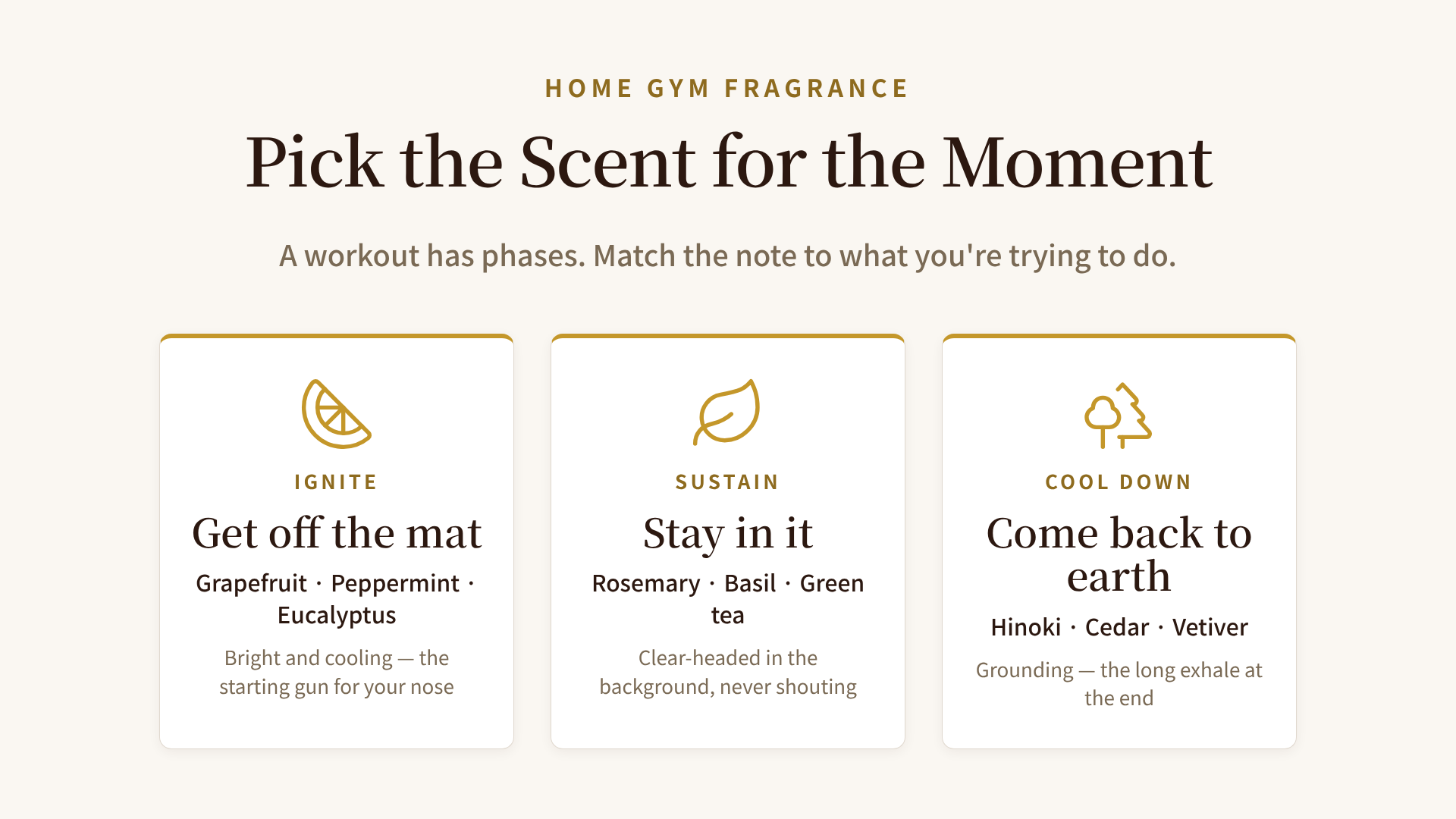
Ignite. The hardest part of any home workout is the bit before it starts, when the sofa is right there. A bright, cold-feeling scent like grapefruit, peppermint, or eucalyptus acts like a starting gun for your nose. There’s even research that finds peppermint odour can nudge people toward feeling a workout is a little less effortful: in one classic study, sniffing peppermint was linked to people doing a few more push-ups and shaving time off a sprint. I’ll be honest about the asterisk in the next section, but as a “get me moving” cue, a fresh minty room genuinely helps. If you want this same energising trick for mornings, our wake-up-without-coffee routine runs on the same idea.
Sustain. Once you’re moving, you don’t want a scent shouting at you. Herbal and green notes like rosemary, basil, or a clean green tea sit in the background and keep the room feeling clear-headed rather than stuffy. Rosemary in particular has a long association with alertness and focus, which is why it shows up in our home-office focus guide too. A workout and a deadline want surprisingly similar air.
Cool down. This is the part everyone skips, and it’s the best one. When you’re stretching or catching your breath, switch the room toward something grounding: hinoki, cedar, vetiver, a soft pine. Woody and forest notes read as the long exhale at the end of a session. The room stops being a gym and goes back to being a room.
The Format Question: Anything With a Flame Is Out
In a normal room I’d happily light a candle. In a space where you’re swinging kettlebells, sweating onto the floor, and breathing hard, the rules change. You want a format that needs zero attention and has zero flame.
| Format | Good for a workout space? | Why |
|---|---|---|
| Electric / ultrasonic diffuser | ★★★★★ | No flame, cool mist, set-and-forget. The clear winner |
| Nebulizing diffuser | ★★★★★ | No heat, strong throw; great for a quick pre-workout hit |
| Reed diffuser | ★★★★ | Safe and passive, but humidity slows it and it’s easy to knock over |
| Room spray | ★★★★ | Perfect for a fast refresh between sets; you control the dose |
| Candle | ★ | Open flame near movement, plus wax you have to remember. Just don’t |
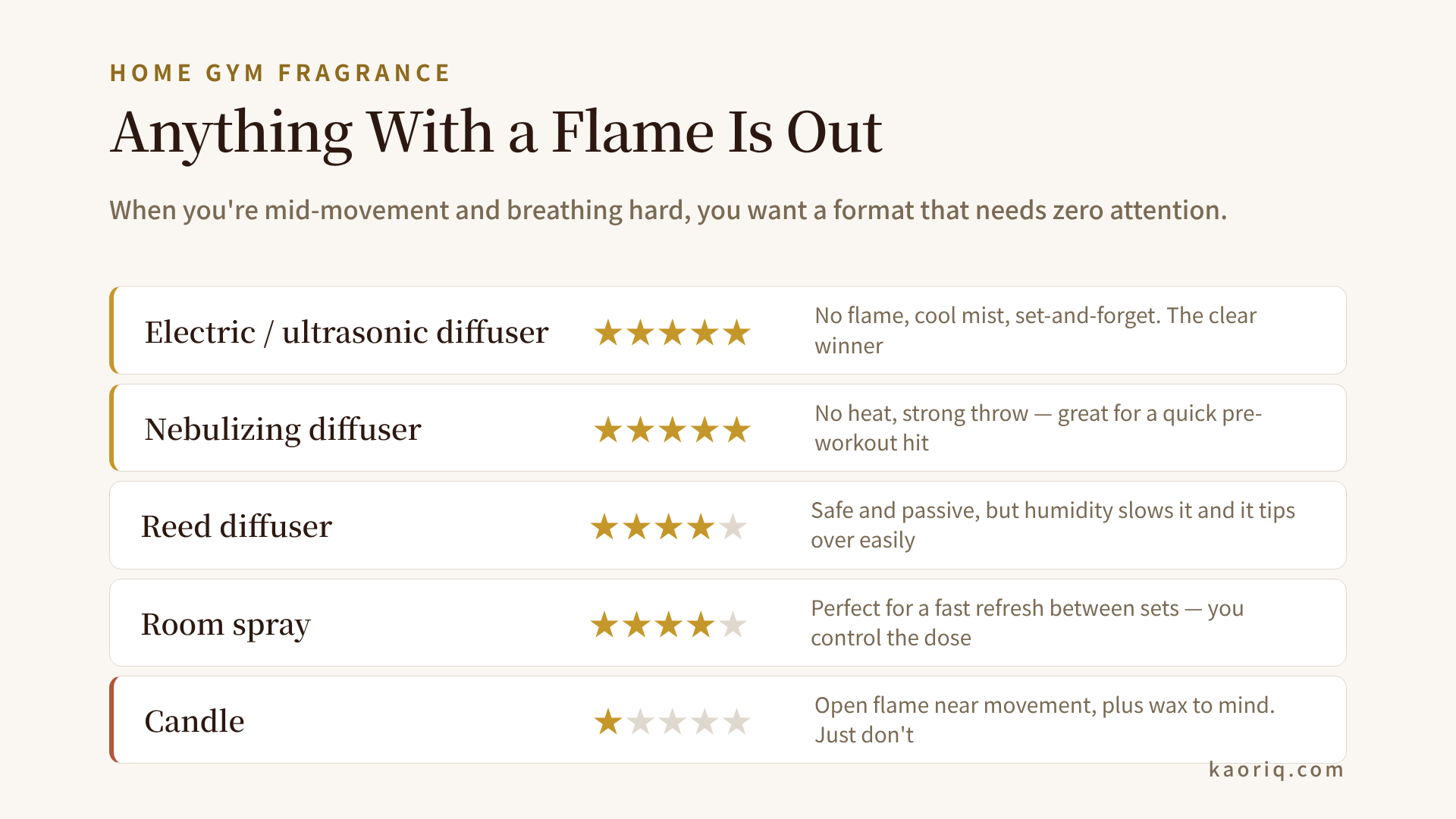
The headline: a no-flame, low-maintenance format is the only sensible choice when you’re mid-movement. An electric or ultrasonic diffuser you can switch on and forget is the MVP. A room spray is the perfect sidekick for a five-second refresh between sets, because you control exactly how much and when. Reed diffusers are safe but sluggish in humid air and very easy to send flying with a stray foot. Candles, in a space full of motion, are a hazard wearing a nice label. If you’re a renter or just flame-averse anyway, our flameless setup guide covers the no-candle approach in full, and the diffuser types comparison helps you pick between the electric options.
Build It as Three Phases
Here’s the setup I actually use now, mapped to the session.
- Before (Ignite): Two minutes before I start, a quick burst of citrus-mint, either a few sprays or the diffuser kicked on high. It’s a ritual cue as much as a smell: this corner is now the gym.
- During (Sustain): A herbal or green note running low and steady in the background. Quiet enough that I forget it’s there, which is the point.
- After (Cool down): As I stretch, I switch to something woody. Hinoki or cedar tells my body the hard part is over.
You don’t need three separate devices for this. One diffuser and one room spray, with a bottle of “start” scent and a bottle of “finish” scent, covers all three phases. The transition is the trick.
Three Honest Caveats
1. Fragrance scents the room, not you. This is the important one, legally and practically. A diffuser or room spray freshens the air of your workout space. It is not an antiperspirant, a deodorant, or anything you put on your body. Anything that touches skin is a different category of product entirely. Ventilate, shower, and let the room fragrance do the one job it can: keeping the space pleasant.
2. The peppermint research is intriguing, not a supplement. Those studies mostly had people inhale concentrated oil directly, not stand in a lightly scented room. Diffusing peppermint won’t add reps to your bench. What a fresh, minty room reliably does is make the space feel inviting enough that you actually show up, and showing up is most of the battle. Treat the scent as motivation and mood, not performance enhancement.
3. Your nose goes blind in twenty minutes anyway. Olfactory adaptation means you stop consciously smelling a constant scent fast. So don’t run a heavy diffuser the whole session hoping it’ll “fight the sweat.” It won’t, and you won’t even notice it after the warm-up. Short, well-timed bursts at the start and finish do far more than a smell running flat-out for an hour.
Your Workout-Space Scent, in One Line Each
If you skim nothing else:
- Ventilate first. Open the window or run a fan before any fragrance. Scent moving air, never trapped air.
- Match the note to the moment: citrus-mint to start, herbal-green to sustain, woody to cool down.
- Go flameless. An electric or ultrasonic diffuser plus a room spray; never a candle near movement.
- Short bursts beat all-day runtime. Your nose adapts; your bottle lasts; the room smells fresh exactly when you walk in.
A workout space asks more of home fragrance than any other room, and the answer isn’t a bigger, more expensive scent. It’s a fresh, moving, well-timed one. Get the air right, pick a note for each phase, and the corner that used to smell like a museum of old sweat becomes the one room you actually want to walk into.
Which note set is yours depends a lot on what gets you off the mat in the first place: some of us need to be jolted awake, others need to be calmed into focus. That’s the same thread we pull in why personality matters for fragrance, and it’s the best place to figure out your starting scent.
Sources consulted on scent and exercise: the peppermint-and-performance study summarised by Science of Essentials, Raudenbush et al. in the Journal of Sport and Exercise Psychology, and the peppermint exercise trial in the Journal of the International Society of Sports Nutrition.
Was this article helpful?