How to Choose a Home Office Fragrance That Helps You Focus (Without Distracting You)
The “Focus Candle” That Buys You Forty Minutes of Thinking About Cookies
Some candles are sold as productivity. Bergamot, rosemary, “cognitive clarity” — the label even has a little drawing of a brain. Light one on a Tuesday morning before a long writing session and you expect to enter some sort of monk-like flow state.
Instead you draft three sentences, notice the candle smells exactly like the biscotti from a cafe you used to go to, and spend the next forty minutes trying to remember the cafe’s name.
That candle wasn’t a bad candle. It was the wrong fragrance for the job I’d given it.
This is the part nobody warns you about when you set up a home office: the scent you pick will work on you, not just around you. Some smells genuinely help you focus. Others trigger memories, cravings, or low-grade emotional weather that pulls your attention sideways every time you inhale.
Here’s how to pick one that actually helps.
What “A Focus Fragrance” Actually Means
Three fragrance categories show up consistently in cognitive research, and each does a slightly different job.
Rosemary is the most studied. Mark Moss and his team at Northumbria University have run a series of experiments since 2003 showing that rosemary aroma improves performance on memory tasks, with measurable effects on the quality of recall. The active mechanism appears to be 1,8-cineole, a compound that crosses the blood-brain barrier; later studies even found that prospective memory — remembering to do things later — improves under rosemary aroma exposure. Useful, if you keep forgetting to actually send the email you keep telling yourself you’ll send.
Peppermint improves alertness and reaction time. The driving-task studies are the most striking: people perform measurably better on attention-heavy tasks under peppermint aroma. The catch — and it’s a real one — is that the effect is strongest in people who like peppermint. If you find peppermint medicinal or off-putting, the cognitive boost mostly disappears. Your nose has opinions.
Bergamot doesn’t make you sharper. It makes you less stressed, which often produces the same end result. Studies have shown reduced salivary cortisol after bergamot exposure, slower anxiety-induced heart rate, and improvements on mood and fatigue scores. If your “focus problem” is actually a “I cannot stop refreshing email because I’m anxious about that one Slack message” problem, bergamot is for you.
So: rosemary for deep memory work, peppermint for alertness and execution, bergamot for the anxious days. Different jobs.
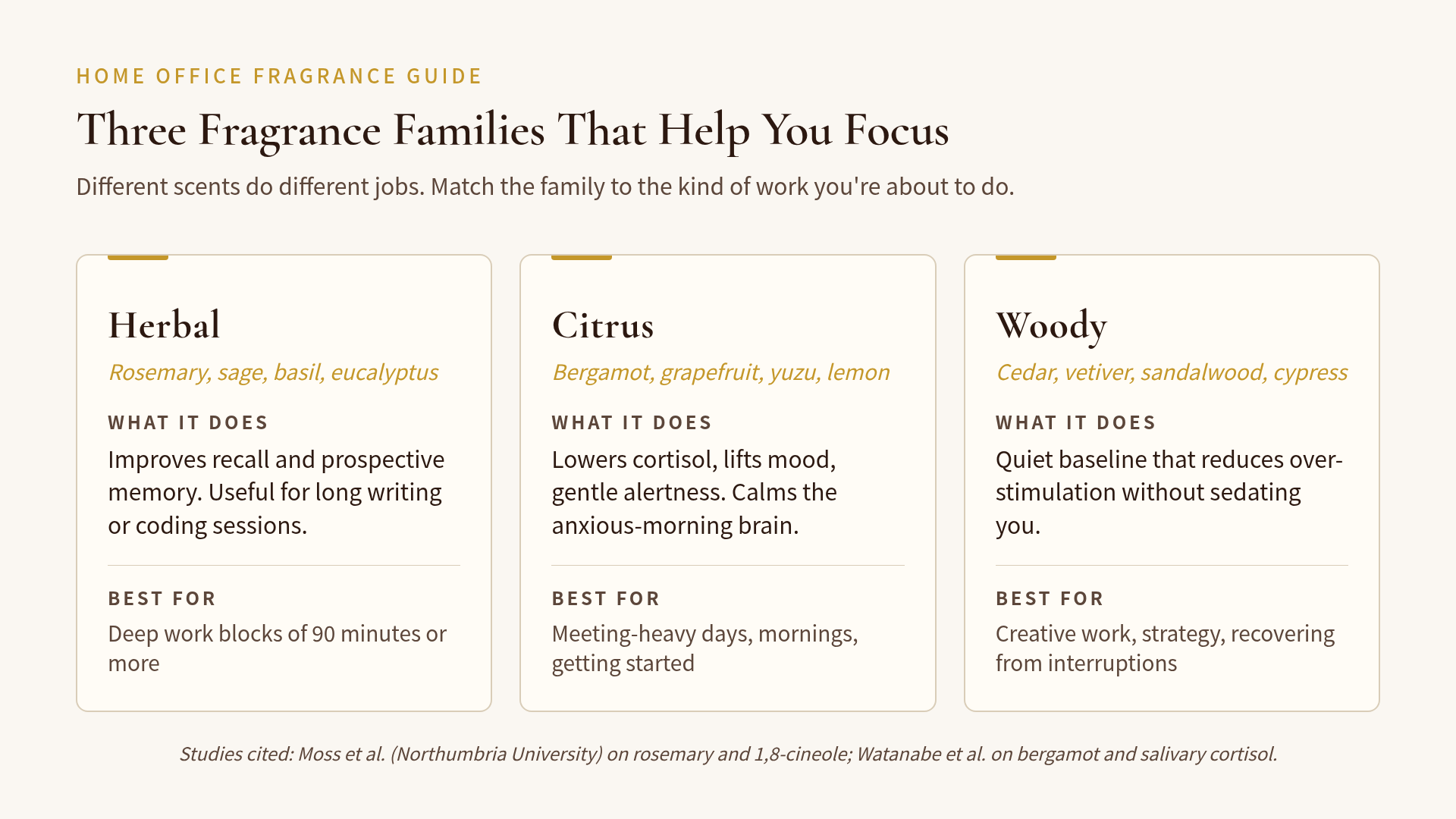
The Three Families, Side by Side
| Family | Best For | What It Does | Watch Out For |
|---|---|---|---|
| Herbal (rosemary, sage, basil, eucalyptus) | Long writing/coding sessions, memory-heavy work | Improves recall and prospective memory | Can feel cold or “kitchen-y” if you don’t like green notes |
| Citrus (bergamot, grapefruit, yuzu, lemon) | Anxious mornings, meeting-heavy days, getting started | Lowers cortisol, lifts mood, gentle alertness | Fades fast — needs refreshing every 90-120 minutes |
| Woody (cedar, vetiver, sandalwood, cypress) | Creative work, deep thinking, recovering from interruptions | Calm without sedation; reduces over-stimulation | Heavier woods (oud, leather) tip toward “lounge” not “work” |
The cheat code: most people pick a single bottle and expect it to handle every kind of work. It won’t. A bergamot diffuser is great for the first hour of the day and irrelevant by 2 PM. A rosemary candle is excellent for a two-hour focus block and exhausting if it runs all afternoon. Match the family to the kind of work you’re about to do.
Format Matters As Much As Scent
A small home office is not a small living room. The format choices change.
Tiny office (6-10 m² / 65-110 sq ft): A single-wick candle, a small reed diffuser (4-5 reeds), or a USB-powered passive diffuser. Anything bigger and you’ll get a headache by 11 AM.
Standard home office (10-15 m² / 110-160 sq ft): A medium candle or a small ultrasonic diffuser running on intervals (15 minutes on, 30 off). The interval setting is critical — continuous diffusion in a closed room means you stop noticing the scent within 20 minutes anyway, thanks to olfactory adaptation.
Shared workspace (kitchen-table office, living room corner): Reed diffusers only. You don’t want a candle competing with cooking smells, and you don’t want a diffuser misting essential oil onto someone else’s laptop. Reeds give you a polite background note without claiming the whole room.
One specific thing to avoid: a nebulizer diffuser in a small office. Nebulizers shatter pure essential oil into the air, and the concentration in a 8 m² room becomes oppressive within minutes. Save those for open-plan spaces.
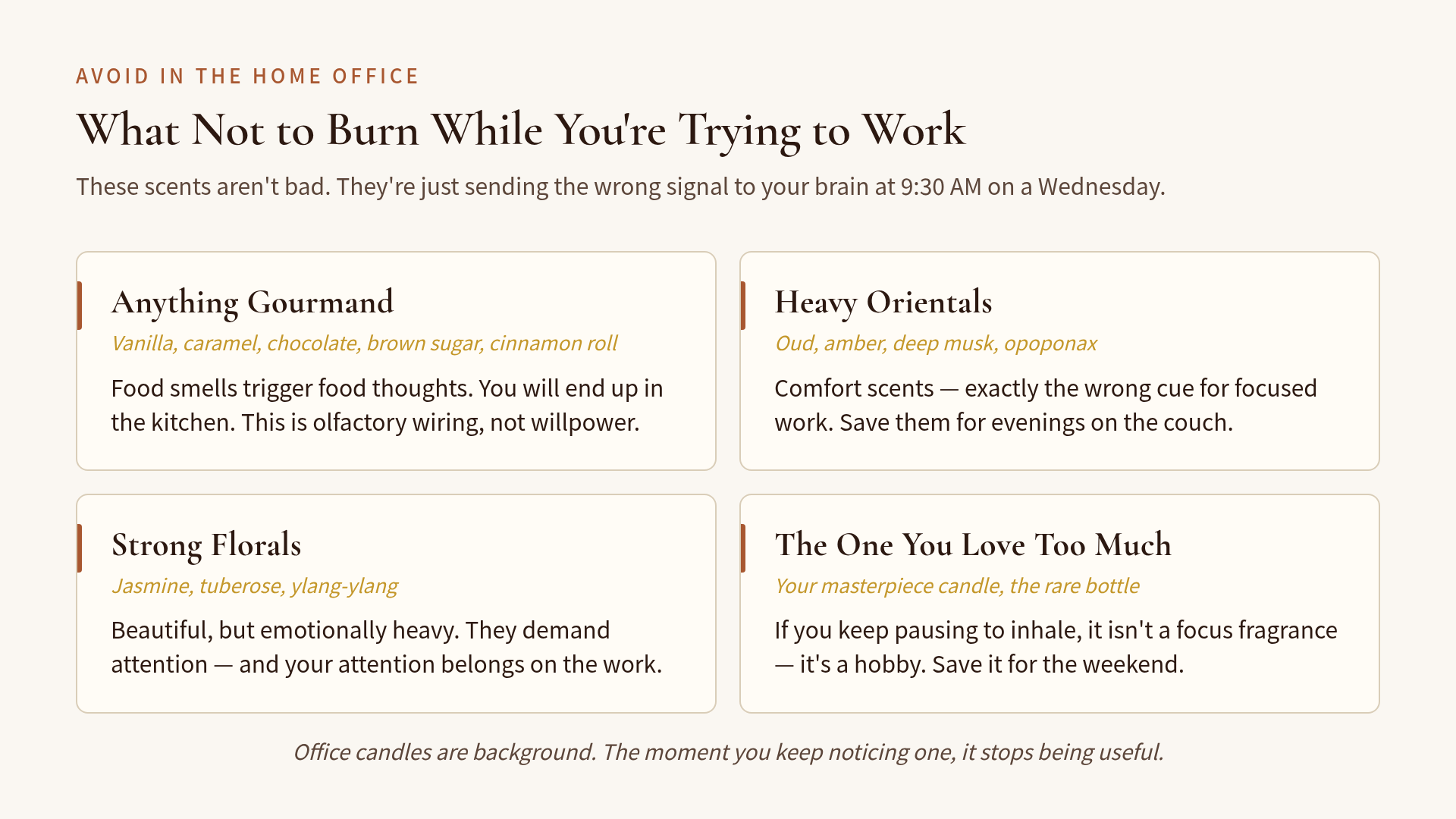
What Not to Burn While You’re Trying to Work
The list of fragrances that actively sabotage focus is longer than you’d think.
Anything gourmand. Vanilla, caramel, chocolate, brown sugar, cinnamon roll — all of it. Food smells trigger food thoughts. You will end up in the kitchen. This is not a moral failing; it’s olfactory wiring.
Heavy orientals. Oud, amber, deep musk, opoponax. These are comfort scents — the candles you light when you want to sink into a couch with a book. They are exactly the wrong signal to send your brain at 9:30 AM on a Wednesday. Save them for evenings.
Strong florals. Jasmine, tuberose, ylang-ylang. Beautiful in the right context, emotionally heavy in a workspace. They demand attention, and your attention is meant to be on the work.
The fragrance you love too much. This one’s counterintuitive. If you find a scent so good that you keep pausing to inhale, it’s not a focus fragrance, it’s a hobby. Save the masterpiece for weekends. Your office candle should be pleasant background, not a thing you keep noticing.
Match the Scent to the Way You Work
Here’s the part where the candle stops being generic and starts being yours.
If you’re a long-form writer, coder, or analyst — the kind of person who needs to hold three things in working memory for an hour at a time — start with rosemary. The memory data is genuinely on your side. A pinch of pine or eucalyptus mixed in keeps it from feeling too kitchen-herb.
If your day is fragmented — meetings, Slack threads, ticket triage, context-switching every fifteen minutes — you don’t need a memory boost, you need cortisol management. Try bergamot in the morning and a citrus blend (grapefruit, yuzu, mandarin) at midday when you reset.
If your work is creative or strategic — the kind that requires you to not be over-caffeinated and over-stimulated — go woody. Cedar, cypress, or a soft vetiver. These give you a quiet baseline that lets the ideas surface without your nervous system shouting over them.
And if none of that sounds like you, that’s the actual point. Your fragrance preferences track your personality more reliably than any “top 10 productivity scents” list, which is why we built a personality-based fragrance fit framework instead. The herbal-loving conscientious type and the citrus-loving extrovert want different things from a focus candle, and pretending otherwise just sells more candles people don’t enjoy.
The One-Line Version
Pick a scent that matches the job you’re doing today, in a format that matches your room, and don’t choose anything that smells like dessert. Rosemary for memory, bergamot for stress, cedar for calm. That’s basically it.
The rest is just figuring out which of those three is your one. And if you’re not sure — well, that’s what the personality piece is for. Start there. Then come back and pick the candle.
Volta, by the way, closed in 2023. The biscotti are gone. But somewhere out there, a much better focus fragrance is waiting for you, and it almost certainly does not smell like baked goods.
Was this article helpful?