How to Layer a Candle, Diffuser, and Incense Without Giving Yourself a Headache
What Happens When You Stack Three Scents
Come home one afternoon with a new sandalwood candle. Light it next to the existing peppermint reed diffuser, then — because “layering creates depth” is something you read somewhere — burn a yuzu incense stick “for vibes.”
Within fifteen minutes the apartment smells like a confused spa, your eyes are watering, and you’re on the front step googling “is olfactory adaptation reversible.” It is, mercifully. The evening is not.
That’s the part nobody tells you about layering home fragrance: more is not better. Three good scents, layered carelessly, will produce one bad scent. And one expensive headache.
This guide is the recipe I wish I’d had that day.
Why Scents Clash (in Plain English)
When you light a candle, the warm wax pushes top notes into the air first — bright, sharp molecules like citrus, mint, or fresh herbs. Within twenty to thirty minutes, the heavier middle and base notes (florals, woods, resins) take over.
A diffuser, meanwhile, is doing its own thing on a different schedule, releasing whatever notes its formula favours at a steady, slower pace.
Now run both at once. You’re stacking two volatility curves on top of each other. If the dominant notes happen to be in the same family — two woody scents, say — they reinforce. If they’re competing — bright citrus from one, heavy oud from the other — your nose gets handed a cocktail it didn’t order.
To make matters worse, your brain is a quiet saboteur. Olfactory adaptation kicks in within fifteen to twenty minutes of constant exposure: the room stops smelling of much to you, even though anyone walking in will get a face full of it. So you, helpfully, decide to add more.
That’s how the headaches happen.
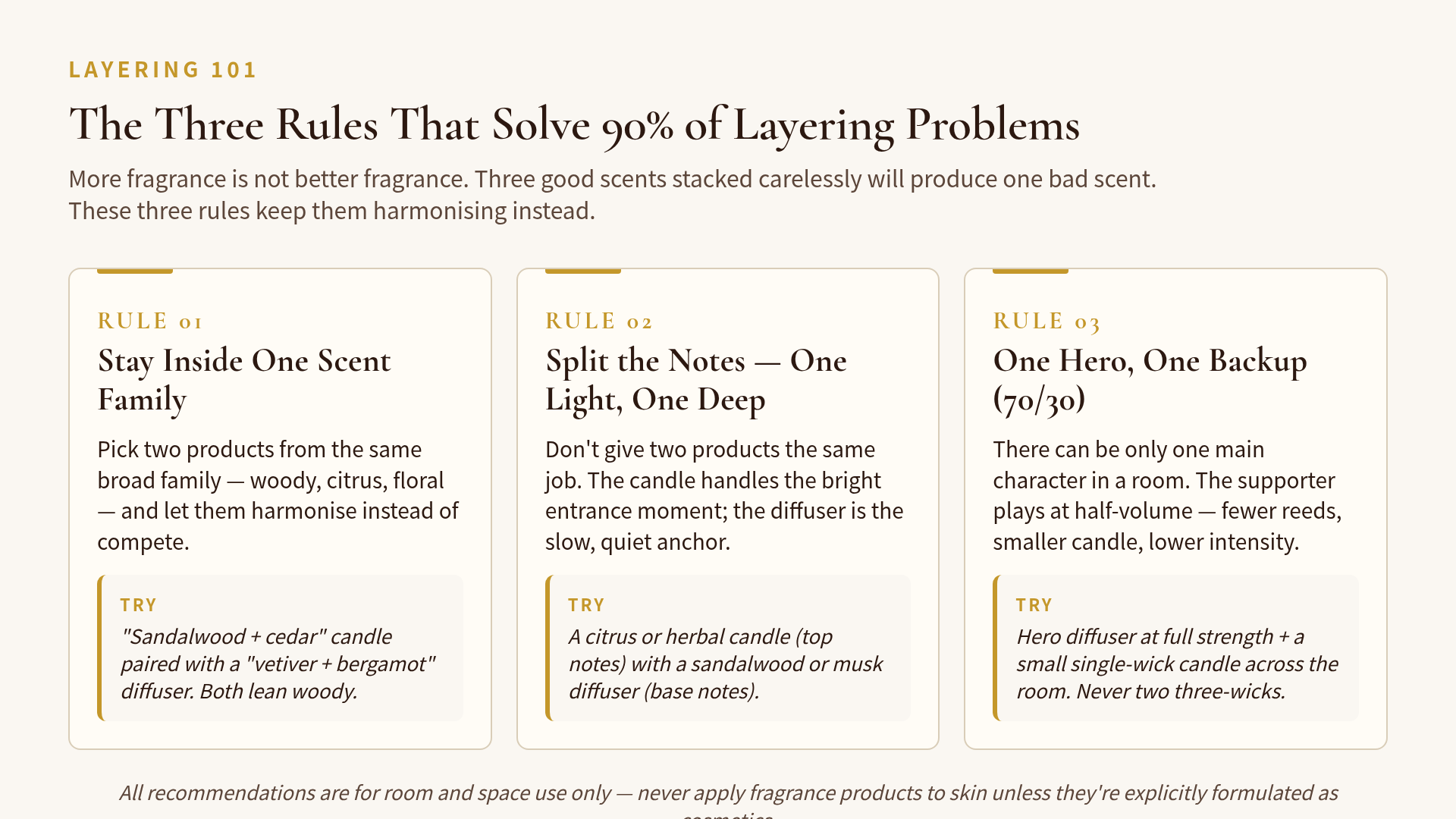
The Three Rules That Solve 90% of Layering Problems
Rule 1: Stay Inside One Scent Family
The single fastest fix is to pick two products from the same broad family and let them harmonise.
| Scent family | Plays well with | Avoid mixing with |
|---|---|---|
| Woody (sandalwood, cedar, vetiver) | Other woods, soft florals, light spices | Bright citrus, fresh aquatics |
| Citrus (bergamot, yuzu, grapefruit) | Light florals, herbs, green notes | Heavy oud, smoky incense |
| Floral (jasmine, rose, neroli) | Soft woods, warm vanilla, citrus | Heavy resins, smoke |
| Spicy / Warm (cinnamon, clove, amber) | Woods, vanilla, soft tobacco | Cool aquatics, sharp citrus |
| Smoky / Resinous (oud, frankincense) | Woods, leather, deep spices | Anything bright or floral |
If your candle says “sandalwood and cedar” and your diffuser says “vetiver and bergamot”, you’re already 80% safe. Both lean woody.
Rule 2: Split the Notes — One Light, One Deep
When the candle is doing the bright, top-note work, the diffuser should be doing slow, base-note work in the background. Reverse it if you prefer; just don’t give them the same job.
Practical version: pair a citrus or herbal candle with a sandalwood or musk diffuser. The candle handles the entrance moment; the diffuser is the long, quiet anchor.
Rule 3: One Hero, One Backup
There can be only one main character in a room. If the candle is the hero, the diffuser plays understudy at half-volume — fewer reeds, lighter scent. If the diffuser is the hero, the candle should be the smaller single-wick one across the room, not a three-wick monster on the same coffee table.
Visualise it as 70/30. Your hero is 70%. Your supporter is 30%. Anything closer to 50/50 and you’re back to the cocktail problem.
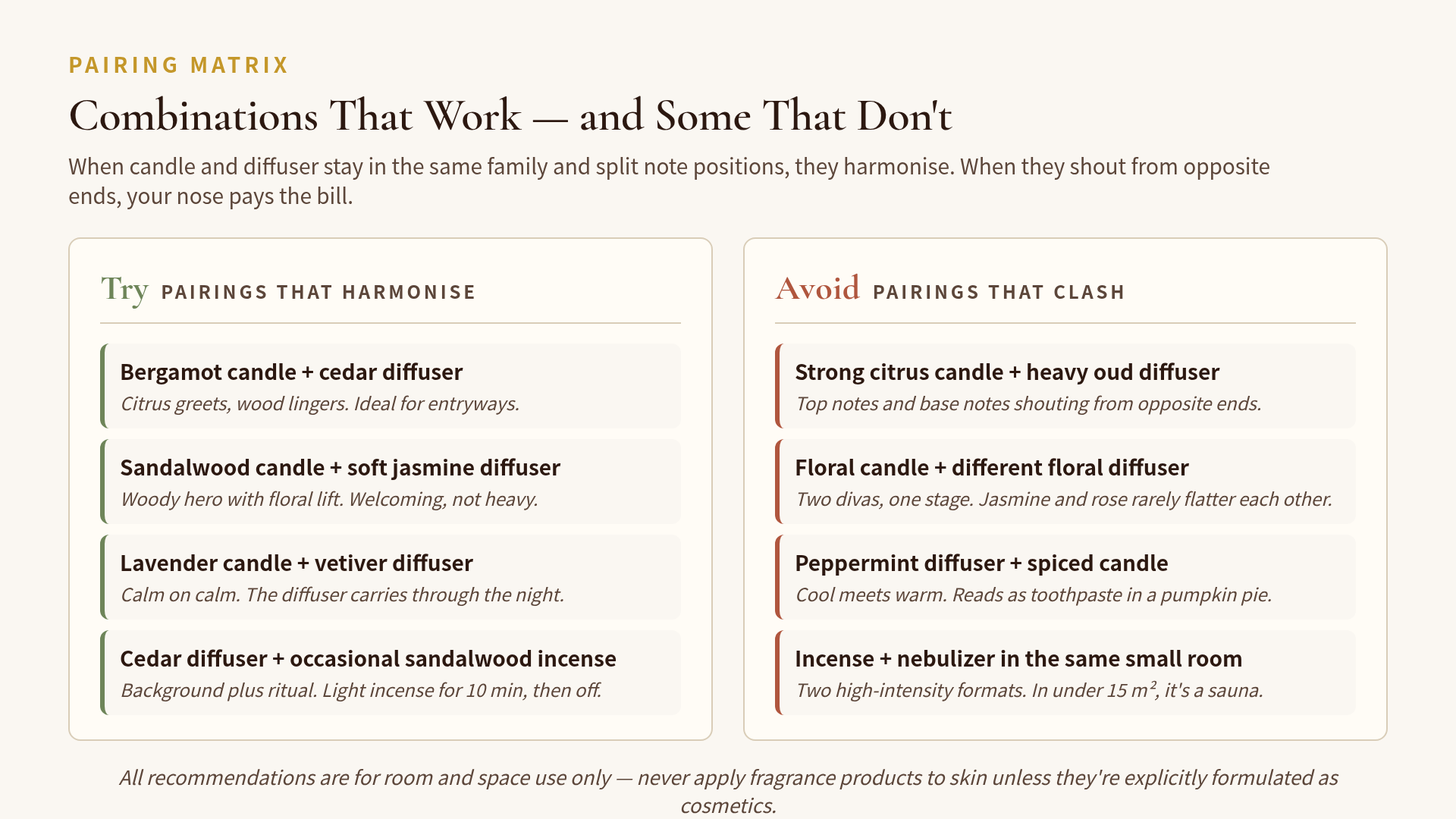
Combinations That Work (and Some That Don’t)
Avoid These Pairings
| Combination | Why it fails |
|---|---|
| Strong citrus candle + heavy oud diffuser | Top notes and base notes shouting from opposite ends. Your brain gets whiplash. |
| Floral candle + floral diffuser (different florals) | Two divas, one stage. Jasmine and rose competing rarely flatter each other. |
| Peppermint diffuser + spiced candle | Cool and warm in equal measure. Reads as “toothpaste in a pumpkin pie.” |
| Incense + nebulizer diffuser in the same small room | Both are high-intensity formats. Together in under 15 m², it’s a sauna. |
| Two strong-throw candles, both lit | Doubles the volume, halves the elegance. |
Try These Pairings
| Room | Candle | Diffuser / Incense | Why it works |
|---|---|---|---|
| Entryway / hallway | Light bergamot candle | Cedar reed diffuser (4-5 reeds) | Citrus greets, wood lingers. First impression layered cleanly. |
| Living room (15-25 m²) | Sandalwood candle, single wick | Soft jasmine diffuser, low | Woody hero with floral lift. Welcoming, not heavy. |
| Bedroom | Lavender candle (only when in the room) | Vetiver reed diffuser | Calm on calm. The candle dims after blowing out; vetiver carries through the night. |
| Reading nook / study | None | Cedarwood diffuser + occasional sandalwood incense (10 min, then off) | Background plus ritual. The incense marks the start of focused reading. |
| Bathroom (under 8 m²) | None | Eucalyptus reed diffuser only (3-4 reeds) | Small space, single source. Layering here just smothers. |
A note on incense specifically: treat it as punctuation, not paragraph. Burn it for ten to twenty minutes when you want a moment — the start of meditation, the wind-down before sleep — then let the diffuser carry the room afterwards. Incense lingering in the same air as a strong candle for an hour is when ventilation stops being a comfort issue and becomes a survival one.
How to Start Layering Without Buying Three Things at Once
If you’re new to home fragrance, please do not walk into a shop and buy a candle, a diffuser, and an incense set on the same trip. I have done this. It does not end well.
A saner sequence:
- Week 1. Pick one product. A reed diffuser is the easiest first move — it’s passive, consistent, and it’ll show you what scent family you actually enjoy living with for several days in a row. (The store sniff is a date; the home diffuser is a marriage.)
- Week 3-4. Once you know your base, then add a candle. Pick something that complements rather than competes — same family, different note position. Apply Rule 3: the diffuser stays as your hero, the candle is the supporter.
- Month 2+. Only after the first two settle, consider incense as the occasional accent. Not daily. Not while the candle is also burning.
This is also how you avoid the trap of buying three lovely products that, together, smell like nothing in particular.
One More Thing — Your Nose Is Lying to You
Before you reach for a third product because “the room doesn’t smell of anything anymore,” try this: leave the room for five minutes. Walk to the kitchen. Make tea. Come back.
Nine times out of ten, the room is fine. You had simply adapted.
If after the reset it really does feel underscented, the right move is to refresh — flip your reeds, relight the candle — not to add a new fragrance on top. Adding is the easy answer. Refreshing is the correct one.
Where to Go From Here
Layering gets much easier when you know what scent family suits you in the first place. If you’re guessing — and most people are — start by figuring out what kind of fragrance personality you have, because that’s the constant that makes every product choice afterwards simpler. And if you’re not yet sure which format belongs in which room, the room-size guide is the prerequisite to all of this.
Two scents in one room, one decision at a time. Your sinuses, your wallet, and the friend who walks into your apartment will all thank you.
Was this article helpful?