How to Buy Your First Home Fragrance Without Wasting Money: A Sample-First Strategy for Beginners
The $82 Candle That Gets Used Twice
Here is a story that happens constantly. Someone walks into a fancy candle store, sniffs something labeled “smoky leather, oud, vetiver,” feels very sophisticated for about four seconds, and walks out with an $82 single-wick. It gets lit twice. The first time, the apartment fills with what can only be described as the inside of a damp horse barn. The second time, it’s lit out of guilt. Then it lives on a high shelf for two years before being quietly re-gifted.
If you are about to buy your first home fragrance, that’s the experience worth skipping. The mistake isn’t taste. It’s the order of operations: buying a full-size product before knowing what you like. Most beginners make the same move. The way out is so simple that the industry quietly prefers you don’t notice it: sample before you commit.
The Hidden Rule of Fragrance Buying
Serious perfume people almost all learned the same lesson the same way: they wasted real money on a full-size bottle they ended up hating, decided “never again,” and from that day forward bought samples first. The pros do this. They have nothing to prove and they still do this. And yet, somehow, every new home fragrance buyer is expected to walk into a store, sniff three candles, and drop $50-200 on the one that smelled best in the first ten seconds.
Here’s why those first ten seconds lie to you:
Cold scent lies about warm scent. A candle smells one way unlit and a different way burning in your living room with your radiator on. A reed diffuser smells one way at the store and another after it has been quietly dosing your hallway for three days.
Your nose adapts in fifteen minutes. Olfactory fatigue is real. Within fifteen to twenty minutes of continuous exposure, your brain tunes the scent out. A scent that felt overwhelming at first will feel like nothing by dinnertime. The only way to know if you actually like a scent at home is to live with it for a week.
The bottle is the easy part. Once you know what scent family you like, the bottle and the wick and the diffuser format all become solvable. The hard part, the only part that needs trial and error, is figuring out which scents you’d genuinely choose to walk into every day.
So the entire beginner strategy reduces to one move: buy the sample, not the bottle.
The Sample-First Ladder
Here is the path I wish someone had drawn for me five years ago. Every step is reversible. Every step is cheap.
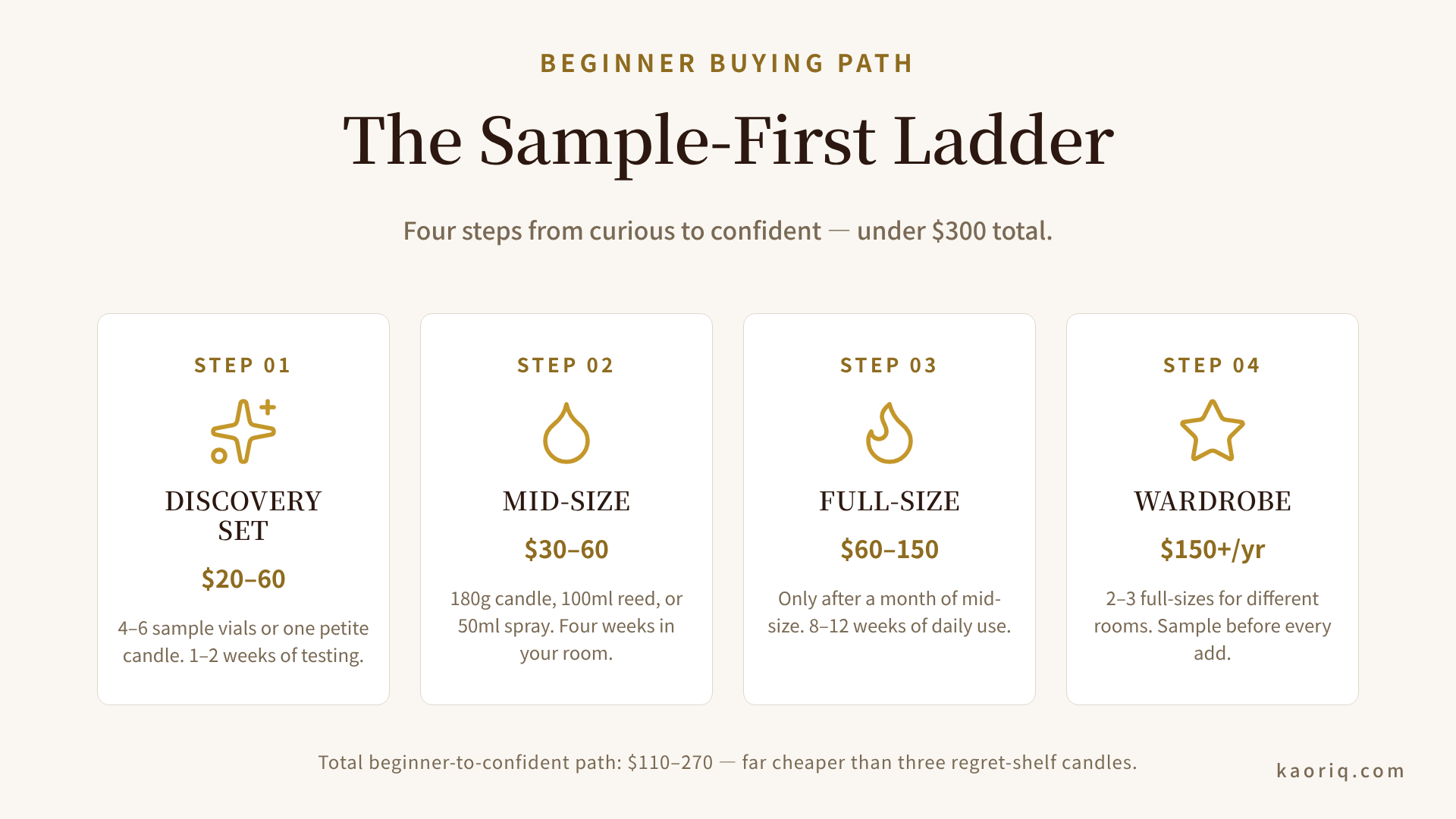
Step 1: The discovery set ($20-60)
Most respected fragrance houses now sell discovery sets: a curated box of 4-8 mini bottles or sample vials at a fraction of full-size prices. Diptyque’s eau de toilette discovery set is around $90 for 5 × 7.5ml. NEST New York runs $30-50 discovery sets for their bestsellers. For home fragrance specifically, look for “petite” candles (60-100g, ~$20-30) which give you four or five evenings of testing before they’re gone.
A single discovery set tells you more about your taste than three full-size purchases ever will. Watch for the one you reach for on day four. That, more than first-sniff fireworks, is your scent.
Step 2: One mid-size of your favorite ($30-60)
You’ve narrowed your discovery set to one or two scents that didn’t get boring. Now buy the mid-size: a 180-220g candle, a 100ml reed diffuser, or a 50ml room spray. This is the “I’m serious about this scent” stage. You will use this product in actual rooms, on actual evenings, for at least four weeks before deciding.
This is also where you find out the second thing samples can’t tell you: whether the format works in your space. A scent that punched above its weight in a 30ml decanter may disappear in an open-plan living room. If that happens, the scent isn’t wrong, the format is, and our room-size guide is built for exactly that question.
Step 3: The full-size, but only the one ($60-150)
If you’re still happy with the scent after a month of mid-size, this is the point where buying the full-size finally makes sense. A 400g three-wick candle, a 200ml reed diffuser, a 100ml room spray, whatever format your space actually needs. By this stage, you’ve spent maybe $80 total getting here. The alternative, buying full-size on instinct, would have cost roughly the same money and produced one hit and three regret-shelves.
Step 4: Build the wardrobe, slowly
A home fragrance “wardrobe” (different scents for different rooms or moods) is the goal, but it should be built one bottle at a time, with samples preceding every full-size purchase. The day you skip the sample step is the day you accidentally buy your next $82 horse barn. We’ve all done it. The trick is doing it only once.
The Budget Reality Check
Here is roughly what you should expect to spend at each step. I’ve cross-referenced US and UK pricing for 2026 across direct-to-consumer, Sephora-tier, and Anthropologie-tier brands.
| Step | Format | Typical Spend | What You Get |
|---|---|---|---|
| Discovery | 4-6 sample vials or one petite candle | $20-60 | 1-2 weeks of testing, 4-6 scents in your hand |
| Mid-size | 100ml reed, 180g candle, or 50ml spray | $30-60 | A full month in your actual rooms |
| Full-size | 200ml reed, 400g candle, 100ml spray | $60-150 | 8-12 weeks of daily use |
| Wardrobe | 2-3 full-sizes for different rooms | $150-350 over a year | A complete home-scent system |
The full beginner-to-confident path costs around $110-270 depending on tier. Buying three full-size candles on instinct, hating two, and quietly giving them away costs about the same amount of money and a lot more disappointment.
Three Scent Families to Avoid as Your First Buy
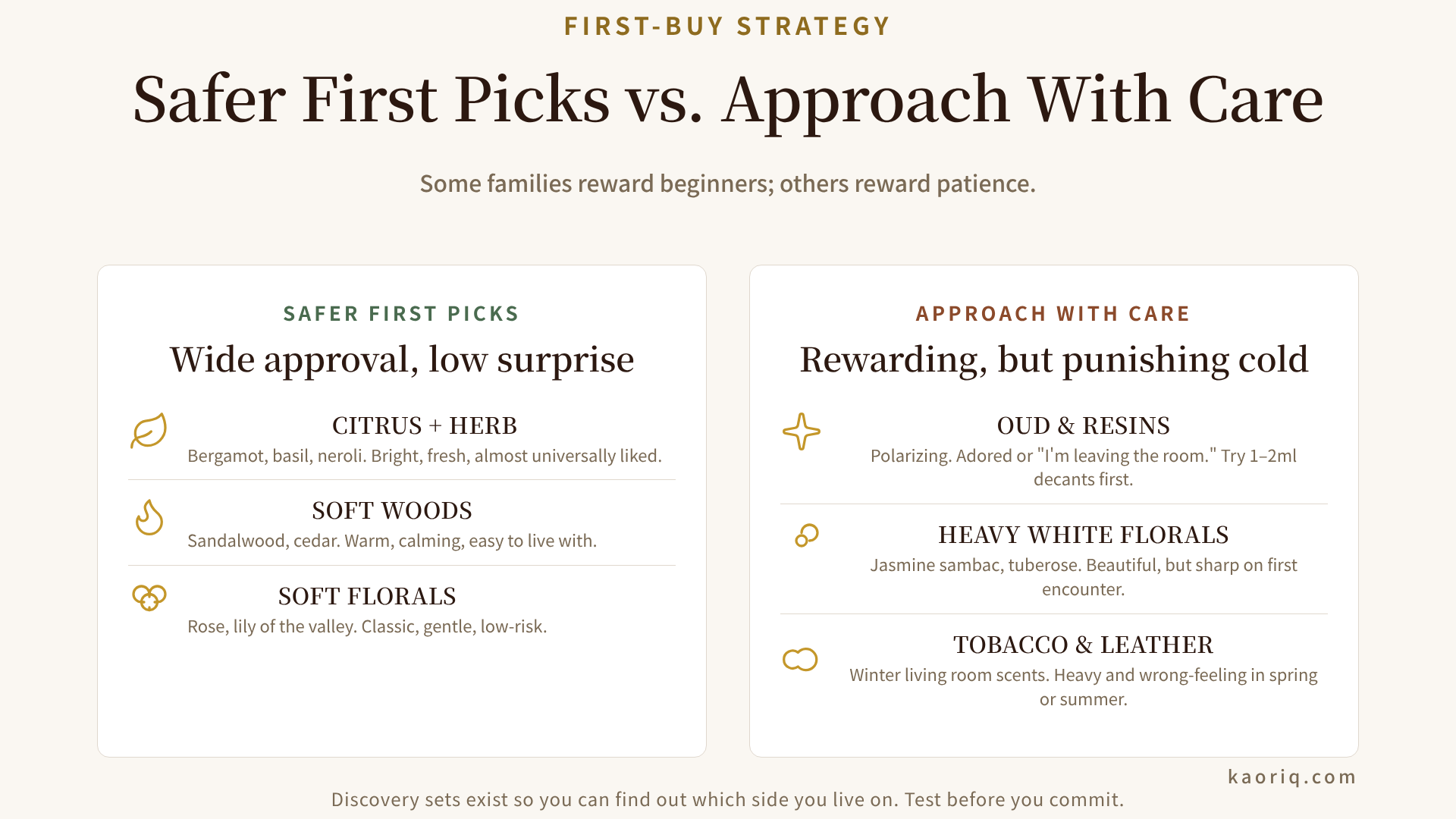
Call this a strong suggestion rather than a rule. Some scent families are deeply rewarding once you know what you like, but they’re punishing to encounter cold.
Oud and heavy resins. Oud is the polarizing fragrance note. People who love it adore it for life; people who don’t will excuse themselves and leave the room. Cost-wise, oud candles often start at $70 minimum. As a beginner, this is a high-stakes gamble. Try a 1-2ml decant first if you’re curious.
Heavy jasmine sambac or tuberose. Beautiful, classic, also capable of stopping conversation. White-floral concentrations smell sharp and almost medicinal at first encounter. They reward patience but can feel overwhelming on day one.
Tobacco and leather. These are amazing in winter living rooms. They are intense in May. If you’re buying your first home fragrance in spring or summer, a tobacco-leather scent will feel like wearing a wool coat to the beach.
Safer first picks: citrus + herb blends (bergamot, basil, neroli), light woods (sandalwood, cedar), or soft florals (rose, lily of the valley). These have wide approval and a low chance of provoking “what is that?” from anyone who walks in.
The One Thing Every Beginner Gets Wrong
When testing samples at the store, you’ll catch yourself doing a thing: smelling one, then another, then a third, then back to the first to “compare.” After about four scents in a row, you cannot smell anything anymore. This is olfactory fatigue, and it’s why beginners walk out with the worst scent in the store: it’s the only one they could still smell clearly.
The classic fix, sniffing coffee beans between scents, doesn’t work. Multiple studies have confirmed it, including one from Beloit College that found coffee beans, lemon slices, and plain air all produced identical results. Coffee just adds another scent to the mix; it doesn’t reset anything.
What actually works: smell your own wrist or the inside of your elbow for a few breaths. Perfumers do this. Your skin is the most neutral, familiar baseline your nose has, and the lack of fragrance gives the receptors a chance to reset. After about two minutes of fresh air or skin-sniffing, you can sample one more scent. After four samples total, go outside or come back tomorrow.
Where This Takes You
You don’t need to be a fragrance person yet. You just need to test before you commit, give every product time to actually live in your space, and resist the urge to buy your way out of indecision. Almost every home fragrance shelf has at least one candle that was bought on instinct and never burned. Sampling first, every time, is the single discipline that keeps that number at zero — and it saves hundreds of dollars and a lot of guilt about throwing away wax.
Once you’ve found a scent family you trust, the next questions get interesting. What format works in your room size? That’s our diffuser comparison. Which scent fits your temperament? That’s why personality predicts fragrance preference, and you can find your fit with our quiz. How do you build a real wardrobe? That’s scent rotation.
But all of that is downstream of the same first move: buy the sample, not the bottle.
Your future self, the one not staring at a shelf of expensive regrets, will thank you.
Was this article helpful?