How to Choose a Closet and Wardrobe Fragrance Without Wrecking Your Clothes
How White Shirts End Up Smelling Like a Temple Gift Shop
A sachet bender looks like this: five lavender pouches, three cedar sachets, and one optimistic “midnight oud” thing from a craft fair, all hung in the same closet on the same Sunday afternoon. Three weeks later a white linen shirt comes out for a work dinner, and someone leans in to ask whether you’ve just come back from a meditation retreat. That shirt has been washed twice. The scent does not care.
A closet isn’t a small room. It’s a fabric-stuffed sealed box that absorbs every molecule you put near it, then quietly hands those molecules back on your shirt, in a meeting, on a Tuesday. You can absolutely make your closet smell wonderful. You just have to do it on purpose, not by stacking five products and hoping for the best.
Why a Closet Needs a Different Fragrance Strategy Than a Room
Three things make closets behave nothing like the rooms they sit inside.
1. They’re sealed. A living room has windows and a door that opens all day. A closet has one door, opened maybe twice a day for thirty seconds. Whatever you put in there has nowhere to go; the same diffuser that smells faint in your bedroom will hit you like a wall when you open the closet next to it.
2. Everything in there absorbs scent. Wool, cotton, cashmere, silk, denim: every fabric you own is chemically a sponge for fragrance molecules. Wool is especially eager. Once a scent settles into the fibers, washing reduces it but rarely removes it.
3. It’s the first sensory hit of your day. You open the closet, reach for something, and that scent imprints whatever you’re about to put on with a mood. A tiny morning ritual, basically a layered home fragrance setup compressed into a single sealed cube of fabric.
The goal isn’t a closet that smells strong. It’s a closet that smells like a quiet, specific moment the instant you open the door, without spreading itself permanently into your sweaters.
The Four No-Flame Methods, Compared
Closets are non-negotiably flame-free. No candles, no incense, no warmers. That leaves four real options.
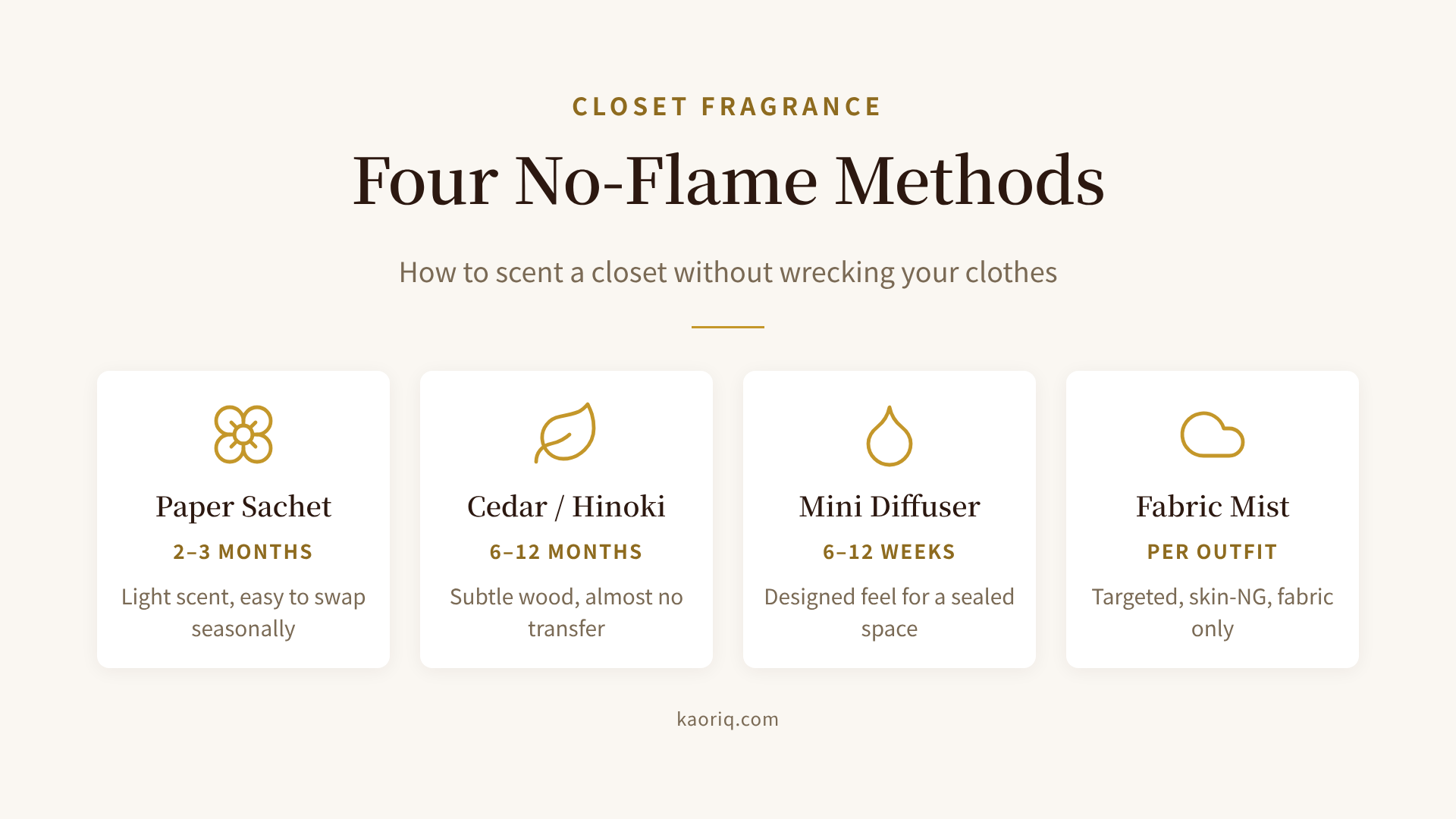
| Method | Intensity | Lifespan | Price (USD) | Transfer to clothes | Best for |
|---|---|---|---|---|---|
| Paper sachets | Light | 2–3 months | $5–$15 | Higher (close contact) | Switching scents seasonally |
| Cedar blocks / hinoki chips | Subtle | 6–12 months | $15–$35 | Very low | A natural, woody baseline |
| Closet-sized diffuser (no flame) | Medium | 6–12 weeks | $25–$50 | Low–medium | A designed, modern feel |
| Fabric mist (clothing only, not skin) | Adjustable | Instant, lingers hours | $15–$35 | Controllable | Targeting one outfit, one day |
A bit more on each.
1. Paper Sachets
A small fabric or paper pouch filled with scented material: dried botanicals, scented beads, or a fragrance-soaked card. You hang one from a hanger bar and forget about it for a season.
The trick is restraint. Fragrance molecules in a sealed closet fall and pool downward, so hang the sachet at the top of the rod, not buried among shoes. Start with one. Add a second only if you genuinely can’t smell it after a week. Three or more in a standard closet is how you end up like me, explaining to your dinner host that no, you have not just left a yoga class.
2. Cedar Blocks or Hinoki Chips
The American “cedar chest” tradition has been doing this for two hundred years for a reason. Aromatic red cedar gives off a dry, slightly sweet wood smell that quietly fills a closet, deters moths without chemicals, and almost never transfers noticeably to clothes. Hinoki (Japanese cypress) does the same thing with a cleaner, bath-house character.
Both fade over six to twelve months. Sand them lightly when the scent dulls, or add a drop of matching essential oil. Low-maintenance, hard to mess up. If you read only one section of this guide, act on this one.
3. Closet-Sized Diffusers
A miniature reed diffuser, passive gel jar, or non-electric scent vessel sized for a small space. These give a slightly louder, “designed” closet smell, the kind of thing you’d find in a boutique fitting room.
Do not repurpose a living-room reed diffuser into your closet; it will be far too strong in a sealed space. Buy something explicitly labeled for closets, drawers, or “small spaces,” or pull half the reeds out of a regular diffuser to dial it down. This is the closet equivalent of matching fragrance format to room size.
4. Fabric Mist (for Clothes, Not Skin)
A water-and-fragrance spray formulated for fabric. The footnote: it must say “for fabric” or “linen spray” on the bottle. Mists for skin are cosmetics, a different category entirely; mists for fabric are household products. Buy the household one, spray it on the clothes, not on you.
This is the only method on this list that’s outfit-by-outfit. Navy blazer today gets a light pass; tomorrow’s white shirt gets nothing. Hold the bottle about 12 inches away, mist the inside of the fabric, and let it dry fully before buttoning up. Test on silk, light colors, and dry-clean-only pieces first; some dyes will spot.
It’s also the only method I’d recommend pairing with another. A cedar baseline plus targeted fabric mist for “today’s outfit” is, honestly, the setup I’ve ended up with.
Match the Scent to Your Wardrobe Season
Closets change contents twice a year. So should the scent inside them.
Spring–Summer Closet (May–September)
Mostly linen, cotton, lighter knits. Colors lean white, beige, pastel, navy, washed denim. What works: citrus florals and clean greens. Think bergamot, neroli, white tea, green fig, light musks. The dampness American closets pick up between May and August pairs better with crisp scents than heavy florals. Same logic as my seasonal scent rotation guide, smaller box.
Fall–Winter Closet (October–April)
Wool, cashmere, denim, tweed. Colors deepen: brown, charcoal, oxblood, forest green. What works: woody and warm-spice. Sandalwood, cedar, vetiver, soft amber, a whisper of clove. Heavier fabrics absorb and release these notes beautifully, and a winter closet’s cooler temperature softens warm-spice scents into something subtle rather than aggressive.
Rotate Scents When You Rotate Clothes
The single highest-leverage habit: change your closet fragrance on the same day you swap out your wardrobe. Not the week after, not “when I remember.” Same day. The clothes coming out are already neutral; the clothes going in haven’t soaked up anything yet. A clean reset twice a year. More than most rooms in your house ever get.
The Three Most Common Mistakes
A short list of things that look smart and aren’t.
- Mixing scented sachets with mothballs. Naphthalene mothballs and floral or woody fragrances are chemically loud-mouthed, and they fight. The combination produces a smell that is best described as “an estranged aunt’s hallway.” If you need pest protection, choose herbal moth deterrents (lavender, cedar, hinoki) and let them do both jobs. Skip the conventional mothballs entirely if you can.
- Spraying perfume directly into the closet. Perfume is formulated for skin chemistry, not fabric, and it can spot delicate materials, fade dyes unevenly, and last far longer in fibers than on a body. If you want airborne fragrance in a closet, use a closet product. If you want a fragrance on your clothes today, use a fabric mist.
- Closing the door before the mist dries. Wet fabric + closed dark space = mildew. Always give a freshly misted garment 10–15 minutes of open air before the closet door shuts. This applies double in humid months.
A Quick Personality-Based Starter Pick
Match it to how you actually buy things.
- The collector → cedar blocks as the baseline, fabric mist for variety. Stable floor, rotating top layer.
- The set-and-forget person → cedar or hinoki blocks alone. Replace once a year. Done.
- The “I want it to smell expensive” type → a closet-specific diffuser in a woody-amber direction.
- The minimalist with a capsule wardrobe → one paper sachet, replaced seasonally.
- The outfit-by-outfit dresser → fabric mist primary, cedar blocks underneath to keep the closet neutral.
The longer version of why these patterns track to personality lives in why personality matters for fragrance.
Bottom Line: When in Doubt, Start with Cedar
If you have ten minutes and don’t want to think about this again for six months: buy a pack of aromatic cedar blocks, hang one on the top rod of your closet, and stop.
It’s quiet, it doesn’t migrate onto your clothes, it deters moths, it costs less than lunch, and it has roughly zero chance of producing a “temple gift shop” moment in a meeting. If you want more, add a fabric mist for outfit days. If you want less, you can’t really get less; cedar is the floor.
The point of a closet fragrance isn’t to perform. It’s to give you one good thirty-second moment, every morning, when you open the door and feel like the day is already a little more organized than you are.
White-shirt-meditation-retreat-energy entirely optional.
Was this article helpful?