How to Choose a Home Fragrance by How You Want to Feel (Not the Note on the Label)
Staring at a Shelf of Candles and Understanding None of the Words
“Vetiver.” “Galbanum.” “Petitgrain.” You’re standing in a shop holding a candle that costs more than lunch, reading a label that may as well be a list of spell ingredients. No idea whether you’d like it. No idea what you’re supposed to do with it. So it goes back on the shelf and you buy the one that says “Fresh Linen” — which is how people end up with a candle that smells like a hotel that doesn’t like them.
The problem isn’t the candle. It’s shopping from the wrong end.
Note names (bergamot, oud, neroli, the whole perfumer’s dictionary) are the answer. But almost nobody walks into a room thinking “I’d like to feel more like cedarwood today.” We think in feelings. I want to wake up. I want to stop bracing. I want to focus. I want this place to feel welcoming. I want to feel safe. So here’s the reframe that makes home fragrance make sense: pick the feeling first, then let the feeling pick the note.
The Cheat Sheet: Five Moods, Five Scent Directions
Smell is the only sense wired straight into the limbic system, the brain’s emotion-and-memory hub, with no stopover in between. That’s why a scent can change a room’s mood before you’ve consciously noticed it’s there. It also means you can run the logic backwards: decide the mood, and a fairly reliable family of scents points to it.
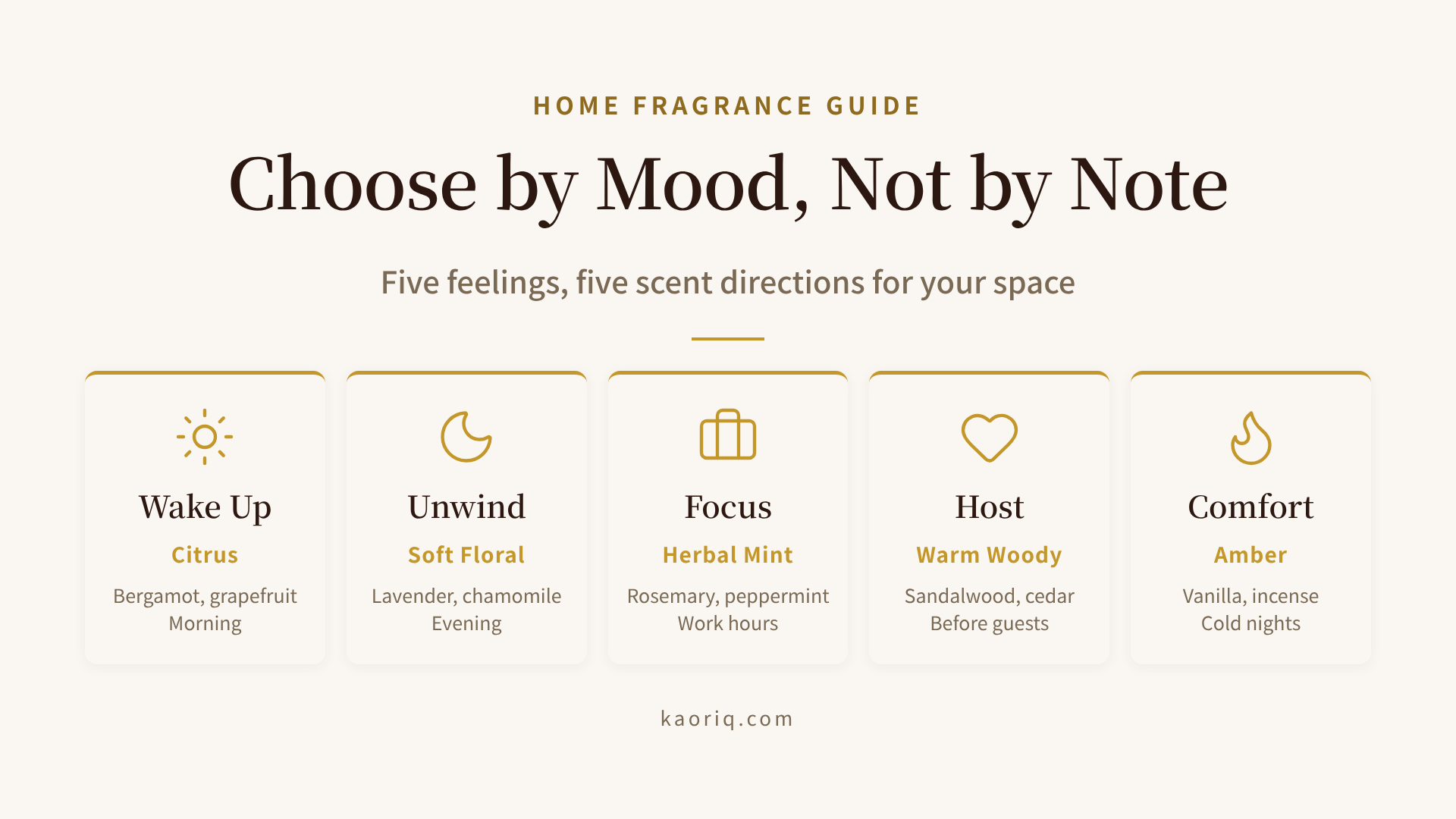
Here’s the whole guide in one table. Find the row that sounds like your day.
| You Want To… | Scent Direction | A Note You’ll Recognise | Best Format | When |
|---|---|---|---|---|
| Wake up | Citrus / bright fresh | Bergamot, grapefruit, lemon | Candle, room spray | Morning |
| Unwind | Soft floral / lavender | Lavender, chamomile | Reed diffuser | Evening |
| Focus | Herbal / minty green | Rosemary, peppermint, eucalyptus | Electric diffuser | Work hours |
| Host | Warm woody | Sandalwood, cedar, hinoki | Candle | Just before guests |
| Comfort | Amber / sweet resin | Vanilla, tonka, incense | Candle, incense | Night, cold months |
One thing before we go further: everything here is about scenting a room: candles, diffusers, incense, sprays for the air. Not your skin. Home fragrance lives in the space around you, and the families behave a little differently filling a room than they would warming on a wrist.
Wake Up → Citrus
Lemon, bergamot, grapefruit, mandarin. Citrus oils are made of small, fast molecules that flare bright and clear out quickly, which is exactly what you want at 7am. They read as clean and awake, and there’s a tidy reason why: bright citrus scents are associated with a lift in alertness and mood. A bergamot candle through your morning coffee is the closest thing home fragrance has to a free shot of caffeine, minus the jitters.
Because citrus fades fast, lean on formats that refresh in pulses: a short candle burn while you get ready, or a room spray you mist into the morning light.
Pick this if: you want your mornings to feel like an open window, and you find anything sweet too heavy before noon.
Unwind → Soft Floral and Lavender
Lavender is the cliché, and the cliché is right. It’s one of the most-studied calming scents there is, linked in trials to lower heart rate and reduced stress. Chamomile and a soft, clean floral sit beside it. These aren’t loud scents; they’re the olfactory equivalent of your shoulders dropping an inch.
A reed diffuser is ideal here, because the whole point of unwinding is that you don’t want to tend a flame or press a button. You want the scent already there, low and constant, when you walk in after a long day.
Pick this if: your evenings need a hard line between “on” and “off,” and you want the room to do the work of crossing it.
Focus → Herbal and Minty
Rosemary, peppermint, eucalyptus, basil: the cool, green, slightly medicinal end of the shelf. This is the family with the most interesting research behind it: peppermint has been shown to sharpen accuracy and cut fatigue on cognitive tasks, and rosemary is linked to better memory and alertness in people working while they could smell it. (Why rosemary and peppermint actually do this is a whole rabbit hole worth its own read.)
For a desk, an electric diffuser is the right tool: a steady, controllable haze you can run for a work block and switch off when you’re done, rather than a candle you have to babysit through a deadline.
Pick this if: you work or study from home and want a scent that quietly tells your brain it’s go-time.
Host → Warm Woody
Sandalwood, cedar, hinoki (Japanese cypress), a touch of vetiver. Woody scents fill a room without shouting, never read as sweet, and match almost any interior, which is why they so often turn out to be the family people keep. They make a space feel considered and grown-up, the kind of room a guest walks into and quietly decides you have your life together. (You do not have your life together. The candle is doing that.)
A candle is the move for hosting, partly for the warm light and partly for the ritual of lighting it, ideally about fifteen minutes before the doorbell, so the scent has settled into “background” rather than “someone just lit a candle” by the time anyone arrives.
Pick this if: you want a room that reads warm and put-together without a hint of sugar.
Comfort → Amber and Sweet Resin
Vanilla, tonka, warm spice, incense. Amber (the family that used to be called “Oriental”) is enveloping and a little dramatic, the scent equivalent of a heavy curtain and low light. It’s the boldest of the five, easiest to overdo and most rewarding to get right. In a big bright room it can feel like too much; in a reading nook in January it is the only correct choice.
Candles and incense suit it because comfort is the most ritual of the moods. The slow act of lighting something is half the comfort. If your version leans toward incense and smoke rather than vanilla, the Japanese practice of kōdō, or “listening” to incense is a quiet world worth visiting.
Pick this if: you run cold, love a blanket, and think most scents are too timid to bother with.
The Format Is Half the Decision
Here’s the part most people skip, and it quietly ruins more home-fragrance purchases than any wrong note: how you deliver a scent matters as much as which scent it is. The three formats aren’t interchangeable; they’re three different speeds.
- Room spray = instant, then gone. You control the exact moment. Perfect for “guests in ten minutes” or a quick morning lift. The trade-off is it won’t hold for hours.
- Diffuser = constant, hands-off. Reed or electric, it sets a baseline and keeps it there. This is the right tool for any mood you want present without thinking about it: unwinding, focusing.
- Candle or incense = ritual, with a flame. Slower to fill a room, but the act of lighting it is part of the effect. Best for moods tied to a moment you’re marking: hosting, winding down for the night.
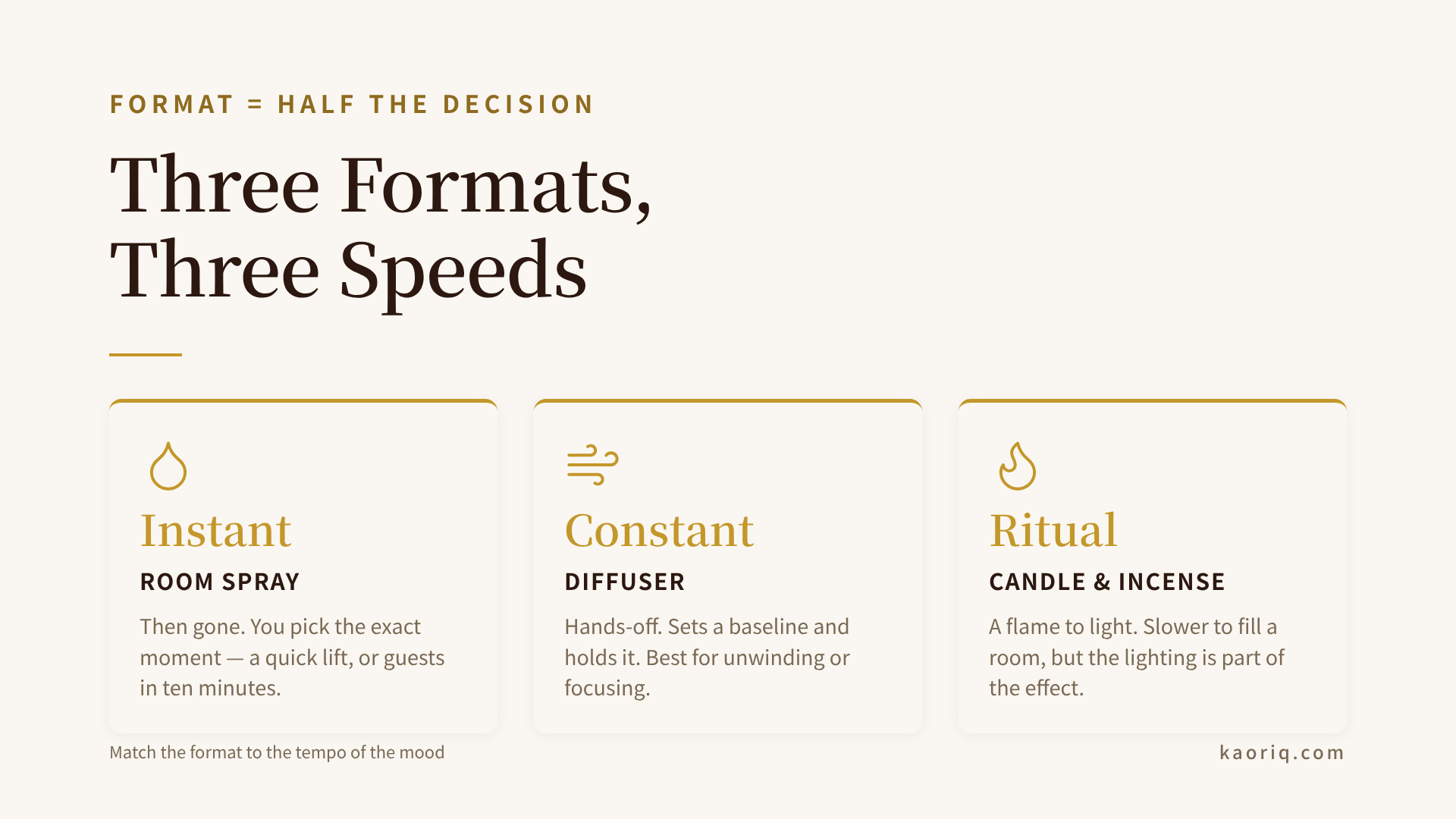
Match the format to the tempo of the mood, as much as to the scent, and the whole thing clicks. A focus scent in a candle you keep forgetting to light is a focus scent that does nothing.
So Which Are You Today?
The honest truth: most people don’t live in one mood. You might want citrus on a Tuesday morning and amber on a Sunday night, and that’s not indecision; it’s a scent wardrobe, and it’s the normal endgame. Start with the one mood you reach for most, buy one good thing in that direction, and add from there.
And if every row in that table sounded a bit like you, that’s information, not failure. Which moods you gravitate toward tends to track who you are more than what’s trendy this season. That’s a more reliable compass than any label, and it’s exactly what our fragrance personality quiz is built to read. If you’d rather start from notes than feelings, the four-fragrance-families guide comes at the same problem from the other end.
The usual ending: the hotel-linen candle goes out, a citrus one lives by the coffee machine, a cedar one comes out for company, and the word “galbanum” never has to come up again. It was never a candle problem. It was a translation problem.
Sources: The Neuroscience Behind Fragrances (West Sussex Scents), Aromachology vs. Aromatherapy (Gya Labs), Brain-Boosting Scents (Neurolaunch), How the Scent of Herbs Helps with Focus (Noisli)
Was this article helpful?