How to Choose a Car Fragrance That Survives Summer Heat (and Won't Make You Drowsy at the Wheel)
The Air Freshener That Tries to Redecorate the Dashboard
Leave a little gel air freshener in the cupholder over a long July weekend, and it doesn’t just lose its scent. It quietly liquefies, creeps out of its vented case, and leaves a sticky halo on the plastic that takes two cleanings and one quiet swear word to remove.
Here’s the thing nobody tells you when you’re standing in the shop aisle holding a cardboard tree: a car is the single most hostile place you will ever ask a fragrance to live. A parked car in summer routinely passes 140°F (60°C) inside. Your dashboard is basically a solar oven with cup holders. It’s a small sealed box. And you’re operating heavy machinery while breathing whatever you put in it.
So choosing a car scent isn’t really about picking a smell you like. It’s about picking one that survives the heat, doesn’t make you sleepy, and actually fixes the smell that’s already there. Let’s sort it out the way I wish someone had sorted it out for me.
First, Two Rules the Car Imposes On You
Most “best car air freshener” lists skip straight to scents. But the car decides two things for you before you get a vote.
1. It gets brutally hot. Interior cabin temperatures regularly top 60°C on a sunny day, even when it’s mild outside. That’s hot enough to melt low-quality gels, rupture plastic cases, and flash off delicate top notes so your fresh citrus turns into something flat and faintly sour by August. Heat is why the cheap stuff fails, and occasionally why it leaks onto your dash and peels the finish.
2. You’re driving. This is the rule people forget. A relaxing scent is a liability behind the wheel. Lavender, chamomile, and the cosy “spa” blends are wonderful for winding down, which is exactly the problem when you need to stay sharp for ninety minutes on the motorway. The small sealed cabin concentrates whatever you choose, so the wrong note works against you faster than it would at home.
Keep those two in mind and the whole shopping aisle reorganises itself.
Format Comparison: What Actually Holds Up in a Car
Here’s the cheat sheet, then the explanations.
| Format | Longevity | Scent Strength | Heat Resistance | Spill / Mess Risk |
|---|---|---|---|---|
| Vent clip | ★★★ | ★★★★ | ★★★ | ★★ |
| Hanging (paper) | ★★ | ★★ | ★★★★★ | ★★★★★ |
| Gel / can | ★★★★ | ★★★ | ★★ | ★★ |
| Liquid diffuser | ★★★★★ | ★★★★★ | ★★ | ★ |
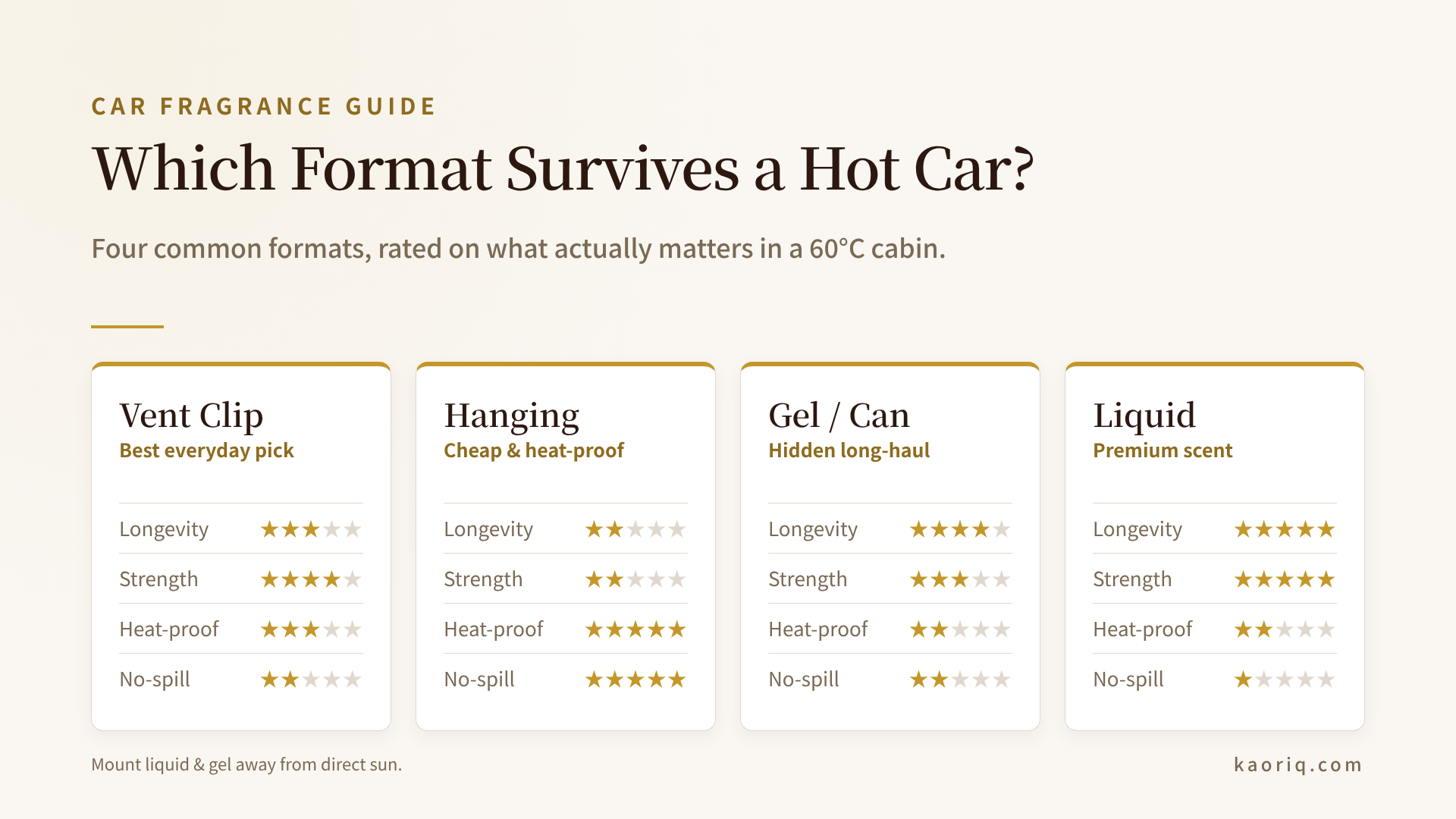
Vent clips are the crowd favourite for a reason. They sit on the air vent and use your car’s own airflow to push scent around, so they punch above their weight and you can usually dial the intensity up or down. The catch: clip it to a vent blade, never flat on the sun-facing slope of the dash, where heat is most likely to make a liquid clip leak.
Hanging paper trees are the cheap, cheerful, nearly indestructible option. Nothing to spill, nothing to melt, and good ones last roughly 3–6 weeks. The trade-off is honesty: the scent is light, fades steadily, and you’ll be replacing them often. Perfectly fine as a low-commitment background note.
Gel and can fresheners tuck into a cupholder or under a seat and tend to last longest of the cheap formats (30 to 90 days), with a shrinking gel that visibly tells you when it’s done. They’re also the format most likely to throw a tantrum in extreme heat (see: my dashboard). Buy a reputable one and keep it out of direct sun.
Liquid diffusers are the premium tier: strongest, most adjustable, longest-lasting, and the only format where the scent quality genuinely competes with home fragrance. The price is fragility: liquid plus a 60°C cabin means you must mount it securely and away from the sun, or you’ll learn about leaks the expensive way.
The honest summary: vent clip for everyday ease, liquid diffuser if you actually care about the scent, hanging tree as a disposable refresher, gel for hidden long-haul corners.
Deodorize First, Then Perfume
This is the step almost everyone skips, and it’s why so many cars smell like “vanilla and also fast food.”
A fragrance does not cancel a bad smell. It stacks on top of it. If your cabin has the ghost of old takeaway, a damp gym bag, a dog, or yesterday’s cigarette, adding a scent just gives you a confusing duet. The fix is the same logic we use for neutralising cooking smells in a kitchen: remove the source first, then layer the nice thing on a clean base.
So before you buy anything scented: pull the rubbish, vacuum the mats, crack the windows for ten minutes of real airflow, and consider an unscented odour absorber (activated charcoal or baking soda) for a week. Then add fragrance. A clean car needs far less scent than a smelly one, and the result reads as “fresh” instead of “covered up.”
Match the Scent to How You Actually Drive
Now the fun part, and where it stops being a generic list and starts being your car. How you drive should decide what you smell, the same way your personality shapes the fragrances you reach for at home.
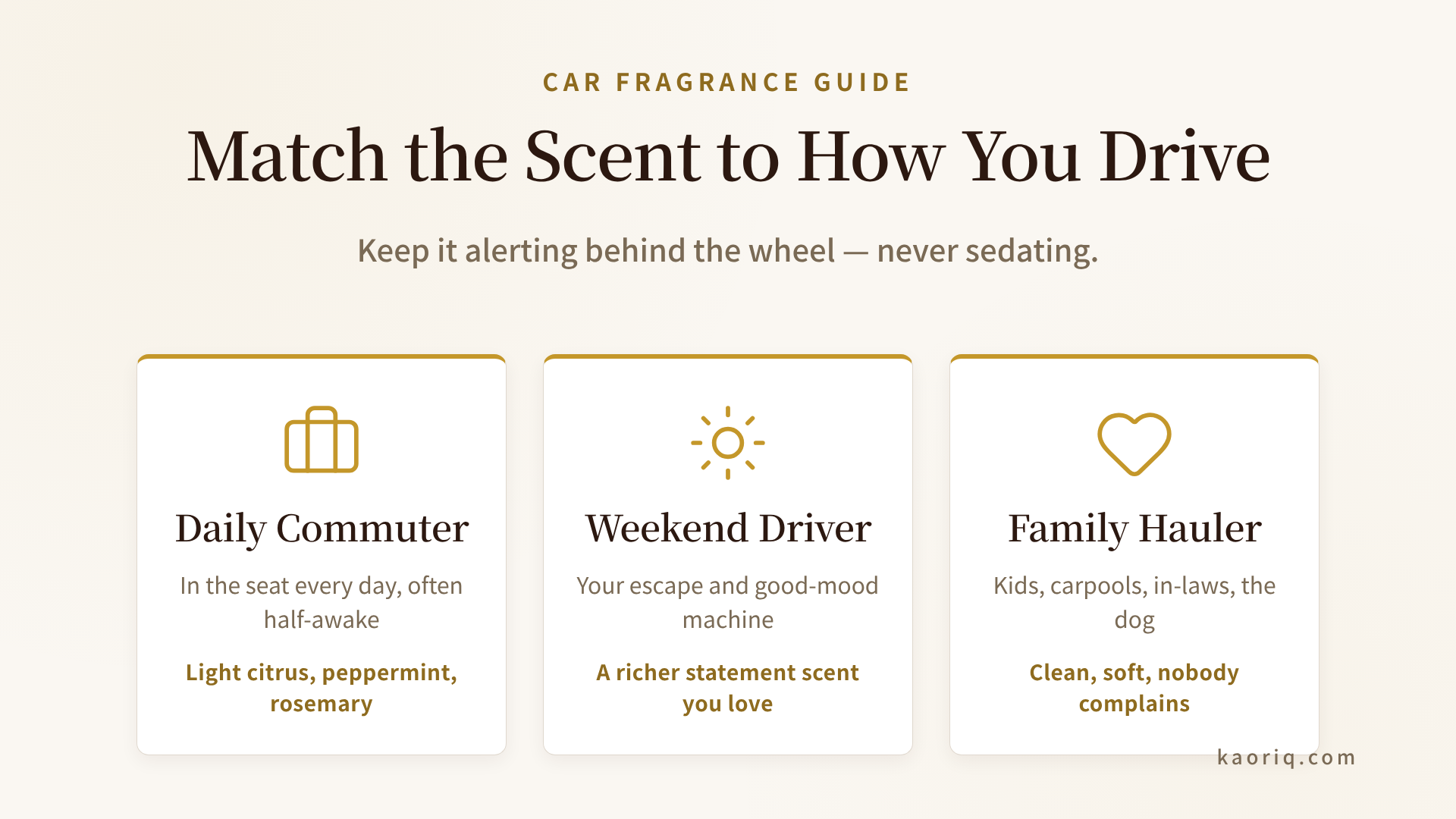
The daily commuter. You’re in this seat every single day, often half-awake, sometimes for an hour each way. You want alertness, not drama. Reach for the energising, focusing family: citrus (lemon, grapefruit), peppermint, or rosemary, all widely associated with feeling more awake and attentive. And keep it light: a scent you smell every day at full blast becomes invisible within a week (your nose adapts fast) or, worse, slightly nauseating. Subtle and clean wins the long game. These are the same notes that earn their keep in a focus-friendly home office.
The weekend driver. This is your fun car, your escape, your good-mood machine. Here you can afford a statement scent: something richer and more characterful you’d never want eight hours a day but love for a Saturday, a woody note, a confident fresh-spicy blend, a proper “this is my car” signature. Lean toward a liquid diffuser so the quality matches the occasion.
The family hauler. Kids, in-laws, carpools, the dog. Your job is inoffensive and clean: a scent nobody will complain about and that won’t trigger anyone’s headache in a packed cabin. Think soft cotton-fresh, light citrus, or a barely-there clean musk. Skip the bold and the polarising. Whatever you pick, somebody back there has an opinion, so aim for the diplomatic centre.
One rule cuts across all three: no sedating scents while you’re driving. Save the lavender and the sleepy blends for the bedroom. Behind the wheel, you want a note that keeps your eyes open, not one that whispers “nap.”
If You Read Nothing Else
- Heat decides the format. Keep anything liquid or gel off the sun-facing dash; clip and mount in the shade. Hanging trees are the only truly heat-proof pick.
- Clean before you scent. Deodorize the source first; fragrance on top of a stink just makes confusing stink.
- Driving decides the note. Citrus / mint / rosemary to stay sharp; never the sleepy lavender blends behind the wheel.
- Match it to your drive. Commuter → light and alerting. Weekend → a statement you love. Family → clean and uncontroversial.
Your car doesn’t need to smell like a fragrance counter. It needs to smell like a clean, calm, awake version of itself, one that survives the July heat and gets you there sharp. Sort the format and the source first, and the scent becomes the easy, pleasant part.
Still not sure which scent family is even you? Start with our beginner’s guide to finding your fragrance family. Once you know that, the car (and every other room) gets a lot easier to scent.
Sources consulted for car temperatures, format longevity, heat-leak behaviour and scent-alertness research: Automoblog’s 2026 car air freshener reviews, Drift’s non-toxic car freshener guide, Michigan Legal Center on air freshener clips melting dashboards, and Healthgrades on essential oils, alertness and memory.
Was this article helpful?