How to Keep Your Kitchen From Smelling Like Last Night's Dinner: A Fragrance Guide for the Hardest-Working Room in Your Home
8am in the Kitchen, and Last Night’s Salmon Is Still There
Not the salmon. The salmon was long gone. The smell of the salmon is still there, sitting in the air like a houseguest who didn’t get the hint. Cooked sixteen hours earlier. Window opened. Everything a reasonable person does. And there it is at breakfast, faintly fishy, mingling now with the garlic from the night before and a top note of “Tuesday.”
So most people do the same thing: light a vanilla candle and walk away feeling productive.
What I’d actually made was fishy vanilla. Which, if you’re wondering, is not a fragrance anyone is rushing to bottle.
If your kitchen has ever ambushed you like this, this guide is for you. The kitchen is the hardest-working room in the house and the worst-treated. We ask it to absorb fish, garlic, fried oil, burnt toast, and bin smells, and then we’re surprised it doesn’t smell like a meadow. The good news: you can make it smell properly fresh. You just have to stop doing the one thing everyone does first.
Masking Is Not the Same as Clearing
Here’s the core mistake, and it survives for years in most kitchens: spraying something nice on top of something bad doesn’t remove the bad. It just introduces it to a friend.
There are really two different jobs, and they get confused constantly:
- Neutralizing / clearing: physically removing the odor molecules from the air. Ventilation does this. So does adsorption: activated charcoal and odor-absorbing gels work by trapping volatile odor molecules in millions of tiny pores so they stop floating around your nose. The smell doesn’t get covered. It gets caught.
- Masking: adding a stronger, nicer smell so you notice the bad one less. This is what a candle or a diffuser does. It’s not useless. It’s just second.
The order matters a lot. If you mask before you clear, the original odor is still in the room, and now it’s slow-dancing with your fragrance. If you clear first and then add a little scent, you get an actually fresh kitchen with a pleasant signature on top.
So the real sequence is boring and unglamorous and it works every single time.
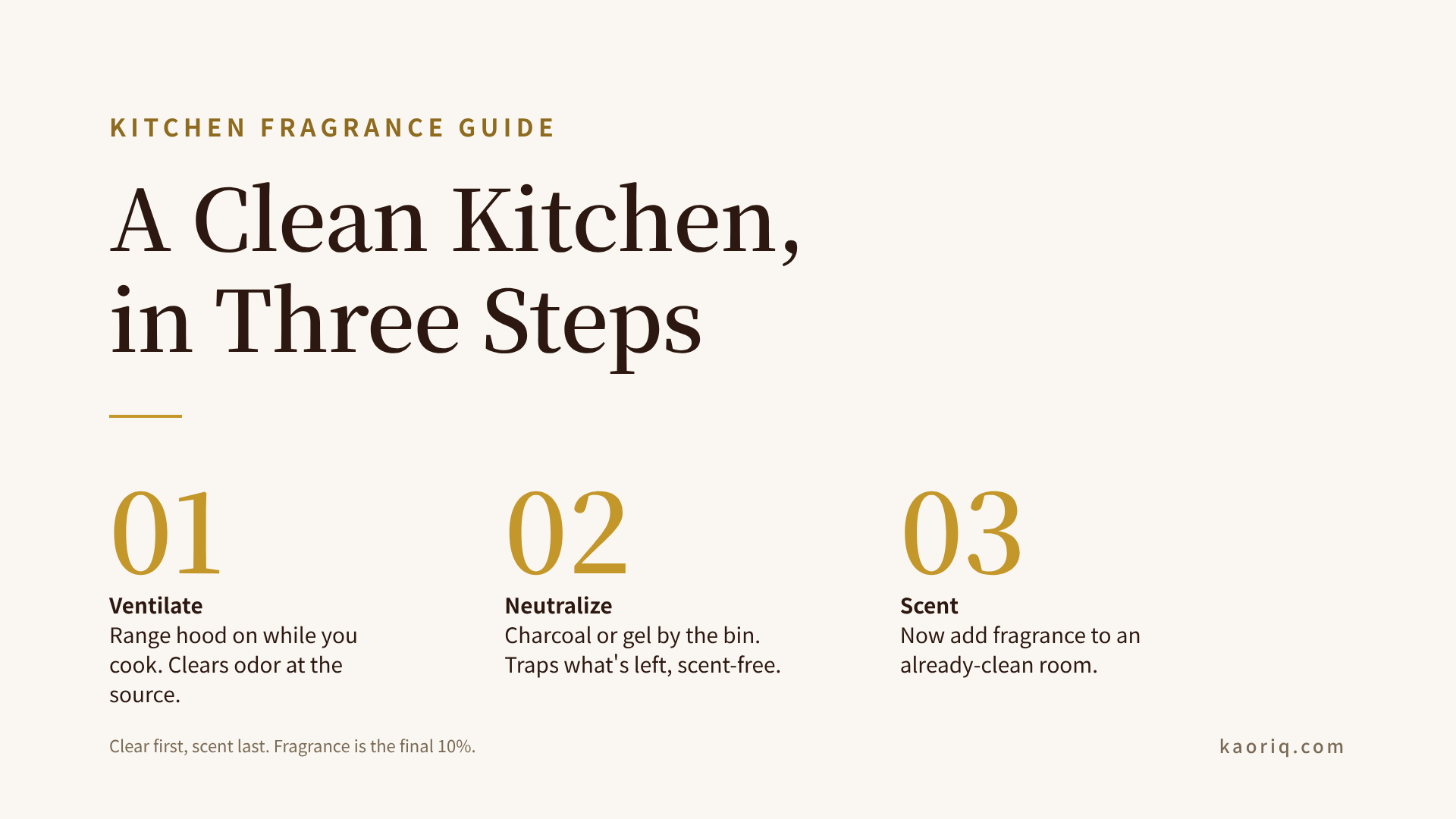
Step 1: Ventilate (the part nobody wants to hear)
Run the range hood while you cook, not after. It catches odor at the source before it spreads. Crack a window for cross-breeze. Honestly, ninety percent of “my kitchen smells” is solved here, and no fragrance product can compete with an extractor fan doing its job. The answer everyone wants is a beautiful diffuser. It isn’t.
Step 2: Neutralize (set it and forget it)
Tuck a small bag of activated charcoal or an odor-absorbing gel near the bin and somewhere by the counter. These work quietly, around the clock, with no scent of their own. They’re the unsung middle layer that turns “masked kitchen” into “clean kitchen.” Keep them out of damp spots, since moisture blunts how well charcoal grabs odors.
Step 3: Scent (now, finally, the fun part)
Now you add fragrance, to a kitchen that’s already clean, not as a cover-up. This is where you get to have a personality.
The Format Question: What Actually Survives Near a Stove
Here’s the constraint that makes the kitchen different from every other room: there’s an open flame in it. A candle right next to a gas burner or under a hanging tea towel isn’t ambiance, it’s a small fire-safety conversation waiting to happen. Splattering oil and a naked flame are not a couple you want to introduce.
So for the cooking zone specifically, I lean flameless. Here’s how the formats stack up:
| Format | Kitchen Fit | Why |
|---|---|---|
| Electric / ultrasonic diffuser | ◎ | No flame, runs while you cook, easy to wipe grease off. The default for the counter near the stove. |
| Reed diffuser | ◎ | Zero flame, zero effort, constant low output. Perfect for a windowsill or shelf away from splatter. |
| Odor-absorbing gel | ○ | Quietly clears rather than scents. Great by the bin; lightly fragranced versions add a faint freshness. |
| Room / linen spray | ○ | Instant reset after a smelly cook. A burst, not a baseline. It fades in an hour. |
| Scented candle | △ | Lovely on a dining shelf away from the hob. Never beside the burners or under cabinets. |
| Stick incense | ✕ | Smoke on top of cooking smoke, plus a flame near grease. Wrong room. |
If you take one thing from this section: put an electric or reed diffuser on the counter, keep any candle on the far side of the room, and let a charcoal sachet handle the bin. That trio covers a kitchen without ever putting a flame where the cooking happens.
(If you can’t use a flame anywhere in your home (renter’s clause, pets, kids), the same logic scales up. I went deep on that in the renter’s guide to flameless scent, and on picking between diffuser types in the reed vs ultrasonic vs electric breakdown.)
Which Scents Actually Fit a Kitchen
Not every nice smell belongs here. A heavy oud or a sweet gourmand vanilla in a kitchen does something subtly cruel: it makes the room smell like a bakery that’s hiding something. You want fragrances that read as clean and alive, the way a kitchen does when someone’s just wiped the counters and cut a lemon.
Four families do this beautifully, and conveniently, they’re the ones that cut through grease and fish best.

Citrus (lemon, bergamot, sweet orange). The undisputed kitchen champion. Bright, clean, and really good at slicing through lingering oil and fish notes. Lemon especially reads as “this surface was just cleaned,” which is exactly the message you want a kitchen sending. Hard to overdo, easy to love.
Herbs (rosemary, basil, sage). These share a register with cooking ingredients, so they feel native to the room instead of imported into it. A soft rosemary note makes a kitchen smell like an afternoon herb garden rather than a recovering crime scene. Bonus: they pair naturally with the food you’ll cook next.
Eucalyptus (and a touch of mint). Sharp, cool, and a quiet powerhouse against the heavy smells meat and fish leave behind. It’s the closest thing to a “reset button” in scent form. A little goes a long way, so keep the hand light.
Coffee. The wildcard, and a real one. Coffee grounds are a classic odor absorber, and the smell itself reads as warm, clean, and unmistakably kitchen. A coffee-leaning diffuser oil, or literally a bowl of fresh grounds by the sink, pulls double duty.
| Scent Family | Cuts Through | Mood It Sets | Watch Out For |
|---|---|---|---|
| Citrus | Oil, fish, garlic | Clean, just-wiped | Almost nothing, so start here |
| Herb | Greasy, heavy meals | Garden, homey | Keep it soft, not “potpourri” |
| Eucalyptus | Fish, strong meat | Cool, reset | Easy to overpower, so go light |
| Coffee | General staleness | Warm, cozy | Can read sweet if blended badly |
What to skip near the kitchen: heavy vanillas and gourmands (you’ll be oddly hungry and the room will smell muddled), deep ouds and ambers (too serious for a room full of dish soap), and anything floral-sweet that fights with the savory smells already in the air. Save those for the living room, where they get to be the main act.
The Cheat Sheet
Screenshot this and stick it on the fridge, which is the only acceptable place for fridge magnets to earn their keep:
| Situation | Do This |
|---|---|
| Cooking right now | Range hood ON, window cracked. Fragrance comes later. |
| Just finished a smelly cook | Quick burst of citrus room spray to reset the air. |
| Everyday background | Reed or electric diffuser on the counter, citrus or herb. |
| The bin / under-sink funk | Activated charcoal sachet or gel. No scent, just clears. |
| Near the actual burners | No flame. Electric diffuser only. |
| Want cozy, not clean | Coffee notes, and keep the candle on the far shelf. |
What to Know Before the Fishy Vanilla Incident
Two things.
One: a kitchen doesn’t want to be perfumed, it wants to be cleared and then lightly signed. Ventilate, let a charcoal sachet do its quiet work, and only then add a scent you actually like. Fragrance is the last 10%, not the first move. And it can’t fix a job the extractor fan should have done.
Two: the kitchen plays by different rules than the rest of the house. It has a flame in it and the most aggressive smells in the building, so the elegant candle that rules your living room is the wrong tool here. Give the kitchen a flameless diffuser, a bright clean scent, and a charcoal sachet by the bin, and it’ll finally smell like the hardest-working room in your home should: fresh, alive, and not even slightly like last night’s salmon.
If you’re not sure whether you’re a crisp-citrus person or a cozy-coffee person, our personality-based scent quiz is a surprisingly good shortcut. The same trait that makes you a minimalist cook tends to predict the kitchen scent you’ll actually keep refilling. And if you want the longer argument for why your personality predicts your fragrance at all, here’s the deep dive.
The salmon, for the record, has not returned. The kitchen now smells like lemon and, faintly, like a room where someone has their life together. I’m choosing to believe both.
Was this article helpful?