How to Build One Signature Scent for Your Whole Home (Instead of a Different Fragrance in Every Room)
The House That Smelled Like Four Different Houses
A lot of apartments have a personality disorder. The entryway smells of grapefruit. The living room is doing a warm sandalwood thing. The bedroom has drifted into lavender, and the bathroom, inexplicably, eucalyptus. Each one is lovely on its own. Walking from one to the next feels like channel-surfing with your nose.
That is exactly what every “scent each room” guide tells you to do. What those guides skip is that the sum of four good decisions can be one incoherent home.
So try the opposite. One scent. Whole house. The trend forecasters have landed in the same place: the 2026 conversation has shifted, as one report puts it, “from viral scent to personal system.” A home, like a person, can have a signature.
This guide is how to build yours without buying a diffuser for every door.
What a “Signature Home Scent” Actually Means
It does not mean the identical product blasting from six identical diffusers. That’s not a signature; that’s a hotel lobby, and not the good kind.
A signature home scent means one base note family runs through the whole house (the thread that makes it recognisably your home) while the intensity and format change room by room. Same character, different volume. The way a person’s voice stays the same whether they’re whispering or laughing.
Designers call this “zoned scenting around a cohesive profile.” I call it “stop making your hallway argue with your bedroom.”
The payoff is the moment a guest walks in and, twenty minutes later, still feels like they’re in the same place. Continuity is a luxury you can’t quite name when it’s there, but you absolutely notice when it’s missing.
Step 1: Choose One Base Note (This Is the Whole Game)
Your base note is the foundation everything else sits on. Pick it for staying power and friendliness, not for the exciting top note that sold you in the shop. Top notes are a first date. Base notes are who you live with.
Three families do whole-home duty well because they’re warm, low-drama, and they don’t fight food, people, or each other:
| Base family | Character | Best for a home that feels… | Watch out for |
|---|---|---|---|
| Woody (sandalwood, cedar) | Grounded, calm, unisex | Quietly put-together | Can read “spa” if too clean |
| Amber / Warm (amber, benzoin, soft vanilla) | Cosy, enveloping, sweet-adjacent | Welcoming and soft | Heavy in summer; ventilate |
| Musk (clean musk, soft skin notes) | Subtle, “fresh laundry” | Effortless, barely-there | So subtle it can vanish |
If you have no idea which is you, that’s not a flaw: it’s the actual starting point. Your fragrance preferences track your personality more than your aesthetics, which is why knowing your fragrance personality makes this single decision far less of a guess. Pick the base your temperament wants to come home to, not the one that photographs well.
Step 2: Keep the Base, Change Only the Dial
Here’s the part that saves money: you do not buy a different scent per room. You buy one base plus, at most, one or two accent products in the same family. Then you vary two things only: intensity and format.
Think of your home as having zones, not separate scent worlds:
| Zone | Intensity | Format | Why |
|---|---|---|---|
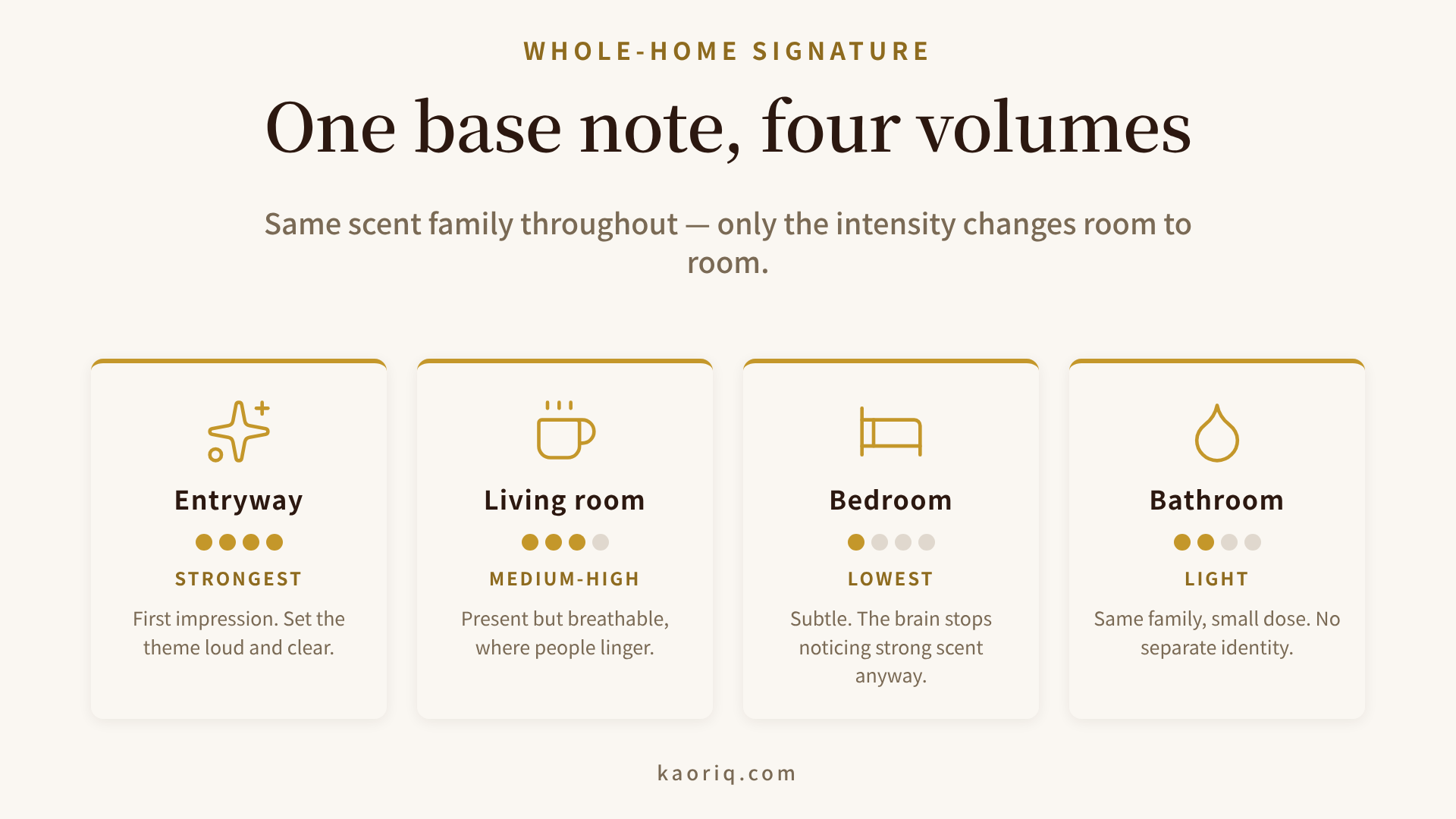
| Entryway | Strongest | Reed diffuser (more reeds) or a candle when home | First impression. Set the theme loud and clear. |
| Living room | Medium-high | Electric diffuser or single candle | Where people linger; the base note should feel present but breathable. |
| Bedroom | Lowest | Few reeds, or a spritz of linen mist | You sleep here. Subtle. The brain stops noticing strong scent anyway. |
| Bathroom | Light + functional | Small reed diffuser | Same family, small dose. No need for a separate eucalyptus identity. |
| Kitchen | Lightest / off while cooking | Quick room spray after cooking | Let food win during dinner; restore the base afterward. |
Same sandalwood thread, four volumes. The entryway announces it; the bedroom merely hums it. That’s coherence. And it’s the difference between a home with a scent and a home with a scent problem.
Step 3: Avoid the Combinations That Break Coherence
A signature falls apart when you let one room go rogue with a clashing family. If your whole home is woody and your bathroom is screaming citrus, the thread snaps the moment someone walks the hallway.
Stay inside one family, or pair only with its friendly neighbours:
| Your base | Safe to accent with | Will break the signature |
|---|---|---|
| Woody | Soft amber, light musk, a whisper of vetiver | Sharp citrus, aquatic “fresh”, strong mint |
| Amber / Warm | Soft woods, vanilla, gentle spice | Cool aquatics, green herbal, bright lemon |
| Musk | Soft florals, light woods | Heavy oud, smoky incense, gourmand sweets |
One more rule that quietly fixes most disasters: never run two strong-throw formats in adjacent rooms at full volume. A nebulizer in the hallway plus a three-wick candle in the living room doesn’t read as “luxurious.” It reads as “did something spill?” Loud everywhere is the same as loud nowhere.
The Buy-Once Shopping Plan
You do not need a cartful. Resist the cart. The whole appeal of a signature is that it’s simpler than scenting four rooms separately, and your bank account should feel that simplicity too.
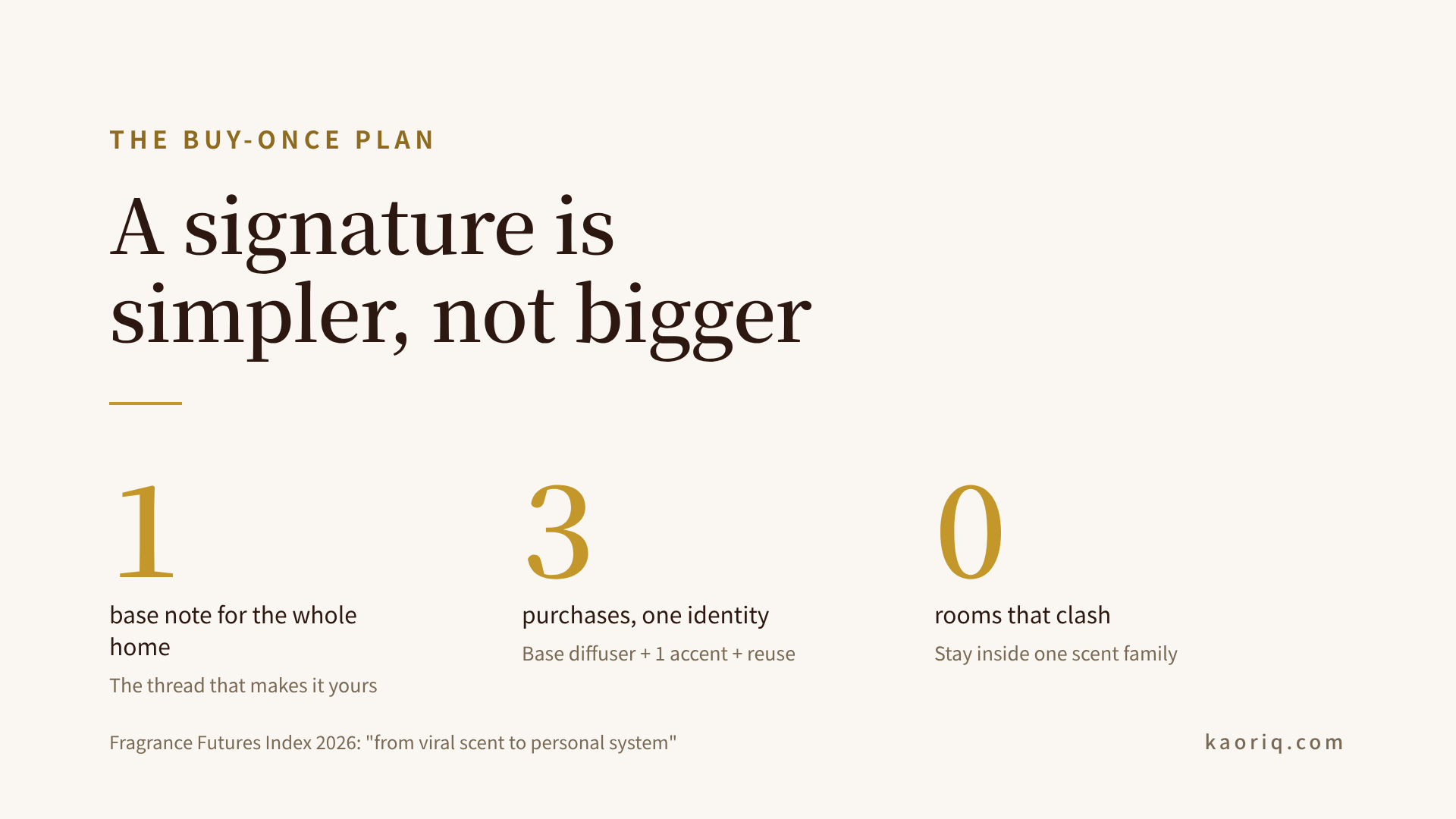
- Buy one base, in reed-diffuser form. Live with it for a week, in the living room. The shop sniff is a date; a week at home is the relationship. If you still like it on day six, it’s your base.
- Add one accent in the same family: a candle for the entryway moment, say. Same thread, different format.
- Reuse, don’t rebuy. For the bedroom and bathroom, a smaller dose of the same base is the move. A linen mist version of your base note covers soft zones without a single new fragrance family entering the building.
Three purchases, one identity. Compare that to a year of collecting four unrelated scents that, together, smell like a duty-free aisle.
When a Wardrobe Beats a Signature
Honesty check: the signature approach isn’t for everyone. If you genuinely love variety (changing your home’s mood by season or whim is the fun part), then a rotating scent wardrobe might suit you better, and that’s a completely valid different game. Signature is for people who want recognition; a wardrobe is for people who want range.
Most homes, though, lean signature without realising it. We crave the comfort of walking in and feeling instantly home. A consistent base note is the fastest shortcut to that feeling.
Where to Go From Here
Building a whole-home signature is really three decisions stacked: which base note, how to zone the intensity, and how to keep the rooms from clashing. The base note is the one that matters; get that right and the rest is just turning dials.
If you’re still unsure which family is yours, start with what your fragrance personality says about you. It’s the constant that makes every other choice easier. And if you want your scent to actually agree with your furniture, the home fragrance interior style guide is the natural next read.
One note, one home, one identity. Your hallway and your bedroom can finally stop arguing.
Was this article helpful?