How to Match Your Home Fragrance to Your Interior Style (Japandi, Minimalist, Mid-Century, Boho, Coastal)
A Coconut Beach Candle in a Very Serious Walnut Library
Picture a room of dark wood, leather chairs, and books nobody has read but everybody wants guests to think they have. Very Mid-Century, very “I have opinions about whisky.” Now light a tropical-coconut candle in it, and the whole room starts smelling like a piña colada has wandered into a law firm.
Nothing is wrong with the candle. It’s wrong for the room. The walnut wanted leather and tobacco. It got sunscreen.
This is the mistake almost nobody warns you about, because we shop for scent the way we shop for snacks: one nice-sounding thing at a time, with zero thought to the space it lands in. But your home already has a point of view. The furniture, the colours, the materials: they’re all saying something. A good room fragrance agrees with that statement instead of arguing with it.
So here’s a different way to choose. Not by room size (we covered that elsewhere), and not by season. By taste — the actual look and feel you’ve built. Find your style below and let your nose follow your eyes.
The One-Glance Map
If you only read one thing, read this. Find the row that looks like your living room.
| Your Interior | Scent Family | Hero Notes | Best Format | Skip |
|---|---|---|---|---|
| Japandi | Woody / Green | Hinoki, green tea, soft musk, mineral | Incense, reed diffuser | Sweet gourmand, heavy florals |
| Minimalist | Clean / Musky | White musk, linen, cucumber, blanc | Electric diffuser, candle | Smoky, spicy, “loud” scents |
| Mid-Century Modern | Woody / Amber | Leather, tobacco, amber, dark wood | Candle | Aquatic, bright citrus |
| Boho | Earthy / Spicy | Patchouli, sandalwood, warm spice | Incense, candle | Crisp “clean linen,” ozonic |
| Coastal | Fresh / Aquatic | Sea salt, citrus, fig leaf, driftwood | Reed diffuser, electric | Dense amber, gourmand |
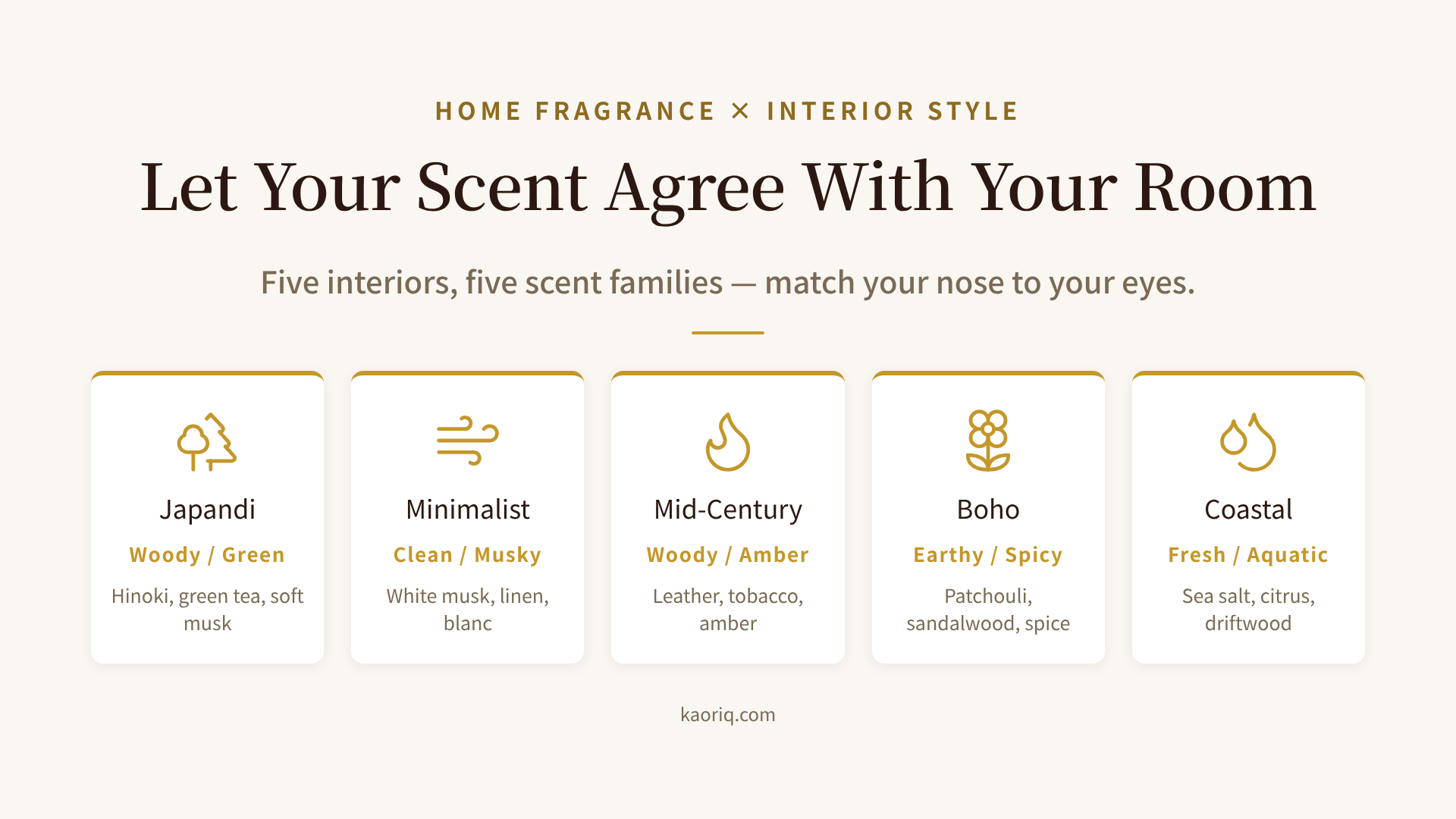
One ground rule before we go deeper: everything here is about scenting a room (candles, diffusers, incense), not your skin. Home fragrance lives in the air, and it behaves like a piece of décor. You wouldn’t put a neon sign in a Japandi tea corner. Same logic, different sense.
Japandi: Quiet, Natural, a Little Monastic
Japandi is what happens when Japanese wabi-sabi and Scandinavian hygge share a flat: warm neutrals, pale wood, hand-thrown ceramics, and nothing on the shelf that doesn’t earn its place. The whole aesthetic is about restraint that feels warm rather than cold.
Your scent should do the same. This is the natural home of hinoki (Japanese cypress) — cool, clean, faintly watery wood that smells like a quiet bathhouse. Pair it with green tea, a whisper of soft musk, and a mineral or stone-like note, and the room reads exactly the way it looks: calm, considered, slightly elevated. The notes most common in actual Japanese homes (soft musk, tea, smoky woods, bitter citrus) are practically a Japandi shopping list.
Format matters here more than usual. Japandi loves ritual, which makes good incense the perfect fit, and a discreet reed diffuser the everyday workhorse. Avoid anything sweet or gourmand — a vanilla-caramel candle in a Japandi room is like a pop-up ad in a poetry book.
Pick this if: your palette is beige-on-greige, you own at least one ceramic thing with a visible thumbprint, and “calm” is the adjective you’re chasing. Hinoki is the deep end of this whole world, and worth a read if you’ve ever wondered why cypress feels like a deep breath (in Japanese).
Minimalist: Less, but Make It Breathe
Minimalist interiors (crisp whites, hard surfaces, a sofa that looks faintly disappointed in you) are the trickiest to scent, because the point is the absence of clutter. A bold fragrance in a minimalist room is visual noise you can smell.
The answer is the “barely there” family: white musk, clean linen, cucumber, cool blanc notes. These read as freshly laundered air, never a Statement. Soft musk in particular adds warmth and a skin-like softness without ever announcing itself — which is the entire minimalist brief. You want a guest to feel the room is clean, not to ask what you’re burning.
Reach for an electric diffuser set low, or a single understated candle. The goal is a consistent, low background hum of fresh — never a peak. If your scent has a “wow” moment, it’s too much for this room.
Pick this if: your shelves are 80% empty on purpose, you alphabetised something this month, and your dream is a space that feels like exhaling. (Worth a gentle warning: minimalism plus a too-strong diffuser is the most common over-scenting mistake I see. When in doubt, use less, then less again.)
Mid-Century Modern: Warm Wood and a Little Swagger
Mid-Century is walnut and teak, low-slung leather, brass, and colours that look great next to a record player. It’s the most grown-up of the looks — a little Mad Men, a little jazz-on-vinyl. It has confidence, and it wants a scent with the same.
This is where the warm, slightly smoky end of the wheel comes alive: leather, tobacco, amber, and dark resinous woods. These notes echo the actual materials in the room, the leather of the chair and the wood of the sideboard, so the fragrance feels like it grew out of the furniture itself, never sprayed on top of it. Amber’s cosy, enveloping warmth is the connective tissue that ties it all together.
Candles are the move here. Mid-Century is a theatre aesthetic — low light, a good drink, a flickering flame fits the whole mood. Steer clear of aquatic and bright citrus scents; a fresh-laundry note in a walnut den feels like someone opened a window mid-conversation.
Pick this if: you own a record player you actually use, your sofa is leather and you’re proud of it, and “cosy but sophisticated” is the target. (Yes, this is the room that rejected my coconut candle. It was right to.)
Boho: Layered, Earthy, Gloriously Imperfect
Boho is the maximalist of the bunch: rugs on rugs, trailing plants, rattan, macramé, and a colour story that technically shouldn’t work but does. It’s warm, lived-in, and a bit wandering — a room that’s clearly been places.
Its scent is patchouli, sandalwood, and warm spice — earthy, resinous, faintly incense-y. These are the notes that smell like texture, which is exactly what Boho is made of. Patchouli gets unfairly mocked (the ’70s did it dirty), but a modern, clean patchouli is grounding and rich, not a hippie cliché. Layer in sandalwood and a pinch of clove or cardamom and the room smells as collected as it looks.
Incense is the soul of this style, and a warm candle the supporting act. The thing to avoid is anything crisp and “clean-linen” or ozonic — a freshly-laundered scent in a Boho room flattens all that lovely texture into a hotel hallway.
Pick this if: you have more plants than you can reliably keep alive, every surface tells a story, and you’d describe your ideal evening as “warm, dim, and a little incense-y.” If your Boho leans toward the smoke-and-resin end, the slow world of Japanese kōdō incense is a beautiful rabbit hole.
Coastal: Air, Light, and Salt
Coastal interiors are all breeze: whites and blues, natural linen, light woods, woven textures, and a feeling that the windows are always slightly open. The whole aesthetic is about lightness and air.
So the scent has to stay weightless: sea salt, bright citrus, fig leaf, and a touch of pale driftwood. Aquatic and fresh notes keep the room feeling open and sun-washed; the faint woody-mineral base of driftwood or fig stops it from smelling like a cleaning product. Together they read as “window onto the sea” rather than “scented candle of the sea,” which is the line you’re walking.
A reed diffuser or a low electric diffuser suits this best — gentle, continuous, never heavy. Skip dense amber and gourmand scents entirely; a warm vanilla in a breezy coastal room is like wearing a wool coat to the beach.
Pick this if: your palette is white-and-blue, you own at least one thing made of rope on purpose, and you want a room that feels like a deep breath of clean air. If fresh-and-bright is your whole personality, our five fresh notes for summer rooms is the natural next stop.
When Your Home Is a Blend (Most Are)
Here’s the honest part: almost nobody lives in a magazine spread. You’ve got a Japandi living room and a Boho bedroom, or a Mid-Century sofa marooned in a minimalist flat. That’s normal, and it actually makes scenting easier, not harder.
Two rules cover most of it:
| Situation | What To Do |
|---|---|
| Open-plan, one big style | Pick the dominant material — the wood, the leather, the linen — and scent to that. Materials don’t lie about a room’s mood. |
| Different styles, different rooms | Treat each room as its own brief. Hinoki incense in the Japandi study, leather candle in the Mid-Century lounge. Rooms are allowed different personalities — so are you. |
And if two styles genuinely clash in one space, let the smaller, more intimate zone win the scent. You experience a reading nook more closely than a hallway, so scent for the spot you actually sit in.
The Real Reason This Works
Matching scent to interior isn’t decorating dogma. It’s that the way you’ve arranged your home is already a fairly honest portrait of you: the materials you’re drawn to, the mood you want to come home to. Your décor and your scent preference tend to spring from the same root, which is why aligning them feels less like a rule and more like a relief.
That’s also why, if you’re still not sure which lane you’re in, the fastest shortcut isn’t staring at your sofa — it’s looking at your temperament. The same traits that make you choose pale wood over walnut tend to predict whether you’ll re-light a hinoki candle or a leather one. We dug into why personality predicts fragrance better than trends do, and it’s a more reliable compass than any style label.
So: look at your room. Name its material. Let your nose agree with your eyes.
The fix is usually relocation: the coconut candle moves to the bathroom, which has beachy tiles and absolutely no opinions about whisky. Everyone’s happier. It was never a candle problem. It was a zoning problem.
Sources: Japandi Design 2026 — Oblist, Japanese candle scents — Livingetc, 5 Calming Japanese Scent Notes — Homes & Gardens, Interior Design Trends — Decorilla
Was this article helpful?