How to Choose a Summer Home Fragrance: 5 Notes That Stay Fresh When the Air Is Heavy
The Winter Candle Starts Smelling Wrong by Mother’s Day
I keep a big amber-and-tonka candle on the entry console all winter. It is the closing handshake of the apartment: warm, slightly boozy, the olfactory equivalent of a velvet blazer. By late April it still smells nice. By Mother’s Day, it smells like wearing wool in a humid airport.
The candle did not change. The air did.
Once temperatures climb past about 22°C (72°F) and humidity creeps up, fragrance starts behaving differently. Top notes flare louder. Base notes go thick. The same blend that felt cosy at 14°C feels like a stranger has been sitting in your living room for several hours. Most people respond by lighting less of the same candle, which solves nothing. What they actually need is a different family of scents.
This is the short version of which note families stay light when the air gets heavy, and how to deliver them without making your apartment smell like a hotel lobby.
Why Heat and Humidity Mess With Your Nose
Three things shift at once when summer arrives:
- Higher temperature speeds up evaporation. Top notes, the bright volatile molecules, flash off faster and louder. The bergamot candle that purred all winter is suddenly shouting at you from across the room.
- Higher humidity slows airflow around surfaces. Heavier base notes like vanilla, oud, tonka, and animalic resins hang around in the dense air instead of dissipating. They feel doubled because, in a sense, they are.
- Your nose itself shifts. Olfactory mucous is wetter and more sensitive to sweet, gourmand, and warm-spice molecules in summer. The same vanilla that read “comforting” in December reads “cloying” in July.
The takeaway is simple. Anything sweet, dense, or resinous will feel heavier in summer. Anything bright, watery, herbal, or “transparent” will feel like a window opening.
So the move is to pick fragrances that the heat thins rather than thickens.
The Five Note Families That Stay Fresh
Here’s the cheat sheet, then the explanations.
| Family | What It Smells Like | Throw in Heat | Best Format |
|---|---|---|---|
| Citrus | Bergamot, yuzu, grapefruit, lemon | ★★★★★ (loud, then gone) | Candle, spray |
| Green | Fig leaf, tomato leaf, galbanum, cut grass | ★★★★ (steady, alive) | Reed diffuser |
| Aquatic | Sea salt, marine, “ozone” | ★★★ (subtle, atmospheric) | Electric diffuser |
| Light white floral | Neroli, orange blossom, jasmine sambac | ★★★★ (lifts in heat) | Candle, reed diffuser |
| Light woody | Hinoki, white cedar, white musk | ★★★ (grounds without weight) | Reed diffuser, electric |
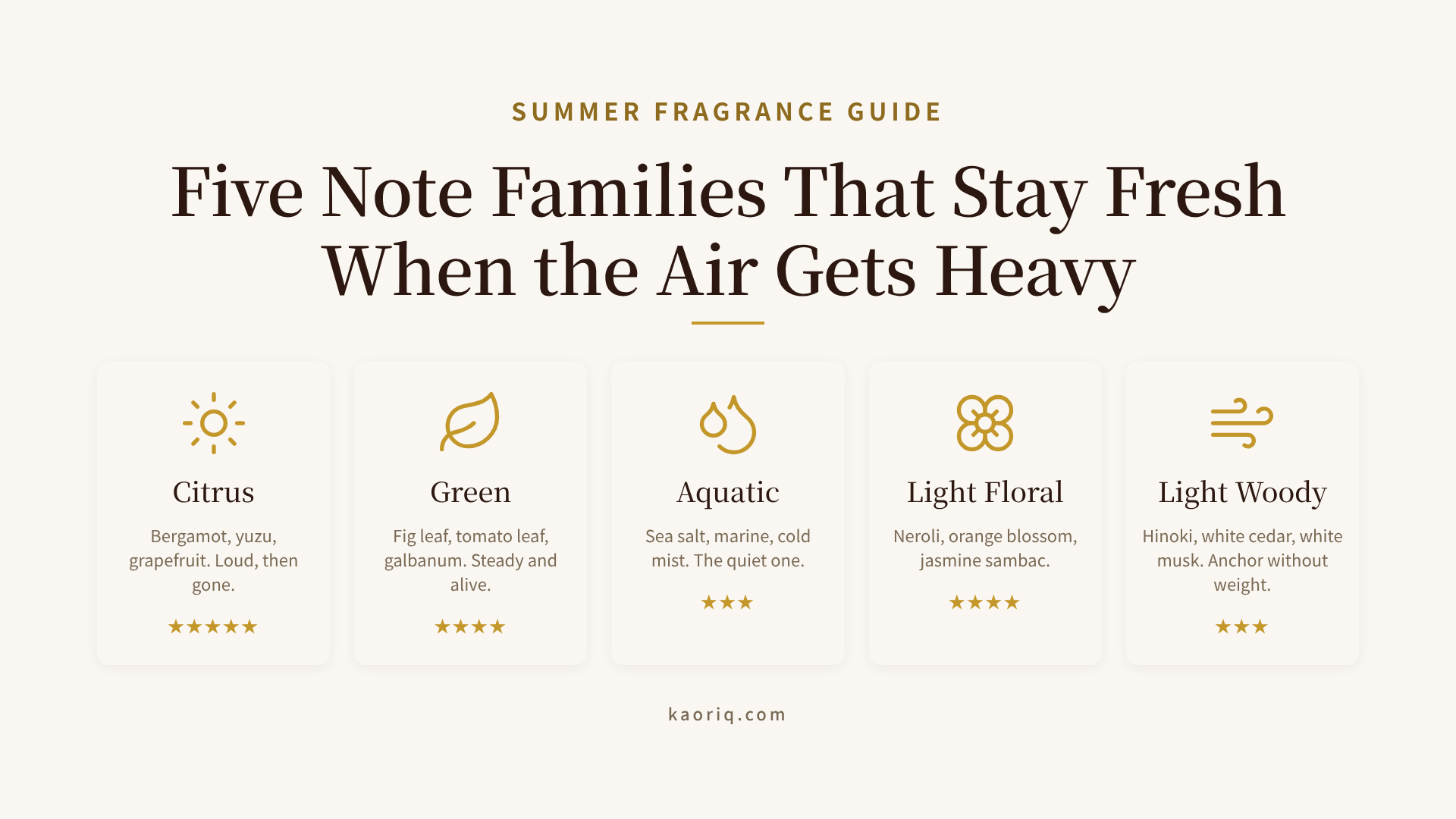
Citrus: The Obvious One That’s Still Right
Bergamot, yuzu, grapefruit, lemon, mandarin. Citrus oils are mostly limonene and related terpenes: small, volatile molecules that punch up hard and clear out fast. In summer that is a feature, not a bug. They lift the room, then leave it. No residue, no regret, no headache by 5pm.
The catch is that citrus is fragile. Cold throw is brilliant, hot throw is short. A pure-citrus candle peaks in the first thirty minutes and then politely fades into the background. Combat this by pairing citrus with one quiet anchor (a single green note or a faint white musk), and by choosing formats that refresh in pulses: short candle burns before dinner, or a room spray you mist twice as guests are arriving.
Pick this if: your apartment gets a lot of direct sun, you cook, or your default summer mood is “open the curtains and pour something cold.”
Green: The Underrated Workhorse
Fig leaf. Tomato leaf. Galbanum. Cut grass. Vetiver tops (not the deeper vetiver roots, which read more wintery).
Green notes have a stubbornness citrus lacks. They do not flash off. They hum. A fig-leaf reed diffuser will hold a room for weeks without ever feeling sweet or sticky. Tomato leaf in particular has this slightly bitter, garden-shed quality that registers as “fresh” without registering as “perfumed.”
This is the family to reach for when you want a room to smell like a place rather than a product. It is also the family least likely to give a visitor the “what cologne are you wearing” reaction, which some people consider a feature.
Pick this if: you live somewhere humid, you have houseplants, or sweet scents give you a low-grade headache by mid-morning.
Aquatic: The Quiet One
“Aquatic” is a slightly misleading word. There is no actual water smell. It is a family of synthetic molecules (Calone is the famous one) that evoke wet stone, sea air, and cold mist. Done badly, it smells like a 1996 men’s deodorant. Done well, it disappears into the architecture and just makes the room feel five degrees cooler than it is.
Aquatics shine in electric diffusers because they need a steady, soft dispersion. A candle pushes them too hard; a reed diffuser doesn’t quite get them airborne. They also work well underneath a citrus or green top note. They are the bass, not the melody.
Pick this if: you want a scent that is barely there, or you are scenting a bathroom and want it to feel like a clean hotel rather than a spa.
Light White Floral: But Only the Light Ones
This family is the trickiest of the five. Heavy white florals like tuberose, gardenia, and ylang-ylang get worse in summer. They tip from “intoxicating” to “headache in a wine glass” by 3pm.
But the lighter end of the family does something magical when the air warms up. Neroli (the steam-distilled oil from orange blossom), bitter orange blossom, and jasmine sambac (not jasmine grandiflorum) all have a high green-citrus facet that the heat pushes forward. The indolic, animalic parts soften. They feel sunlit instead of nighttime.
A neroli reed diffuser in a bedroom in July is one of the great unsung pleasures of home fragrance.
Pick this if: you find pure citrus too short-lived and pure green too understated, and you want a scent with a bit of personality.
Light Woody: The Quiet Anchor
Hinoki (Japanese cypress). White cedar. Cypress. White musk. Some sandalwoods, but only the lightest, milkiest ones. The dark, smoky sandalwoods belong to autumn.
These give you a base without giving you weight. They are the difference between a room that smells fresh and a room that smells like nothing at all. Use them as the under-layer beneath a citrus or green top, or run them alone if you live somewhere very humid and want something that reads calm rather than active.
Hinoki especially is a gift in summer. It has a cooling, almost watery quality that no other wood quite has.
Pick this if: you found out the hard way that pure citrus diffusers go silent after a week, or you want a “just got out of the shower” register holding the room all day.
Format × Family: What Actually Works
This is the part that catches most people. The right note in the wrong delivery system underperforms badly.
| Candle | Reed Diffuser | Electric Diffuser | Room Spray | |
|---|---|---|---|---|
| Citrus | ◎ | △ | ○ | ◎ |
| Green | ○ | ◎ | ○ | △ |
| Aquatic | △ | △ | ◎ | ○ |
| Light white floral | ◎ | ◎ | △ | ○ |
| Light woody | ○ | ◎ | ◎ | △ |
◎ excellent · ○ good · △ mediocre
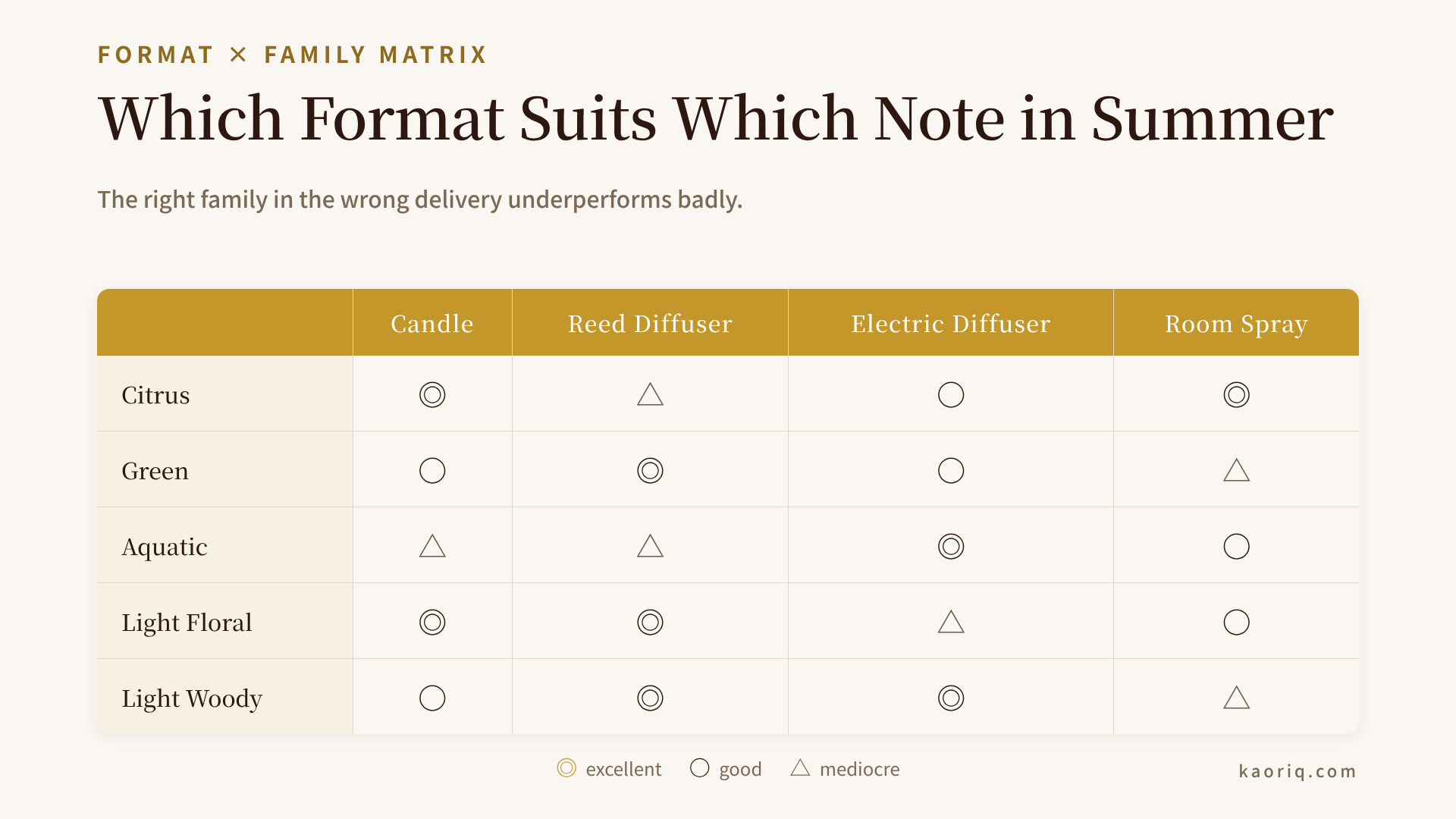
A few notes on the table:
- Citrus + candle works because the burn is short. You don’t want all-day citrus; you want a bright thirty-minute pulse before dinner.
- Green + reed diffuser is the most forgiving setup in the whole guide. Hard to overdo, lasts months, never reads sweet.
- Aquatic + electric diffuser is the only place aquatics really earn their keep. The cool mist matches the cool scent.
- Room sprays punch above their weight in summer because you can mist into the airflow from an AC vent or open window and let the moving air carry the scent through the room.
Three Things Nobody Tells You About Summer Fragrance
1. Run things shorter, not weaker. Most people respond to “this feels heavy” by buying a less-concentrated version of the same scent. Don’t. Buy the right family, then run it in shorter bursts. A 45-minute candle burn before guests arrive beats a four-hour burn that exhausts your nose by the time anyone walks in.
2. The AC vent is your ally. Place reed diffusers and spray near the airflow, not away from it. Cool moving air picks up light molecules and leaves the heavier ones behind. It is the closest thing to a free upgrade in home fragrance.
3. Your winter favourites have not gone bad. You do not need to throw out the amber candle. Put it in a cupboard with the wool throws. It will smell brilliant again in October, and by then you will have missed it.
So Which Should You Actually Buy?
If you have never thought about your home scent by season, start with one switch:
- Pick one of the five families above. Probably green or citrus if you want something obvious. Aquatic or light woody if you want something the eye cannot see but the room can feel.
- Match it to your most-used room’s primary delivery. A reed diffuser in the entryway, a candle in the living room, an electric diffuser in the bedroom. Resist the urge to try all four formats at once.
- Run it for two weeks. If you’ve stopped noticing it by week two, it’s working. That’s olfactory adaptation, not the product failing. Walk outside for five minutes and come back. The room will smell exactly as you set it up.
If you want something more personal than “pick a family from a list,” our piece on why personality predicts fragrance preferences better than season or trend goes one layer deeper.
For now: open a window, pour something cold, and put the winter candle away. The room will thank you.
Was this article helpful?