What Your Big Five Personality Score Says About the Candle You'll Actually Re-Light
The Hallway Shelf Is a Cemetery for Candles Bought Once
Most people have an embarrassingly specific shelf somewhere in the hallway. Eleven candles, three reed diffusers, and one stick of incense that got lit, panicked at, and immediately stubbed out in a plant pot. Every single one bought with genuine optimism. None of them re-lit.
This is, I’ve decided, the only home fragrance metric that matters: the Re-Light Rate. Forget “did the candle smell nice in the shop” (every candle smells nice in the shop, that’s the shop’s whole job). The honest question is: “did I, of my own free will, on an unremarkable Tuesday, decide to light it a second time?”
For most of my candle graveyard, the answer is no. And the reason, I now think, is that I was buying candles for the person I wanted to be that week (the one with herbal tea rituals and a stack of thick novels she actually reads), rather than for the person I am. The fix, weirdly, came from a personality test.
The Big Five in About Thirty Seconds
The Big Five (sometimes called OCEAN) is the most-researched personality model in psychology. It scores five independent traits, each on a low-to-high scale:
- Openness: how much you enjoy novelty, abstraction, the unfamiliar
- Conscientiousness: how much you like order, structure, follow-through
- Extraversion: how much energy you draw from external stimulation
- Agreeableness: how much you prioritise warmth and harmony with others
- Neuroticism: how reactive you are to stress and negative emotion
There’s a growing pile of research, including the early work by Mensing & Beck and later replications by Sorokowska, suggesting these traits predict scent preferences with surprising stability, more reliably than age, gender, or season. Which means the candle on your shelf is doing a job most people don’t realise it’s doing: it’s a small daily vote for the version of you who lives in your room.
The Re-Light Rate is just personality, made physical.
The Quick Map
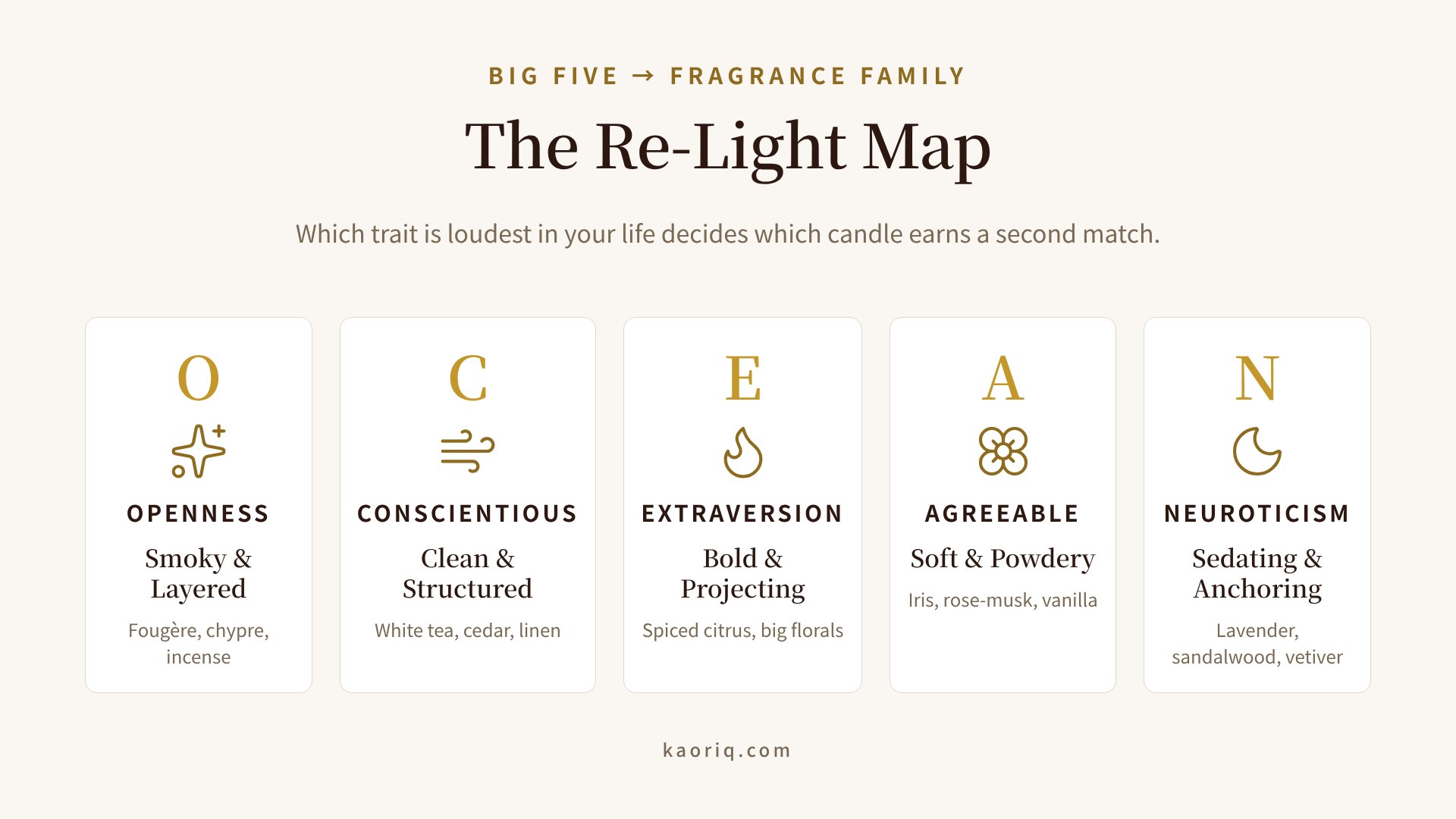
Here’s the cheat-sheet version. Each trait pulls toward a different fragrance family, with a different room behaviour.
| Trait (when high) | Pulls toward | Best room format | Common mismatch |
|---|---|---|---|
| Openness | Complex, layered: fougère, chypre, smoky amber, incense | Single-wick candle for evenings; reed diffuser for “always something interesting” | Bright clean citrus (reads as boring) |
| Conscientiousness | Clean, structured: fresh aromatics, white tea, minimalist linen | Reed diffuser, low refill volume; small incense sticks | Gourmand (reads as messy) |
| Extraversion | Bold, projecting: spiced citrus, statement gourmand, big florals | Three-wick candle; fragrance oil diffuser for a larger room | Quiet wood-and-musk (disappears on them) |
| Agreeableness | Soft, approachable: powdery florals, rosy musk, warm vanilla | Pillow mist or linen spray; small candle | Sharp aromatics (feel “unfriendly”) |
| Neuroticism | Sedating, anchoring: lavender, sandalwood, vetiver, chamomile | Diffuser on intervals; bedside candle | Energising citrus (worsens overstimulation) |
Most people are not “high in one trait.” You’re some mix, and the mix is the actual signature. But for the candle on your nightstand tonight, the trait that’s loudest in your life right now is the one that decides whether you’ll re-light.
Three Picks Per Trait
These aren’t affiliate recommendations. They’re the directions I’d send a friend in, based on the trait they keep telling me about over coffee.
High Openness: You Get Bored Before the Candle Does
Your real problem is boredom. Nothing stays interesting for very long. You re-light a candle the way you re-read a book: only when there’s something new to find on the second pass.
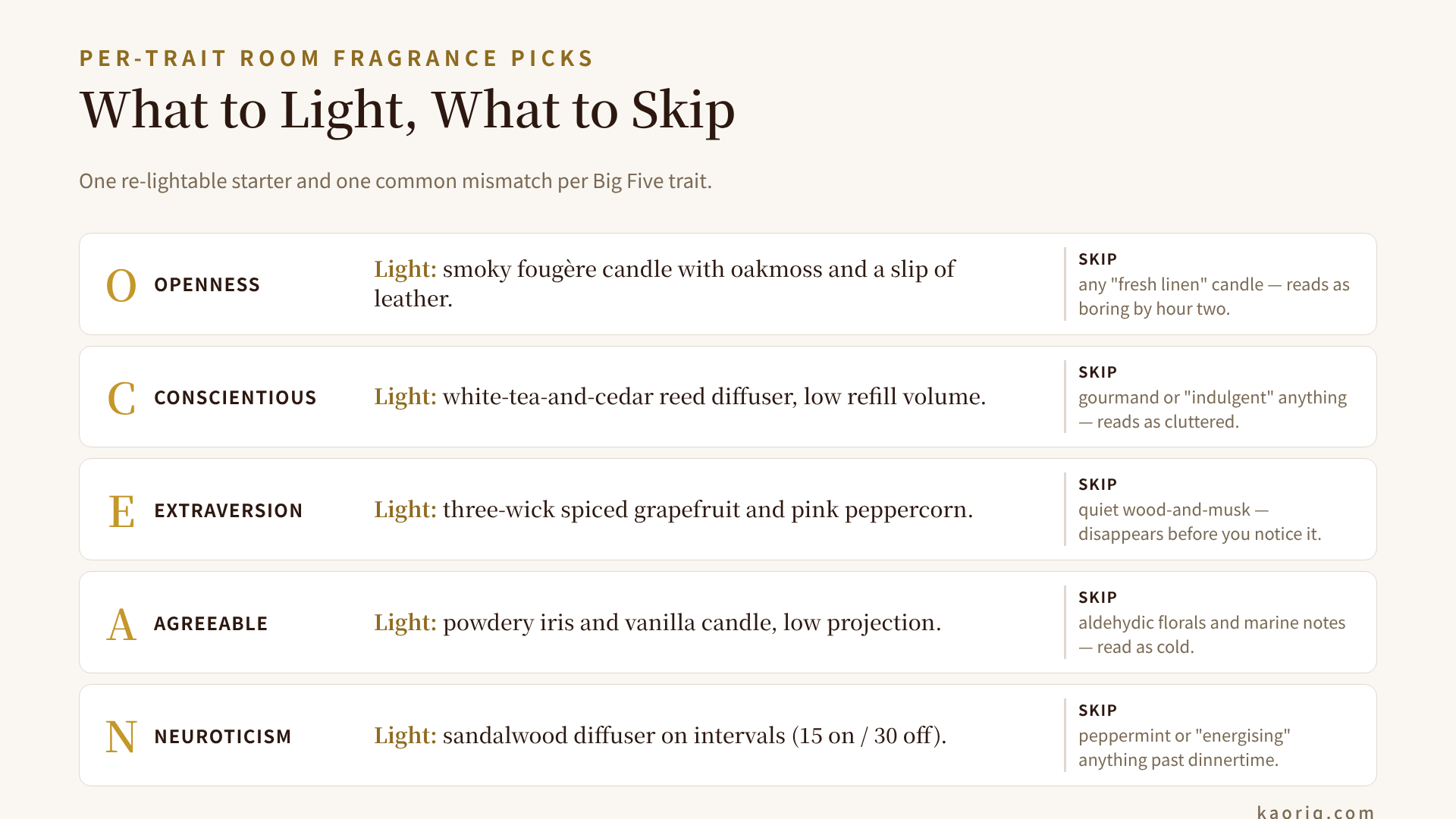
- A smoky fougère candle (lavender, oakmoss, a slip of leather). The layers reveal themselves at different burn temperatures. Hour one is herbal, hour three is dirty and quiet.
- An incense stick blend with hinoki and resin notes. Japanese-style incense burns in about fifteen minutes, but leaves the room thinking for an hour after.
- A reed diffuser in dried fig and benzoin. The kind of “what is that?” smell that makes guests forget what they were saying.
What to avoid: any “fresh linen” candle. You will hate it. It will sit on the shelf with the others.
High Conscientiousness: You Want a Room That Looks Tidy in Smell Form
You don’t actually want fragrance, you want order made olfactory. Anything that smells cluttered is the same to you as a stack of unwashed mugs.
- A white-tea-and-cedar reed diffuser. Quiet, structured, doesn’t change all day. You can leave it for a week without thinking about it.
- A single-note rosemary candle in a small jar. Herb-clean, doesn’t drift into food smells.
- A low-smoke aromatic incense. Frankincense or hinoki, nothing sweet, nothing complicated.
What to avoid: anything labelled “indulgent,” “decadent,” or written in a hand-drawn font.
High Extraversion: You Need a Room That Walks Up to Greet You at the Door
A quiet sandalwood candle is, for you, basically an unlit candle. You don’t register it. You want the room to introduce itself before you’ve taken your coat off.
- A spiced grapefruit and pink peppercorn three-wick candle. Loud, social, and somehow still classy.
- A warm gourmand diffuser: toasted vanilla, tonka, a whisper of burnt sugar. Reads as “the host has thought about this.”
- Big white florals as a room spray: tuberose, jasmine, magnolia. Use ten minutes before people arrive, not while they’re already there.
What to avoid: anything described as “barely there.” That phrase, on a candle, is functionally an insult.
High Agreeableness: You Want a Room That Hugs
You’re really selecting fragrance for whoever walks in, more than for yourself. You want guests softened on arrival, never impressed at it.
- A powdery iris and vanilla candle. Soft, low-projection, the olfactory equivalent of a cashmere throw.
- A rose-musk pillow mist. (Your guest room will become someone’s favourite room.)
- A creamy sandalwood-and-tonka diffuser. Warm without being heavy, sweet without being a dessert.
What to avoid: sharp aldehydic florals and salty marine notes. They read as cold and won’t make sense in your space.
High Neuroticism: You’re Buying Regulation, Not Decoration
If your daily emotional weather has more storms than most people’s, your room fragrance is a thermostat. You’re not picking a smell, you’re picking what your nervous system gets to land on.
- A true lavender candle (look for Lavandula angustifolia, not synthetic lavender oil). The linalool research is real; the calming effect is small but stable.
- A sandalwood diffuser on intervals (fifteen minutes on, thirty off). α-santalol has measurable sedative effects, and intervals stop your nose from adapting and ignoring it.
- A vetiver-and-cedar room spray for racing-mind evenings. Earthy bottom-of-the-pot smells that pull your attention out of your head and into the room.
What to avoid: bright citrus, peppermint, “energising” anything. Helpful at 7 AM, ruinous at 10 PM.
A Word on the Combinations
Almost no one is purely one trait. The interesting picks live in the overlaps.
- Open + Conscientious (the architecturally curious): smoky vetiver in a clean ceramic diffuser. Layered enough to keep them interested, restrained enough not to read as messy.
- Extraverted + Agreeable (the natural host): a soft spiced amber candle. Big enough for the room, warm enough that no one feels braced.
- Neurotic + Open (the anxious aesthete, hi, me): a complex sandalwood and incense blend. The complexity gives the mind somewhere to land that isn’t the worry; the wood does the actual sedating.
When two traits both lean high, pick a fragrance that satisfies the harder one. A high-Neuroticism, high-Openness person who buys an exciting fougère won’t sleep. Same person who buys a plain lavender will be bored by Wednesday. The sandalwood-incense blend threads both needs at once.
Re-Light Rate Is a Personality Test
Your candle graveyard exists because the fragrance industry sells to occasions (autumn, the holidays, “self-care Sunday”) and to fantasies (the version of you who finally has matching laundry baskets), instead of selling to who you already are.
A room scent that matches your personality is one you stop noticing, in the good way. Your brain stops flagging it as a foreign object in the room and starts treating it as part of you. You re-light it for no special reason at all: today is Tuesday and you live here.
If you’re not sure which trait is loudest in your life right now, the personality piece is the long version of the reasoning. Or you can take the much faster route: open your candle graveyard, look at what’s left unlit, and ask honestly what those candles were trying to be for you. The pattern is usually obvious once you stop pretending you bought them on purpose.
The candle you’ll actually re-light is, almost certainly, the one that smells like the person you already are, not the person you keep meaning to become.
Was this article helpful?