The Housewarming Candle Problem: How to Choose a Home Fragrance Gift for a Home You've Never Smelled
“Oh, Anything’s Fine” Is the Most Dangerous Sentence in Gifting
When you ask someone what scent they’d like for their new home, they almost always say “oh, anything’s fine, honestly.” This is a trap, and I say that with love. In my experience, the people who insist anything is fine are precisely the people who will quietly relocate the wrong candle to the downstairs bathroom within a week. “Anything” means “I have very specific tastes I have not told you, and I’m about to find out whether you can read minds.”
You cannot read minds. I cannot read minds. And with a housewarming gift, the problem is harder than usual, because you’re not just buying for a person whose taste you don’t fully know. You’re buying for a room you have never smelled. You don’t know what the place is going to be like. Bright and minimal? Cosy and book-stuffed? Still smelling faintly of the previous owner’s life choices? You’re choosing a fragrance for a space that, as far as your nose is concerned, doesn’t exist yet.
Here’s how to do it anyway, and do it well.
Why a New Home Is a Special Case
A housewarming gift isn’t just a “gift for someone whose taste you don’t know” (I’ve written that broader guide already, and it holds up). A new home adds two complications that change the maths.
First: the place probably already smells of something, and that something is chemistry. Fresh paint, new flooring, sealants, that boxed-up “new build” tang. These are VOCs off-gassing, and they’re loud. A delicate floral candle doesn’t stand a chance against a freshly painted hallway, and a strong candle on top of paint fumes is genuinely unpleasant. So the first rule of new-home fragrance is humility: you’re not perfuming a finished space, you’re offering something gentle for a room still finding its feet.
Second: it’s chaos in there. Boxes everywhere, nothing where it should be, the recipient running on adrenaline and takeaway. A gift that asks them to do something (find the matches, trim a wick, locate a free outlet) is a gift that gets shelved until “things calm down,” which is to say, forever. Your gift has to work with zero setup, in a house where nobody can find anything.
Hold those two facts in your head and the rest of this gets easy.
The Three Safe Families (When You Don’t Know the Space)
For a home you’ve never smelled, you want scents that read as clean and welcoming rather than decisive. Three families do this almost universally. None of them will fight the paint smell, and none of them will impose a personality on a space that hasn’t chosen one yet.
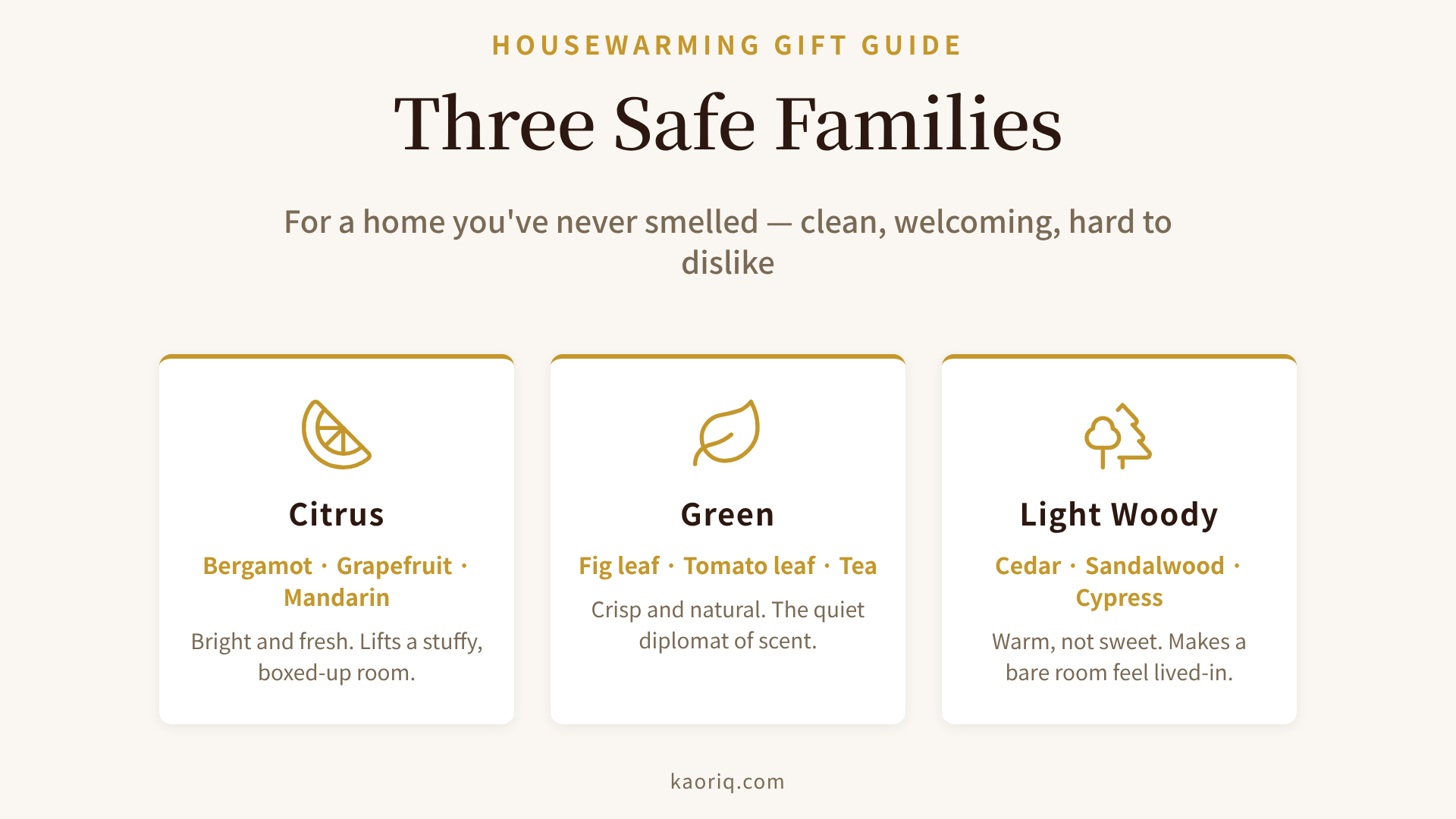
| Family | Why it’s safe for a new home | Imagine it as |
|---|---|---|
| Citrus (bergamot, grapefruit, light mandarin) | Bright, fresh, reads instantly as “clean.” Lifts a stuffy boxed-up room without dominating. Almost nobody dislikes it. | Opening a window on the first sunny morning. |
| Green (fig leaf, tomato leaf, light tea) | Crisp and natural, like a houseplant just watered. Calm, modern, neither sweet nor heavy. The quiet diplomat of scent. | A florist’s back room, all stems and leaves. |
| Light woody (cedar, sandalwood, soft cypress) | Warm without being sweet, grounding without being loud. Makes a bare room feel a little more “lived in.” | A wooden shelf warmed by afternoon sun. |
The shortcut, if you remember one thing: a bergamot-and-cedar scent is the housewarming handshake. Fresh on top, warm underneath, offensive to no one. It’s the smell equivalent of arriving with a bottle of decent wine and good manners.
What unites these three is that they’re background scents, not statement scents. And a brand-new home, full of half-unpacked boxes, wants a friendly background. Not a headline.
What to Avoid (Almost Regardless of Who They Are)
The flip side. These are gorgeous in the right home, chosen by the right person, and gift landmines when you’re aiming blind at a space you’ve never entered:
- Heavy oud and incense: divides households like nothing else, and on top of new-build fumes it can tip a room into “what is that.” Skip.
- Strong patchouli: people either love it or want it out of the house within the hour. There is no middle ground, and a new home is no place to gamble.
- Full-strength white florals (tuberose, jasmine, gardenia): can read as funeral, hairspray, or someone’s grandmother depending on the recipient’s last association. Too loaded.
- Bakery-sweet vanilla, caramel, “cupcake” scents: lovely for ten minutes, cloying in a small new flat by hour three.
The bottle-description tell, same as ever: if the words intense, bold, seductive, dark, or opulent appear, you’re holding a fragrance the recipient should choose for themselves once they’ve settled in. Put it back.
Format Matters More Than You Think: Go Flameless
For a new home specifically, the format might matter even more than the scent, and the rule is simpler than you’d expect: when in doubt, go flameless.
There’s a real reason. Plenty of new homes are rentals with strict no-open-flame clauses, or first flats where nobody’s worked out yet whether the smoke alarm is theatrically sensitive. And in the unpacking chaos, a candle is one more open flame near a tower of cardboard boxes. A reed diffuser or an electric diffuser sidesteps all of it: no flame, no matches, no fuss, works the second they put it on a shelf.
| Format | Verdict for a new home |
|---|---|
| Reed diffuser ✅ | The safe default. No flame, no plug, no setup. Sits on any shelf and just works for weeks. The rice cooker of housewarming gifts. |
| Room / linen spray ✅ | Great companion gift. Lets them control when and where, perfect for freshening a boxy room on demand. Low commitment. |
| Electric / ultrasonic diffuser ➖ | Generous, but it’s infrastructure: needs an outlet and counter space they may not have sorted yet. Lovely for a second gift, risky as the only one. |
| Candle ➖ | Beautiful, but assumes they can (and are allowed to) burn it, and that they can find the matches. Pair it with a reed diffuser so something works on day one. |
| Incense ❌ | The smoke alone is unwelcome in many homes, and a non-starter in most rentals. Skip unless you know they burn it. |
If you take only one thing from this section: a reed diffuser in one of the three safe families is the gift that works before the boxes are even unpacked. Boring on purpose. Boring gets used.
The Three-Question Diagnostic
Still stuck? You don’t need to know their favourite scent. You need to know three things you can probably figure out from one visit or a single Instagram scroll. Answer these and the choice makes itself.
1. What does their current place look like?
- Bright, white, minimal, lots of glass → citrus. It matches the clean, airy energy.
- Plants everywhere, natural textures, linen and wood → green. It echoes what they already love.
- Warm tones, books, soft lighting, a bit cosy → light woody. It deepens the snug feeling.
2. Is the new place a rental, or somewhere brand new / freshly painted?
- Rental or new build → flameless, no question. Reed diffuser or spray.
- Long-term owned home, settled in → a candle is back on the table if you want it.
3. How well do you actually know them?
- Close friend or family → you can lean toward what you’ve heard them mention; one of the three families in a format they’ll enjoy.
- Colleague, new neighbour, a friend’s partner you’ve met twice → go maximally safe. Bergamot-and-cedar reed diffuser. Done.
Notice the pattern: the less you know, the more “boring” your answer should be. In housewarming gifts, boring is a compliment. It means it will actually get used.
Price: Spend Less Than You’d Guess
The instinct is to spend up, on the theory that a fancier candle is a safer gift. The opposite is closer to true. Expensive home fragrance is often more opinionated, because high-end designers are paid to make distinctive things, not safe ones.
- $25–40: mid-range reed diffusers and candles from brands that lean clean and household-friendly. The three safe families are easiest to find right here.
- $45–70: the sweet spot. Better materials, longer life, cleaner burn. Most well-mannered home brands cluster in this band.
- $80+: you’re paying for design language and brand more than universal appeal. Spend here only when you actually know their taste.
A $45 bergamot-and-cedar reed diffuser is, nine times out of ten, a better housewarming gift than a $120 niche oud candle. The diffuser ends up on their hallway shelf. The oud candle ends up, unlit, in the drawer where people keep the candles they’re too polite to mention.
The One-Line Rule
If you take nothing else from all of this:
One of the three safe families (citrus, green, or light woody), flameless, moderately priced, matched to the home they already have.
A bergamot-and-cedar reed diffuser in a clean glass bottle is a more thoughtful housewarming gift than the most exquisite candle in the shop, because it works on day one, in a half-unpacked room, in a home you’ve never smelled. That’s the entire job. A gift that disappears quietly into a new home, doing its small welcoming work while the boxes get unpacked around it, is the only kind of housewarming fragrance that counts.
And the friend who said “oh, anything’s fine”? They’ll text you a photo of the diffuser on the new hallway shelf within the week. That’s how you know “anything” was, as ever, a complete lie. A nice one. But a lie.
If you want to take the guesswork out of it entirely (or you suspect the recipient is someone whose taste deserves a more personal scent), our personality-based fragrance match is built precisely for this. It asks five quick questions and recommends a scent direction based on how the person actually responds to the world, not on what was stacked by the till. Two minutes, and you’re choosing for them instead of guessing.
Further reading:
- How to Choose a Home Fragrance Gift When You Have No Idea What They Like: the broader version of this guide, for any unknown-taste recipient.
- Father’s Day Home Fragrance: A Guide for the Dad Who Says He Doesn’t Want Anything: the same logic, aimed at the hardest gift recipient of them all.
Was this article helpful?