How to Choose a Home Fragrance Gift When You Have No Idea What They Like
The Gift Candle That Sits Unopened for Eight Months
Picture a beautiful candle. Black-and-gold packaging, the kind of brand you whisper the name of. The notes promise “smoked oud, leather, and tonka.” It’s a confident moment in the shop. Surely everyone wants to live in a fragrance ad.
Eight months later, visiting their house, the candle is on a shelf in the spare bedroom, wick still pristine, cellophane still on. They were gracious about it on the day. They also, very clearly, never lit it.
If you have ever given a fragrance gift and quietly suspected it never got used, you are not alone. Fragrance is the gift category with the highest good intention to actual use gap, because the rules for buying for yourself (“get something you love”) are exactly the wrong rules for buying for someone else. The thing you love is, by definition, opinionated. And opinionated scents are how candles end up in the spare bedroom.
Here is how to do this properly when you don’t know their taste.
Why Fragrance Gifts Are Uniquely Hard
A sweater you got wrong is just slightly too tight. A book you got wrong sits on a shelf and looks like a sweet attempt. A wine you got wrong gets quietly cooked into a stew.
A candle you got wrong fills the entire room of someone trying to relax with a smell they didn’t choose. The bar isn’t “do they like it.” The bar is “do they want to live inside it for three hours.” Those are very different questions.
And then there is the genetic part. Olfactory receptors vary person to person, so the same compound (musk, certain woods, civet-style animalics) can read as “warm and inviting” to one nose and “headache, please open a window” to another. You cannot predict this from talking to them. They cannot predict it from describing themselves. It’s hardware.
So the goal of an unknown-taste fragrance gift is not “find their favourite scent.” That’s a coin flip. The goal is “pick something they almost certainly won’t object to, in a format they’ll actually use.” Lower the variance. Win on safety, not flair.
The Four Notes That Almost Everyone Quietly Likes
When research labs run blind hedonic preference tests on scent compounds (the boring rooms with the cotton swabs and the clipboards), a small set of notes consistently land in the top quartile of liking across cultures, genders, and ages. Perfumers call this hedonic universality, and it is the home fragrance gift-giver’s best friend.
These four are the closest thing to a safe bet:
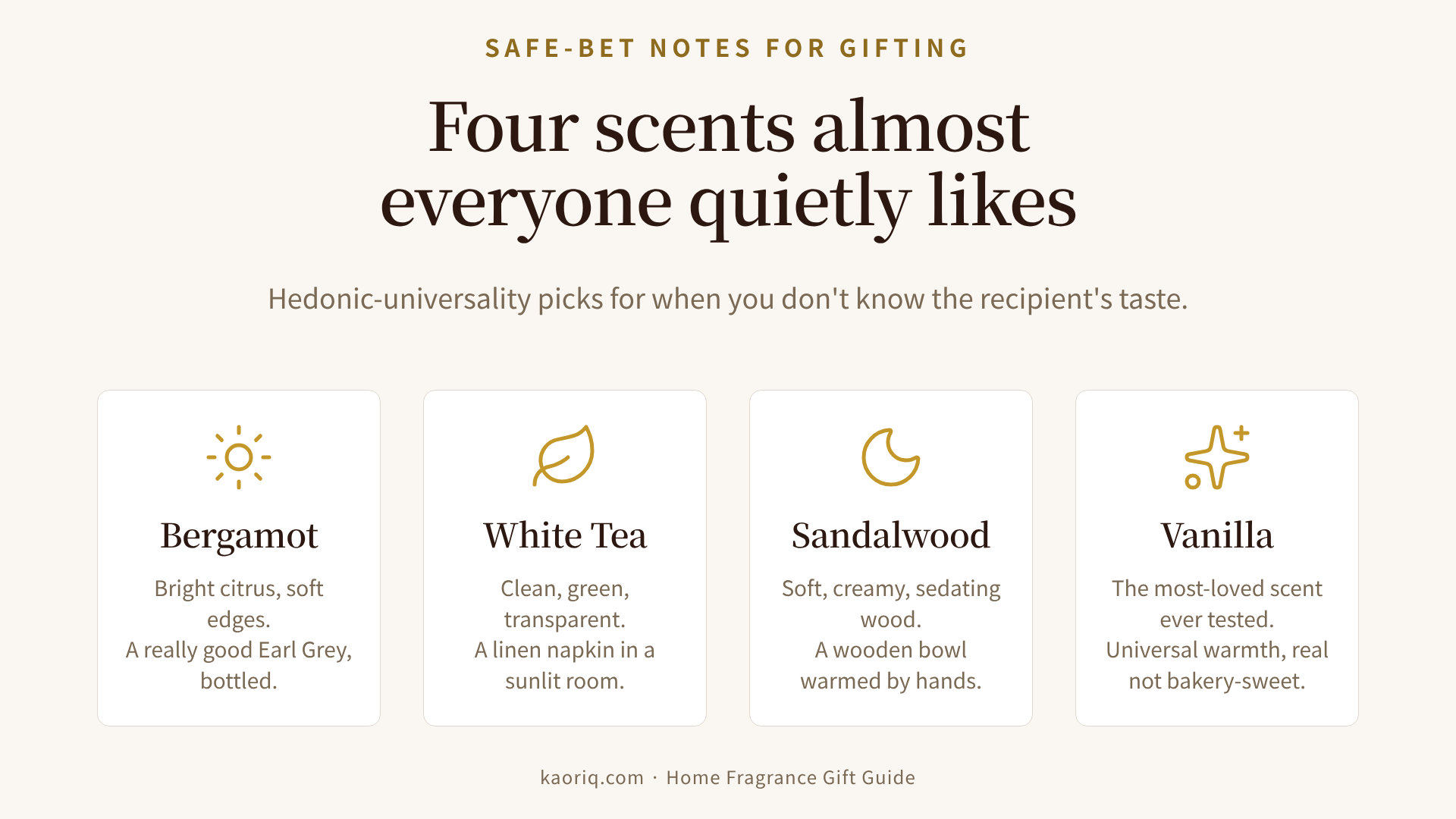
| Note | Why it’s safe | One sentence to imagine it |
|---|---|---|
| Bergamot | Bright citrus without the aggression of lemon. The most-loved top note in the world, full stop. | The smell of a really good Earl Grey, bottled. |
| White tea | Clean, green, almost transparent. Reads as “fresh air with manners.” | A linen napkin in a sunlit room. |
| Sandalwood | Soft, creamy wood. Sedates rather than excites. Loved across cultures, no harsh edges. | A wooden bowl warmed by hands. |
| Vanilla (real, not bakery-sweet) | The single most cross-culturally pleasing scent compound ever tested. Even people who say they hate sweets like real vanilla. | A baby’s head, somehow. Trust me. |
The shortcut, if you remember nothing else: a bergamot-and-sandalwood candle is the diplomatic handshake of fragrance gifts. Light, clean, warm, almost no one will recoil. It’s the smell equivalent of “would you like some water.” Universally acceptable.
What these four have in common is that none of them are statement scents. They are background scents. And background is exactly what a gift recipient wants from something they didn’t choose themselves.
What To Avoid (Almost Regardless of Who They Are)
These four families look impressive in shop and split households in practice. None of them are bad scents in their own right; they just don’t belong in a gift box:
- Heavy oud: divides households like nothing else. Gorgeous on someone who chose it. Smells “medicinal” or “barnyard” to someone who didn’t.
- Strong patchouli: people either love it or want it out of the house immediately. There is no middle.
- White florals at full strength (tuberose, jasmine, gardenia): can read as funeral, hairspray, or grandmother depending on the recipient’s last association. Polarising.
- Strong synthetic musks: the most common cause of “this is giving me a headache” complaints. Skip especially for older relatives.
- Smoky leather/tobacco: the classic overshoot. Beautiful in concept. A lot of human to ask someone to live with.
If the bottle description uses the words intense, bold, seductive, dark, or opulent, you are looking at a fragrance the recipient should choose for themselves. Put it back.
The Decision Tree: Match the Risk to the Relationship
The other lever you can pull, beyond the notes, is how adventurous you allow yourself to be. The closer you are to the person, the more you actually know about their taste, and the more permission you have to take a risk. The further away, the safer you go.
| Relationship | How much you can risk | Recommended choice |
|---|---|---|
| Boss, client, professional | Almost zero | Reed diffuser in white tea or bergamot. Quiet, low-stakes, doesn’t impose. |
| Coworker, distant friend | Low | Soy candle in bergamot-and-sandalwood, mid-size. Universal blend, no commitment. |
| Close friend, sibling | Medium | One of the four safe notes, but in a format they’ll enjoy choosing when to light. Candle or a small set. |
| Parent, partner | Higher (you know them) | You can lean into something you’ve heard them mention liking, but still skip the polarising families above. |
| Someone you’ve never met (new home gift, host of a party) | Zero | Reed diffuser in white tea. Boring on purpose. They can leave it in any room without thinking. |
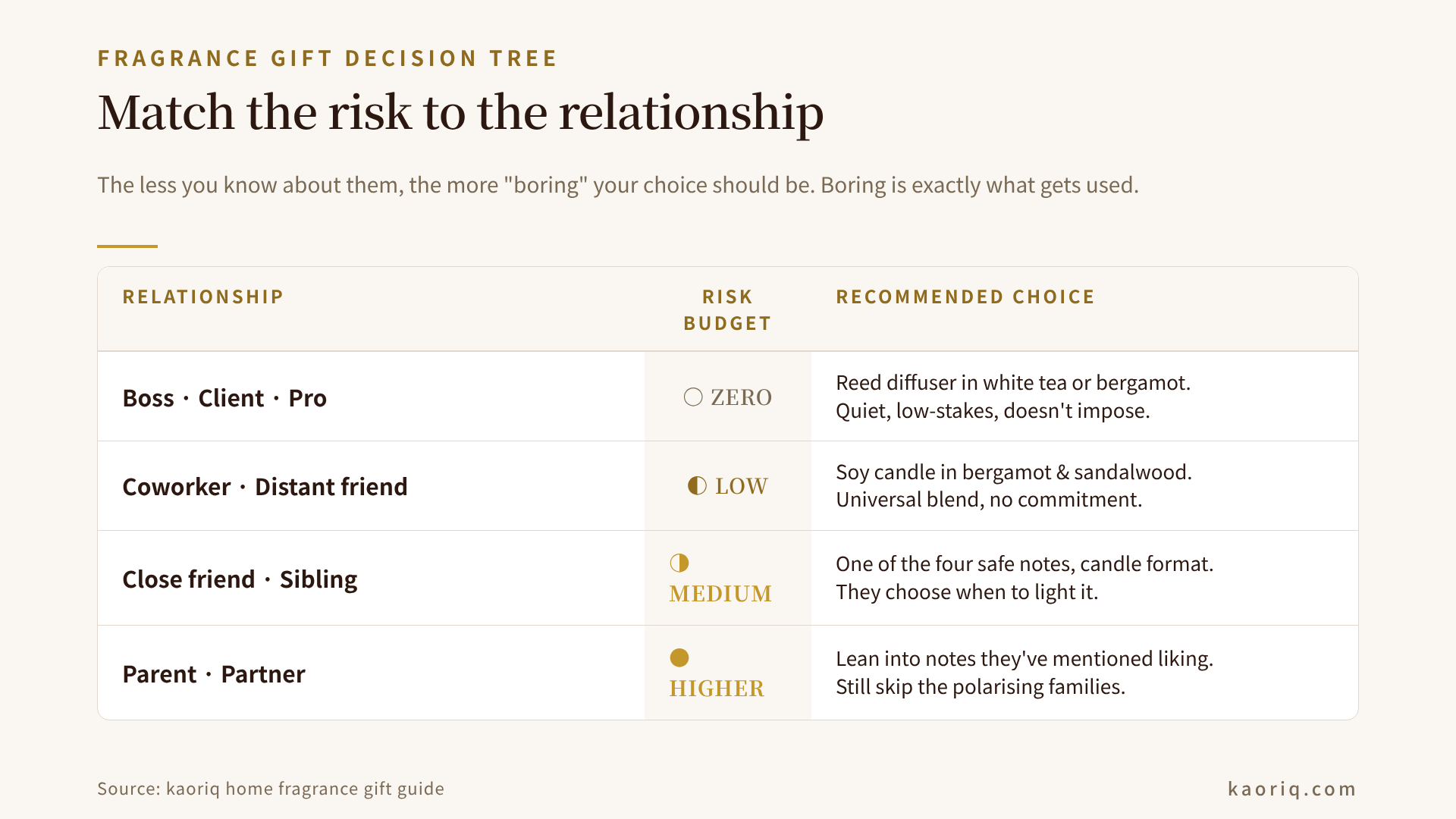
The honest rule: the less you know about them, the more “boring” your choice should be. And boring, in this context, is the exact right word for a gift that will actually get used.
Then Pick the Right Format
The note matters. The format matters almost as much, because the format dictates whether the gift gets used at all.
- Reed diffusers are the safest format for unknown recipients. They run on their own, don’t require a lighter, are pet-safe, and the recipient can put them in a less-trafficked room if they’re not in love with the scent. Best for: coworkers, in-laws, hostess gifts, new-home gifts.
- Soy or coconut wax candles are the most universally enjoyed format among people who actually use fragrance. Best for: friends, family, anyone who has lit a candle in their home in the last year. Skip if you know the recipient has small children running around the house or anxious pets.
- Pillow mists or linen sprays are wonderful if you know they have a bedtime routine. Best for: close friends, partners, anyone who has mentioned trouble sleeping. Skip for casual acquaintances; it’s a slightly intimate gift.
- Incense is the most divisive format. The smoke alone is enough to be unwelcome in some households. Skip entirely unless you know they already burn incense.
- Electric or ultrasonic diffusers are a generous gift, but they’re effectively infrastructure: you’re asking them to commit to a device on their counter. Only give if you’re sure they want one.
If you’re unsure: reed diffuser. It is the rice cooker of the fragrance gift world. Quietly useful. Doesn’t ask the recipient to make decisions.
Price: Not What You Think It Should Be
A common mistake is to spend more, on the assumption that the fancier the candle, the safer the gift. The opposite is closer to true. Expensive fragrance gifts are often more opinionated, because designers at the high end are paid to make distinctive things, not safe ones.
Rough guidance:
- $20-35: Mid-range candles or small reed diffusers from brands that lean toward neutral, household-friendly scents. This range is where the four safe notes are easiest to find.
- $40-70: The sweet spot. Better wax, cleaner burn, longer life. Most household-friendly brands cluster here.
- $80+: You’re paying for design language and brand more than scent universality. Spend in this range only when you actually know the person’s taste, or when the recipient is someone who already buys luxury home goods themselves.
A $45 bergamot-and-sandalwood reed diffuser from a thoughtful mid-range brand is almost always a better gift than a $120 niche oud candle. Save the niche oud for yourself.
The One-Line Rule
If you take nothing else from this:
Pick one of the four safe notes, in a low-commitment format, at a moderate price. Save your taste for your own home.
A bergamot reed diffuser in a clean glass bottle is a more thoughtful gift than the most exquisite oud candle of your year, because the bergamot will get used. The whole point of a gift is that it enters the recipient’s life. Used > admired > unopened on a spare bedroom shelf.
The follow-up gift, a year later, was a small white-tea candle. Lit three times in a fortnight. We have, as the candle people say, a winner.
If you want to take this further (or you suspect the recipient is someone whose taste actually deserves a more personal scent), our personality-based fragrance match is built precisely for this. They can take it in two minutes and get a small set of recommendations based on how they respond to the world, not on what was on sale at the airport.
That’s the version of fragrance gifting where they actually light it. Which, in the end, is the only kind that counts.
Was this article helpful?