How to Choose Your First Incense: Sticks, Cones, Coils, and Backflow (Without the Smoke Headache)
The First Time You Light Incense, It Usually Goes Wrong
Cones look tidy, so they’re a common first purchase. Light one in a sealed studio apartment the size of a generous walk-in closet, sit down to enjoy your newly serene life, and twenty minutes later you’re standing on a chair fanning a smoke alarm with a tea towel.
The incense wasn’t the problem. The format was. I’d grabbed the most concentrated, fastest-burning option on the shelf and set it loose in the smallest possible room. It was like buying a bullhorn to whisper a bedtime story.
If you’ve ever stood in front of a wall of incense (sticks, cones, those mesmerising little spirals, the waterfall ones all over your feed) and quietly given up, this is the guide for that moment. Four formats, plainly explained, with an honest comparison table and a one-line answer for “which one is actually me?”
The Four Formats, in Plain English
Sticks: The Easygoing Default
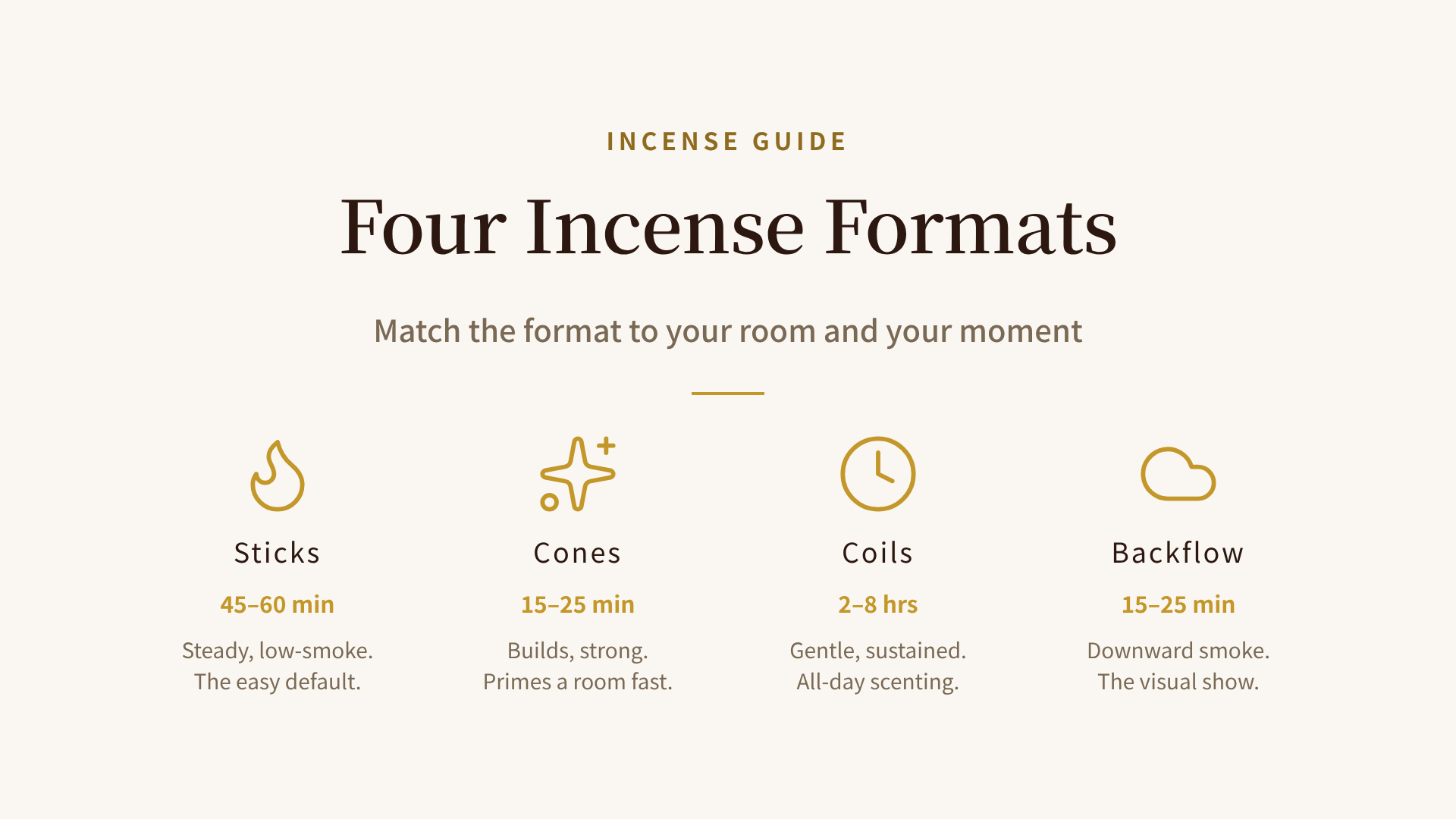
A thin bamboo core coated in scented paste (or, in finer Japanese incense, a solid extruded stick with no core at all). You light the tip, blow out the flame, and it smoulders evenly for 45 to 60 minutes. Because the burning surface stays roughly constant, the scent comes out steady and even from start to finish: no crescendo, no fade. The most forgiving format and the one I’d hand any beginner first.
Cones: Small, Mighty, and Easy to Overdo
A little pressed cone that sits on a dish or stone. Cones burn fast, just 15 to 25 minutes, and because more of the cone is alight as the flame works downward, the scent builds as it goes. The throw is concentrated and strong. Wonderful for scent-priming a room before guests arrive. Slightly perilous in a small, closed space, as smoke alarms tend to point out.
Coils (Spirals): The Long-Haul Option
A tight spiral that maximises burning length while staying compact. One coil can release scent for anywhere from a couple of hours to most of a day, depending on size. This is the format for all-day ambient scenting or a larger, open room where you want a gentle background presence rather than a moment.
Backflow: The One That Does the Waterfall Trick
A special cone with a hollow channel running down the middle, designed to sit on a sculpted burner. The smoke cools inside the channel, becomes denser than the surrounding air, and pours downward in a slow, hypnotic stream instead of rising. Here’s the part nobody tells you: scent-wise, it’s just a cone. Same 15-to-25-minute burn, same intensity. You’re paying for the visual, not a different fragrance experience. (Which is completely fine. I’ve absolutely watched one for twenty minutes instead of doing anything useful.)
The Honest Comparison Table
Here’s the chart I wish the shop labels had shown me. Ratings reflect typical mid-range products (◎ excellent / ○ good / △ workable).
| Sticks | Cones | Coils | Backflow | |
|---|---|---|---|---|
| Burn time | 45-60 min | 15-25 min | 2-8 hours | 15-25 min |
| Scent strength | ○ steady | ◎ builds, strong | ○ gentle, sustained | ◎ builds, strong |
| Smoke volume | ○ moderate | △ heavy | ○ moderate | △ heavy (by design) |
| Best room size | small-medium | medium-large | medium-large | small (with burner) |
| Beginner-friendly | ◎ | ○ | ○ | △ needs setup |
| Needs special holder | stick stand | small dish | coil stand | sculpted burner |
| Best for | daily ambient | priming a room | all-day scenting | the visual show |
A few of these deserve a sentence before you decide anything.
Smoke is the variable everyone underestimates. Cones and backflow concentrate more material into a shorter, hotter burn, which means more visible smoke per minute. In a small, unventilated room that adds up fast. Sticks and coils spread the same scent over a longer, cooler burn, gentler on the air and on a sensitive nose.
Burn time should match your occasion, not your patience. A 60-minute stick is wrong for a five-minute “make the room nice before someone arrives” moment, and a 20-minute cone is wrong for a slow Sunday you want to scent all afternoon. Pick the format that fits how long you actually want scent in the room.
Sticks, but Which Style? (Japanese vs. Indian)
If you go with sticks (and most beginners should), there’s a second fork in the road that trips people up. Two broad traditions, very different volumes.
- Japanese-style sticks tend to be coreless, slim, and built around woods like sandalwood and agarwood. The character is quiet, clean, and low-smoke, made for small rooms and close listening. (Japan has a whole 600-year art devoted to exactly this. I wrote about the lost art of kōdō if you want the full story.)
- Indian-style “masala” sticks are hand-rolled with resins, oils, and spices. The character is warm, rich, and far more potent: glorious in a large or well-ventilated space, overwhelming in a sealed bedroom.
If your room is small or your nose is sensitive, start Japanese. If you want a room to announce itself the moment someone walks in, go Indian. There’s no wrong answer, only a wrong room for the answer.
So, Which One Is Actually You?
The one-line version, for when you just want to be told:
- “I want the easy, foolproof start.” → A box of Japanese-style sticks. Steady, low-smoke, beginner-proof.
- “I want to make the room lovely right before people arrive.” → Cones. Fast, strong, dramatic. Crack a window.
- “I want gentle scent all afternoon without re-lighting.” → A coil. Set it and forget it.
- “I mostly want the thing to look beautiful.” → Backflow, and own it. The waterfall is the whole point.
- “My room is tiny / I get headaches easily.” → Slim Japanese sticks or a small coil, always with ventilation. Skip cones and backflow until you have more air to work with.
Three Safety Notes Worth Having Before the Hard Way
These take ten seconds and save the evening.
- Always use a proper heatproof holder. A glowing ember will travel down a stick or burn a ring into your table. The right stand isn’t optional decor.
- Ventilate. Even low-smoke incense needs somewhere for the air to go. A cracked window turns “too much” into “just right.”
- Never leave it burning unattended, and keep it clear of curtains, paper, and anything a draft could nudge into the ember.
One thing worth saying plainly: incense here is strictly for scenting your room and your space: it’s a homeware, not anything you put on skin. Treat it as ambience, enjoy it as ambience.
If You’re Still Not Sure Where to Start
Don’t overthink the format. Start with a small box of Japanese-style sticks in a scent family you already know you like: something woody, something fresh, something soft. The format question is much easier to answer once you know which smells pull at you, and that’s the part worth getting right first.
If you’ve no idea which scent family is yours yet, that’s the better place to begin: figure out your fragrance family first, then come back and pick the format that fits your room. Get those two right and the smoke alarm stays exactly where it belongs: silent, on the ceiling, ignored.
Sources: Aroma Paradise, MONIAN, Kin Objects, Heazz.
Was this article helpful?