Wooden Wick vs. Cotton Wick Candles: Which Fits the Sound You Want (and the Way You Actually Burn)
The Crackle Has Ten Million Views on YouTube. Is There Still a Reason to Pick Cotton?
There is a corner of YouTube where people record wooden wick candles for hours and rack up ten million plays. I know because I lost a Tuesday evening to one of them. The soft pop every few seconds is genuinely lovely, the kind of ambient noise that turns a rented apartment into something with a hearth in it.
So you would think the argument was over. Wooden wick wins. Everyone go home.
Except I own three candles right now, and two of them are cotton. Not by mistake. There are rooms where I want the crackle, and there are rooms where I want to light the thing, forget about it, and read for two hours without it demanding my attention. Those are different jobs, and the wick, more than the wax, is what decides which job your candle is good at.
Here is the honest version of the wooden-vs-cotton conversation, without the shop’s marketing filter. This is a guide about matching the wick to how you actually burn, not to who you wish you were on Sunday.
First, What a Wick Actually Does
Skim if you know it. Otherwise this is the floor.
- Cotton wicks are braided, round, and act like a vertical fuel line. Heat travels up the braid, wax vaporizes at the tip, you get a tall teardrop flame.
- Wooden wicks are flat strips of thin wood. The flame spreads across the top edge instead of climbing a braid, so you get a wide, horizontal flame instead of a tall vertical one.
That one geometric difference — vertical vs. horizontal — is the reason every other difference on this page exists. Wider flame means wider melt pool. Wider melt pool means more wax surface exposed to air. More exposed wax means more fragrance evaporating. Which is why wooden wicks tend to throw scent harder and reach the corners of a room faster than cotton, even when both candles use the same wax and the same fragrance oil.
The crackle is a bonus, not the point. It happens because trace moisture and organic compounds trapped in the wood vaporize when the flame hits them, and each little pressure release sounds like a pop. It’s the flame telling you it’s eating breakfast.
The Comparison Table You’ll Actually Use
Here’s the cheat sheet first. Each axis is rated ◎ great · ○ good · △ limited.
| Wooden Wick | Cotton Wick | |
|---|---|---|
| Scent throw (hot) | ◎ strong, fast to fill a room | ○ steady, more contained |
| Ambiance (sound) | ◎ soft fireplace crackle | △ silent |
| Maintenance | △ finicky, easy to drown | ◎ light-and-forget |
| Burn evenness | ◎ wide melt pool, less tunneling | ○ good if you burn ≥3h |
| Lighting ease | △ can need 2–3 tries | ◎ lights in 3 seconds |
| Soot / smoke | ◎ near-zero, clean burn | ○ low, minor mushrooming |
| Best in | living room, big open spaces | bedroom, bathroom, small nooks |
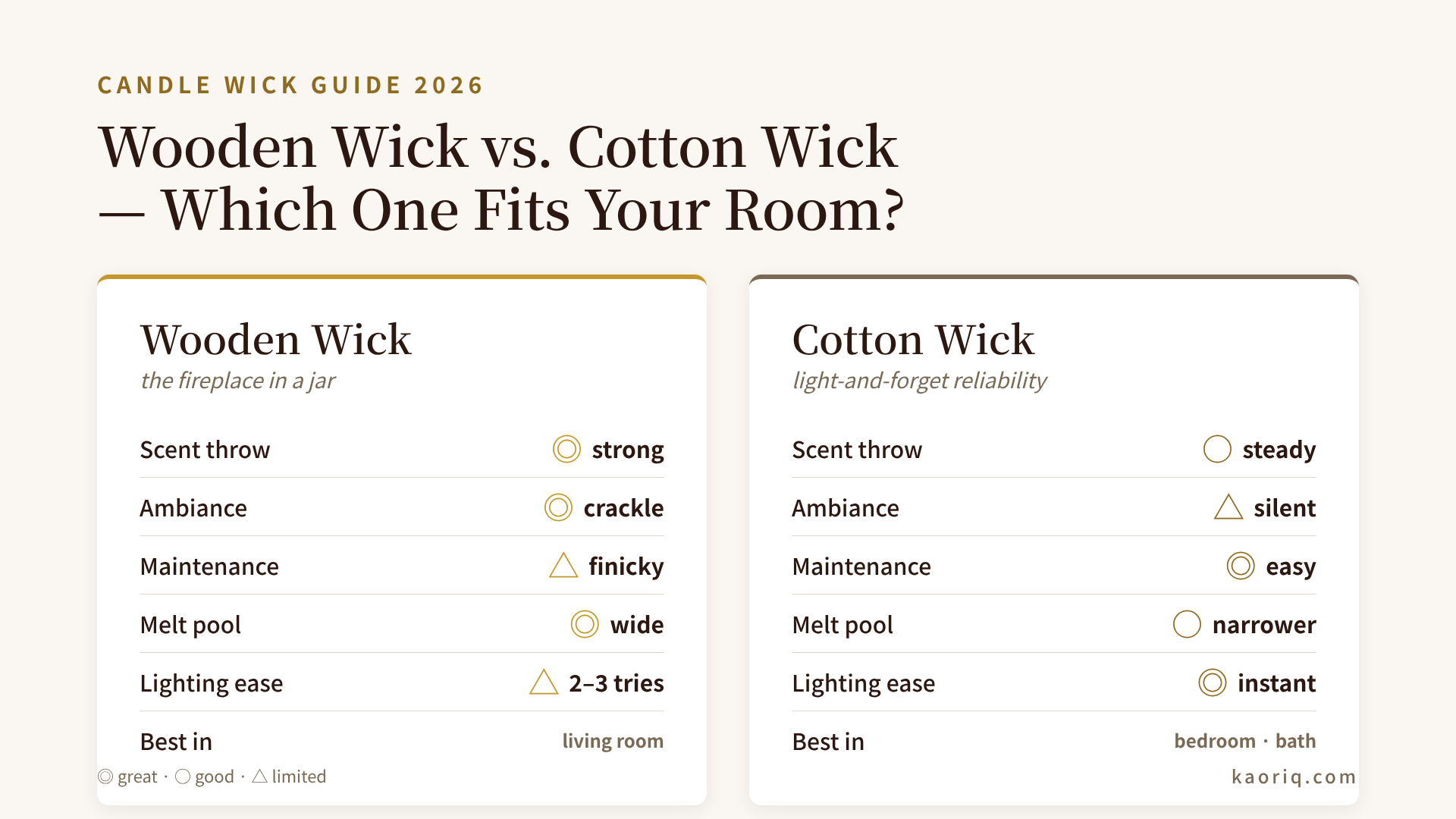
Two things worth pulling out before we go deeper. First, wooden wick wins on scent throw and vibe but is genuinely more work — it wants your attention on the first burn and every burn after. Second, cotton wick wins on reliability. You can light it while doing something else, and it will not sulk. If you have ever bought a candle you were “too tired to deal with,” that is a candle that should have been cotton.
Wooden Wick Fits You If…
You are somebody who lights the candle as the event. The lighting is part of the evening. You want the room to sound different when it’s on. You are willing to trim the charred edge before each burn, and you are willing to accept that some nights the wick will just… not want to light, and you’ll try it three times before it takes.
In personality terms this tends to skew high-openness, high-sensory. If you are the kind of person who has strong opinions about lamp color temperature and where the record player goes, you are probably a wooden wick person.
Three to Consider
- WoodWick Fireside (Yankee Candle Group) — the reference bergamot-amber-woodsmoke that basically defined the “fireplace in a jar” category. Their Hearthwick flame technology gives you a wide dancing flame and a very consistent crackle. Mid-price, easy to find, 4.7-star Amazon average across thousands of reviews. If you have never owned a wooden wick candle, this is the safe first buy.
- MBur Beeswax (single-wax series) — 100% pure beeswax and a wooden wick, which is a rare pairing. The beeswax gives you the longest burn time in the category (their 12oz vessel goes ~80 hours) with almost no soot. Vanilla Tobacco and Lavender Spa are the standouts. Premium price, but the burn hours per dollar are actually competitive if you calculate it out.
- Hemlock Park Wood Wick — an indie brand that leans clean-ingredient and hits a solid $28–35 sweet spot. Their Cedar Sandalwood is a good introduction to the woody-earthy end of the crackle-candle spectrum.
Under $20 and still wooden wick? Manly Indulgence is the honest budget answer. The scent is less nuanced but the crackle is real and the burn is even.
Cotton Wick Fits You If…
You want ambient scent without ambient theatre. You light the candle while doing something — cooking, reading, working — and you don’t want to babysit it. You want it to light in three seconds, burn cleanly, and go out when you blow on it.
Personality-wise this is high-conscientiousness territory. You like things that work the way they’re supposed to work. You are the person in your friend group who remembers to actually replace the batteries in the smoke detector.
Three to Consider
- Nest New York (any 3-wick jar) — the industry benchmark for cotton wick fragrance quality. Grapefruit and Bamboo are the two that never leave stock. The 3-wick 21oz burns 100–150 hours, and the scent throw is quiet but confident — you smell it across a living room, not through a hallway. Premium price, but the throw-per-dollar is honest.
- Bath & Body Works 3-Wick — the reason most Americans know what a “3-wick” is. Not subtle, not delicate, but if you want a big room to smell like Autumn Leaves within twenty minutes, this format is engineered for exactly that. Rotate through their seasonal releases if you’re bored easily. Frequent sales get these to $10–14 each, which is genuinely hard to beat on scent-per-dollar.
- Boy Smells (any 8.5oz cotton wick) — the design-forward option. Beeswax-coconut wax blend, cotton wick, and fragrance profiles that lean queer, playful, unusual (their Cowboy Kush and Violet Ends have real character). This is the cotton wick that reads as an aesthetic choice, not a default.
The Mixed Strategy Nobody Tells You About
You do not have to pick one side. The strongest candle setup I’ve seen in someone’s apartment was this:
- Living room: wooden wick. Big open space, the crackle actually reaches you where you sit, and the wide melt pool fills the room with scent within twenty minutes. This is where you want the event.
- Bedroom: cotton wick. Small enclosed space, you’re going to blow it out in an hour anyway, and the last thing you want at 10:47pm is a wick that won’t light on the first try.
- Bathroom / kitchen: cotton wick, single-wick, small. Short burns, humid or greasy air, you want a candle that behaves.
Match the wick to the room, not to the aesthetic you saw on Instagram. Your candles will last longer and you will actually enjoy them more.
The Two Failure Modes, and How to Not Get Them
Wooden wick that keeps going out. This is the number one complaint, and 90% of the time it’s because the charred edge from the previous burn wasn’t broken off. Before each burn, snap off the black crumbly bit at the top with your fingers (it comes off cleanly). Also: wooden wicks want a bigger first burn. Give them 2–3 hours the first time so the melt pool reaches the edge of the jar. If you blow it out at 45 minutes, you have taught the candle to tunnel.
Cotton wick that mushrooms and smokes. That black clump on top of the wick is a carbon ball, and it means the wick got too long. Trim to ¼-inch (6mm) before every burn using a wick trimmer or a pair of scissors. If you skip this, the flame runs hot, the wax combusts incompletely, and you get soot on the glass. The trimmer is $8. Buy the trimmer.
Both wicks reward the same first-burn discipline: let the melt pool reach the edge of the jar the first time you light it. If you don’t, both wick types will tunnel in different but equally annoying ways.
So Which One?
If you had to pick right now, without reading the rest of this page: wooden wick for the room you want to fill, cotton wick for the room you want to relax in. That single sentence is 80% of the guidance.
But the honest answer is that this decision isn’t really about wicks. It’s about how you use candles — whether they’re the event of your evening or the background of it. And that is a personality question more than a product question.
If you want to skip the trial-and-error, take the kaoriq personality quiz — it maps your sensory preferences and your maintenance patience against candle formats (wick type, wax type, single vs. multi-wick, jar size) and gives you a shortlist that actually fits how you burn. It saves you from being the person who buys the beautiful $48 wooden wick candle and then never lights it because trimming the char is too much effort.
Whichever wick you land on: light it earlier in the evening than you think, give the first burn the full three hours, and let the room do what candles are for.
Was this article helpful?