How to Pick a Home Fragrance for an Open-Plan Apartment (Where the Kitchen, Sofa, and Desk All Share the Same Air)
The Day a Garlic Stir-Fry Murders a $58 Candle
Picture a beautiful tuberose candle. Heavy white floral, expensive vessel, the kind you light when you want the apartment to feel like a hotel lobby. Light it on a Saturday evening in the living room, then — because everyone is the protagonist of their own kitchen — go and make a garlic-and-soy-sauce stir-fry six metres away.
By the time I sat down, the tuberose was gone. Not muted. Not adjusted. Gone. My open-plan apartment had served me one giant bowl of garlic-scented air, with maybe a hint of confused florist underneath.
If you live in an open-plan flat — the kind where the kitchen, the sofa, and the desk you “work” from all breathe the same air — you have probably had a version of this evening. You bought a nice diffuser, placed it on the coffee table, and then wondered why it smells of dinner four nights a week.
This guide is the playbook I wish I’d had. It’s not about buying a stronger candle. It’s about understanding that an open-plan space isn’t one room — it’s three rooms that forgot to install walls.
Why Open-Plan Spaces Eat Your Fragrance
Closed rooms are easy. The air sits still, the scent builds, and a single reed diffuser can carry a 12 m² bedroom for weeks.
Open plans break every assumption. You’re not scenting a room; you’re scenting a volume of air that’s:
- Two to four times larger than a comparable closed living room
- Constantly stirred by the kitchen extractor, the air-conditioning, the front door
- Already occupied by competing smells — onions, coffee, laundry steam, the dog
- Multi-purpose — you cook here, you relax here, you take video calls here, all in the same air
Most fragrance products are designed for the closed-room assumption. Walk into a store, sniff a reed diffuser meant for a “small living room”, bring it home, place it on the kitchen island, and you’ve essentially put a tea-light in a wind tunnel.
The fix isn’t a bigger product. It’s a different mental model.
The Three Zones Diagnostic
Stand in the middle of your open-plan space. Look around slowly. You’ll see three functional zones, even if they share a floor plan:
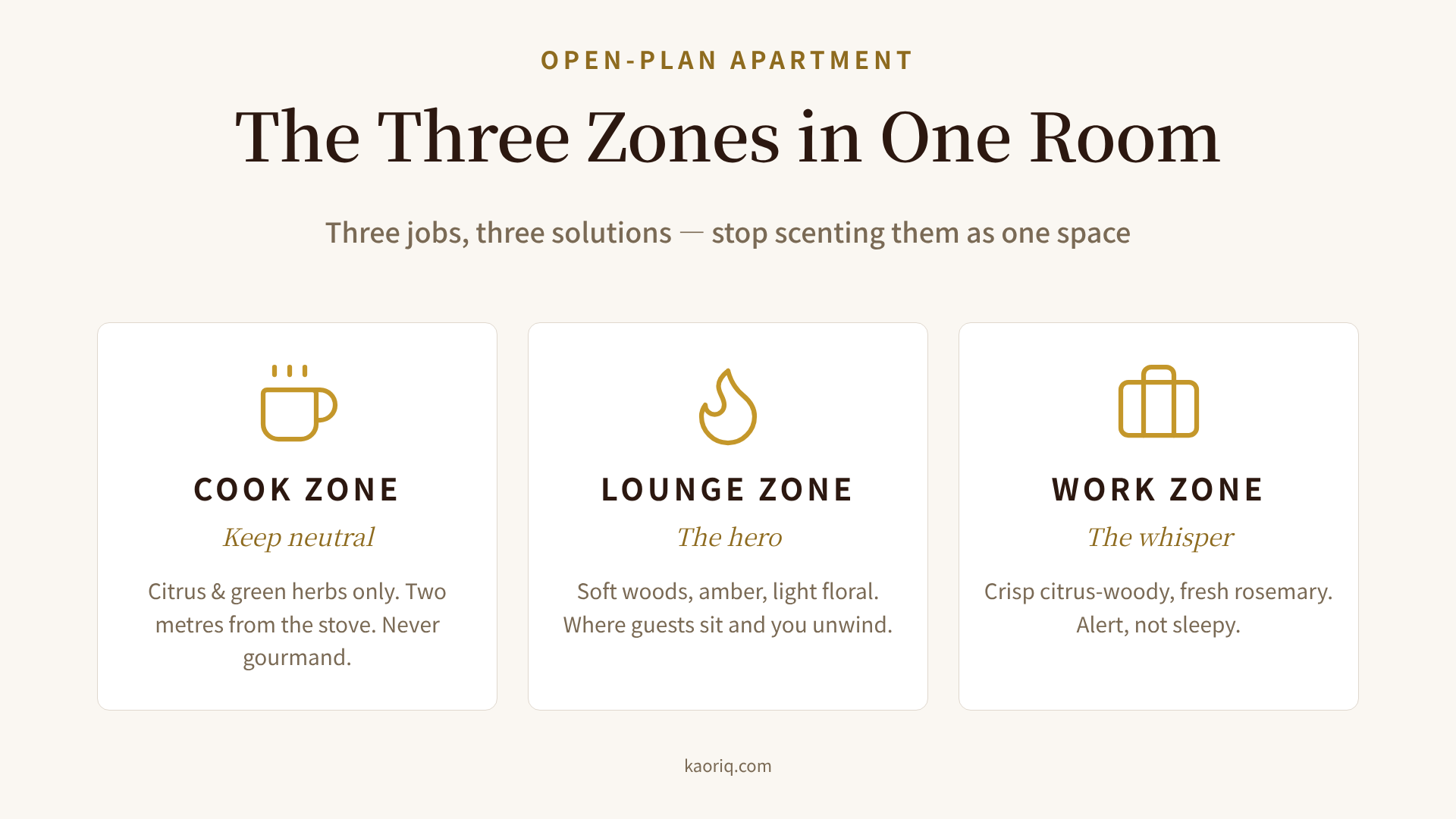
Zone A — The Cook Zone. Anywhere within about two metres of the stove. Air here is hot, busy, and frequently invaded by food smells. Fragrance behaves differently here: top notes vanish fast, heavy bases get coated in cooking oil aerosol (yes, really).
Zone B — The Lounge Zone. The sofa, the rug, the coffee table. This is where you actually want to feel the fragrance. It’s where guests sit. It’s where you decompress at the end of the day.
Zone C — The Work / Transition Zone. Desk, dining table, the hallway-that-isn’t-really-a-hallway. You’re alert here, you’re moving, you’re often in front of a screen.
Each zone has a different job for fragrance. Trying to make one product do all three is the most common mistake I see — and the most expensive one, because you keep buying bigger versions of the wrong solution.
Which Fragrance Families Survive Each Zone
Not every scent family can hold its ground in an open plan. Here’s the honest matrix.
| Zone | Works well | Don’t bother |
|---|---|---|
| Cook Zone (A) | Citrus (bergamot, yuzu, grapefruit), green herbs (basil, rosemary), light eucalyptus | Heavy floral (tuberose, jasmine), sweet gourmand (vanilla, caramel), dense oud |
| Lounge Zone (B) | Soft woods (sandalwood, cedar), warm amber, soft floral (neroli, light rose), tea notes | Sharp peppermint, sterile aquatic, anything industrial-citrus |
| Work / Transition (C) | Crisp citrus-woody (bergamot + vetiver), light rosemary, fresh fig leaf | Heavy resin, deep oud, sweet vanilla (sleepy at the desk) |
The reason citrus and green herbs survive near the kitchen isn’t strength — it’s compatibility. They sit in the same olfactory neighbourhood as the lemon you squeezed over the fish, the parsley you chopped, the steam off the rice. They blend instead of fight.
Tuberose, on the other hand, is a soprano. Soprani do not negotiate with garlic.
One Product vs. Zone Split: The Honest Comparison
Now the real choice. Do you scent the whole apartment with one strong product, or split it across zones?
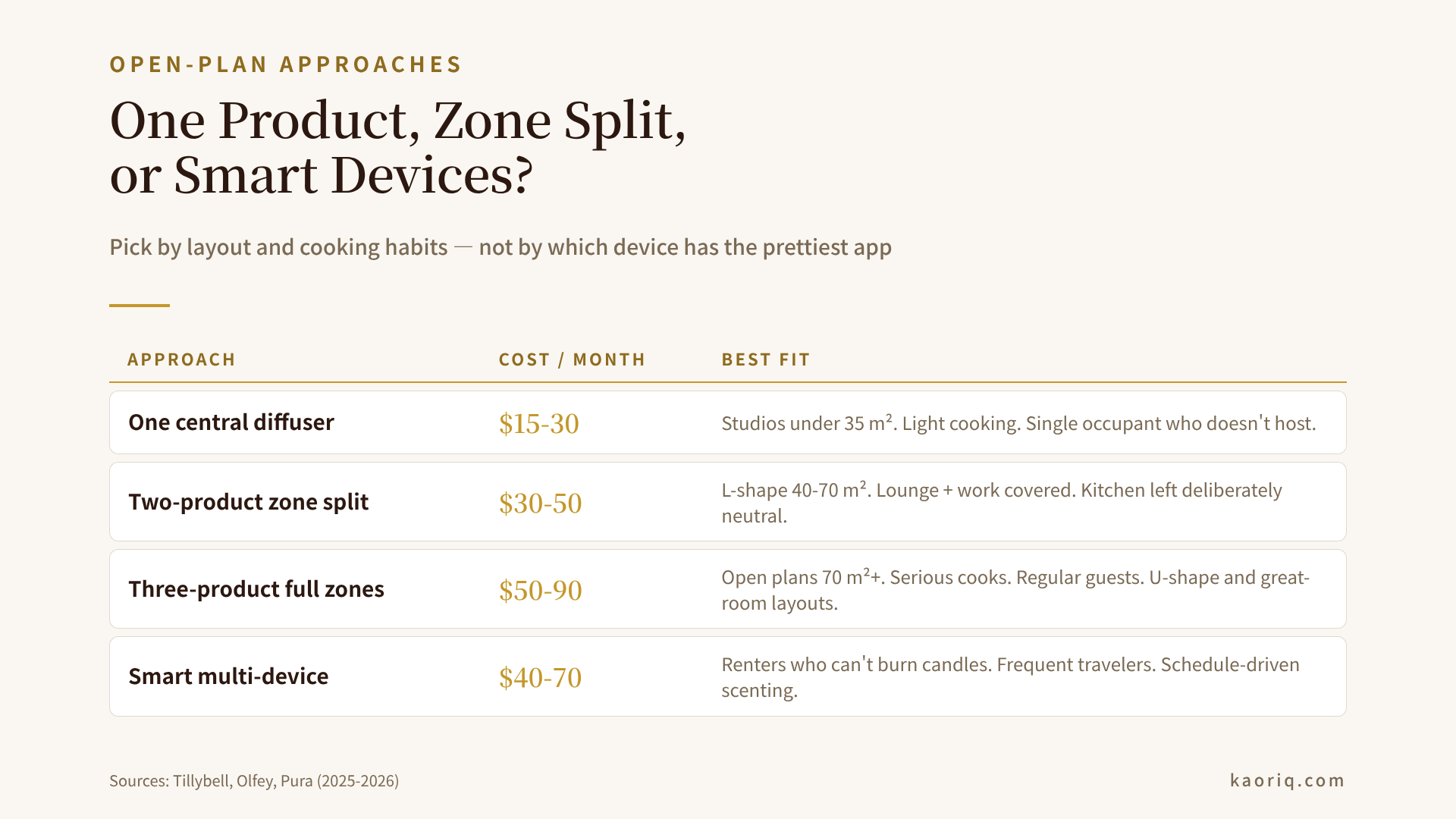
| Approach | Cost / month | When it works | When it fails |
|---|---|---|---|
| One large diffuser, centrally placed | $15-30 | Studios under 35 m², minimal cooking, single occupant | Open plans over 40 m², serious cooking, anyone with food allergies (smell is information) |
| Two products, zone-split (B + C) | $30-50 | Most one-bedroom open plans (40-70 m²). Lounge + work covered, kitchen left neutral | If you cook heavily; the kitchen smell will still drift |
| Three products, full zones (A + B + C) | $50-90 | Larger flats (70 m²+), serious cooks, anyone with guests over regularly | Studios where the products end up two metres apart and the scents collide |
| Smart multi-device (Pura Plus, Aera, etc.) | $40-70 + device cost | Renters who can’t burn candles, anyone who travels (scheduling matters) | Heavy upfront cost; subscription fatigue is real |
The pattern that works most reliably is the two-product zone split. One reed diffuser in the Lounge Zone, one small candle or sachet in the Work Zone, and the Cook Zone kept deliberately neutral. You don’t need a kitchen-specific scent. You need the kitchen to not fight with the others.
If your kitchen is the loudest room when no one is cooking, fix the kitchen with ventilation, not perfume.
Match Your Layout to an Approach
Here’s the shortest version of this whole guide. Find your layout, follow the rule.
Studio / one-room open plan (under 35 m²). One reed diffuser, placed as far from the stove as you can manage, ideally near where you sit. Don’t try to subdivide. The air is too mixed.
L-shape open plan (35-60 m²). This is the most common modern layout: kitchen along one wall, lounge in the L. Use a reed diffuser at the end of the L (furthest from the kitchen). Add a small candle on the coffee table for evenings. Two products, two zones, kitchen left clean.
U-shape or “great room” (60 m²+). Three products. Light citrus or eucalyptus diffuser between the kitchen and lounge as a buffer, soft-wood reed diffuser in the lounge proper, and something crisp at the desk. Treat it like three small rooms that happen to share a ceiling.
Loft with high ceilings. This is the cruelest layout for fragrance, because vertical air volume is enormous and scent rises and disappears. Smart microdroplet diffusers (Aera-style) and multiple medium reed diffusers work better than one big candle. Stop thinking floor area and start thinking cubic metres.
Placement Physics, in Plain English
This part costs nothing and probably matters more than which scent you bought.
Find the airflow, then place the product just inside it — not in it. If a fragrance product sits directly in front of an open window, the scent gets pulled outside. If it sits one metre back from that window, the inflow air drags scent across the room. Doorways and hallways do the same thing.
Keep fragrance at least two metres from the stove and extractor. Heat alters how oils evaporate, and the extractor pulls your fragrance straight up the duct. You paid for that scent. Don’t vent it to the neighbours.
Vertical height matters. Reed diffusers want to sit at seated nose height — a side table, a shelf at roughly 80-100 cm. Putting them on the floor is throwing fragrance into a cul-de-sac.
Furniture is a wall. A large sofa back, a bookcase, or a kitchen island will block fragrance the way a wall would. Use this. The “wall” the sofa makes can be exactly what separates your Lounge Zone from the kitchen air.
The Mistakes That Cost the Most Money
A short list, all of which I have personally paid for:
- Buying a single huge candle to “fill” the whole space. Open plans don’t fill — they dilute. A 600 g candle in a 65 m² space is still one candle, and it’s still being eaten by the stir-fry.
- Placing the diffuser on the kitchen island. The single most popular wrong place. It looks beautiful in real-estate photos and it scents nothing but the courgettes.
- Picking a sweet gourmand for the lounge. Vanilla and caramel notes drift into the kitchen and read as food. Suddenly your living room smells of dessert at 11 a.m. and you have no idea why you’re hungry.
- Running an aggressive scent during dinner parties. Strong fragrance plus food smells equals nobody can taste anything. Turn the lounge diffuser to its lowest setting (or move it temporarily) before guests arrive.
- Refusing to ventilate. No fragrance system can out-perfume a closed apartment that’s been cooking for an hour. Open a window for ten minutes before you scent. The fragrance lands on clean air, not on dinner.
If You Only Remember One Thing
An open-plan apartment is not a single room. Stop trying to scent it with a single product. Pick your Lounge Zone as the hero, leave the kitchen neutral, and let the Work Zone whisper in a complementary key.
Two thoughtful products in the right places will outperform one expensive product in the wrong place every single time. And neither of them will be murdered by a stir-fry.
If you’d like a head start on which scent family fits your lounge — as opposed to a generic “warm and woody” guess — our personality-based fragrance guide walks through how temperament maps to scent preferences. Pair that with the zone diagnostic above and you’ve got a plan, not a shopping list.
Sources and further reading:
Was this article helpful?