How to Choose a Living Room Fragrance: The One Space Every Visitor Smells First
When “Your Apartment Smells Like a Hotel Lobby” Is Not a Compliment
Two months is a normal amount of time to spend picking a living room candle. Reviews get read. A shortlist gets made. Three small versions get bought before committing to the full size of a $72 amber-and-tuberose situation, lit with great ceremony every evening at six.
Then a guest sits down on the sofa and says, “Oh, this smells very… hotel lobby in here.”
They mean: generic, performing, slightly trying too hard. They mean: nobody can relax in this room. The candle, beautiful as it is, is doing the wrong job. It is scenting a lobby. The room needs it to scent a living room.
That’s the thing nobody quite says out loud. Your living room is the most demanding room in your house to fragrance. The bedroom has a clear function (sleep). The kitchen wants neutral. The bathroom wants fresh. The entryway wants a four-second impression. The living room? It has to please you for six hours at a stretch, survive a conversation, welcome a stranger, host your children, soothe you at 11 PM, and still not be the loudest thing in the room.
It’s the main stage. And most fragrance advice is written for closets.
Why the Living Room Is the Hardest Room to Scent
Three things make the living room uniquely difficult, and none of them get talked about in product copy.
1. You are in it the longest. The average household spends five to seven hours a day in the living room, more than any other room except the bedroom (and you’re unconscious for most of that one). That long exposure is murder on the wrong fragrance. A scent that’s lovely at minute three becomes oppressive at hour four, and you don’t even notice yourself getting irritable until you realise you’ve moved to the kitchen to “read.”
2. The room has to host strangers and your inner life. Your living room is where guests sit down for the first time. It’s also where you cry at a documentary on Tuesday. The fragrance has to read as “welcoming” to a stranger and not get in the way of you being a person alone. Most “signature” scents are too assertive for that double job.
3. The household votes. Bedrooms can be personal. Bathrooms can be personal. The living room belongs to everyone who lives there, and quite often to one person who hates patchouli. A successful living room scent is a compromise candidate, not a coronation.
If your living room fragrance is failing, the issue is almost never “the scent isn’t nice enough.” It’s that you picked a scent designed for a different job and asked it to live on stage.
The Three Constraints That Should Drive Every Living Room Choice
Before talking about scent families, talk about constraints. These three are the ones that quietly decide whether a fragrance survives in a living room or quietly gets replaced in six weeks.
Constraint 1: It has to hold up for five-plus hours without becoming a headache.
Long exposure is the enemy of intensity. Heavy oud, dense tuberose, sweet caramel gourmand: all gorgeous in a thirty-minute meeting with a candle in a shop, all exhausting by hour four. The right living room scent leans quiet and layered, the kind that you stop consciously noticing but still benefit from. Think of it as room lighting: you want a warm lamp, not a stadium spotlight.
Constraint 2: It has to disappear during conversation.
When two people are talking, fragrance should sit underneath the conversation, not interrupt it. The instant someone says “oh wow, what’s that smell?”, your scent has crossed a line. You wanted ambience, you got attention. Look for fragrances that fade into the room rather than reach across it. Soft woods, light florals, creamy musks all do this well. Anything described as “bold,” “statement,” or “addictive” almost certainly doesn’t.
Constraint 3: It has to be the household’s least-objectionable favourite.
If you live with anyone, the living room scent has to clear a low bar with everyone, not a high bar with you. The most divisive scent families in living rooms tend to be: heavy florals (jasmine, tuberose), strong gourmands (vanilla, caramel), incense-heavy resins (frankincense, myrrh), and any oud. The safest harmonisers tend to be light woody, soft floral, and warm-but-clean amber. Boring? On paper. In a household? Diplomatic.
If a candidate scent fails any one of these three, it’s not a living room scent. It’s a bedroom scent, a bathroom scent, or a scent that belongs in a shop.
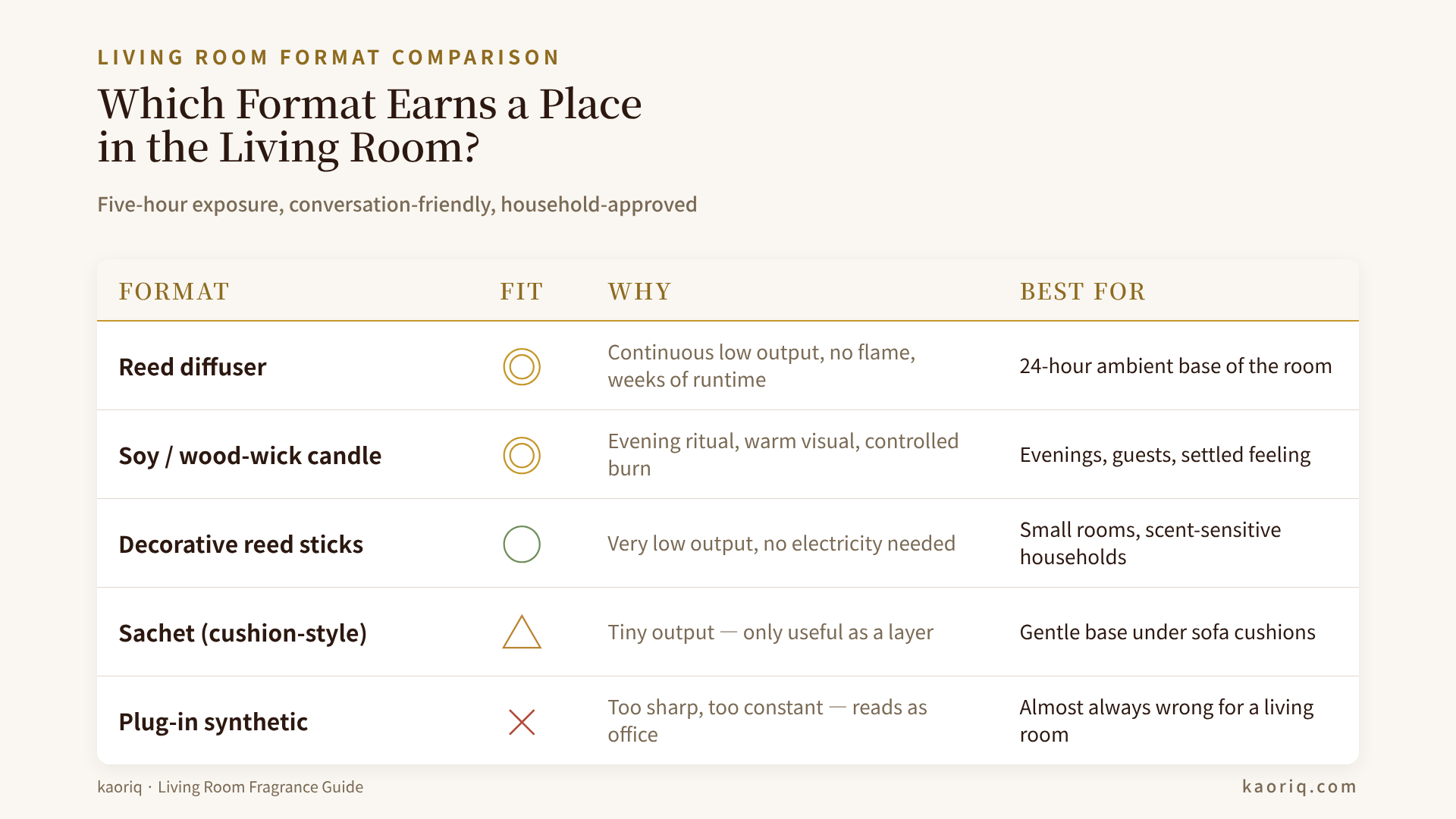
Format Comparison: What Actually Earns a Place in the Living Room
The other half of the question is format, not scent. The wrong format in a living room is the most common waste of money I see.
| Format | Living room fit | Why | Best for |
|---|---|---|---|
| Reed diffuser | ◎ | Continuous low-output, no flame, runs for weeks. The most “set and forget” option. | The 24-hour ambient base of the room |
| Soy / wood-wick candle | ◎ | Evening ritual, warm visual, controlled burn window. Stops working when you blow it out. | Evenings, guests, “settled” feeling |
| Reed sticks (decorative) | ○ | Very low output, low maintenance, no electricity. | Small living rooms, renters, anyone scent-sensitive |
| Electric / ultrasonic diffuser | ○ | Programmable, strong on demand, modern look. Can over-scent quickly. | People who travel, smart-home households |
| Sachet (drawer-style) | △ | Tiny output. Useful as a layer, not as the only scent. | Tucked under sofa cushions for a gentle base note |
| Incense stick | △ | Strong, single-burn moment. Powerful but committed. | Sunday morning rituals, not nightly use |
| Plug-in air freshener (synthetic) | × | Too sharp, too constant, reads as “office.” | Avoid; almost always wrong for a living room |
The pattern I see in successful living rooms is two formats layered: a reed diffuser as the always-on ambient base, plus a candle for evenings. The diffuser carries the room while you’re working from the kitchen table at 2 PM; the candle takes over when you sit down with a book at 8 PM. They don’t fight if you pick them in the same family: soft woods + soft amber, or light floral + creamy musk.
One product can also do the job, but it has to be the right product. A single high-quality reed diffuser, placed not on the coffee table, is enough for a smaller living room. A single candle, even an expensive one, is almost never enough on its own. The moment you blow it out, the room is unscented again, and you’ve just paid $70 for two hours of evening.
Morning Scent vs Evening Scent: The Cheapest Upgrade You’re Not Making
Most people pick one living room scent and run it from sunrise to bedtime. That’s a single outfit for a fifteen-hour shift.
Living rooms naturally split into two scent moods.
Morning to mid-afternoon (light and a little green). Sunlight, coffee, maybe a window open. The right fragrance here is on the light-woody or soft-floral side: white cedar, cashmere wood, peony, freesia, white tea. Quiet, alert, slightly fresh. Anything with a hint of warmth but nothing approaching “dessert.”
Evening through night (warmer and a little sweeter). Lamps on, blinds drawn, conversation. The room can carry more weight now: soft amber, sandalwood, a creamy musk, the gentlest end of vanilla. Heavier than morning, but still on the quiet side of warm. The trap to avoid is going full gourmand at night, because by 11 PM the room starts to smell like a dessert that nobody ordered.
The mechanism is simple: leave the reed diffuser running for the daytime base, and light the candle (or activate a stronger diffuser) in the evening. The room gets a second wardrobe for the price of one extra product. This is the single highest-impact change most people can make to their living room scent without buying anything they wouldn’t have bought anyway.
Four Types of Living Room: Find Yours, Then Buy
The last and most useful question is: how do you actually use your living room? Most fragrance recommendations skip this and jump straight to scent families. That’s why so many living room scents end up wrong: they were chosen for a fantasy living room rather than the one you have.
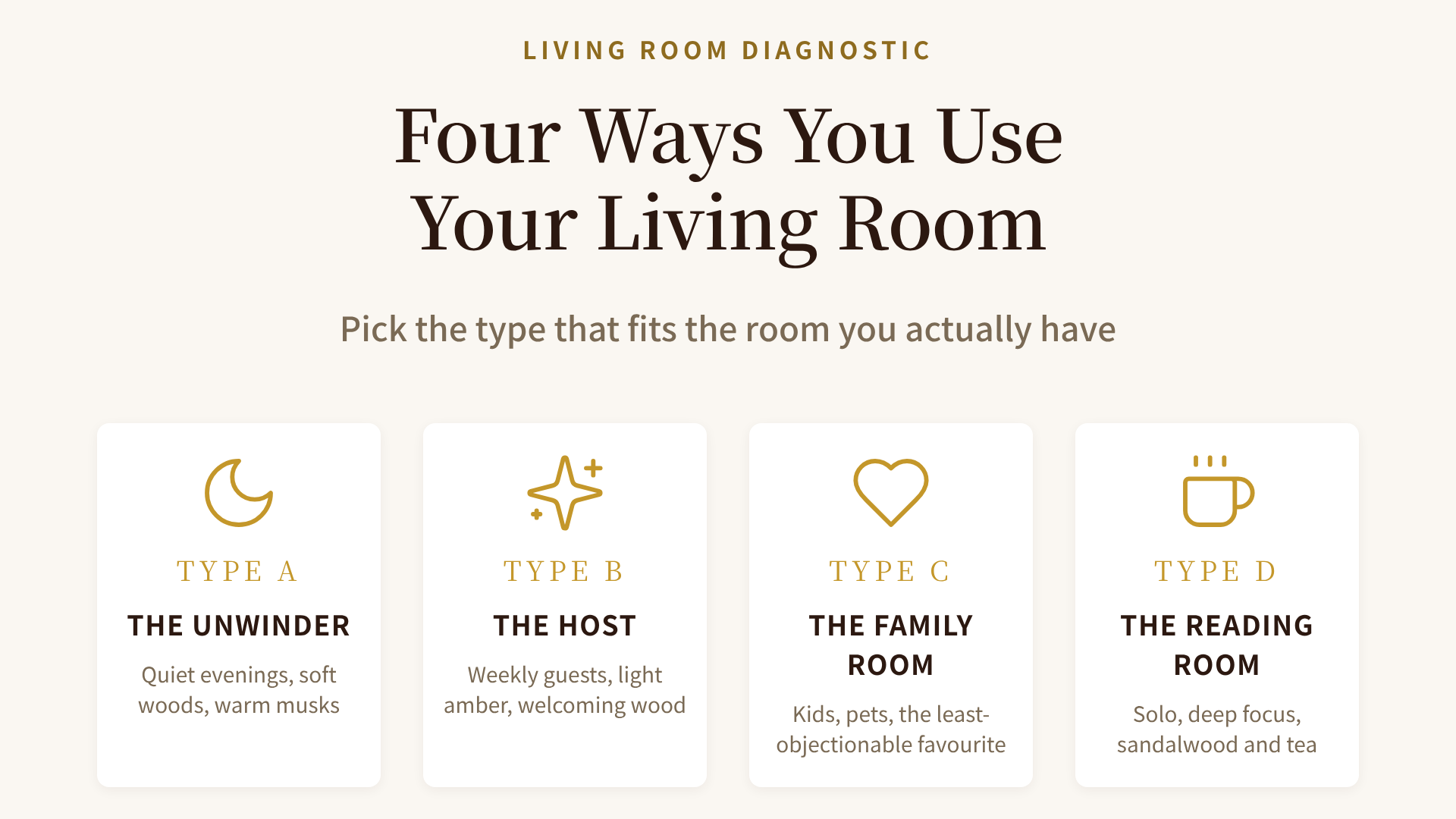
Type A: The Unwinder
Your living room is where you decompress after work. The TV is on more often than not. You’re often alone or with one other person. Guests are occasional. You want the room to feel like a quiet exhale.
Lean toward: soft sandalwood, warm cashmere wood, gentle amber, creamy white musk. Avoid sharp citrus tops, which cue alertness when you want the opposite.
Format suggestion: one reed diffuser running continuously, one wood-wick candle for evenings. Pick scents in the same warm-wood family so they blend.
Type B: The Host
Your living room is a stage for guests. You have people over weekly, or your home is the family default at holidays. The room rarely sits empty. You want it to feel welcoming and intentional the moment someone walks in.
Lean toward: light woody-amber, soft fig leaf, a hint of leather, white tea, gentle bergamot warmed by sandalwood. Avoid anything that screams “I just lit a candle six minutes before you arrived” (sweet vanilla, heavy cinnamon, which read as panicked).
Format suggestion: a more assertive reed diffuser for the always-on base, plus a candle you light thirty to ninety minutes before guests so the warm wax pool is doing the heavy lifting, not the flame.
Type C: The Family Room
The living room is everyone’s room. Kids are in it. Pets are in it. Toys are in it. A different person uses it differently every two hours. You want a scent that doesn’t impose, that no one notices and no one objects to.
Lean toward: very gentle florals (light peony, freesia), soft cottony musks, low-intensity citrus-and-wood blends. Avoid anything heavy, anything sweet enough to attract food associations, and anything pet-irritating (essential-oil-heavy blends can be problematic with cats; check the ingredient list).
Format suggestion: a single low-output reed diffuser, placed out of reach. Skip candles unless you’re alone in the room. The fragrance equivalent of a “default neutral.”
Type D: The Reading Room
Your living room is also your quiet hour: a book, a podcast, a long afternoon with the cat. Guests are rare. You’re often the only nose in the room. You want the scent to deepen concentration, not announce itself.
Lean toward: quiet woods (sandalwood, light cedar, hinoki), a hint of vetiver, soft tea notes, very subtle amber. Avoid sweet gourmands, which cue snack-time, and avoid anything sharp that pulls attention away from the page.
Format suggestion: small reed diffuser at seated nose height (a side table or low shelf, not the floor). A candle is optional and best lit for the last hour of evening reading rather than the whole afternoon.
Placement: The Free Upgrade Nobody Talks About
Where you put the product matters more than which product you picked. This part costs nothing.
Seated nose height beats coffee table. Reed diffusers want to sit at about 80-100 cm: a side table, a low shelf, a console behind the sofa. The coffee table is too low (you’re throwing fragrance toward the floor) and too central (the room becomes “the candle room”).
Off-axis from the TV. Don’t put a scent product directly in front of or behind the television. Heat from electronics changes how oils evaporate, and the visual centring makes the candle look like the main event rather than the background.
Use furniture as a wall. A sofa back, a bookcase, a console: these all block and redirect airflow. Placing a diffuser behind the sofa often works better than in front, because the fragrance has to wrap around to reach you, which slows it down and smooths the experience.
Two metres from heat sources. Radiators, fireplaces, sunny windows all accelerate evaporation in ways the product wasn’t designed for. You want the diffuser to release at the rate the perfumer intended, not at double speed because it’s roasting next to a radiator.
The Mistakes That Quietly Ruin Living Room Scent
A short list, all of which I have personally paid for at retail:
- Picking a “statement” candle for a five-hour room. The bolder the candle, the faster you tire of it. Living rooms reward quiet.
- One candle, nothing else. The moment it’s blown out, the room is unscented. Pair candles with a diffuser, always.
- Sweet gourmands in the room next to the kitchen. Vanilla and caramel drift toward the kitchen and read as “dessert,” which makes everyone weirdly hungry and slightly confused.
- Running the same scent from morning to night. You’re asking one perfume to do two completely different jobs. Split into a light daytime base and a warmer evening layer.
- Putting the diffuser on the coffee table. It looks beautiful in interior photos. It scents your knees.
If You Only Remember One Thing
Your living room is the main stage of your home, and the fragrance has to be the lighting, not the performance. Two quiet, well-placed products in the same family will outperform one expensive statement candle every single time. Pick for the way you actually use the room, not the magazine version of it, and the room starts to feel like yours instead of a showroom.
The hotel lobby compliment is what you get when the scent is technically beautiful but emotionally generic. Aim lower in intensity and higher in fit, and you’ll get a different sentence from the next person who sits on your sofa.
If you want a head start on which scent family fits your temperament, as opposed to a generic “warm and woody” guess, our personality-based fragrance guide walks through how everyday traits map to scent preferences. Pair that with the four-type diagnostic above and you’ve got something better than a shopping list: a brief for the room you actually live in.
Sources and further reading:
Was this article helpful?