How to Make Your Home Smell Like a Luxury Hotel: Choosing a Signature Scent by the Feeling You Want at the Door (2026 Guide)
Recreating a Hotel Smell and Getting a Gift Shop Instead
You know the moment. The lobby doors part, and before you’ve even reached the desk, the air does something. Clean, warm, quietly expensive. You stand there thinking: I want my house to feel like this.
So most people do the same thing. They come home and buy things. A vanilla candle. A “fresh linen” plug-in. A reed diffuser in a scent called something like “Amber Noir.” All three get deployed in roughly the same square metre of hallway, the candle gets lit for good measure, and everyone waits to feel like they’ve checked in somewhere with a concierge.
It doesn’t work. The hallway smells like a gift shop having an argument with itself. Three good scents, all shouting, none of them in charge. Hotels aren’t doing more than this. They’re doing dramatically less, and they’re doing it on purpose. This guide is how to skip the gift-shop phase.
Why Hotels Actually Smell Like That (It’s Two Boring Things)
The luxury-hotel smell isn’t a secret blend you can’t buy. It comes down to two unglamorous decisions, and you can copy both at home.
One. They pick a single signature and commit. A good hotel doesn’t run a vanilla candle in the lobby, a citrus spray in the lift and a floral in the rooms. It chooses one scent identity and repeats it everywhere. Westin has run the same white-tea signature since 1999. That consistency is the whole trick. Your brain reads “one clear smell, everywhere” as deliberate and high-end, and “five smells fighting” as a gift shop. (Any hallway running three competing plug-ins will confirm it.)
Two. They spread it evenly, not strongly. Hotels use what’s called cold-air diffusion, a quiet machine that breaks fragrance oil into a dry, fine mist and lets it drift through a space without heat, water or smoke. The point isn’t power. It’s evenness: the scent is the same gentle level by the door, at the desk and down the corridor. No hot zone, no dead zone.
At home you can’t install lobby hardware, and you don’t need to. You copy the thinking: pick one scent family, and place a few low-key sources along the path people actually walk, instead of one overachieving candle in a corner. That’s it. That’s the hotel.
The Three Hotel Scent Families: Pick the One That Matches Your Air
Here’s where most “smell like a hotel” articles stop being useful. They hand you a shopping list. But “hotel smell” isn’t one smell. Luxury hotels actually split into three very different moods, and the right one for you depends on the feeling you want hanging in the air when you open your own front door.
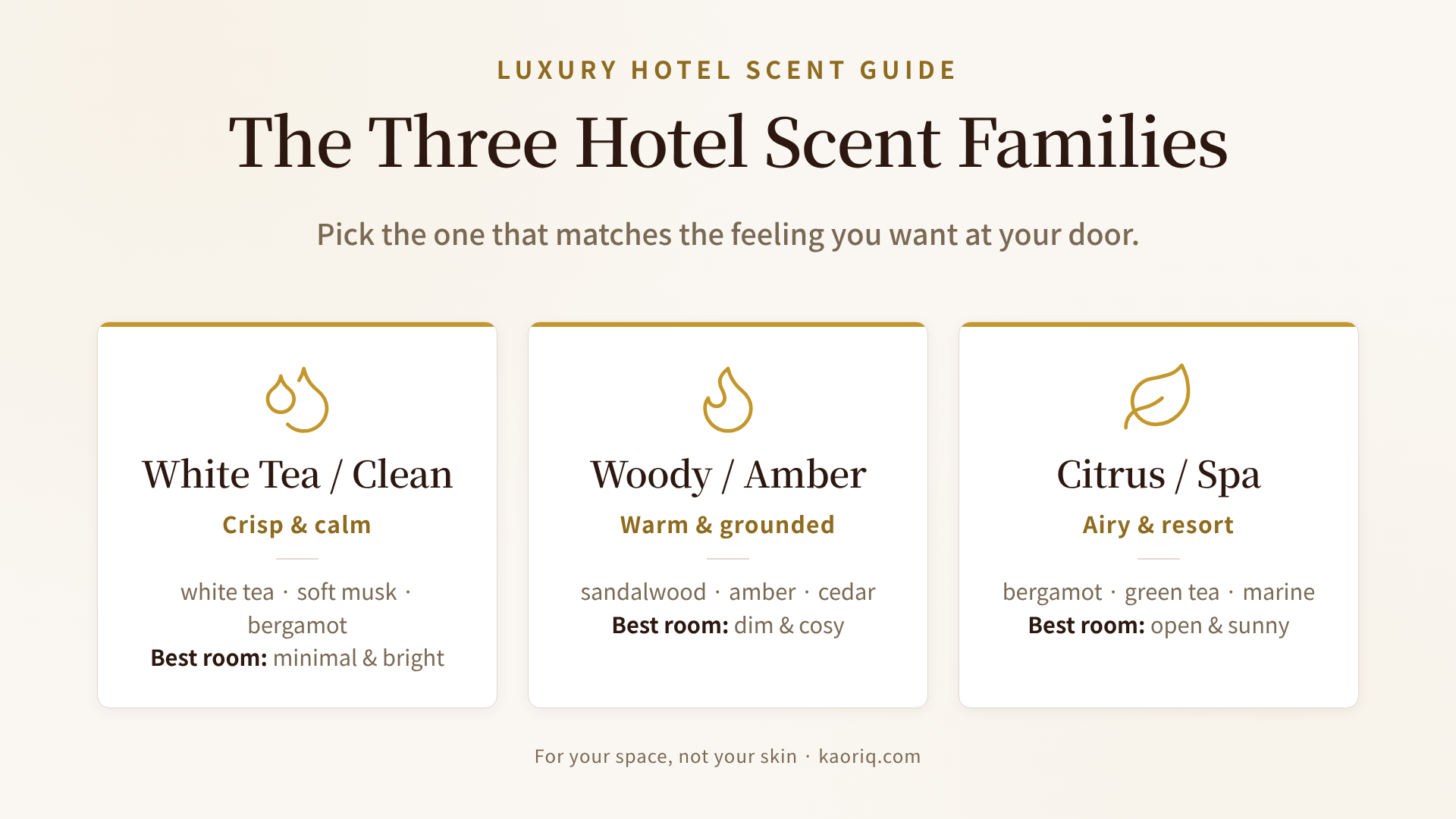
| Family | The feeling at the door | Notes you’ll notice | Best for the room that’s… | Your kind of person |
|---|---|---|---|---|
| White Tea / Clean ◎ | Crisp, calm, freshly-made-bed | white tea, soft musk, a whisper of bergamot | …minimal, bright, tidy | Likes order; finds clutter and loud scent equally exhausting |
| Woody / Amber ◎ | Warm, grounded, grown-up luxury | sandalwood, amber, cedar, a little spice | …dim, cosy, layered | Likes depth and a room that feels like a held breath |
| Citrus / Green / Spa ◎ | Airy, resort, “I just exhaled” | bergamot, green tea, light florals, a marine lift | …open, sunny, breezy | Likes lightness and hates anything that feels heavy or sweet |
A few real reference points so you can place yourself, not so you go buy these exact things: the White Tea / Clean world is Westin territory, that long-running white-tea signature. The Woody / Amber mood is the 1 Hotels register (think sandalwood, amber, a soft floral underneath) and a lot of the deep, lobby-at-night scents. Citrus / Green / Spa is the Four Seasons-ish blend of soft citrus over light wood, the one that makes a place feel like a holiday. (Note: all of this is for your space. Hotel scenting is a room thing, not a skin thing, so keep it that way.)
Read those three rows and one of them probably already felt like you. That instinct is doing real work. It’s the same instinct our why personality matters for fragrance overview is built on. The scent that feels “right” in a room tends to match how you actually like to live in it.
Where to Put It: The Entryway → Living Room → Bathroom Path
Once you’ve picked a family, placement is what separates “smells nice” from “smells like a hotel.” You’re not trying to fill the house. You’re staging three moments along the path a person walks.
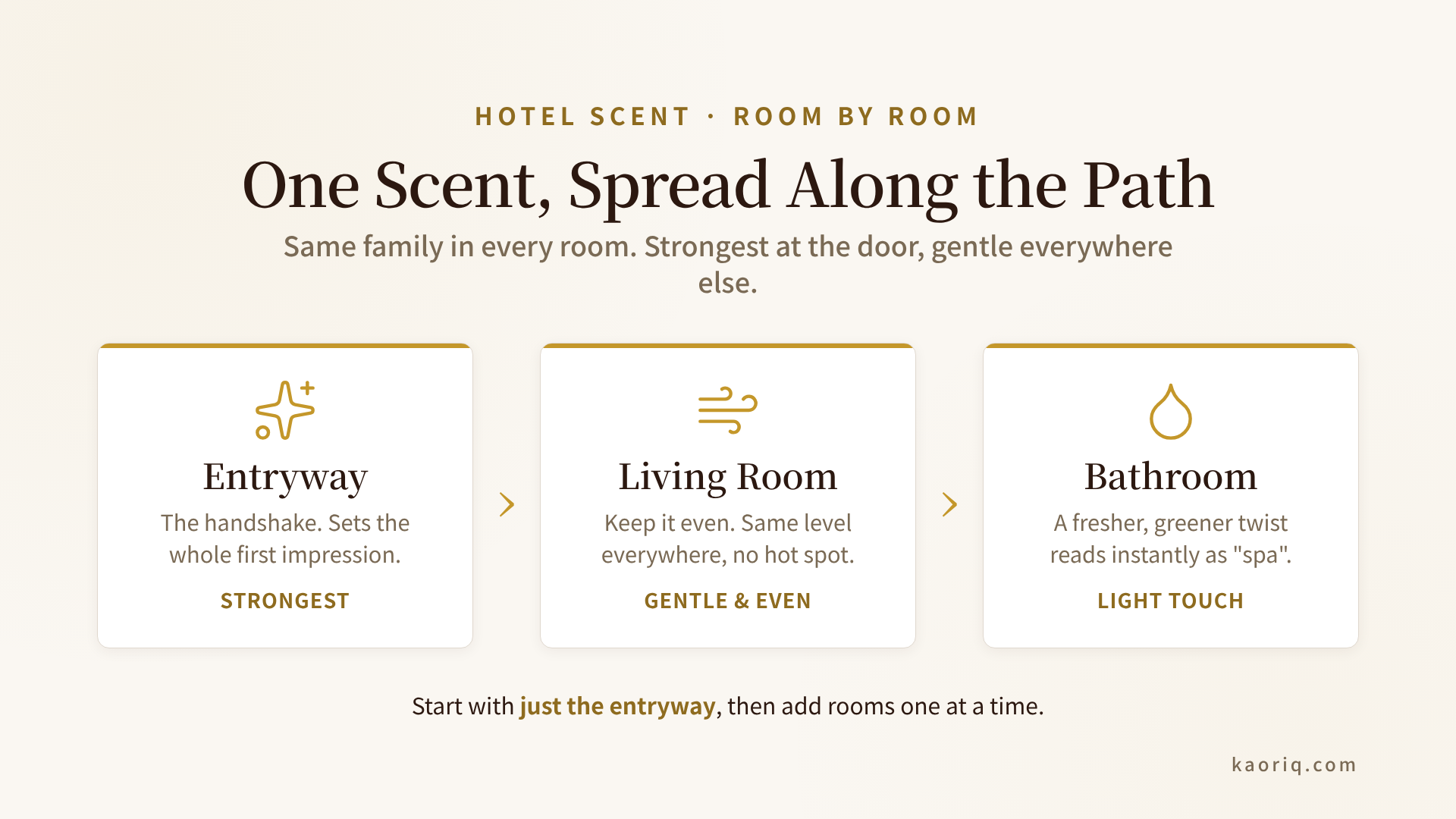
The entryway: the handshake. This is the lobby moment, and it’s the only place a slightly stronger scent earns its keep. One good reed diffuser here, in your chosen family, sets the entire first impression. Get this one right and people think the whole house is scented even when it isn’t. If you only do one thing, do this. (Our entryway welcome-scent guide goes deeper on the front-door moment.)
The living room: keep it even. This is where people linger, so the goal is the same gentle level everywhere, not a hot spot. Place your source away from where everyone sits and along an air path, so it drifts rather than blasts. Same family as the entryway. That repetition is the hotel trick, remember.
The bathroom: the spa upgrade. The one room where you’re allowed a small twist within your family: a slightly fresher, greener version reads instantly as “spa.” Small space, so go gentle, because bathrooms turn any scent up a notch on their own.
What to skip: the kitchen mid-cook (fragrance just loses a wrestling match with garlic) and any room with a fan running, where even spread becomes no spread.
The Budget Version: Start With One Door
You do not buy the whole house at once. Hotels didn’t either. They scaled. Here’s the honest order of operations:
- One reed diffuser at the entryway, in your family. This alone does most of the heavy lifting for the least money.
- Add the living room once you’re sure of the family. Same scent, second source.
- Add a spa note to the bathroom last. It’s the luxury, not the foundation.
Three small, matched sources beat one expensive candle every time, because you’re buying evenness, which is the actual hotel effect, instead of buying volume, which is the gift-shop effect.
So: One Scent, Spread Thin
If you remember nothing else: hotels smell expensive because they edit down to one scent and spread it evenly, not because they spend more. Your move is to pick the family that matches the air you want at your door (clean, woody, or spa), put the strongest source at the entryway, and keep everything else quiet and matching.
And if you’re standing in a shop torn between white tea and warm amber, that’s not really a fragrance question. It’s a you question. The whole point of choosing by personality is that the right room scent is the one that matches how you already like to feel at home. If you want that decided for you instead of guessed, our best room fragrance by personality type guide maps the families to who you are, so you can skip the gift-shop phase entirely. I’m told it’s a phase best skipped.
Was this article helpful?