When You Love the Candle and Your Partner Hates It: A Guide to Home Fragrance for Two
“It Smells Like a Hotel Lobby in Here”
Spend an entire Saturday morning choosing a new diffuser. Bergamot, neroli, a whisper of cedar. Set it up triumphantly. Then your partner walks in, stops at the threshold, and says, with the specific weariness reserved for these conversations, “It smells like a hotel lobby in here.”
That was, technically, what the money bought.
If you live with someone and you are the designated scent person of the household, you already know this story. One of you wants warm and woody. The other one thinks “warm and woody” is a polite way of saying “your grandfather’s wardrobe.” One of you loves anything floral. The other one says florals make their head ache by hour three.
Most home fragrance guides quietly assume you live alone. This one doesn’t. Here’s how to scent a shared home when the two noses involved have different opinions, without anyone having to “compromise” on something neither of you actually likes.
First, the Surprising Part: It’s Not Personal
Before any tactics, this helps to know.
When your partner pulls a face at your favourite candle, they are not being difficult. They are, quite literally, smelling a different thing than you are. Researchers have found that genetic variation in our olfactory receptors (the most-studied being a gene called OR7D4) changes how we perceive certain compounds. The same molecule (androstenone, found in some musks and woods) can smell sweet and pleasant to one person, sweaty and offensive to another, and like absolutely nothing to a third.
Multiply that across the roughly 400 working olfactory receptors in the human nose, and you and your partner are walking around with what amount to slightly different scent dictionaries.
So when you think they’re being picky, and they think you have terrible taste, the kinder truth is: your noses disagree at the hardware level. There’s no winning that argument. There is, however, working around it.
The Three-Zone Strategy
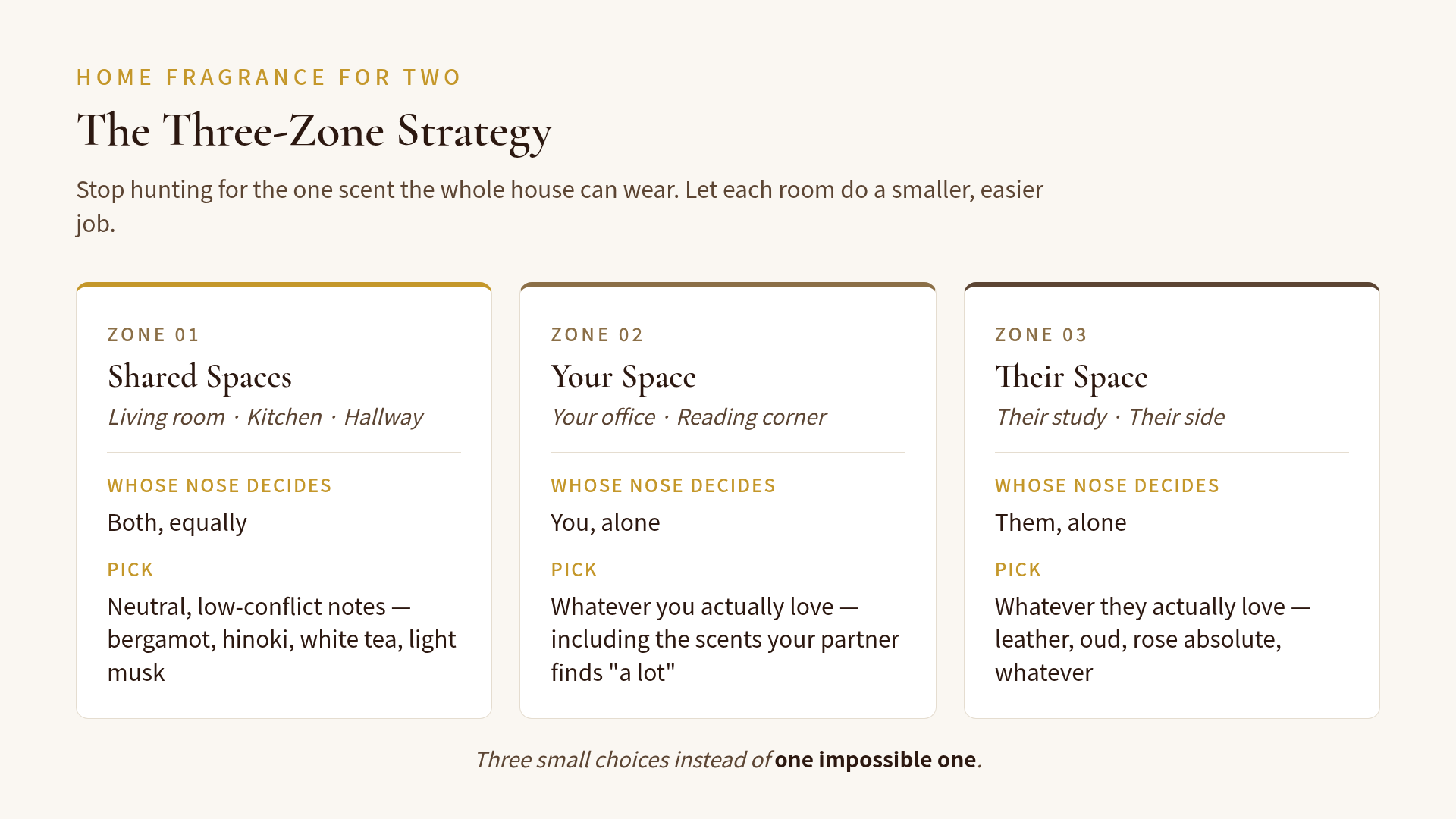
Stop trying to find the One Perfect Scent the whole house can wear. There isn’t one. Instead, divide the home into three zones, and let each zone do a different job.
| Zone | Whose nose decides? | Best fragrance choice |
|---|---|---|
| Shared spaces (living room, kitchen, hallway) | Both of you, equally | A neutral, low-conflict scent family |
| Your personal space (your home office, your reading corner) | You | Whatever you actually love |
| Their personal space (their study, their side of the bedroom) | Them | Whatever they actually love |
The shared zone is the only place where the scent has to please two people at once. Stop subjecting it to your most polarising favourites. Save those for the rooms where you spend time alone.
This sounds obvious written down. In practice, almost no one does it. We pick one candle for the whole house and then act surprised when half the house objects.
What Goes in the Shared Zone: The Neutral Shortlist
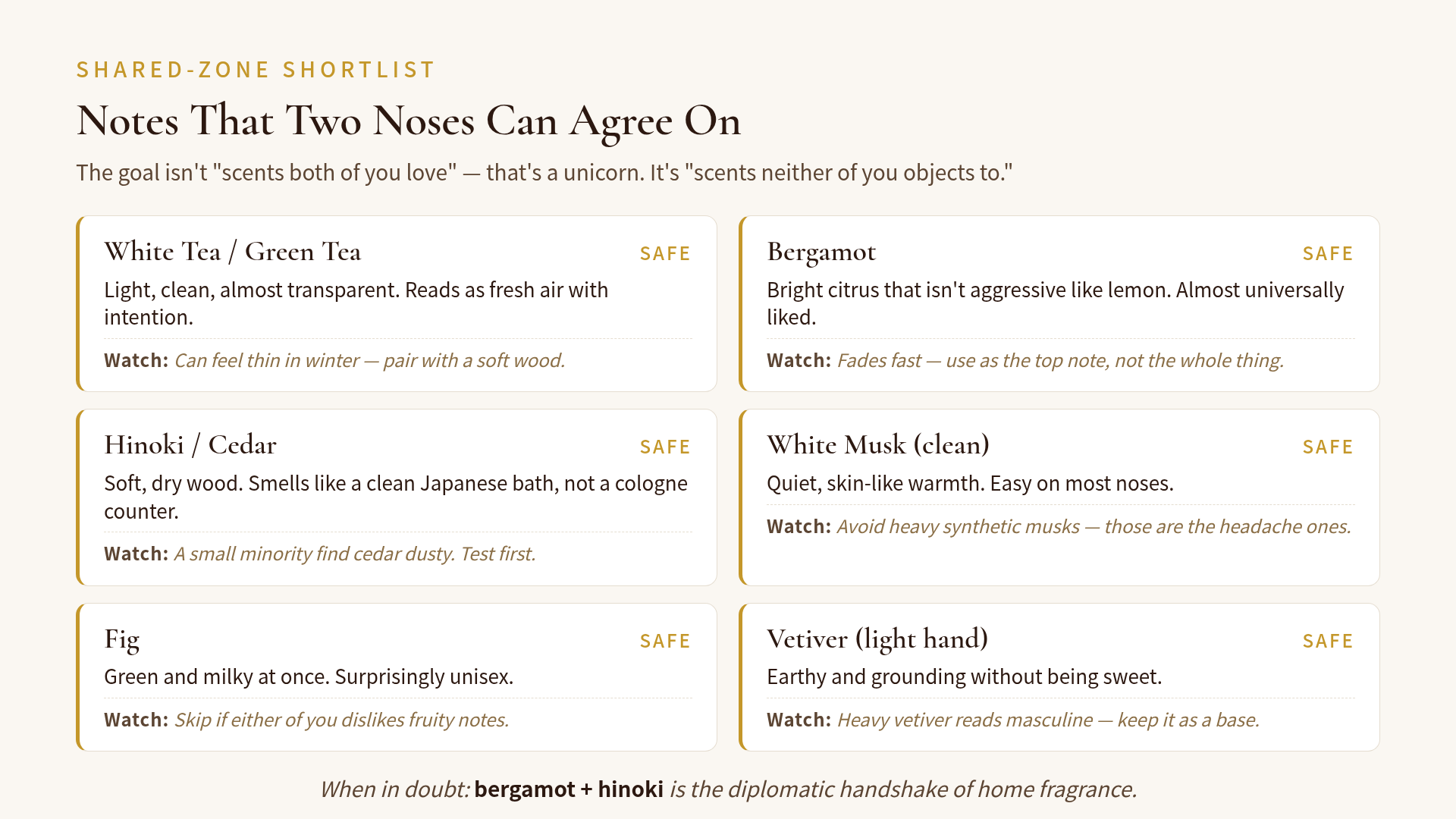
For the shared spaces, you want scents that almost no one actively dislikes. Not “scents both of you love.” That’s a unicorn. “Scents neither of you objects to” is a much more honest goal, and a much more achievable one.
These tend to land safely:
| Note | Why it works for two | Watch out for |
|---|---|---|
| White tea / green tea | Light, clean, almost transparent. Reads as “fresh air with intention.” | Can feel thin in winter; pair with a soft wood. |
| Bergamot | Bright citrus that isn’t aggressive like lemon. Almost universally liked. | Fades fast. Use as the top note, not the whole thing. |
| Hinoki / cedar | Soft, dry wood. Smells like a clean Japanese bath, not a cologne counter. | A small minority find cedar dusty. Test before committing. |
| White musk (clean, not animalic) | Quiet, skin-like warmth. Easy on most noses. | Avoid heavy synthetic musks. Those are the headache ones. |
| Fig | Green and milky at once. Surprisingly unisex. | Skip if either of you dislikes “fruity” notes. |
| Vetiver (light hand) | Earthy and grounding without being sweet. | Heavy vetiver reads as masculine to some, so keep it as a base, not the lead. |
The shortcut: if you can’t agree on anything else, a bergamot-and-hinoki combination is the diplomatic handshake of home fragrance. Light, clean, neither of you will complain.
What to avoid in the shared zone, almost regardless of taste:
- Heavy oud: divides households like nothing else
- Strong synthetic musks: the most common cause of “this gives me a headache” complaints
- Patchouli at full strength: people either love it or want it out of the house
- Strong gourmands (vanilla, caramel, coffee): one of you will eventually find it cloying
These aren’t bad scents. They are simply opinionated scents. Save them for the personal zones.
Then Let the Personal Zones Do the Work
This is the part that quietly fixes the whole problem.
In your room (your office, your reading nook, the corner where you do yoga), put the diffuser or candle that you actually love. The one your partner mildly tolerates. The one that, if you only had this scent in the whole house, you’d be happy.
In their room, return the favour. Their leather-and-tobacco candle, the heavy oud, the rose absolute. Whatever they wanted that you politely talked them out of for the living room, let them have it where they spend their time.
Now neither of you is making a daily compromise. The shared zone is calm and uncontroversial. Your personal zones are exactly what each of you wants. The argument simply stops happening.
Format Matters Too
A couple of practical notes on what to put where:
- Candles are best in the shared zone. They’re event-based, you light them when you’re together, and they fill a room briefly rather than constantly.
- Reed diffusers are best in personal zones. They run all day and slowly stake a claim on a room, which is perfect for your office, less ideal in shared space if your partner has to live with it for ten hours.
- Incense is the most divisive format. If either of you mildly dislikes smoke, keep it out of shared rooms entirely.
- Electric diffusers with a timer are the peace treaty of shared bedrooms. They run for an hour at bedtime and then stop, so the scent doesn’t accumulate overnight.
The One-Line Rule
If you remember nothing else from this guide, remember this: stop trying to find one scent for the whole house, and let each room do a smaller, easier job.
A neutral hello in the shared zone. Your favourite, unchallenged, in your space. Their favourite, unchallenged, in theirs. Three small choices instead of one impossible one.
Your partner will stop sighing in the doorway. You’ll stop apologising for your taste. And the candle that used to smell, allegedly, like a hotel lobby gets to live a happy second life in the room where you do your best work, the room where the only nose passing judgement is yours.
If you want a starting point for the personal zones, our personality-based fragrance match is built precisely for this. It picks scents around how you respond to the world, not how a household averages out. You and your partner can take it separately, get different answers, and each end up with something you actually love.
That, it turns out, is the only real way two noses live in one house.
Was this article helpful?