How to Choose a Home Fragrance for Your Dining Table (Without Fighting the Food)
The Night a Fig Candle Picks a Fight With the Garlic Bread
Picture a small dinner. Four people, garlic bread fresh out of the oven, a roast in the middle of the table, and, because you want to be the kind of host who notices these things, a fig-scented candle in the centerpiece. A nice candle. The kind with a glossy box.
The first guest arrives. The candle gets lit.
By the time everyone sits down, there’s a small but very real argument happening inside your nose. The garlic and the fig have gotten into it, and neither is winning. The roast smells like fig. The bread smells like fig. The wine, somehow, also smells like fig. You spend the meal half-eating and half-trying to identify what you’re tasting. So does everyone else. They’re polite about it.
That candle was not a bad candle. It was the wrong job for that candle.
This is the part nobody tells you about dining fragrance: a scent that works beautifully on a coffee table can sabotage the food when you move it twelve feet to the right. Your dining table isn’t a room. It’s a 30-centimeter zone where your nose, the candle, and the food are all fighting for the same small piece of air.
So here is the guide I wish I’d had before the fig incident. It mostly comes down to four rules and five dinners.
Why the Dining Table Is Its Own Problem
Your living room scent has hours to make an impression. Your bedroom scent has all night. The dining table has minutes, and during those minutes, the candle is competing with the most intense source of smell in the house: the meal.
A few things flip the rules.
Your nose is close to everything. When you’re sitting at a table, your nose is roughly 30 centimeters from your food and probably the same distance from any candle on the surface. There is no buffer. The candle and the food are both foreground, fighting for the same receptors.
Smell is most of taste. Around 80% of what we call “flavor” is actually retronasal smell: aroma traveling up the back of the throat as you chew. The food and the candle are using the same neural pipeline. Add a candle that doesn’t match, and the brain hears two stations at once.
The meal moves; the candle doesn’t. Food smells change every five minutes. The bread cools, the wine breathes, the dessert arrives. The candle has been broadcasting the same note for two hours. By dessert, the candle is the loudest thing on the table, and it’s still saying whatever it said when you sat down.
Charles Spence’s Gastrophysics (2017), a book I’d recommend to anyone who throws dinner parties, spends a fair chunk of pages on this. The summary is that ambient scent and food scent really do interact, and the interaction is mostly bad unless you’ve planned for it.
Most people don’t plan for it. They light whatever candle they like in their living room and hope for the best.
The Four Rules of Dining Fragrance
I’ve boiled my own mistakes into four principles. Almost every dinner candle disaster I’ve seen breaks one of them.
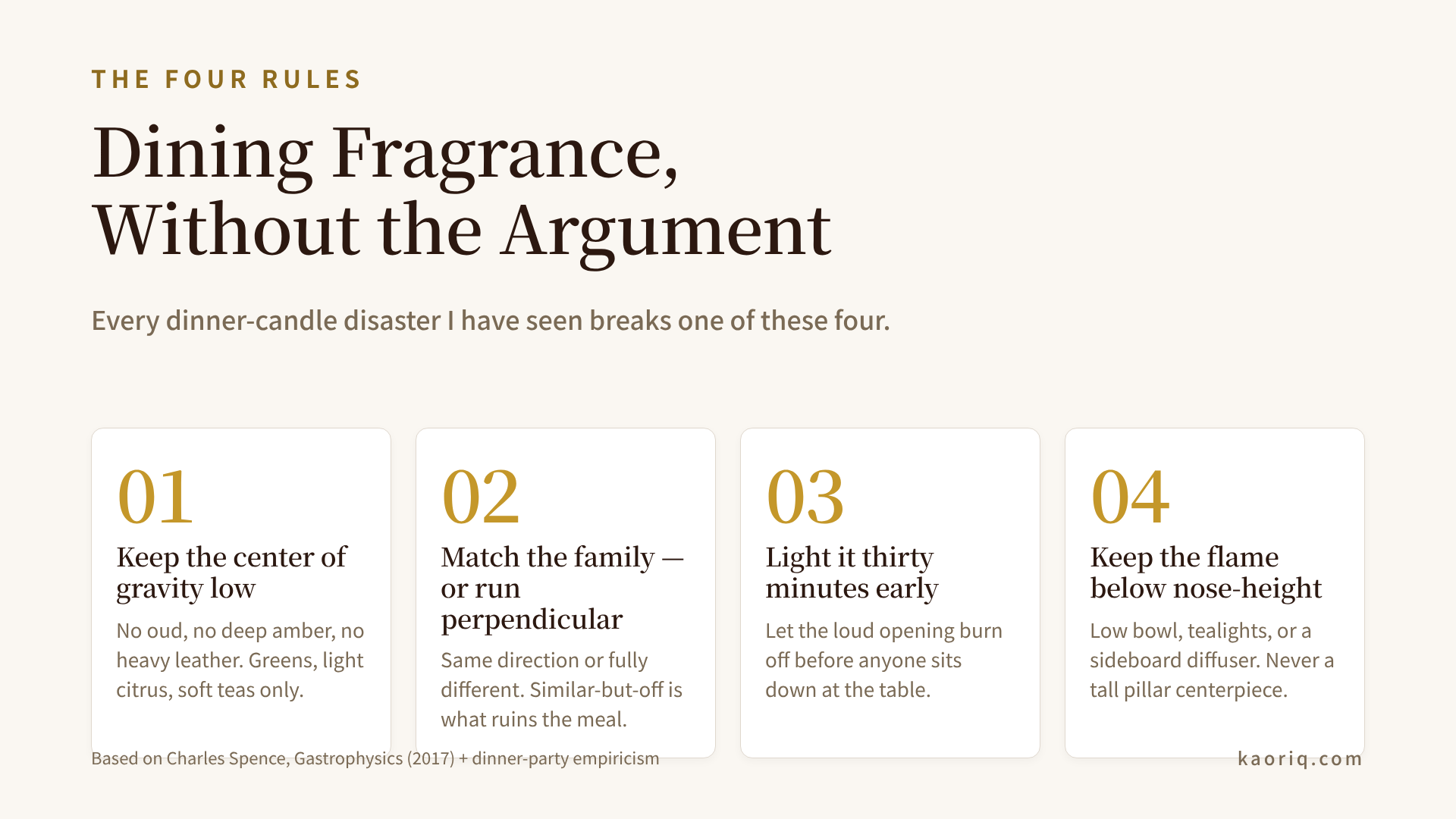
1. Keep the center of gravity low.
Heavy bases like oud, deep amber, leather, or smoky incense will steamroll the food. They’re built to hold a room for three hours; a roast doesn’t stand a chance. For the table, you want fragrances that sit lightly: green herbs, soft citrus, mineral notes, light teas, clean musks. Anything that announces itself first as “warm and serious” is in the wrong seat.
2. Match family, or run perpendicular.
The two safe moves with food are same family (vanilla candle, vanilla dessert; they amplify each other) or perpendicular (an herbal candle next to a meat dish: two different conversations that don’t argue). The disaster is similar but slightly off: a fig candle next to figgy-feeling balsamic vinegar, a tomato-leaf candle next to actual tomato sauce. The mind tries to reconcile them and can’t.
3. Light it 30 minutes before anyone sits down.
A candle’s first thirty minutes are the most aggressive. The wax is reaching a steady state, the throw is climbing, and the top notes are the loudest. By the time guests sit, you want the candle in its mellow middle phase, broadcasting a stable signal that the food can negotiate with. Light it when you start plating the appetizer, not when you call people to the table.
4. Keep the flame below nose-height.
A pillar candle on the dining table is at exactly the wrong altitude. It puts the scent column directly into everyone’s faces. A low bowl candle, a tealight cluster, or a reed diffuser on a sideboard sends the scent up and around instead of straight at the nostrils. The setup that works best is a low ceramic bowl with three tealights, off-center on the table, lit forty minutes before the meal. It does its job and then politely shuts up.
Five Dinners, Five Different Answers
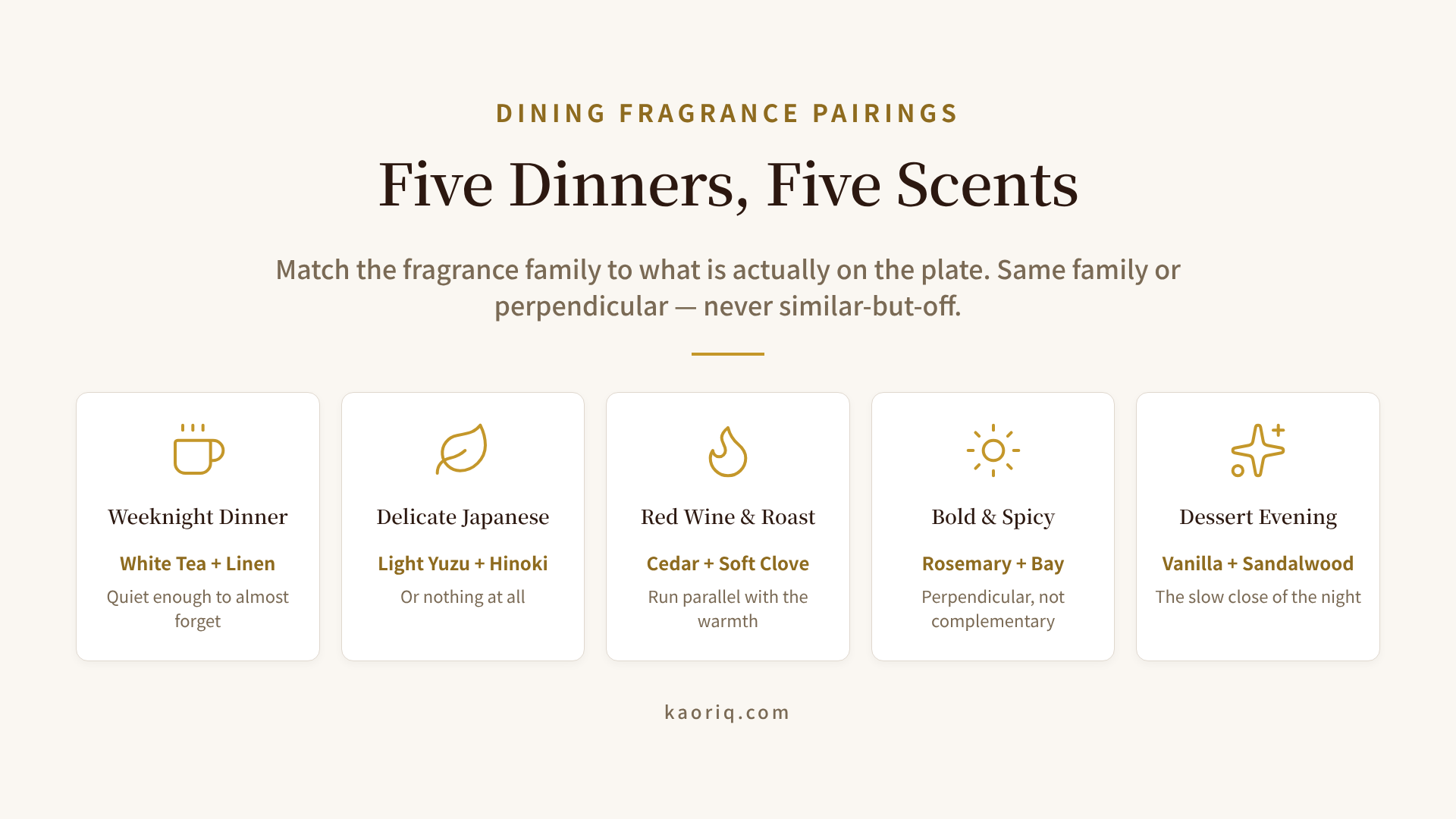
Here’s where most generic advice falls apart, because “a good dining candle” depends entirely on what’s actually on the plate.
1. The Weeknight Dinner (Just You and Whoever’s Home)
Low stakes, low effort, low scent. You’re not impressing anyone, but you also don’t want to eat in an unscented box. The best fragrance here is something so quiet you almost forget it’s on.
Try: White tea + linen. Soft cotton accords. A whisper of bergamot. These read as “clean room” rather than “scented room,” which is exactly what a weeknight wants.
Avoid: Anything you’d describe with a strong adjective. If you can call it “rich” or “smoky” or “decadent,” it’s for a different night.
2. The Subtle Japanese Dinner (Sushi, Dashi, Anything Where the Food Is Delicate)
This is the hardest scenario, because the food itself is the fragrance. Subtle ingredients like a clear broth, raw fish, or a perfectly cooked piece of rice can be wiped out by almost any candle. The honest answer here is often no candle at all, but if you want something:
Try: A barely-there yuzu + shiso direction. Citrus that echoes what’s on the plate, kept extremely light. Or a soft hinoki note, which leans into the cultural register of the meal without competing with it.
Avoid: Everything floral. Anything vanilla-adjacent. Heavy spices. If your fragrance has a top note that survives the first bite, it’s already too loud.
3. The Red Wine and Roast Dinner (Big Reds, Slow-Cooked Meat, Heavy Plates)
Now you can play. A rich meal can hold its own against a richer scent, and you actually want the candle to run parallel with the warmth on the table.
Try: Cedarwood + clove. Soft tobacco. A leather-adjacent note that’s been pulled back to about 40%. These echo the temperature of the meal (warm, slow, dark) without competing with the specific flavors.
Avoid: Citrus, which fights tannic wine. Bright herbs, which read as wrong in this register. Anything that smells like spring when the food smells like autumn.
4. The Garlic and Spice Dinner (Italian, Thai, Indian, Anything With a Strong Identity)
This is the dinner that teaches the lesson. The food has a strong, specific identity, and any candle is going to argue with it. The honest answer:
Try: Probably nothing. If you really want a candle, go perpendicular: soft rosemary, bay leaf, a touch of pine. Herbal notes that share a register with the cooking ingredients without trying to be them. Imagine a candle that smells like a kitchen herb garden during the afternoon, not the kitchen during the dinner.
Avoid: Anything sweet, anything fruity, anything trying to “complement” garlic. There is no candle that complements garlic. Accept this.
5. The Dessert-Only Evening (Coffee, Cake, Late Conversation)
This is where dining candles actually shine. Dessert is itself a high-signal smell, and a well-chosen candle can extend it, the way a good wine pairing extends a meal.
Try: Vanilla + sandalwood. Soft fig (yes, now the fig candle is welcome). Brown sugar accents kept light. The candle becomes the slow ending of the evening, a fragrance that says “stay another twenty minutes.”
Avoid: Anything bright or sharp. This is not the time for citrus or green notes. You’re closing the evening, not opening it.
The Format Question: Candle, Diffuser, or Nothing
Format matters as much as scent for the dining table, because what you light controls how the fragrance moves.
| Format | Dining Table Suitability | Why |
|---|---|---|
| Low bowl candle / tealights | ◎ | Below nose-height, easy to extinguish, low throw. The default answer. |
| Reed diffuser on sideboard | ◎ | Constant, mellow output. Doesn’t compete with food because it’s not on the table. |
| Tall pillar candle on table | △ | Pretty, but its scent column hits everyone in the face. Use unscented if you must. |
| Stick incense | △ | Smoky character clashes with most food. Save for after-dinner only. |
| Single-wick centerpiece candle | ○ | Workable if the wick is low and the throw is gentle. Test before guests arrive. |
| Plug-in or nebulizer diffuser | ✕ | Way too much output for a table-sized event. |
If you take one thing from this section, take this: the safest dining fragrance setup is an unscented candle on the table for atmosphere, plus a scented reed diffuser six feet away on a sideboard. The candle gives you the warmth and the flicker; the diffuser provides the ambient note from outside the food zone. The two never collide.
”But I Just Want Zero Smell”: The Unscented Dinner Candle
There’s a small, sane niche of hosts who want absolutely no fragrance interference with the meal. If that’s you, the answer is straightforward: look for dinner candles or unscented household candles, which are widely available and exist for exactly this purpose. White, off-white, or dark colors are easiest to find in unscented; novelty colors are usually scented.
This is also a courtesy move if you’re hosting someone who’s particularly sensitive to smell: pregnant guests, friends with migraine triggers, someone going through chemo. An unscented candle on the table is one of those quiet hospitality choices that almost nobody notices and almost everybody appreciates.
The Cheat Sheet
Screenshot this part if nothing else:
| Dinner | Fragrance Direction | Format |
|---|---|---|
| Weeknight (you + family) | White tea, linen, soft bergamot | Reed diffuser on sideboard |
| Delicate (sushi, dashi) | Featherlight yuzu, hinoki, or nothing | Unscented candle + light yuzu on sideboard |
| Hearty (red meat, big wine) | Cedar, clove, soft tobacco | Low bowl candle, lit 30 min early |
| Bold (Italian, Thai, Indian) | Probably nothing; if you must, rosemary or bay | Reed diffuser, far from table |
| Dessert evening | Vanilla, sandalwood, soft fig | Tealights or low bowl candle |
What to Know Before the Fig Incident
Two things.
One: a dining table is not a place to add fragrance. It’s a place to give fragrance a polite, well-rehearsed supporting role. The food is the lead actor. Your candle’s job is to make the food taste like a better version of itself, not to perform its own monologue while the meal is happening.
Two: most dinner-party fragrance mistakes happen because the candle that looked beautiful in the shop got tested on a coffee table in an empty room and then deployed into a 30-centimeter combat zone full of garlic and roast. They are different jobs. Test the candle near food before you stake a dinner party on it. Light it on a Sunday afternoon while you’re cooking something normal and see whether the two smells make sense together. If not, that candle belongs in the living room.
If you’re still not sure which direction matches your hosting style, our personality-based scent quiz can help. The kind of person who hosts five-course dinners wants a very different table fragrance than the kind of person who throws together pasta on Tuesday. Or, if you want a deeper read on why fragrance preferences track personality at all, our why personality predicts fragrance preferences piece is the long version of the argument.
The fig candle, by the way, belongs in the living room. The dining table mostly wants one low bowl of unscented tealights and, when you’re being ambitious, a soft cedar reed diffuser on the sideboard. The garlic bread has had no further complaints.
Was this article helpful?