Why Your Bathroom Deserves Its Own Fragrance Strategy (And the Three Constraints That Change Everything)
A Bathroom Reed Diffuser Can Quit in Eleven Days
It bent.
Not gradually, the way reeds eventually do. It bent like a sad daisy after a rainstorm, the reeds drooping toward the sink as if they’d given up. The base oil had turned faintly cloudy. The label, which had promised “fresh linen with hints of bergamot,” now smelled like fresh linen that had been left in a gym bag for a long weekend.
The bathroom is where home fragrance advice quietly admits it has nothing useful to say. Every guide assumes a living room: medium-sized, ambient airflow, no major humidity events. Bathrooms break all of those assumptions at once. They are smaller, wetter, and ventilated more violently than any other room in the house, and the moment you put a scented product in there, three constraints start fighting it.
So here’s a guide built around those constraints, not in spite of them.
The Three Constraints That Make Bathrooms Different
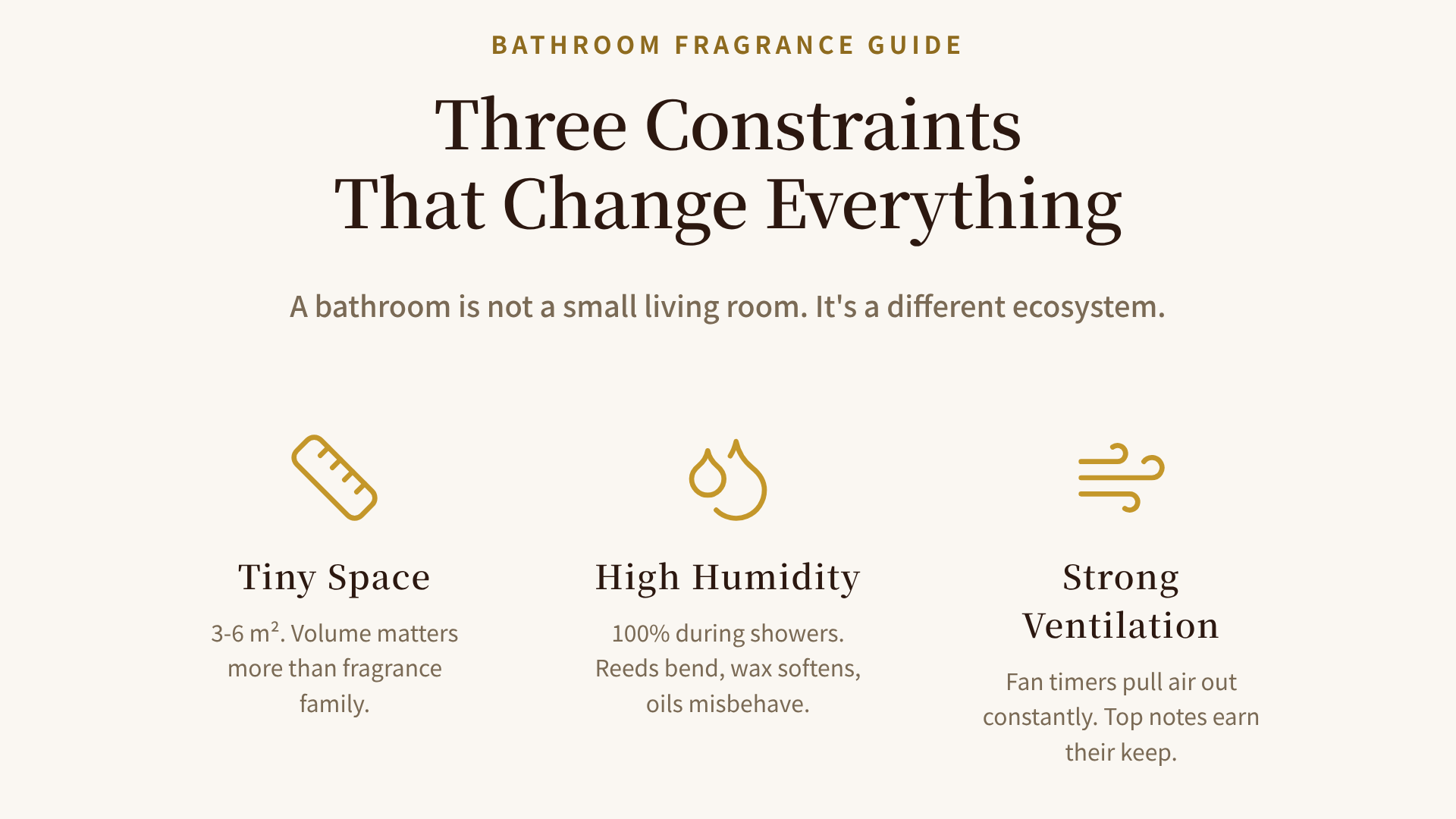
If you remember nothing else from this article, remember that a bathroom is not a small living room. It’s a different ecosystem.
1. The space is tiny. Most bathrooms are 3-6 m² (32-65 sq ft). A diffuser or candle tuned for a 15 m² space will be overwhelming in here, the same way a stadium speaker would be overwhelming in a closet. Volume matters more than fragrance family. A “subtle” scent in a living room is a “loud” scent in a powder room.
2. The humidity is high and cyclical. Hot showers push the air to nearly 100% humidity, then a fan or a window drops it back to room baseline in twenty minutes. Most fragrance products were not designed for this. Reed diffuser oil thickens. Wax melts soften. Pure essential oils on a wood surface can dampen, then re-evaporate later, sometimes at concentrations strong enough to give a guest a headache from the floor.
3. The ventilation is the strongest in the house. A bathroom fan is louder than any vent in the rest of your home, and many run on a timer that turns on automatically with the light. Whatever scent you place here is on a treadmill: the air is constantly being pulled out and replaced. Long-lasting bases (vanilla, amber, oud) waste a lot of their good work in here. Top notes that fade fast elsewhere actually pay their way.
All three tend to be learned the long way, usually after a diffuser that empties in eleven days. Below is the version worth having before that happens.
The Format Question: What Actually Survives a Bathroom
Format matters more here than in any other room. Pick the wrong one and you end up with a slow-motion mess.
| Format | Bathroom Suitability | Why |
|---|---|---|
| Electric / plug-in diffuser | ◎ | Sealed cartridge survives humidity. Continuous low output, no flame, safe near water (use a proper bathroom-rated outlet, GFCI). The default modern answer. |
| Room spray | ◎ | Cheap, immediate, no permanence. Perfect for the “guest is arriving in five minutes” moment. Choose a water-based formula; alcohol-heavy sprays evaporate faster than the smell registers. |
| Solid sachet / scented stone | ○ | No oil, no flame, no electricity. Slower throw than a diffuser, but immune to humidity. Great for powder rooms and storage cabinets. |
| Short incense stick (5-10 min) | ○ | One stick before guests arrive resets the air dramatically. Don’t use the long Japanese variety, or you’ll over-scent the space. |
| Reed diffuser | △ | Workable only if the bathroom has a dry corner well away from the shower. The reeds will eventually soften and the oil will thicken. Plan to replace every 2-3 months instead of 6. |
| Single-wick candle | △ | Lovely, but most of the time it’s not lit, which means most of the time it’s nothing. Also: hair spray and aerosol propellants near an open flame are an underrated bathroom hazard. |
| Wax melt warmer | ✕ | The wax holds moisture, and the bathroom heats and cools too fast for a clean melt cycle. Skip. |
| Nebulizer diffuser | ✕ | Designed for 25 m²+ open spaces. In a bathroom it produces a wall of essential oil mist that will make your eyes water. |
The honest answer for most people is: a plug-in or electric diffuser as your baseline, plus a room spray for emergencies. Reed diffusers are a maybe; everything else is a hobby.
Three Bathroom Scenarios, Three Scent Strategies
This is where most generic advice falls apart, because bathrooms come in very different shapes and do very different jobs. Here’s the split I’d use.
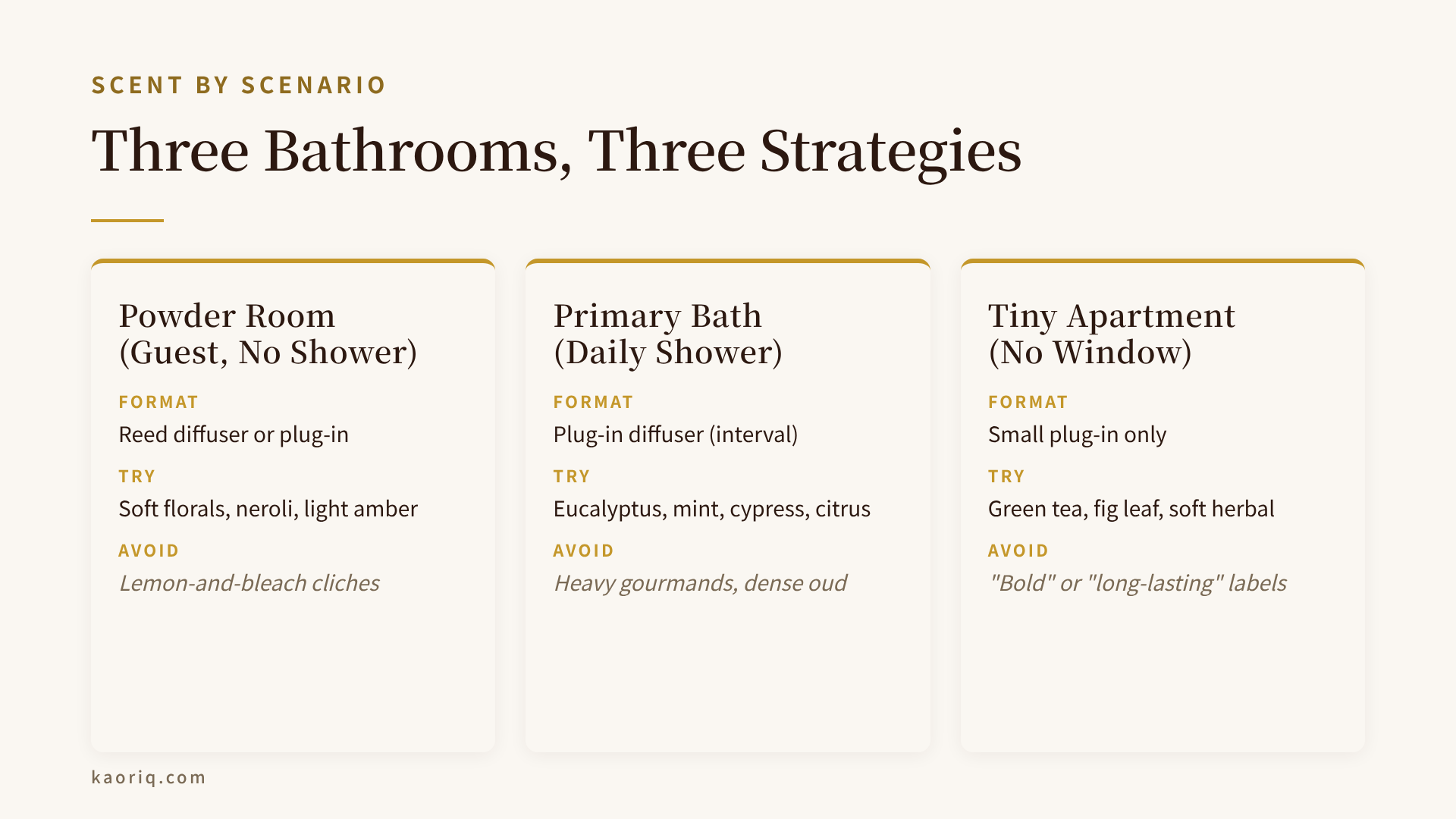
1. The Powder Room (Guest Bathroom, No Shower)
The dream bathroom for fragrance. No humidity cycle, no shower steam, low ventilation, infrequent foot traffic. Whatever you put here, you control entirely.
Try: Soft white florals (jasmine, magnolia, peony), classic colognes with hesperidic openings (bergamot, neroli, petitgrain), or a discreet amber. This is the one bathroom where a reed diffuser actually shines, because none of the three constraints apply at full force.
Avoid: Anything aggressively “clean,” like the lemon-and-bleach school of bathroom scent. Your guests already know it’s a bathroom. The scent’s job is to make the room feel like part of your home, not a service station.
2. The Primary Bathroom (Shower, Daily Use)
The hardest scenario. Humidity, ventilation, and steam all peak twice a day. Top notes vanish. Heavy bases sit on damp surfaces and behave unpredictably.
Try: Eucalyptus, mint, cypress, rosemary: the so-called “spa families.” Not coincidentally, these are the notes that handle steam well; their molecules ride humid air rather than fight it. Light citrus blends (yuzu, grapefruit, mandarin) also do well because they’re designed to refresh, not linger.
Avoid: Heavy gourmands (vanilla, caramel, chocolate) and dense orientals (oud, deep amber, opoponax). These read as cozy in a bedroom and confusing in a bathroom, like wearing a velvet jacket into a swimming pool. They also tend to grip damp tile and become persistent in a way you didn’t sign up for.
3. The “Tiny Apartment, No Window” Bathroom
The hardest version of the hardest scenario. No natural airflow, a 24-hour timer fan that may or may not be working, and a single hook for towels that absorb every smell in the room.
Try: A small plug-in diffuser with a fresh herbal or light green tea note, set to interval mode if your model supports it. The goal is gentle, continuous, low-volume. Skip anything sprayed; it has nowhere to go.
Avoid: Any product whose label says “bold” or “long-lasting.” In a windowless bathroom, “long-lasting” means “still in your towels next Tuesday.” Mid-strength only. If you’re a renter and you can smell the previous tenant’s bathroom fragrance, you understand why this matters.
The Spa-Family Bonus: Why Eucalyptus and Mint Work So Well in Steam
A small detour into the science, because it’s actually interesting.
Eucalyptus, peppermint, and rosemary all contain high concentrations of monoterpenes: small, volatile molecules that interact unusually well with warm, humid air. The vapour from a hot shower acts as a carrier; the scent disperses more evenly than it would in a dry room, and the perceived “freshness” gets amplified by the cool sensation of menthol (in mint) and 1,8-cineole (in eucalyptus) on the nasal passages.
This is also why some hotels run a faint eucalyptus scent through the air supply of their wet rooms. Beyond the obvious aesthetic appeal, it works with the room’s physics rather than against them. If your bathroom has a steam-heavy morning routine, leaning into a spa family is the closest thing to a cheat code in home fragrance.
The Deodorising vs Scenting Distinction
One thing worth saying out loud: bathroom fragrance is not the same as bathroom deodoriser, and confusing the two ruins both.
Deodorising is the chemistry of neutralising specific molecules (sulfur compounds, ammonia, the things you obviously don’t want). Activated charcoal, baking soda, and some commercial sprays use neutralising agents that remove odour molecules rather than mask them.
Scenting is the layer on top: the smell you actively want, that signals to a guest or to yourself that this room is part of a curated home.
Most people skip step one and pile on step two, which is why the world has so many bathrooms that smell like “vanilla cinnamon roll on top of yesterday’s gym towel.” A small carbon air purifier or a discreet charcoal sachet in the cabinet does step one. The diffuser does step two. They are not the same product, and asking one to do both is the most common bathroom fragrance mistake I see.
The Personality Layer
The three scenarios above tell you what the room needs. Personality tells you which version of that you’ll actually love.
- Outgoing, social, host-by-default types: Bright florals or a tasteful classic eau de cologne in the powder room. The bathroom becomes a small, friendly signature for guests.
- Quietly conscientious, “everything in its place” types: Clean white florals, soft cotton accords, or a faint cypress in the primary bath. The bathroom as a calm declaration of order.
- Curious, novelty-seeking types: Unusual spa notes (fig leaf, smoked mint, cardamom) for the primary bath. The bathroom as a tiny surprise.
- Comfort-seeking, sensory-rich types: Soft eucalyptus and lavender in the primary bath, paired with a charcoal sachet to keep the room actually clean. The bathroom as a hug, structurally supported.
If you’ve taken any version of a personality test, you can probably pick yours out of this list. If you haven’t, our why personality predicts fragrance preferences piece is the deeper version of this argument.
The Cheat Sheet
Screenshot this if nothing else:
| Situation | Format | Scent Direction |
|---|---|---|
| Powder room, guests welcome | Reed diffuser or plug-in | Soft floral, classic cologne, light amber |
| Primary bath, daily shower | Plug-in diffuser (interval mode) | Eucalyptus, mint, cypress, light citrus |
| Windowless rental | Small plug-in only | Green tea, fig leaf, mid-strength only |
| Pre-guest reset | Room spray | Whatever you have, opened five minutes before |
| Lingering odour problem | Charcoal sachet + diffuser | Don’t try to mask; neutralise first, scent second |
| Steamy weekend bath ritual | Solid sachet or short incense | Eucalyptus, rosemary, deep cypress |
What to Know Before the Eleven-Day Diffuser
Two things, for the record.
One: the bathroom is the room where format wins. You can pick the right scent and the wrong format and still end up with a faintly mouldy reed diffuser by month two. The fan, the steam, and the closeness of the space punish lazy hardware. Spending an extra ten dollars on a sealed plug-in instead of an open reed diffuser is, in the bathroom, one of the highest-ROI fragrance decisions you can make.
Two: bathrooms are also the room where guests form their fastest, most unspoken opinions about your home. The living room is where they look around politely. The bathroom is where they’re alone for two minutes with their thoughts and your towels. The scent there does a surprising amount of quiet work, and the absence of a scent in there says something too. (Mostly, “this person hasn’t thought about it,” which is fine, until they have.)
If you’re not sure which direction matches you, take our personality-based scent quiz and let the matching do the work. And if you’re between the “guest-ready powder room” and “spa-ish primary bath” decisions: pick the one you spend more time in. Your guests get four minutes. You get four hundred a week.
Mine, for what it’s worth, is now eucalyptus and a small charcoal sachet I keep forgetting is in the cabinet. The diffuser hasn’t bent in months. The shower steam treats it as collaboration, not war. Most mornings, that’s all I’m asking of it.
Was this article helpful?